Flipkart Minutes App Launch: 1,500 Dark Stores by 2026 end
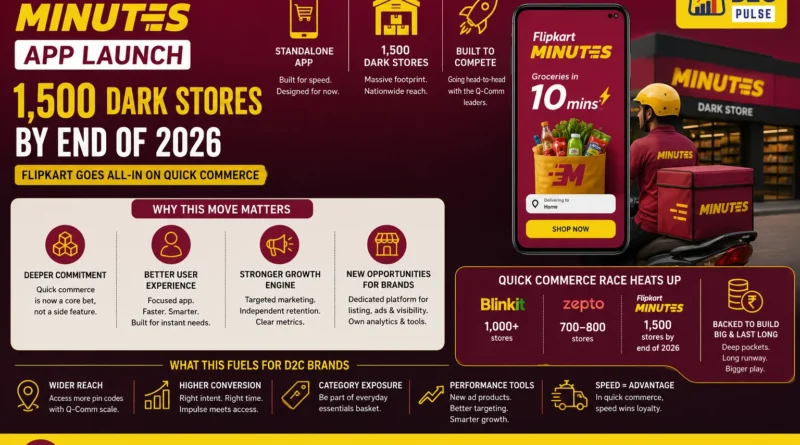
Flipkart is pulling Flipkart Minutes out of its main app and launching it as a standalone quick commerce platform by July — backed by an aggressive plan to operate 1,500 dark stores by year-end. The Flipkart Minutes app launch is not a feature update. It is a structural commitment to compete directly with Blinkit, Zepto, and Swiggy Instamart on their own terms.
For D2C brands already navigating the quick commerce channel, this changes the supply equation significantly.
What Flipkart Is Actually Doing Here
Right now, Flipkart Minutes operates as an embedded experience within the Flipkart app. The move to a dedicated app signals that Flipkart is done treating quick commerce as a side feature. It wants a separate consumer identity, separate retention loop, and separate growth metrics for the vertical.
The 1,500 dark store target is the more consequential number. For context, Blinkit crossed 1,000 stores in late 2024. Zepto operates around 700–800. If Flipkart executes even 70% of this target, it immediately becomes one of the largest quick commerce infrastructure players in the country — not by GMV, but by physical footprint.
Walmart’s backing gives Flipkart the capital depth to absorb the losses that come with this kind of rapid dark store expansion. This is a long-game play, not a profitability story.
Why a Standalone App Is a Strategic Signal, Not Just a UX Decision
Separating Flipkart Minutes from the core Flipkart app does several things at once.
First, it allows independent product development. Quick commerce UX — sub-10-minute delivery, real-time inventory display, impulse-friendly category layouts — is fundamentally different from horizontal e-commerce. Bundling both in one app creates product conflict.
Second, it enables standalone marketing and user acquisition. Flipkart can now run performance campaigns specifically for Minutes without cannibalizing or confusing its core e-commerce funnel.
Third, and most importantly for the ecosystem, it creates a dedicated seller and brand surface. D2C brands will likely be able to list, advertise, and build visibility on Flipkart Minutes as a distinct channel — with its own analytics, ad products, and category hierarchies.
This mirrors exactly what happened when Blinkit separated from Grofers. The rebrand wasn’t cosmetic. It unlocked a new commercial identity and a new brand partnership model.
The D2C Startup Mafia: How Second-Time Founders are Securing 2026 Funding
Shopify vs WooCommerce for Indian D2C Brands: Which Platform Should You Pick in 2026?

Consumer Behavior Trends: Ten Shifts That Changed How Indians Buy
The Future of Indian Consumer Brands: 10 Forces That Will Shape the Next Decade
The Evolution of D2C in India: Five Phases That Shaped an $80 Billion Market
Best Shopify Apps for Indian D2C Brands: The 2026 Stack That Actually Converts
The D2C Opportunity Inside This Infrastructure Bet
For D2C founders, the question is not whether to be on Flipkart Minutes. The question is when and how to prepare.
Category readiness matters first. Quick commerce favors specific product profiles — high repurchase frequency, low average order value sensitivity, impulse-friendly SKUs, and products with strong brand recall. If your D2C brand plays in personal care, health supplements, snacks, beverages, or home essentials, you are a natural fit. If you sell considered-purchase or high-ticket products, quick commerce is a sampling and awareness channel, not a primary revenue driver.
Dark store density determines your distribution reach. At 1,500 stores, Flipkart Minutes would cover Tier 1 cities deeply and begin penetrating Tier 2 markets. For D2C brands trying to crack distribution beyond metros without building their own logistics, this is meaningful. Piggyback on the infrastructure rather than building it.
Ad inventory will expand. Every new quick commerce platform that scales creates new sponsored listing and display inventory. Early movers on Flipkart Minutes — before CPCs inflate — will get disproportionate visibility at lower cost. This is the same window that existed on Blinkit and Zepto in 2022–2023 before they became expensive.

The Competitive Pressure This Creates
Blinkit, Zepto, and Instamart will not ignore a well-capitalized new entrant with 1,500 dark stores. Expect them to accelerate their own dark store rollouts, deepen brand exclusivity deals, and potentially improve margin structures to retain key D2C partners.
This is good for D2C brands. More platforms competing for the same brand partnerships means better terms, lower take rates, and more negotiating leverage — especially for brands doing meaningful GMV on quick commerce.
The risk is fragmentation. Managing inventory, pricing, and content across four or five quick commerce platforms simultaneously adds operational complexity. Brands that build strong internal systems — or work with aggregator tools — will handle this better than those running it manually.
The Bottom Line
Flipkart Minutes going standalone is not a threat to other platforms yet. It is an infrastructure bet that takes 12–18 months to validate. But the direction is clear: quick commerce in India is moving from a two-player race to a four-player market.
D2C brands should audit their quick commerce readiness now, not after Flipkart Minutes launches. The window to get favorable onboarding terms, early ad rates, and category positioning opens at launch — and closes fast.