
Canvaloop Raises $1.5 Million to Scale Farm-Waste-to-Fabric Platform Supplying India’s D2C Fashion Brands
Shark Tank India-featured biomaterials startup converts agricultural waste into textile-grade fibers using closed-loop technology
Canvaloop, a Surat-based biomaterials startup transforming agricultural waste into textile-grade fibers, has raised $1.5 million in funding. Canvaloop raises this funding from Gujarat Venture Finance Limited (GVFL) and Rockstud Capital to scale its alternative fiber platform in India.
Founded in 2020 by Shreyans Kokra, Canvaloop uses proprietary closed-loop technology to convert crop residues—including pineapple leaves, banana stalks, hemp, and flax—into eco-friendly fibers designed to run on existing spinning infrastructure. The startup, which gained visibility through Shark Tank India, has already served over 200 clients and is now focused on expanding production capacity to meet growing demand from textile manufacturers and D2C fashion brands seeking sustainable material alternatives.
For D2C operators in fashion and lifestyle, Canvaloop’s platform addresses a critical supply chain gap: access to scalable, sustainable materials that don’t sacrifice performance or require complete manufacturing overhauls.
Why Sustainable Materials Matter for D2C Fashion Brands
Global fashion and textile value chains are urgently looking for raw material solutions that are more sustainable, scalable, and resilient. Traditional textile production relies heavily on water-intensive, chemical-heavy processes. Conventional cotton farming consumes vast amounts of water. Synthetic fibers derive from petroleum. Neither approach aligns with the sustainability narratives increasingly driving consumer purchase decisions, especially among the urban, digitally-native demographics that D2C brands target.
Canvaloop’s approach taps into a larger shift: brands and supply chains actively seeking greener, more responsible inputs. By working with natural feedstocks that would otherwise be agricultural waste, the startup positions itself as a key enabler in this transition. Shreyans Kokra noted: from the beginning, we have believed that sustainability has to be built for real adoption—at the speed, quality, and scale the industry demands.

indē wild Becomes First Indian Brand at Sephora U.S.
D2C Funding Trends – India: What Changed, What’s Coming, and What Investors Want Now
Lessons from Failed D2C Startups in India: What Every Founder Must Learn
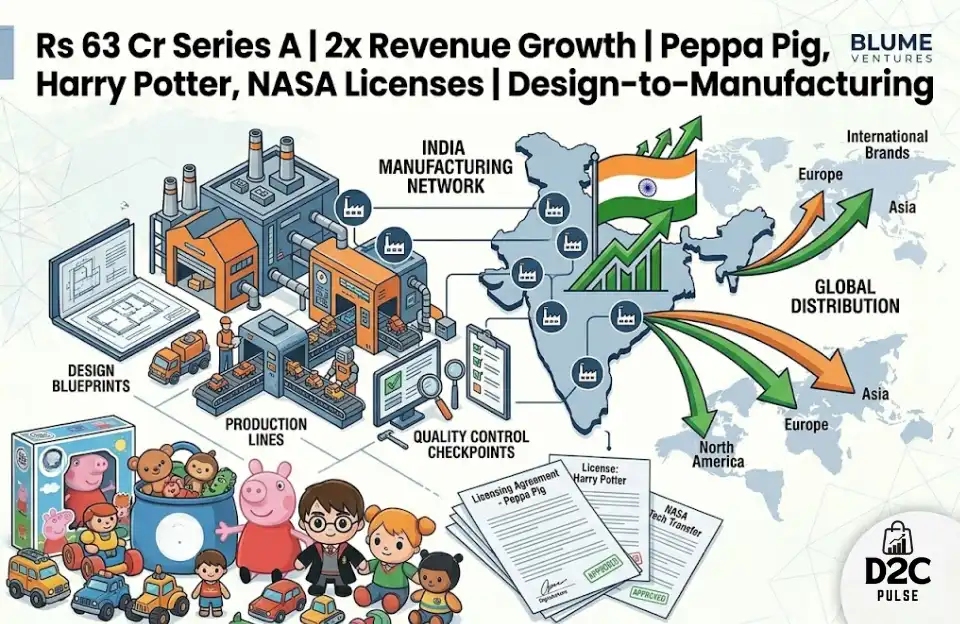
Bidso Raises Rs 63 Crore Series A Led by Blume Ventures to Scale Contract Manufacturing Platform for D2C Brands
8 Structural Advantages That Attract Venture Capital

Amazon and Flipkart Battle for Quick Commerce Supremacy
Closed-Loop Technology Reduces Water and Chemical Usage
At the heart of Canvaloop’s innovation is a proprietary, climate-light, closed-loop technology that minimizes water and chemical usage. This not only reduces environmental impact but also makes the process scalable for industrial adoption. The fibers are designed to be compatible with existing spinning infrastructure, removing the barrier of retooling entire manufacturing facilities.
This compatibility matters. D2C brands evaluating sustainable materials need suppliers who can deliver at scale without forcing them to rebuild supply chains. Canvaloop’s fibers work on conventional textile machinery, allowing brands to integrate sustainable inputs without disrupting production timelines or quality standards.
Mihir Joshi, Managing Director at GVFL, highlighted the strategic opportunity: Canvaloop exemplifies the scalable innovation Gujarat startups are delivering in deep-tech sustainability. We are excited to fuel their journey from a local waste-to-fiber pioneer to a global supply chain backbone.

Capital Deployment: Production Capacity, Supply Readiness, Material Innovation
The $1.5 million will fund three strategic priorities. First, expand production capacity to meet increasing demand from textile manufacturers and fashion brands. Second, improve supply readiness and reduce delivery timelines—critical for D2C brands operating on tight launch schedules and seasonal collections. Third, accelerate commercial scale-up of the alternative fiber platform, including investment in next-generation material innovation such as regenerative fibers.
Abhishek Agarwal, Managing Partner at Rockstud Capital, framed the opportunity: India’s manufacturing future will be shaped by founders rethinking materials and supply chains. Canvaloop’s ability to convert agricultural waste into textile-grade materials shows how sustainability and industrial innovation can go hand in hand.
Canvaloop’s Business model that sets them apart
First, sustainable sourcing is shifting from brand narrative to operational reality. D2C brands that positioned sustainability as marketing messaging must now deliver on those claims with verifiable supply chain changes. Canvaloop-type suppliers provide the materials that make those narratives credible.
Second, circular economy models create competitive differentiation. Brands that can authentically claim their products incorporate agricultural waste converted into premium fibers gain storytelling advantages and consumer trust that generic sustainability claims cannot match.
Third, compatibility with existing infrastructure accelerates adoption. Sustainable alternatives that require complete manufacturing overhauls face slow uptake. Canvaloop’s fibers run on existing machinery, removing the capital expenditure barrier that often stalls sustainability initiatives.
Fourth, B2B enablers matter as much as consumer brands. The D2C ecosystem depends not just on customer-facing brands but on suppliers solving upstream problems. Canvaloop’s platform enables dozens of D2C fashion brands to deliver on sustainability promises without each brand building proprietary material science capabilities. For D2C fashion brands, the strategic opportunity: partner with biomaterials suppliers like Canvaloop to secure sustainable inputs that maintain quality, work on existing infrastructure, and provide authentic stories for increasingly sustainability-conscious consumers. The brands that lock in these supply relationships early will have material sourcing advantages competitors cannot easily replicate.