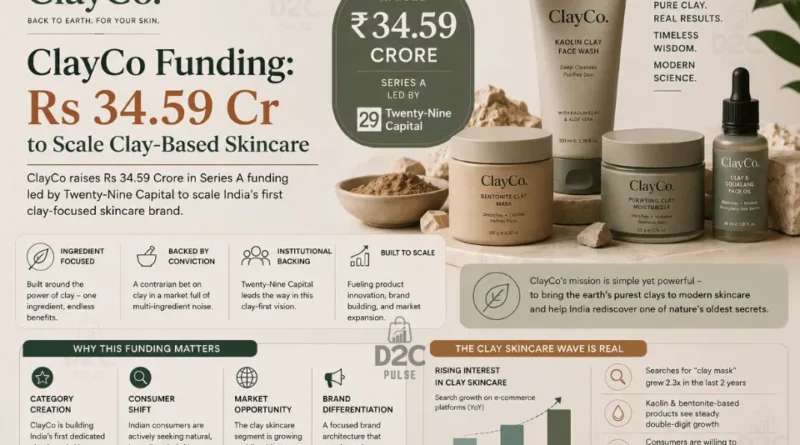
ClayCo Funding: Rs 34.59 Cr to Scale Clay-Based Skincare
India’s skincare market is crowded. Every week, a new brand launches with a clean label, a celebrity face, and a Shopify store. So when a niche, ingredient-led brand like ClayCo closes a ClayCo funding Series A round of Rs 34.59 Crore, led by Twenty-Nine Capital, it signals something more deliberate than just another skincare play.
This is not a brand trying to be everything to everyone. ClayCo funding has made a specific, almost contrarian bet — that clay, one of the oldest skincare ingredients in human history, deserves its own dedicated brand architecture in modern India. In a category dominated by multi-ingredient formulations and trend-chasing SKUs, that kind of conviction is rare. And now, it has institutional backing.
The ClayCo funding arrives at a time when Indian consumers are actively moving toward ingredient-conscious skincare. Searches for clay masks, kaolin, and bentonite-based products have grown steadily on e-commerce platforms. ClayCo is not just riding that wave — it is trying to own the category.
What Is ClayCo and What Makes It Different
ClayCo is a D2C personal care brand built entirely around clay-based formulations. Its product line spans skincare — think face masks, cleansers, and treatment products — all anchored by the functional and sensorial properties of clay as a core active ingredient.
What makes ClayCo unusual in the Indian D2C landscape is its single-ingredient brand identity. Most skincare brands in India are built around a skin concern — acne, pigmentation, hydration — and then source ingredients to solve that concern. ClayCo flips this. It starts with the ingredient and builds a universe of products around it.
This approach mirrors what international brands like Aesop did with botanicals or what The Ordinary did with actives — build credibility through ingredient specificity, not marketing noise. In India, very few brands have successfully executed this model at scale. ClayCo appears to be making a serious attempt.
An interesting detail: clay has been used in Ayurvedic and folk skincare traditions across India for centuries — multani mitti being the most recognizable example. ClayCo is essentially modernizing a deeply familiar ingredient for a new-age consumer who wants both efficacy and aesthetics.
The EleFant Raises $1 Million: What a Toy Subscription Model Reveals About India’s Next D2C Frontier


Retention Marketing Strategies for D2C Brands: How to Turn One-Time Buyers into Lifetime Customers

Why Consumers Are Ready to Pay More and What It Means for D2C Brands


Kraus Jeans 2026 Expansion: 20 New Stores and a Footwear Pivot
How ClayCo Plans to Use the Series A Capital
With Rs 34.59 Crore now in the bank, ClayCo is expected to deploy capital across three primary vectors.
Product line expansion is the most obvious priority. A clay-based brand has significant whitespace — hair care, body care, men’s grooming, and even wellness formats like bath soaks and detox products are all adjacent categories where clay has proven efficacy. Expanding the SKU depth without losing brand coherence will be the key challenge.
Distribution scale-up is the second lever. Most early-stage D2C skincare brands in India are heavily dependent on their own website and Instagram. Series A capital typically funds the shift toward omnichannel — quick commerce platforms like Blinkit and Zepto, marketplaces like Nykaa and Amazon, and eventually, selective offline retail. ClayCo will likely follow this playbook.
Brand building and performance marketing will form the third pillar. Ingredient-led brands require more consumer education than trend-led brands. ClayCo will need to invest in content — explaining why clay works, how different clay types (kaolin vs. bentonite vs. fuller’s earth) serve different skin types, and why a dedicated clay brand is more trustworthy than a generic product with clay as one of twenty ingredients.
Twenty-Nine Capital’s involvement as lead investor adds strategic weight. The firm has been active in the consumer and D2C space, and the ClayCo funding suggests confidence in both the category thesis and ClayCo’s execution capability.

What D2C Founders and Marketers Can Learn From ClayCo Funding
1. Ingredient ownership is a durable moat.
In a market where formulations can be copied overnight, owning a narrative around a specific ingredient is harder to replicate. If your brand becomes synonymous with one ingredient — and you educate the market better than anyone else — you build a defensible position. ClayCo’s entire brand architecture is a masterclass in this.
2. Niche-first is not the same as small.
Clay is not a niche ingredient — it is a globally recognized skincare staple. But ClayCo has chosen to go deep rather than wide. This is a pattern worth studying: find an ingredient or category that has broad appeal but lacks a dedicated, credible brand, and build that brand before the category gets crowded.
3. Cultural anchoring accelerates trust.
Multani mitti is not a foreign concept to Indian consumers. By modernizing a familiar ingredient, ClayCo reduces the consumer education burden significantly. D2C founders should always ask — is there a culturally familiar version of what I am selling that I can anchor my brand to?
4. Series A is a category signal, not just a company signal.
When a focused, ingredient-led skincare brand raises institutional capital, it tells the broader market that investors believe the category has legs. If you are building in adjacent spaces — Ayurvedic actives, mineral skincare, traditional ingredient modernization — this funding is a green light worth paying attention to.