Digital Infrastructure Enabling D2C in India: The 7 Pillars That Made It All Possible
UPI. Aadhaar. 5G. GST. ONDC. Logistics Networks. AI Tools. How India Built the World’s Best Foundation for Direct-to-Consumer Commerce.
India has over 11,000 D2C brands. In 2015, it had fewer than 300. What changed in a decade? The products did not change. Consumer desire for good products always existed. What changed was the digital infrastructure enabling D2C in India.
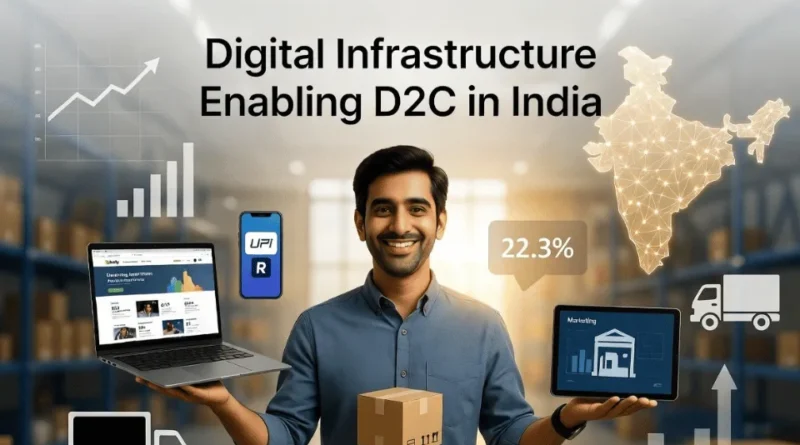
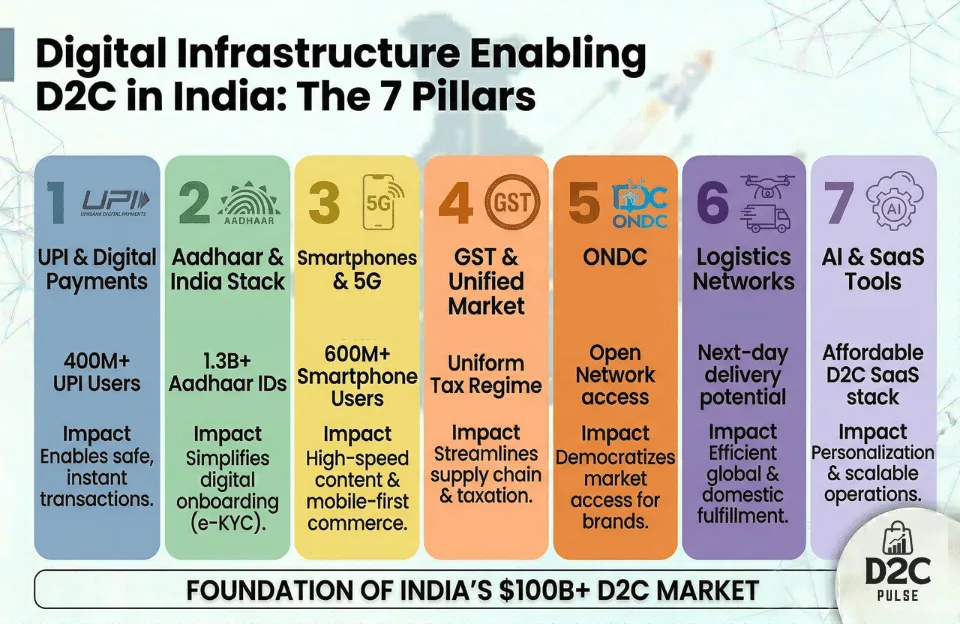
Between 2015 and 2025, India built the most advanced digital infrastructure enabling D2C in the world. UPI made payments instant and free. Aadhaar gave 1.44 billion people a digital identity. Jio and 5G put smartphones and fast internet in the hands of 900 million users. GST turned 28 state markets into one. ONDC opened digital commerce beyond Amazon and Flipkart. Logistics networks like Delhivery and Shiprocket made last-mile delivery affordable. And AI tools slashed the cost of content, customer support, and personalisation.
This article maps the seven pillars of digital infrastructure enabling D2C in India. Each pillar solved a specific problem that would have made D2C impossible a decade ago. If you are a founder, this is the foundation your business stands on. If you are an investor, this is the structural reason India’s D2C market is projected to reach $300 billion by 2030.
Pillar 1: UPI and Digital Payments. The Rails That Made Online Buying Frictionless.
UPI is the single most important piece of digital infrastructure enabling D2C in India. Before UPI launched in 2016, online payments in India were painful. Credit card penetration was under 3%. Net banking was clunky. Wallets required pre-loading. COD was the default because customers did not trust online payments.
UPI changed everything. It linked bank accounts directly to mobile phones. Payments became instant. They became free for consumers. And they worked 24 hours a day. By 2024, UPI handled over 75% of all retail digital payment volumes in India. By early 2026, it was processing over 21 billion transactions and supporting more than 65 million merchants. In December 2024, UPI processed 16.73 billion transactions worth Rs 23.25 lakh crore in a single month.
For D2C brands, UPI did three things. First, it made checkout fast. A customer taps, scans, or enters a UPI ID. Payment clears in 2 seconds. Drop-off at checkout falls. Conversion rises. Second, it reduced COD dependency. Prepaid orders are cheaper to fulfil, have lower return rates, and settle faster. Third, UPI costs almost nothing for merchants. No 2–3% card processing fee. On a Rs 1,000 order, that saves Rs 20–30 per transaction. At 10,000 orders a month, that is Rs 2–3 lakh in saved costs.
UPI is now expanding into credit-linked payments through RuPay credit cards on UPI and auto-pay mandates for subscriptions. For D2C brands with subscription models (Country Delight, Blue Tokai, The Derma Co.), UPI auto-pay reduces payment friction on every recurring order. This is the digital infrastructure enabling D2C subscription models at scale.
Also Read: The Complete D2C Ecosystem in India, Explained for how UPI connects to the full payment layer
Pillar 2: Aadhaar and India Stack. Digital Identity That Powers Everything Else.
Aadhaar is the world’s largest digital identity system. Over 144 crore Aadhaar numbers have been generated as of March 2026. In 2024–25 alone, over 2,707 crore authentication transactions took place. Aadhaar is the foundation of the digital infrastructure enabling D2C in India because it makes everything else work.
For D2C founders, Aadhaar matters in three ways. First, eKYC. A founder can open a business bank account, register with a payment gateway, and onboard with a logistics partner using Aadhaar-based verification in hours. Before Aadhaar, this took weeks of paperwork. Second, DigiLocker (175 million+ users, 6 billion+ documents issued) makes business documentation portable. GST registration, FSSAI licence, IEC code for exports—all stored digitally and verifiable instantly. Third, Account Aggregator lets D2C brands access revenue-based financing by sharing verified financial data with lenders. Recur Club and GetVantage use this to underwrite working capital loans in 48 hours instead of 4 weeks.
India Stack is the broader framework: Aadhaar for identity, UPI for payments, DigiLocker for documents, eSign for digital contracts, Account Aggregator for financial data sharing, and GSTN for tax compliance. Together, they form a digital infrastructure enabling D2C brands to launch, operate, and scale with almost zero paperwork. No other country offers this level of integrated digital public infrastructure.

Pillar 3: Smartphones and 5G. 900 Million People Who Can Shop on Their Phones.
D2C is a mobile-first business. Over 85% of D2C website traffic in India comes from smartphones. If people do not have phones and fast internet, D2C does not exist. This pillar of digital infrastructure enabling D2C in India is the most basic and the most powerful.
India had 500 million smartphone users as of 2024, expected to approach 1 billion by 2026–27. The Jio revolution of 2016 slashed data costs from Rs 250 per GB to under Rs 10 per GB. Overnight, hundreds of millions of Indians could afford to browse, watch videos, and shop online. Mobile broadband speed jumped from 1.30 Mbps in 2014 to 95.67 Mbps in December 2024.
5G has added another layer. India deployed 5.18 lakh 5G base stations across 779 districts by December 2025, covering 85% of the population and 99.9% of districts. 5G enables richer shopping experiences: shoppable video on product pages, AR try-ons (Lenskart’s virtual try-on), live commerce, and high-resolution product photography. These experiences convert browsers into buyers. They would be impossible on 2G or 3G networks.
For D2C brands, the smartphone is the storefront, the checkout counter, and the CRM all in one. Every WhatsApp message, every Instagram ad, every email open, every product video—all consumed on a smartphone. The digital infrastructure enabling D2C in India runs through a 6-inch screen in the customer’s hand.
Pillar 4: GST. One Country, One Tax, One Market.
Before GST launched in July 2017, India was not one market. It was 28 state markets with different tax rates, different compliance rules, and different border checkpoints. A truck carrying goods from Gujarat to Tamil Nadu could be stopped at multiple state borders. Paperwork took hours. Delays added days to delivery timelines.
GST unified all of this. One tax. One registration. One return system. Interstate movement became seamless. GST-enabled e-way bills and FasTag cut transit times from days to hours. For D2C brands, this is the digital infrastructure enabling nationwide fulfilment. A brand in Bangalore can ship to a customer in Assam without worrying about state-level tax complications.
GST also brought digital compliance through GSTN. Invoicing, return filing, and input tax credit—all handled online. Cloud accounting tools like Zoho Books, Tally, and ClearTax integrate directly with GSTN. A D2C founder with a laptop and a GST number can operate a compliant, pan-India business from a one-bedroom apartment.
The logistics impact is measurable. GST-enabled efficiencies have cut interstate transit costs by 20–25% for e-commerce fulfilment. That reduction flows directly into lower shipping costs and faster delivery for D2C brands. It is quiet infrastructure—no one talks about GST at D2C conferences—but it is among the most impactful pillars of digital infrastructure enabling D2C in India.
Pillar 5: ONDC. Open Commerce Without Platform Lock-In.
The Open Network for Digital Commerce is India’s most ambitious piece of digital infrastructure enabling D2C. ONDC does for e-commerce what UPI did for payments: it makes the network open, interoperable, and not owned by any single company.
On Amazon or Flipkart, the platform controls discovery, listing, pricing, and customer data. The brand pays 15–30% commission. On ONDC, the protocol decouples discovery, ordering, payment, and fulfilment. A seller can list on any ONDC-compatible app. A buyer can discover them on any ONDC buyer app. Commissions are around 3%.
As of early 2026, ONDC was operational in over 630 cities with 1.16 lakh+ retail sellers live on the network. Cumulative orders crossed 154 million by December 2024. Average daily transactions reached about 490,000. Adoption is still early and uneven—operational frictions remain, especially in logistics and merchant experience. But the direction is clear.
For D2C brands, ONDC offers a low-cost discovery channel that does not require giving up 25% of revenue to a marketplace. A skincare brand that lists on ONDC-compatible apps reaches new customers at 3% commission instead of 20–25% on Amazon. This is digital infrastructure enabling D2C brands to diversify beyond traditional marketplaces without building their own traffic from scratch.
Pillar 6: Logistics Networks. Last-Mile Delivery That Reaches 19,000+ PIN Codes.
Ten years ago, shipping a product from Mumbai to a tier-3 town in Madhya Pradesh took 10–14 days and cost Rs 150–200. Today, 3PL partners like Delhivery, Shiprocket, XpressBees, Ecom Express, and Shadowfax deliver to 19,000+ PIN codes at Rs 50–100 per shipment in 3–7 days.
This logistics layer is critical digital infrastructure enabling D2C in India because D2C brands do not have retail stores. Every order must be shipped. If shipping is slow, expensive, or unreliable, the brand fails. The growth of 3PL networks solved this problem.
Shiprocket aggregates 25+ courier partners through a single dashboard. A brand ships an order and the system auto-selects the best courier based on destination, speed, and cost. Delhivery runs its own integrated network from first mile to last mile. For brands that need faster delivery and more control, Delhivery handles over 1.5 million shipments per day.
Quick commerce is the newest layer. Blinkit, Zepto, and Swiggy Instamart deliver in 10–30 minutes. For high-velocity D2C SKUs (snacks, personal care, beverages), quick commerce is digital infrastructure enabling impulse purchases that were impossible two years ago. The trade-off: 30–40% commissions mean only high-margin products work on quick commerce.
Warehouse automation is also accelerating. India is projected to become one of the top six users of warehouse automation systems globally by 2026, with the market expected to reach $2 billion. AI-driven inventory planning, NDR management, and address verification reduce RTO rates and delivery costs. This is digital infrastructure enabling D2C brands to fulfil more orders at lower cost per order.
Also Read: Understanding Unit Economics for D2C Brands in India for how logistics costs affect margin
Pillar 7: AI and SaaS Tools. The Software Layer That Slashes Operating Costs.
The final pillar of digital infrastructure enabling D2C in India is the software layer. A decade ago, running an e-commerce brand required a developer team, a custom-built website, and expensive enterprise tools. Today, a founder with a Shopify subscription, Razorpay for payments, Shiprocket for logistics, and WebEngage for CRM can launch a full-stack D2C brand in a week.
The SaaS ecosystem has made each tool affordable and plug-and-play. Shopify starts at Rs 1,994 per month. Razorpay charges 2% per transaction with no setup fee. Shiprocket starts free. WebEngage, Klaviyo, and MoEngage offer retention marketing at a fraction of enterprise costs. This is digital infrastructure enabling D2C founders to operate with 2–4 people instead of 20.
AI tools have accelerated this further. AI-generated ad creatives reduce design costs by 60–70%. AI-driven chatbots handle customer support at Rs 2–5 per interaction instead of Rs 20–30 with human agents. AI-powered product recommendations increase AOV by 15–25%. AI-based demand forecasting reduces dead inventory by 20–30%.
For D2C brands, these tools are not optional. They are the digital infrastructure enabling lean operations. The brands that adopt AI and SaaS early operate with lower fixed costs, faster decision cycles, and better customer experiences. The brands that do not lose on margins and speed.
Also Read: Best Shopify Apps for Indian D2C Brands to grow fast
The Seven Pillars of Digital Infrastructure Enabling D2C in India: Summary
| Pillar | Launched | Scale (2025–26) | D2C Impact | Before vs After |
| UPI | 2016 | 21B+ monthly txns. 65M+ merchants. | Instant checkout. Near-zero cost. COD reduction. | Clunky net banking → 2-second payment. |
| Aadhaar / India Stack | 2009/2016 | 144 Cr Aadhaar IDs. 2,707 Cr auth/year. | Instant eKYC. Digital documents. Fast lending. | Weeks of paperwork → hours of digital setup. |
| Smartphones / 5G | 2016 (Jio) | 900M+ users. 5.18L 5G towers. 95 Mbps. | Mobile-first shopping. Video commerce. AR try-on. | Rs 250/GB → Rs 10/GB. 1.3 Mbps → 95 Mbps. |
| GST | July 2017 | One tax. One market. GSTN digital compliance. | Pan-India fulfilment. 20–25% lower transit costs. | 28 state markets → 1 unified market. |
| ONDC | 2022 | 630+ cities. 1.16L+ sellers. 154M+ orders. | 3% commission vs 15–30%. Open discovery. | Platform lock-in → open network. |
| Logistics | 2011–2015 | 19,000+ PIN codes. Rs 50–100/order. | 3–7 day delivery anywhere. Quick commerce. | 10–14 days, Rs 150+ → 3–7 days, Rs 50–100. |
| AI & SaaS | 2015–2023 | Shopify, Razorpay, Shiprocket, AI tools. | Launch in a week. Operate with 2–4 people. | Rs 50L to build → Rs 5K/month to subscribe. |
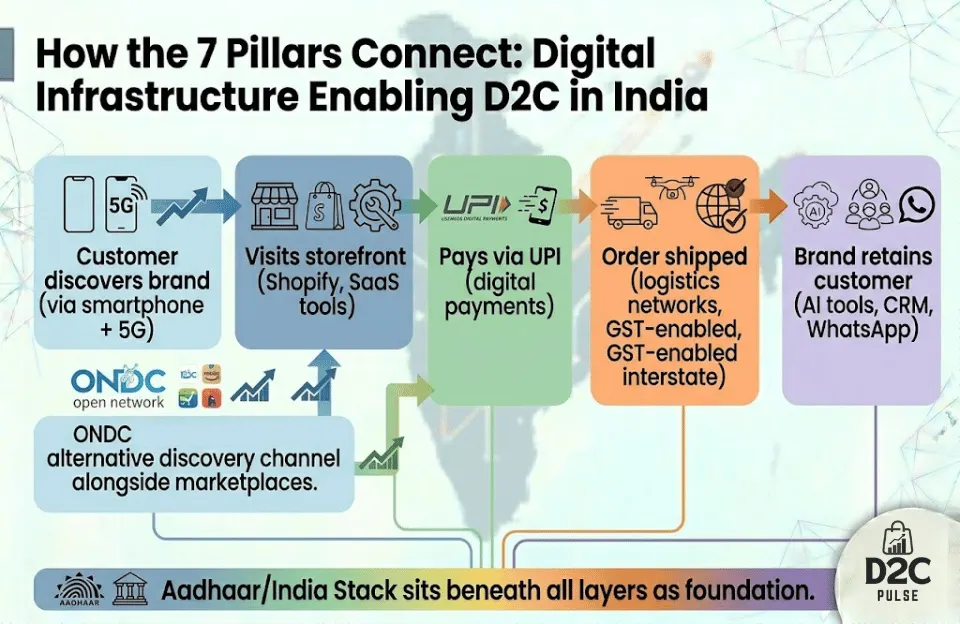
What This Means for D2C Founders in 2026
The digital infrastructure enabling D2C in India has removed every structural barrier that existed a decade ago. Payments are instant and free. Identity verification is digital. Internet is fast and cheap. Tax compliance is unified. Logistics reach every PIN code. Software is affordable and plug-and-play.
This means the barriers to starting a D2C brand are near zero. But the barriers to succeeding are higher than ever. Because the same infrastructure that lets you launch also lets 11,000 other brands launch. The competitive advantage no longer comes from infrastructure. It comes from what you build on top of it: product quality, brand story, retention, unit economics, and customer trust.
The digital infrastructure enabling D2C in India is the floor, not the ceiling. Every D2C founder needs to use it fully. Optimise UPI checkout, leverage ONDC for low-cost discovery, use AI tools to cut operating costs and use 3PL networks to ship everywhere. But remember: the infrastructure is shared. The brand is yours and that is where the real work happens.
Key Takeaways
- India has the world’s best digital infrastructure enabling D2C. The combination of UPI, Aadhaar, 5G, GST, ONDC, logistics networks, and AI/SaaS tools is unique. No other country has all seven pillars working together.
- UPI is the single most important enabler. 21 billion+ monthly transactions. Near-zero cost. Instant settlement. UPI reduced COD dependency, cut payment costs, and made online checkout frictionless.
- 5G and smartphones created the addressable market. 900 million+ mobile users. 85% D2C traffic from phones. Without Jio’s data revolution, D2C in India would still be a niche urban business.
- GST turned 28 states into one market. Digital compliance, seamless interstate shipping, and 20–25% lower transit costs. This is quiet infrastructure that most founders take for granted, but it is essential.
- ONDC is the next frontier. 3% commission vs 15–30% on marketplaces. 630+ cities. 1.16 lakh sellers. Still early, but the potential to reshape D2C discovery and distribution is real.
- The infrastructure is the floor, not the moat. Every D2C brand in India has access to the same 7 pillars. The competitive advantage comes from what you build on top: product, brand, retention, and unit economics.
Frequently Asked Questions
What digital infrastructure enables D2C in India?
Seven pillars of digital infrastructure enable D2C in India: UPI and digital payments (instant, near-free checkout), Aadhaar and India Stack (digital identity and verification), smartphones and 5G (900M+ mobile users with fast internet), GST (unified market across 28 states), ONDC (open commerce at 3% commission), logistics networks (19,000+ PIN code delivery at Rs 50–100), and AI/SaaS tools (affordable, plug-and-play operations). Together, they form the most advanced D2C foundation in the world.
How did UPI change D2C in India?
UPI made online payments instant, free, and frictionless. Before UPI, D2C brands depended heavily on COD (higher returns, slower cash). UPI handles 75%+ of retail digital payments. It reduced checkout drop-off, cut payment processing costs to near zero, and enabled subscription auto-pay. It is the single most important piece of digital infrastructure enabling D2C in India.
What is ONDC and how does it help D2C brands?
ONDC is a government-backed open commerce network. It decouples discovery, ordering, and fulfilment so brands can sell through any ONDC-compatible app at around 3% commission instead of 15–30% on Amazon or Flipkart. Over 1.16 lakh sellers across 630+ cities are live. It is still early but growing fast. For D2C brands, ONDC is digital infrastructure enabling low-cost customer discovery without marketplace lock-in.
Why is India’s D2C infrastructure better than other countries?
No other country combines all seven pillars. The US has Stripe but no UPI. China has Alipay but no ONDC. Europe has strong logistics but fragmented payments. India has Aadhaar (digital identity), UPI (instant payments), GST (unified market), ONDC (open commerce), 5G (fast mobile internet), affordable 3PL networks, and a plug-and-play SaaS ecosystem. This integrated digital infrastructure enabling D2C makes India the best structural market for direct-to-consumer commerce globally.
How can D2C founders use this infrastructure better?
Optimise UPI checkout to maximise prepaid orders. Use Aadhaar eKYC for fast onboarding with payment gateways and lenders. List on ONDC-compatible apps for low-cost discovery. Use Shiprocket or Delhivery to reach 19,000+ PIN codes. Adopt AI tools for ad creative generation, customer support, and demand forecasting. Integrate with GSTN through cloud accounting tools. The digital infrastructure enabling D2C in India is powerful but only if you actually use all seven layers.