

The Playbook for Indian D2C brand for Going Global
Why Indian D2C Brands Should Think Global at Rs 25 Crore, Not Rs 100 Crore. Which Markets to Enter First. What It Costs. What Goes Wrong. And the Step-by-Step Framework That Works.
Here is a number that should change how you think about your D2C brand. Only 80–100 million Indians regularly buy premium D2C products. Spread across 11,000+ D2C brands, that is a crowded pond. CAC has jumped from Rs 400–600 in the early 2020s to Rs 750–1,000 in 2025. Personal care alone has 200+ active D2C brands bidding for the same audiences. At some point, growing in India means spending more to acquire customers who are less loyal because they have ten other options. Hence the focus on cross-border expansion strategies.
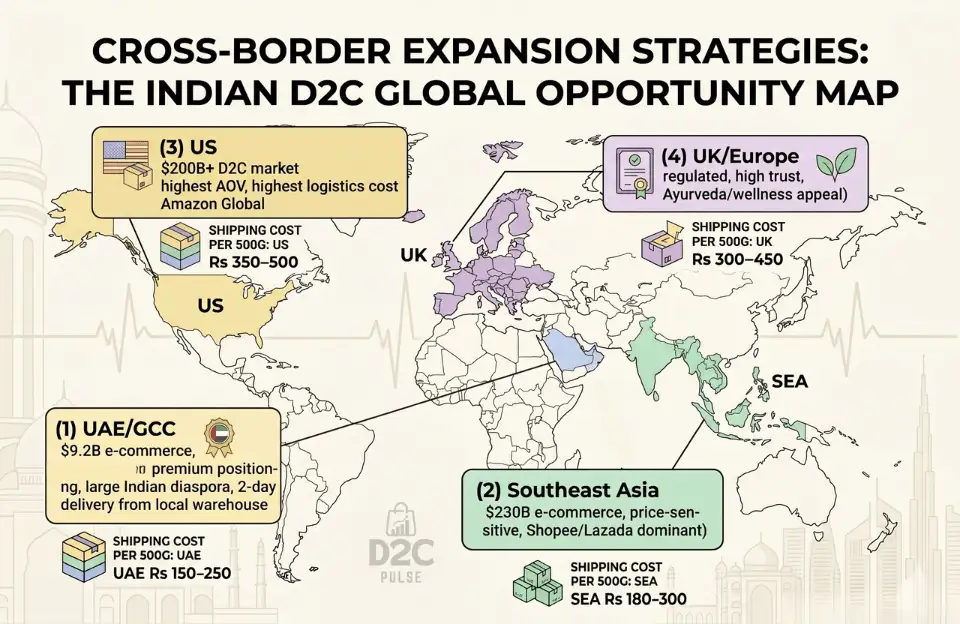
Now consider the other side. The UAE e-commerce market is projected to hit $9.2 billion by 2026. Southeast Asian e-commerce is projected to reach $230 billion by 2026. The US D2C market is worth over $200 billion. And Indian brands carry a structural advantage in these markets: lower manufacturing costs, unique product stories (Ayurveda, clean beauty, ethnic food), and an ecosystem that already forces you to operate lean.
Cross-border expansion strategies are no longer a luxury for mature brands. They are a growth lever that Indian D2C founders should plan at Rs 25 crore in revenue, not Rs 100 crore. At Rs 25 crore, your product-market fit is proven. Your supply chain works. Your team is still nimble enough to experiment. Wait until Rs 100 crore, and your unit economics are likely worse, your team is heavier, and your CAC in India has spiralled.
This article lays out cross-border expansion strategies for Indian D2C brands. We cover why going global makes sense now, which markets to enter first, the five entry models, the real costs, the common mistakes, and a step-by-step framework for launching in your first international market.
Why Cross-Border Expansion Strategies Matter Now for Indian D2C Brands
The India Squeeze Is Real
The Indian D2C market is large. It crossed $108 billion in 2026. But size does not mean easy. Over 11,000 brands compete for the same consumers. Meta and Google CPMs have risen 30–40% year-on-year since 2022. Repeat purchase rates in many categories sit below 20%. The brands that scaled fast during the funding boom of 2020–2022 now face rising CAC, compressing margins, and an investor base that demands profitability. Cross-border expansion strategies offer a release valve. New markets. New customers. Lower competition. Often better unit economics.
Indian Products Have Global Appeal
Ayurveda and herbal wellness resonate in the Middle East and Southeast Asia. Clean beauty and science-backed skincare compete globally. Indian ethnic food (idli batter, dosa mix, spices, snacks) sells to the 32-million-strong Indian diaspora and to non-Indian consumers curious about new flavours. Indian fashion has a design edge at a price point that Western brands cannot match. Cross-border expansion strategies work because Indian products are not niche. They fill gaps in global markets.
Better Unit Economics in International Markets
iD Fresh Food started exporting to the Middle East in 2015. Today, the Middle East contributes 25% of its revenue. With local manufacturing in Dubai, they avoid the margin squeeze that comes from scaling only in India. The same product, sold in a different market, can deliver fundamentally better economics. In the UAE, constant discounting makes you look cheap. Brands that hold their price at AED 49 (roughly Rs 1,100) for a product that sells at Rs 500 in India see 2x the margin without the 40% discount culture that plagues Indian D2C.
Digitally-Born Exports Are a $22 Billion Opportunity by 2030
Cross-border e-commerce from India was worth $4.7 billion in 2024. By 2030, digitally-born exports are projected to reach $22 billion. By 2026, international e-commerce is expected to make up more than 27% of all online sales from India. The infrastructure is ready. Amazon Global Selling, Shopify Markets, and cross-border fulfilment platforms make it possible to sell internationally from day one. Cross-border expansion strategies are no longer operationally impossible. They are plug-and-play.
Which Markets to Enter First: A Cross-Border Expansion Strategy by Region
| Market | E-Commerce Size | Why It Works | Key Challenge | Shipping (per 500g) | Indian D2C Example |
| UAE / GCC | $9.2B by 2026. 12.9% CAGR. | Large Indian diaspora. Premium pricing holds. Low regulatory friction. | ESMA / Emirates FDA approvals for food and BPC. 2–3 months. | Rs 150–250 | Lenskart (27 stores across GCC). iD Fresh (25% of revenue). Wakefit (UAE launch). |
| Southeast Asia | $230B by 2026. 22% CAGR. | Price-sensitive but growing fast. Shopee and Lazada are strong channels. | Fragmented. Each country has different regulations, languages, and platforms. | Rs 180–300 | Plum (available in 15 countries). Bombay Shaving Co. (Singapore, Malaysia). |
| United States | $200B+ D2C market. | Highest AOV. Largest addressable market. Amazon Global reach. | Highest logistics cost. Intense competition. FDA compliance for food/BPC. | Rs 350–500 | iD Fresh (US). Rage Coffee (Amazon US). Mamaearth (Amazon Global). |
| UK / Europe | $150B+ combined. | High trust in Ayurveda and natural products. Premium positioning works. | Complex regulations (EU Cosmetics Regulation, UKCA). Longer compliance. | Rs 300–450 | Forest Essentials (UK). The Moms Co. (Australia, UAE). |
Start with the UAE. Here Is Why.
For most Indian D2C brands, the UAE is the best first market for cross-border expansion strategies. The Indian diaspora in the UAE exceeds 3.5 million. They already trust Indian brands. They have high purchasing power. E-commerce is growing at 12.9% CAGR. Premium pricing is accepted. Shipping from India is Rs 150–250 per 500g. And regulatory approvals, while required, are faster than the US or EU.
Lenskart entered the UAE in 2021 with a $50 million commitment. Within two years, they expanded to 27 stores across the GCC. iD Fresh Food built local manufacturing in Dubai. Wakefit launched in the UAE and sold out its pilot batch within days. Traya is targeting the UAE for hair loss solutions. The pattern is clear: the UAE is the gateway to global for Indian D2C brands.
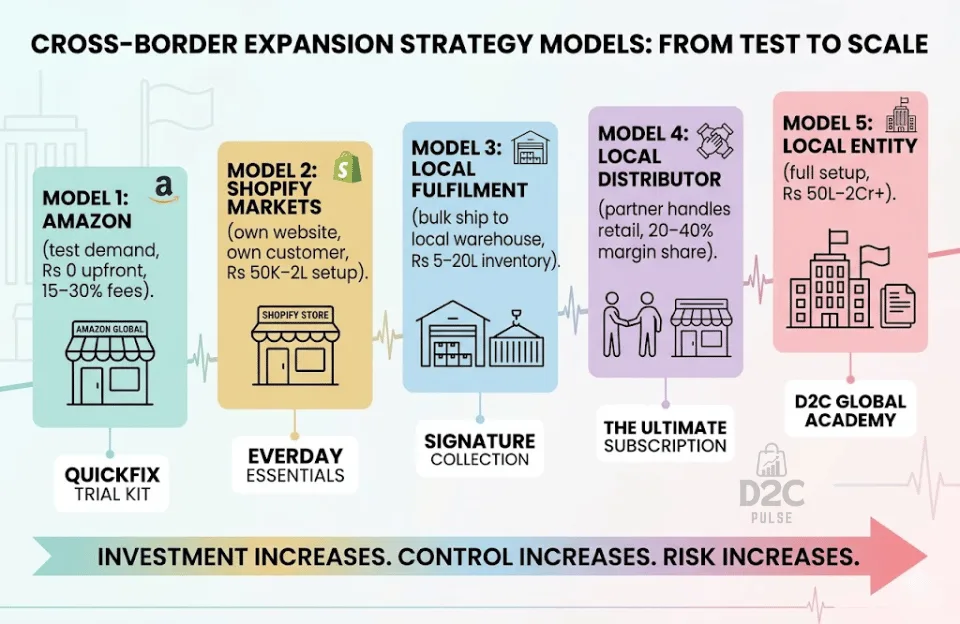
Five Cross-Border Expansion Strategy Models for Indian D2C Brands
Model 1: Amazon Global Selling
How it works: List your products on Amazon US, UK, UAE, or other international marketplaces. Amazon handles discovery, payments, and (optionally) fulfilment through FBA. You ship to Amazon’s warehouse. They ship to the customer.
Best for: Brands testing international demand with low upfront investment. No need to build a local website or marketing presence.
Trade-offs: Amazon takes 15–30% in fees and commission. You do not own the customer. Limited brand-building. Price competition from other sellers. This is cross-border expansion strategies for testing, not for building a brand abroad.
Model 2: Shopify Markets (Own D2C Website)
How it works: Use Shopify Markets to create localised versions of your D2C website for different countries. This works in local currency, with local payment methods and shipping rates. You own the customer relationship and data.
Best for: Brands with strong organic demand from international customers. If you already get traffic from the UAE or the US, this model captures it.
Trade-offs: You must drive your own traffic (ads, SEO, influencers). Customer acquisition in a new market is expensive. Shipping from India adds 5–7 days and Rs 150–500 per order. Returns are harder to manage.
Model 3: Local Fulfilment Partner (Warehouse in Target Market)
How it works: Ship inventory in bulk to a fulfilment partner’s warehouse in the target market (Dubai, Singapore, US). They store, pick, pack, and deliver locally. The customer gets 2-day delivery instead of 10-day.
Best for: Brands committed to a specific market. Local fulfilment cuts delivery time, improves trust, and reduces return rates. This is the model that serious cross-border expansion strategies require.
Trade-offs: Upfront inventory investment. You ship bulk before you sell. If demand is lower than expected, cash is locked in inventory. Requires demand forecasting. But the conversion improvement from 2-day delivery versus 10-day delivery is significant.
Model 4: Local Distribution Partner
How it works: Partner with a distributor in the target market. They handle import, warehousing, retail placement, and sometimes marketing. You supply the product, they sell it.
Best for: Brands entering markets where retail is dominant (Middle East, parts of Southeast Asia). Distributors have existing retailer relationships that take years to build independently.
Trade-offs: You lose margin to the distributor (20–40% depending on the market). You lose some control over pricing and brand presentation. Finding the right distributor takes time. Bombay Shaving Company took 18 months to establish presence across Nepal, UAE, Singapore, Malaysia, and Bangladesh because each market needed a different partner.
Model 5: Local Entity and Manufacturing
How it works: Set up a local company. Build or contract local manufacturing. Sell as a local brand. iD Fresh Food did this in Dubai. Lenskart did this across the GCC.
Best for: Brands with proven demand and serious long-term commitment. This is the endgame for cross-border expansion strategies, not the starting point.
Trade-offs: Highest investment. Requires local team, legal setup, tax compliance, and regulatory navigation. Only makes sense after you have validated demand through Models 1–4.

The Real Costs and Compliance of Cross-Border Expansion Strategies
Shipping Costs
Shipping is the most visible cost. A 500g package costs Rs 150–250 to the Middle East. Rs 180–300 to Southeast Asia. Rs 350–500 to the US. These costs eat into margin quickly if your ASP is under Rs 1,000. Cross-border expansion strategies only work economically for products with Rs 1,500+ ASP or for bulk fulfilment models where per-unit shipping drops to Rs 50–100.
Regulatory Compliance
This is where brands underestimate timelines. The UAE requires ESMA certification for most food and wellness products. Emirates FDA approval is needed for personal care. Allow 2–3 months. Halal certification is not mandatory but improves sales. The US requires FDA compliance for food and cosmetics. The EU has the EU Cosmetics Regulation, which requires safety assessments and a Responsible Person within the EU. FreshToHome took more than two years to establish in the UAE against their initial projection of six months. Compliance delays are the number one reason cross-border expansion strategies stall.
Payment Localisation
If your checkout does not support local payment methods, you lose up to 30% of customers at the last step. The UAE uses Apple Pay, Samsung Pay, and local cards. Southeast Asia uses GrabPay, ShopeePay, and bank transfers. The US uses Stripe, PayPal, and BNPL (Buy Now Pay Later). Cross-border expansion strategies must include payment localisation from day one.
Customs and Duties
Import duties vary by country and product category. Food products face higher scrutiny. Some categories (alcohol, certain supplements) are restricted in GCC countries. Mis-declaring product categories leads to shipments held at customs. Work with a customs broker or cross-border fulfilment partner who handles HS code classification and documentation.
Also Read: Understanding Unit Economics for D2C Brands in India for how to model international per-order costs
Seven Mistakes Indian D2C Brands Make with Cross-Border Expansion Strategies
- Starting with the US instead of the UAE. The US has the largest market but the highest costs, fiercest competition, and most complex regulations. The UAE offers lower friction, higher margins, and a built-in Indian consumer base. Start where friction is lowest.
- Underestimating compliance timelines. FreshToHome planned 6 months for the UAE. It took 2 years. Bombay Shaving Company took 18 months across 5 markets. Add 2–3x your estimated timeline for regulatory approvals, distributor negotiations, and local partnerships.
- Shipping from India instead of warehousing locally. 10-day delivery kills conversion. 2-day delivery from a local warehouse converts 3–5x better. The upfront inventory investment pays for itself in higher conversion rates and lower return rates.
- Pricing too low. Indian D2C brands instinctively price for value. In the UAE or the US, premium pricing is expected. A product that sells for Rs 500 in India can sell for AED 49 (Rs 1,100) in the UAE without discounting. Cross-border expansion strategies should double your domestic margin, not replicate it.
- Ignoring local payment methods. Not supporting Apple Pay in the UAE or GrabPay in Southeast Asia drops 20–30% of customers at checkout. Localise payments before you localise anything else.
- Running Indian ads in international markets. Creative that works in India does not work in Dubai or New York. Language, cultural references, models, and value propositions must be localised. A Hindi ad will not convert an Emirati consumer. Even for diaspora audiences, the context and messaging must shift.
- Not hiring local customer support. A customer in Dubai expects a response during UAE business hours. If your support team operates 9 AM–6 PM IST only, you miss prime time in the UAE (which is 1.5 hours behind IST) and completely miss US customers. Cross-border expansion strategies require time-zone-aware customer support from day one.

boAt Case Study: How a Rs 30 Lakh Startup Became India’s No. 1 Audio Brand

Mamaearth Growth Story: From a Baby’s Eczema to India’s Largest Digital-First BPC Brand

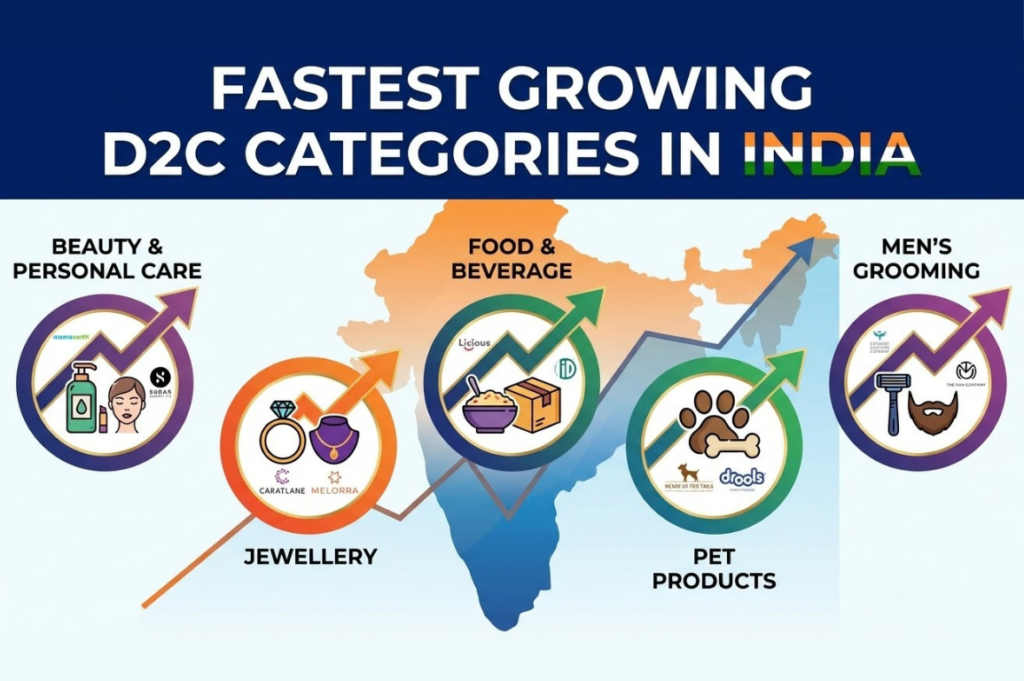
Fastest Growing D2C Categories in India: Where the Next Wave of Growth Is Coming From

Achieving Profitability in D2C: The Stage-by-Stage Playbook for Indian Brands

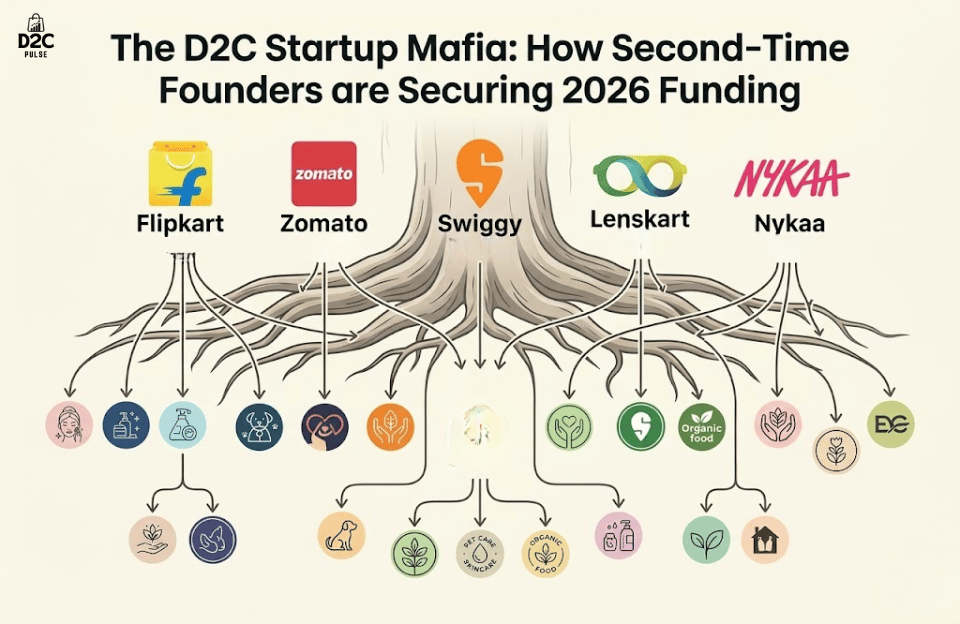
The D2C Startup Mafia: How Second-Time Founders are Securing 2026 Funding
The 10-Step Cross-Border Expansion Framework for Indian D2C Brands
- Pick one market. UAE for most brands. Southeast Asia if your price point is under Rs 1,000. US only if you have $100K+ budget for the first year.
- Validate demand before investing. List on Amazon Global (Model 1). Run a small batch of Meta ads targeting your chosen market. If you get orders with zero organic presence, demand exists.
- Get regulatory approvals. Start compliance 3–6 months before planned launch. Food, BPC, and wellness products need certifications. Work with a local regulatory consultant. Do not DIY this.
- Set up local fulfilment. Ship 500–1,000 units to a fulfilment partner in the target market. Local warehouse means 2-day delivery. This is non-negotiable for serious cross-border expansion strategies.
- Localise your website and checkout. Local currency, payment methods & shipping estimates. If using Shopify, use Shopify Markets. If using Amazon, use the local marketplace.
- Price for the market, not for India. Research local competitors. Price at or above the local premium tier. Do not discount, as in international markets, low price may signal low quality.
- Launch with a diaspora-first strategy. Indian diaspora is your warmest audience. They already trust Indian brands. Target them through Instagram, WhatsApp groups, and diaspora-focused media. Once diaspora traction is proven, expand to local consumers.
- Build local influencer partnerships. Find 10–20 micro-influencers in your target market. Send product. Get UGC. Run it as ads. Local faces build local trust. Indian founders on camera work for diaspora. Local creators work for the broader market.
- Track unit economics separately. Do not blend international revenue with domestic. Track CAC, AOV, shipping cost, return rate, and CM2 for each market independently. Some markets will be profitable from month one. Others will take 6–12 months.
- Scale only what works. If the UAE works, go deeper. Add more SKUs. Open a local entity. Launch offline. If a market does not work after 6 months of effort, exit. Cross-border expansion strategies require discipline. Not every market will be right for your brand.
Indian D2C Brands That Cracked Cross-Border Expansion
| Brand | Category | Markets | Entry Model | Key Insight |
| Lenskart | Eyewear | UAE, Saudi Arabia, Oman, Bahrain. 27 stores by 2025. | Local entity + owned stores (Model 5). | Committed $50M. Targeting 25% of GCC’s $3.5B eyewear market. Proved digital-first in India, then scaled offline globally. |
| iD Fresh Food | Ethnic food | UAE, US, UK, Oman, Saudi Arabia. | Local manufacturing in Dubai (Model 5). | Middle East = 25% of revenue. Started exporting at a relatively small scale. Local manufacturing solved cold-chain and freshness challenges. |
| Bombay Shaving Co. | Grooming | Nepal, UAE, Singapore, Malaysia, Bangladesh. | Local distributors (Model 4). | Took 18 months. Each market needed different partners. Different regulations, packaging, and consumer preferences in each. |
| Plum | Vegan beauty | Available in 15 countries via website and e-commerce. | Shopify + e-commerce platforms (Model 2). | Leveraged Amazon and Nykaa global reach. Clean beauty positioning works across markets. |
| Wakefit | Home and sleep | UAE. | Cross-border fulfilment (Model 3). | Pilot batch sold out within days. Validated demand before scaling. Sleep is a universal need. Product travels well. |
| The Moms Co. | Baby and mother care | Australia, UAE. | E-commerce + distributor (Models 2+4). | Australia-certified natural products. Trust-first category. Certifications opened the market. |
| Traya | Hair loss wellness | UAE (planned). | D2C website + consultation model. | Targeting Rs 2,000 Cr revenue. Telehealth model travels well to markets with Indian diaspora. |
Key Takeaways
- Cross-border expansion strategies are a growth lever, not a later-stage luxury. Start planning at Rs 25 crore revenue when your product is proven and your team is nimble. At Rs 100 crore, domestic problems consume all attention and CAC has already spiralled.
- Start with the UAE. Large Indian diaspora. Premium pricing holds. Lower regulatory friction than the US or EU. Shipping costs Rs 150–250 per 500g. E-commerce growing at 12.9% CAGR. Lenskart, iD Fresh, and Wakefit have already proven the model.
- Five entry models, from test to scale: Amazon Global (test demand), Shopify Markets (own the customer), local fulfilment (2-day delivery), local distributor (retail access), local entity (long-term scale). Start at Model 1. Advance only after validating demand.
- Compliance is the hidden timeline killer. ESMA, Emirates FDA, US FDA, EU Cosmetics Regulation. Allow 2–3x your estimated timeline. FreshToHome planned 6 months for the UAE. It took 2 years. Start compliance 3–6 months before launch.
- Price for the market, not for India. A Rs 500 product can sell at Rs 1,100 in the UAE. Premium pricing is expected internationally. Discounting in the UAE signals low quality. Double your domestic margin, do not replicate it.
- Local fulfilment is non-negotiable for serious markets. 10-day delivery from India kills conversion. 2-day delivery from a local warehouse converts 3–5x better. Ship bulk. Store locally. Deliver fast.
- Digitally-born exports are a $22 billion opportunity by 2030. Cross-border e-commerce from India was $4.7 billion in 2024. The infrastructure is ready. Amazon Global, Shopify Markets, and cross-border fulfilment platforms make it plug-and-play. The window is open.
Frequently Asked Questions
When should an Indian D2C brand start thinking about cross-border expansion?
At Rs 25 crore in revenue. At this stage, your product-market fit is proven, your supply chain works, and your team is nimble enough to experiment. Waiting until Rs 100 crore means your domestic CAC has already spiralled, your team is heavier, and you have less flexibility. Cross-border expansion strategies work best when the brand is proven but the organisation is still agile.
Which is the best first international market for Indian D2C brands?
The UAE for most brands. It has a large Indian diaspora (3.5 million+), high purchasing power, premium pricing acceptance, growing e-commerce ($9.2 billion by 2026), lower regulatory friction than the US or EU, and affordable shipping (Rs 150–250 per 500g). Lenskart, iD Fresh Food, Wakefit, and Bombay Shaving Company all entered the UAE successfully.
How much does it cost to launch in an international market?
It depends on the entry model. Amazon Global Selling requires near-zero upfront investment (just inventory and listing fees). A Shopify Markets international store costs Rs 50,000–2 lakh to set up. Local fulfilment (shipping 500–1,000 units to a warehouse) costs Rs 5–20 lakh in inventory. A local distributor model costs negotiation time and margin share (20–40%). A full local entity costs Rs 50 lakh to Rs 2 crore+ to establish.
What are the biggest mistakes in cross-border expansion for D2C brands?
Seven common mistakes: starting with the US instead of the UAE, underestimating compliance timelines (plan 2–3x your estimate), shipping from India instead of warehousing locally, pricing too low for the target market, ignoring local payment methods (losing 20–30% at checkout), running Indian ad creatives internationally, and not having time-zone-aware customer support.
How do Indian D2C brands handle compliance in international markets?
Compliance varies by market and product category. The UAE requires ESMA and Emirates FDA approvals for food and personal care (2–3 months). The US requires FDA compliance for food and cosmetics. The EU requires the EU Cosmetics Regulation with a Responsible Person in the EU. Halal certification helps in GCC markets. Work with a local regulatory consultant. Start compliance 3–6 months before your planned launch date. Do not DIY regulatory approvals in unfamiliar markets.