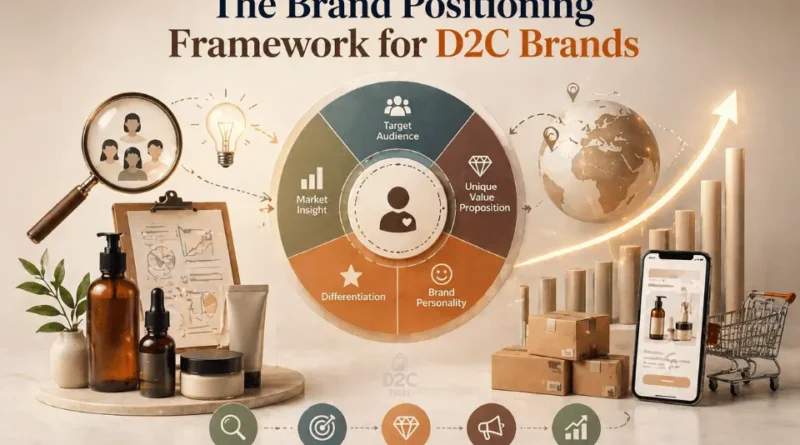
The Brand Positioning Framework for D2C Brands: How to Stand for One Thing in a Market of 11,000 Competitors
Why Most D2C Brands Sound the Same. The 5-Layer Positioning Framework. 8 Indian Brand Examples. And a Step-by-Step Worksheet to Find Your Own Position.
India has 11,000+ D2C brands. Over 200 sell skincare, over 150 sell fashion & over 100 sell health supplements. Most of them sound the same – Natural, Clean, Premium, Affordable luxury, Made-for-you or Backed by science. These words mean nothing when everyone says them. Brand positioning for D2C brands is the single most important strategic decision a founder makes. It decides who your customer is, what you charge, what content you create, what ads you run, and what shelf you sit on. Get it right, and everything else becomes easier. Get it wrong, and no amount of ad spend can fix it. This article gives you a complete brand positioning framework for D2C brands.
Minimalist positioned on ingredient transparency. boAt positioned on lifestyle audio. Sugar positioned on bold self-expression. Whole Truth positioned on radical label honesty. Each brand carved a distinct position in a crowded market. Each grew to Rs 100 crore+ revenue. Brand positioning for D2C brands is what separated them from the hundreds of competitors who sold similar products but failed. Five layers, eight Indian brand examples, a step-by-step worksheet and the five mistakes that kill positioning before it starts.
Why Brand Positioning for D2C Brands Is the Most Important Decision You Will Make
Here is what happens without positioning. A skincare brand launches & sells a vitamin C serum. The website says natural, effective, affordable. Its Instagram looks like every other skincare brand while ads say the same things. The customer scrolls past. She has seen 50 brands that look identical.
Brand positioning for D2C brands solves this. It gives the customer a reason to pick you over 200 alternatives. Not because your product is better. Every founder thinks their product is better. But because your brand stands for something specific that the customer cares about.
Positioning drives pricing. Minimalist charges Rs 500–700 for serums because it positioned on clinical-grade ingredients. A generic brand sells the same serum for Rs 199 and struggles to survive. Same product category, different brand positioning for D2C brands driving completely different economics.
Positioning drives acquisition cost. When a customer searches for the best niacinamide serum in India, Minimalist shows up because its positioning is ingredient-first. Brand positioning for D2C brands turns search intent into organic traffic. It turns paid ads into conversions. It turns a product into a brand.
Positioning drives retention. Sugar Cosmetics customers come back because they identify with the brand. Bold. Expressive. Unapologetic. That identity creates loyalty. Brand positioning for D2C brands turns a transaction into a relationship.
Also Read: Future of Indian Consumer Brands and what to keep in mind while growing yours
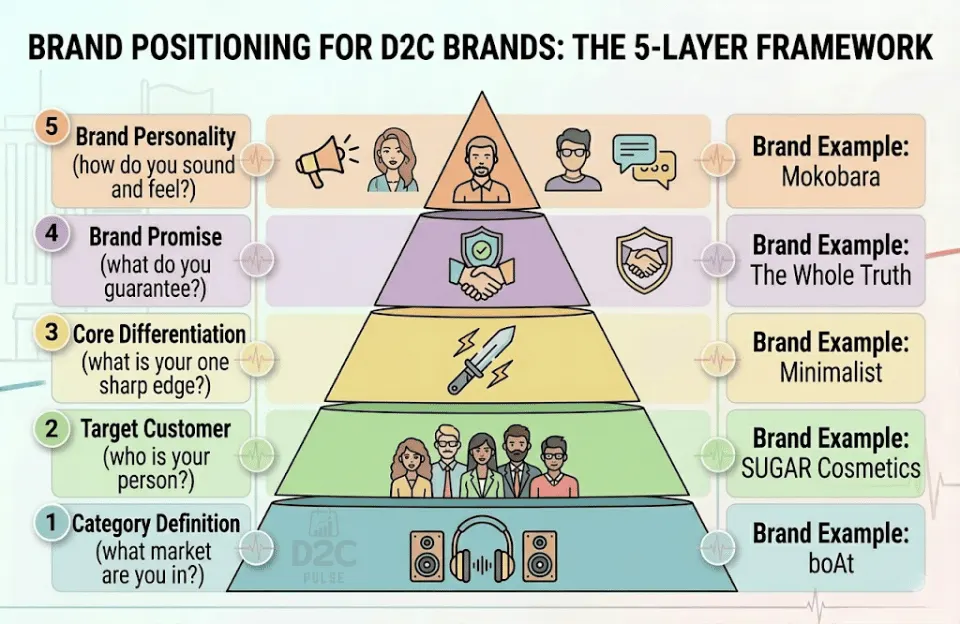
The 5-Layer Brand Positioning Framework for D2C Brands
Layer 1: Category Definition
Question: What market are you in? Not what product you sell. What mental category do you own in the customer’s mind?
Minimalist is not in skincare. It is in science-backed, ingredient-led skincare. boAt is not in electronics. It is in lifestyle audio. Whole Truth is not in food. It is in clean-label, no-hidden-ingredient food. The category you define shapes who you compete against. Brand positioning for D2C brands starts with choosing the right arena.
Mistake: Defining your category too broadly. If you say you are in personal care, you compete with HUL. If you say you are in clinical-grade vitamin C serums for Indian skin, you compete with three brands. Narrow wins.
Layer 2: Target Customer
Question: Who is your person? Not everyone aged 18–45. One specific person with one specific need.
Minimalist’s customer is a 22–30-year-old woman who reads ingredient lists. She knows what niacinamide does. She compares percentages, does not want marketing but wants transparency. Sugar’s customer is a 20–28-year-old woman who uses makeup as self-expression. She wants bold colours that Indian brands did not offer before. Different customers, different needs require different brand positioning for D2C brands.
Mistake: Trying to serve everyone. A brand for everyone is a brand for no one. The sharper your target, the stronger your positioning.
Layer 3: Core Differentiation
Question: What is your one sharp edge? The single thing that makes you different in a way the customer cares about.
This is the hardest layer of brand positioning for D2C brands. Most founders list five differentiators. That is zero differentiators. Pick one. Repeat it relentlessly.
Minimalist: ingredient transparency. Every product is named by its active ingredient and concentration. 10% Niacinamide. 2% Salicylic Acid. No fancy names. No marketing jargon. That is one sharp edge.
Whole Truth: radical label honesty. The back of every pack shows a label that says everything inside, with no fine print and no hidden ingredients. That is one sharp edge.
boAt: audio as lifestyle. Not specs. Not sound quality charts. Lifestyle. Fashion. Self-expression through headphones. That is one sharp edge.
Mistake: Choosing a differentiation the customer does not care about. Your supply chain is not a differentiator. Your manufacturing process is not a differentiator. The customer cares about what the product does for them, not how you made it.
Also Read: Customer Acquisition Strategies for D2C. How to get those customers to grow.
Layer 4: Brand Promise
Question: What do you guarantee the customer will get? Not a feature. An outcome.
Minimalist promises: you will know exactly what is on your skin. No hidden ingredients. No confusing names. Full transparency. The customer’s outcome: confidence that she is making an informed choice.
Wakefit promises: you will sleep better without overpaying. The customer’s outcome: quality sleep at factory-to-consumer price.
Country Delight promises: the freshest milk delivered to your door, every morning. The customer’s outcome: trust that the food she feeds her family is clean.
Brand positioning for D2C brands requires a promise that is specific, testable, and repeatable. If the customer cannot verify your promise, it is marketing fluff. If she can verify it, it is trust.
Layer 5: Brand Personality
Question: How does your brand sound and feel? If your brand were a person, who would they be?
Minimalist is a calm, data-driven dermatologist. Sugar is a bold, expressive best friend. boAt is the cool, energetic friend at the party. Whole Truth is the honest friend who reads labels at the supermarket. Mokobara is the well-travelled, design-conscious minimalist.
Brand positioning for D2C brands becomes real through personality. Personality shows up in your website copy, your Instagram captions, your packaging, your customer emails, and your founder videos. If you cannot describe your brand personality in 3 words, your team cannot maintain consistency.

Also Read: Key Characteristics of Successful D2C Brands that have made it in India.
Brand Positioning for D2C Brands: 8 Indian Examples Mapped
| Brand | Category | Target | One Edge | Promise | Personality |
| Minimalist | Science-backed skincare | Ingredient-aware, 22–30. | Ingredient transparency. | You know what is on your skin. | Calm dermatologist. Data over drama. |
| boAt | Lifestyle audio | Young, urban, 18–28. | Audio as fashion. | Sound meets style. | Energetic party friend. boAtheads tribe. |
| Sugar | Bold makeup | Self-expressive, 20–28. | Bold colours for Indian skin. | Express yourself fearlessly. | Bold best friend. Unapologetic. |
| Whole Truth | Clean-label food | Health-conscious label readers. | Radical label honesty. | You see every ingredient. | Honest friend. No fine print. |
| Mokobara | Design-led travel gear | Tasteful travellers, 25–40. | Design + function at Indian price. | Travel with taste. | Well-travelled minimalist. Understated. |
| Wakefit | Sleep solutions | Value-conscious, quality-seeking. | Factory-to-consumer pricing. | Better sleep, honest price. | Friendly sleep expert. No-markup honesty. |
| Country Delight | Fresh daily delivery | Health-first urban parents. | Farm-to-door freshness. | Freshest milk, every morning. | Trustworthy farmer next door. |
| Blue Tokai | Specialty coffee | Coffee lovers, 25–40. | Single-origin, Indian roasted. | Coffee worth the ritual. | Knowledgeable barista. Craft over commodity. |
Brand positioning for D2C brands is not about being different for the sake of different. It is about being different in a way the customer cares about. Minimalist did not invent serums. It invented a way of naming and selling them that matched what ingredient-aware consumers wanted. That is positioning.
Also Read: Rise of Premiumization in India for how positioning drives premium pricing
Five Mistakes That Kill Brand Positioning for D2C Brands
- Trying to be everything. A brand that sells skincare and supplements and snacks and home decor has no position. The customer cannot put it in a mental box. Brand positioning for D2C brands requires ruthless subtraction. Stand for one thing. Expand later, once that one thing is owned.
- Copying the market leader. If Minimalist owns ingredient transparency, you cannot copy it. You will be a worse version of Minimalist. Find a different edge. Maybe formulation for Indian climate. Or maybe Ayurvedic-clinical hybrids. You can also go niche by saying – skincare for men over 30. Brand positioning for D2C brands demands originality.
- Positioning on price. Low price is not a position. It is a race to zero margin. A Rs 149 serum tells the customer this product is cheap. A Rs 599 serum with education, packaging, and a clear story tells the customer this is worth it. Brand positioning for D2C brands should justify premium pricing, not avoid it.
- Changing position every quarter. Some founders see low traction and pivot their messaging every 3 months. Natural one quarter. Clinical the next. Ayurvedic the next. Each pivot confuses the customer and resets awareness to zero. Brand positioning for D2C brands requires patience. Minimalist repeated its ingredient-transparency message for 4 years. Then HUL paid Rs 2,955 crore for it.
- Not aligning the team. The founder knows the positioning. The content writer does not. The ad designer does not. The customer support agent does not. Brand positioning for D2C brands must be a one-page document that every team member can recite. If the designer creates pastel visuals and the ads run bold, aggressive copy, the customer sees two different brands.
The Brand Positioning Worksheet for D2C Brands: Fill This In
| Question | Your Answer (1–2 Sentences Only) |
| 1. Category: | What specific market are you in? (Not “skincare.” Something sharper.) |
| 2. Target Customer: | Describe one person. Age. City. Need. What frustrates them today? |
| 3. Problem: | What specific problem does your product solve that alternatives do not? |
| 4. Core Differentiation: | What is your ONE sharp edge? (Only one. Not three.) |
| 5. Brand Promise: | What outcome do you guarantee? How can the customer verify it? |
| 6. Brand Personality: | 3 words that describe how your brand sounds and feels. |
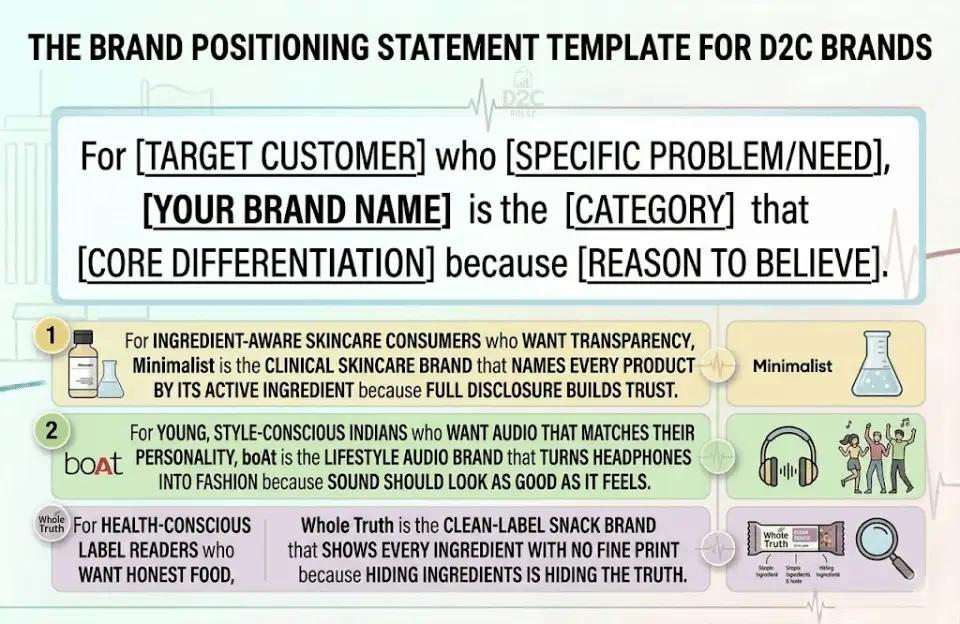
| 7. Positioning Statement: | For [target customer] who [problem], [brand] is the [category] that [differentiation] because [reason to believe]. |
| 8. Anti-Position: | What will you NEVER be? What will you NEVER say? (This sharpens your position.) |
Fill this out. Print it. Share it with every team member. If everyone on your team gives the same answers, your brand positioning for D2C brands is working. If they give different answers, you have a positioning problem.
Also Read: Pricing Strategies for D2C Brands in India for how positioning drives pricing power
Key Takeaways
- Brand positioning for D2C brands is the most important strategic decision. In a market of 11,000+ brands, the ones that stand for one sharp idea win. The ones that try to be everything fail. Positioning decides your customer, your price, your content, and your competitive advantage.
- The 5-layer framework: Category Definition (narrow your arena), Target Customer (one specific person), Core Differentiation (one sharp edge), Brand Promise (one verifiable outcome), Brand Personality (3 words). Fill in all five. Align every team member. Repeat for 4 years.
- The winning Indian brands all have one sharp edge. Minimalist: ingredient transparency. boAt: audio as fashion. Sugar: bold self-expression. Whole Truth: radical honesty. Mokobara: design-led travel. Wakefit: factory-direct pricing. Each edge is simple, consistent & drives everything for the brand.
- Five mistakes kill positioning: trying to be everything, copying the leader, positioning on price, changing position every quarter, and not aligning the team. Brand positioning for D2C brands requires patience and discipline more than creativity.
- Use the positioning worksheet. Fill it in. Print it. Share it. If every team member gives the same answers, your positioning is working. If they give different answers, fix it before spending another rupee on ads. Brand positioning for D2C brands is the foundation. Build it first.
Frequently Asked Questions
What is brand positioning for D2C brands?
Brand positioning for D2C brands is the strategic choice of what your brand stands for in the customer’s mind. It defines your category, your target customer, one sharp differentiator, brand promise, and personality. This answers: why should this customer choose you over every alternative? It is not a tagline but the foundation that shapes pricing, content, ads, packaging, and customer experience.
Why does brand positioning matter more for D2C brands than traditional brands?
Because D2C brands compete in an open digital market with 11,000+ alternatives. A traditional brand in a store has shelf placement, distributor relationships, and retailer endorsement. A D2C brand has a 3-second scroll on Instagram. Without sharp brand positioning for D2C brands, the customer scrolls past. With sharp positioning, she stops, clicks, and buys.
How do you find your brand positioning?
Use the 5-layer framework. Define your narrow category. Pick one specific target customer. Identify your one sharp differentiator. State your brand promise as a verifiable outcome. Describe your personality in 3 words. Then write a positioning statement: For [customer] who [need], [brand] is the [category] that [differentiator] because [reason]. Brand positioning for D2C brands is a subtraction exercise. Cut everything that is not your one sharp edge.
Can brand positioning change over time?
Your positioning can evolve but it should not flip. Minimalist started with skincare and expanded into body care, hair care, and sunscreen. But the core positioning never changed: ingredient transparency. boAt started with headphones and expanded into watches, speakers, and smart accessories. The core positioning never changed: audio as lifestyle. Brand positioning for D2C brands should broaden the product line, not change the brand identity.
What is the biggest brand positioning mistake D2C brands make?
Trying to appeal to everyone. A brand for everyone is a brand no one remembers. The sharpest brand positioning for D2C brands comes from saying no to 80% of the market so you can own 20%. Minimalist said no to marketing jargon. Whole Truth said no to hiding ingredients. Sugar said no to subtle, safe colours. Each “no” sharpened the position. Each attracted a loyal audience.