How Indian Brands Are Rewriting the Commerce Playbook
D2C Brands Are Opening Stores. Traditional Brands Are Going Online. Shoppable Video Is Bridging the Gap. Here Is How the Shift from Offline to Digital-First Is Reshaping Indian Commerce.
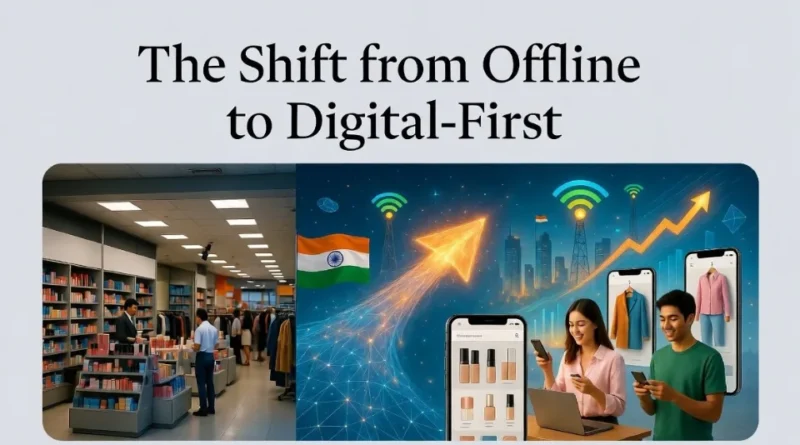
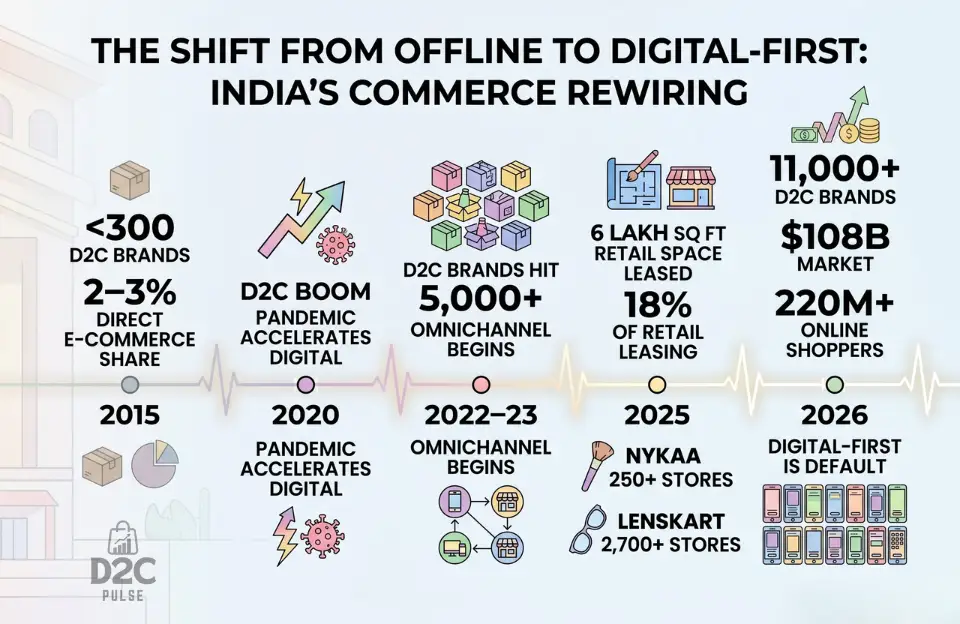
In 2015, India had fewer than 300 D2C brands. In 2026, it has over 11,000. The India D2C e-commerce market crossed $108 billion. Direct e-commerce sales jumped from 2–3% of the market five years ago to 10–15% today. Over 220 million Indians now shop online. And 60% of new online shoppers come from tier-2 and tier-3 cities. This is the shift from offline to digital-first.
It is not a trend but a structural rewiring of Indian commerce. Brands that once needed 500 retail outlets to reach customers now reach them through a Shopify store, an Instagram page, and a WhatsApp broadcast list. Traditional brands that owned shelf space in 50,000 stores are building D2C websites to own customer data instead.
The shift from offline to digital-first is not about choosing one over the other. It is about building a digital core and then adding offline selectively. The most successful Indian brands in 2026 start digital. They build their website, grow through content and performance marketing, build WhatsApp communities. And then, once the brand is proven online, they open stores.
This article maps the shift from offline to digital-first in Indian commerce. We cover the seven forces driving it, the role of shoppable video in accelerating conversions, how brands are using tools like ReelV to grow exponentially, and a practical playbook for founders navigating this transition.

Seven Forces Driving the Shift from Offline to Digital-First in India
1. Smartphones and Cheap Data Made Everyone a Digital Shopper
India has over 900 million smartphone users. Mobile broadband speeds jumped from 1.3 Mbps in 2014 to over 95 Mbps in 2024. Jio slashed data costs from Rs 250 per GB to under Rs 10. The shift from offline to digital-first became possible because the infrastructure landed in people’s pockets. Over 85% of D2C website traffic comes from mobile. The phone is the storefront.
2. UPI Removed the Payment Barrier
Before UPI, online payments were clunky. Credit card penetration was under 3%. COD was the default. UPI made checkout instant and free. It now processes over 21 billion monthly transactions. For D2C brands, UPI reduced checkout drop-off, cut payment costs to near zero, and made prepaid the norm. The shift from offline to digital-first accelerated because paying online became easier than paying at a counter.
3. Social Media Became the Discovery Channel
Instagram replaced shop windows. Reels replaced billboards. Creator recommendations replaced salesperson pitches. 43% of Indian shoppers say they discover new brands through creator content. A consumer in Surat sees a skincare routine on Instagram at 11 PM. She clicks the link. She buys. No store visit needed. The shift from offline to digital-first is powered by social media turning every scroll into a shopping moment.
4. Logistics Networks Reach Every PIN Code
3PL partners like Delhivery, Shiprocket, and XpressBees deliver to 19,000+ PIN codes at Rs 50–100 per shipment. Quick commerce delivers in 10–30 minutes in 150+ cities. A brand in Jaipur can ship to a customer in Nagaland in 5 days. The shift from offline to digital-first works because the last mile is solved. A decade ago, it was not.
5. D2C SaaS Tools Slashed the Cost of Going Digital
Shopify starts at Rs 1,994 per month. Razorpay charges 2% per transaction. Shiprocket starts free. A founder with a laptop can launch a full-stack digital-first brand in a week. The shift from offline to digital-first is no longer a capital-intensive bet. It is a Rs 5,000-per-month bet. The tools exist. The infrastructure exists. The only question is whether the founder builds the brand.
6. First-Party Data Gives Digital-First Brands an Edge
A brand that sells through 500 retail outlets knows how much it sold. A digital-first brand knows who bought, when they bought, what they browsed before buying, whether they came from Instagram or Google, what email subject line made them click, and when they are likely to buy again. The shift from offline to digital-first gives brands a data advantage that offline-only brands cannot match. This data powers personalisation, retention, and smarter marketing spend.
7. Video Commerce Bridges the Trust Gap
The biggest objection to buying online has always been trust. Can I see the product? Does it look like the photo? Will it fit? Video on product pages answers these questions. 81% of consumers have bought a product after watching a video. Product pages with shoppable video see up to 80% higher conversion rates. 93% of businesses using video commerce report stronger ROI. The shift from offline to digital-first is powered by video because video gives online shopping the sensory richness that only stores could offer before.
Offline vs Digital-First: A Side-by-Side Comparison
| Factor | Traditional Offline Brand | Digital-First Brand |
| Reach | Limited by store count and geography. 500 stores = 50 cities. | Nationwide from day one. Shopify + Shiprocket = 19,000+ PIN codes. |
| Customer Data | Minimal. Knows what sold. Does not know who bought. | Rich. Knows who, when, why, and what comes next. |
| Speed to Market | 6–12 months to set up retail. Lease, fit-out, staff, inventory. | 1–4 weeks to launch. Shopify, content, ads, live. |
| Cost Structure | High fixed costs: rent, staff, inventory per store. | Low fixed costs. Variable costs scale with orders. |
| Product Education | In-store staff explains. Limited by footfall. | Content, video, shoppable video on PDP. Scales infinitely. |
| Margins | 30–40% gross after distributor and retailer margins. | 60–80% gross. No middleman. Direct to consumer. |
| Retention | Hard. No direct customer communication channel. | WhatsApp, email, SMS, retargeting. Owned channels. |
| Brand Experience | Controlled in-store. Inconsistent across retail partners. | Controlled end-to-end: website, packaging, unboxing, video, follow-up. |
The shift from offline to digital-first is not about replacing stores with websites. It is about building the brand digitally first, owning the customer relationship, and then adding offline touchpoints where they add value. Digital-first does not mean digital-only.
Shoppable Video: The Missing Layer in the Shift from Offline to Digital-First
Here is the problem with online shopping. A customer lands on a product page. She sees three photos and a bullet-point description. She has questions. What does this serum feel like? How do I apply it? Is the colour what the photo shows? In a store, a salesperson answers these questions. Online, the customer bounces.
Shoppable video solves this. A 30-second video on the product page shows the product in use. A founder explains why they created it. A customer shares a real review. The video has clickable add-to-cart and buy-now buttons. The customer watches. She trusts. She buys. No store visit needed.
The data supports this. 81% of people have bought after watching a video. Product pages with interactive video see up to 39% higher cart conversions. Landing pages with shoppable video boost conversions by up to 80%. 93% of businesses report stronger ROI with video commerce. 83% of consumers want more video from brands.
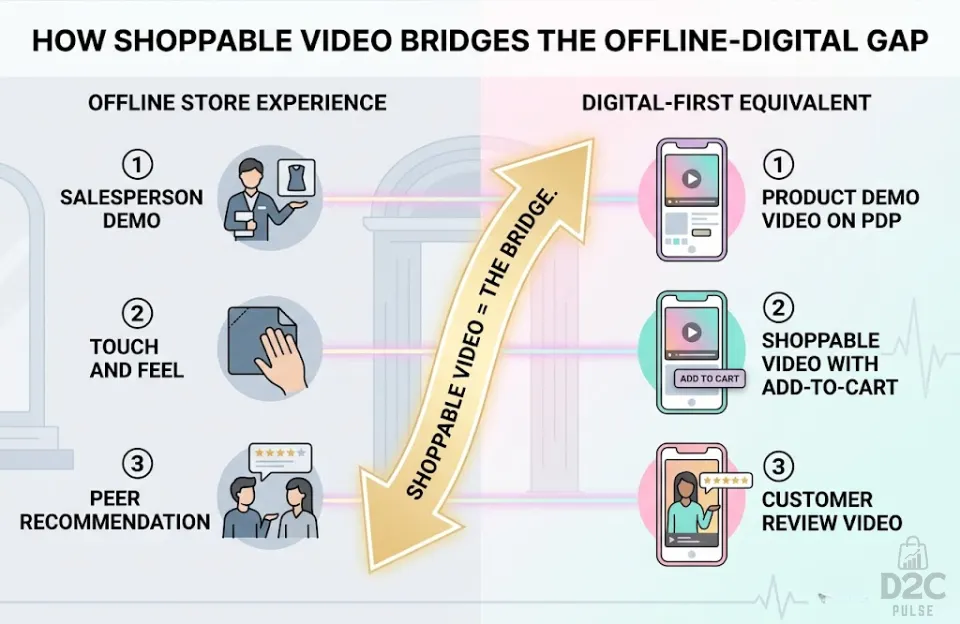
For the shift from offline to digital-first, shoppable video is the bridge. It brings the store experience to the screen. A product demo video on the PDP does what a store salesperson does. A customer testimonial video does what word-of-mouth at the store counter does. An unboxing video does what touching the product at the shelf does. Shoppable video makes digital-first feel as real as offline.
How ReelV Powers Exponential Growth for Digital-First D2C Brands
The shift from offline to digital-first demands tools that make video commerce easy, fast, and measurable. This is where ReelV comes in. ReelV is a shoppable video app built for Shopify stores. It is designed for Indian D2C brands that want to use video on their product pages without slowing down their site or hiring a development team.
What ReelV Does
ReelV offers three video formats that turn any D2C website into a video-first shopping experience. First, Floats: pop-up PDP videos that play when a customer visits a product page. The video shows the product in action. Add-to-cart and buy-now buttons are built into the video. Second, Stories: Instagram-style highlights on the homepage. Customers tap through short videos the same way they use Instagram Stories. Third, Reels: a vertical carousel of shoppable videos with add-to-cart built in. Customers browse video content and buy without leaving the video.
Why It Does Not Slow Down Your Site
Most video tools kill page speed. ReelV does not. It uses a separate CDN and proprietary video compression technology. D2C brands can load 20+ videos on a single page with zero impact on Core Web Vitals. This matters because page speed directly affects conversion rate. A 1-second delay can reduce conversions by 7%. ReelV gives you the engagement of video without the speed penalty.
The Results: 5–30% Conversion Lift and 167x ROI
D2C brands using ReelV report 5–30% conversion lift on pages with shoppable video. One brand generated Rs 20 lakh in additional monthly revenue, delivering 167x ROI on their ReelV subscription. This is not ad spend. This is conversion rate optimisation. You are not paying for more traffic. You are making the traffic you already have convert better.
Media-Level Analytics That Show What Works
ReelV provides analytics at the individual video level. Views per video. Add-to-cart clicks per video. Buy-now clicks per video. Per page and per product. This means you know exactly which video drives revenue and which does not. You can test a founder story video against a customer testimonial video on the same product page and see which converts better. Data-driven video commerce. Not guesswork.
Integrates with Indian Checkout Tools
ReelV integrates with ShopFlo and GoKwik, two of the most popular checkout optimisation tools in Indian D2C. This means shoppable video connects directly to the fastest checkout flows. The customer watches a video, clicks buy now, and lands on an optimised checkout. Fewer steps, fewer drop-offs, higher conversion.
Who Uses ReelV
Over 300 D2C brands use ReelV. Clients include Two Brothers Organic Farms, Alpino Foods, PeeSafe, FemiSafe, Antinorm, and Boombay. These are brands across food, personal care, wellness, and lifestyle. The Plus plan includes a CRO service with monthly performance reports and bi-weekly optimisation calls, backed by a 5x ROI guarantee.
The shift from offline to digital-first is powered by tools that make the digital experience feel as rich as the offline one. ReelV does exactly this. It helps puts video on every product page and makes every video shoppable. It tracks every interaction and it does all of this without slowing down the site. For digital-first D2C brands, shoppable video is not optional, It is the new store salesperson.
Indian Brands Winning the Shift from Offline to Digital-First
Lenskart: Digital-First, Then 2,700+ Stores
Lenskart started as a digital-first eyewear brand. It built its website, its virtual try-on technology, and its online customer base first. Then it opened stores. By FY25, it had 2,700+ stores. Revenue hit Rs 6,652 crore. Net profit hit Rs 297 crore. Lenskart proved that the shift from offline to digital-first does not mean staying online forever. It means building the digital core first and expanding offline with data.
Mamaearth: Born Digital, Now in 40,000+ Retail Outlets
Mamaearth launched on its website. It grew through Instagram and performance marketing. It built a community of parents who trusted the brand. Then it expanded offline. By FY24, it was in over 40,000 retail outlets. Revenue crossed Rs 2,000 crore. The shift from offline to digital-first gave Mamaearth customer data, brand trust, and product-market fit before it spent a rupee on retail distribution.
Nykaa: Digital-First Beauty, Now 250+ Stores Across 80+ Cities
Nykaa started as an online beauty marketplace. It built content (tutorials, reviews, product guides) that educated consumers. Then it opened offline stores as experience centres. The stores drive trial and trust. The website drives repeat purchases and full-catalogue access. The shift from offline to digital-first let Nykaa build a Rs 5,000+ crore business where online and offline feed each other.
D2C Brands Leasing Retail Space at Record Pace
D2C brands leased close to 6 lakh square feet of retail space in H1 2025. That is 18% of total retail leasing, up from just 8% the previous year. Fashion brands led. Jewellery, home, and personal care followed. This is not a retreat from digital. This is the next stage of the shift from offline to digital-first. Build the brand online. Prove the unit economics. Then open stores where they add value. Not 500 stores on day one. 5 stores in high-intent locations.
The Founder’s Digital-First Playbook
If you are building a brand in 2026, here is how to ride the shift from offline to digital-first.
- Start with your website, not a store. Shopify. Razorpay. Shiprocket. You can be live in a week. Prove product-market fit online first. Sell 100 orders. Get reviews. Test pricing. Validate demand. Then think about offline.
- Put video on every product page. Founder story. Product demo. Customer testimonial. How-to-use guide. Use shoppable video tools like ReelV to make every video clickable. Brands using shoppable video see 5–30% higher conversions. This is the highest-ROI change you can make to your website.
- Build owned channels from day one. WhatsApp list. Email list. Instagram followers. These are your distribution channels. They cost almost nothing. They compound. A brand with 50,000 WhatsApp subscribers can generate Rs 5–10 lakh in revenue from a single broadcast. Do not build on rented platforms only.
- Use data to make every decision. Track CAC by channel, conversion rate by page and AOV by cohort. The shift from offline to digital-first gives you data that offline brands dream of. Use it. Tools like ReelV give you video-level analytics. Google Analytics gives you page-level data. WebEngage gives you customer-level data. Use all three.
- Add offline only where it adds value. A pop-up store in a high-footfall mall during a festival season. An experience centre in one city to build trust. A retail listing on Nykaa or Myntra for discovery. Do not open 50 stores because Lenskart has 2,700. They earned those stores over a decade. Start with one. Make it profitable. Then scale.
- Make your offline work for your digital. Every offline customer should join your WhatsApp list. Put QR code linking to your website in every store. Push in-store interaction to drive a second purchase online. The shift from offline to digital-first means your store is a marketing channel, not just a sales channel.
- Invest in content that compounds. Blog posts that rank on Google. YouTube videos that get discovered. Product page videos that convert every visitor. This is the content infrastructure of a digital-first brand. Performance ads get you traffic today. Content gets you traffic every day, for free, forever.
Also Read: Customer Acquisition Strategies for D2C Brands in India for the full channel-by-channel playbook
Key Takeaways
- The shift from offline to digital-first is the defining trend of Indian commerce in 2026. India has 11,000+ D2C brands. The D2C market crossed $108 billion. 220 million Indians shop online. 60% of new shoppers come from tier-2/3 cities. Digital-first is the default.
- Seven forces drive the shift from offline to digital-first: smartphones and cheap data, UPI, social media as discovery, logistics to 19,000+ PIN codes, affordable SaaS tools, first-party data, and video commerce. Together, they removed every barrier to going digital.
- Shoppable video is the bridge between offline experience and online convenience. 81% buy after watching video. Pages with shoppable video see up to 80% higher conversions. 93% of businesses report stronger ROI. Video does the job of the store salesperson on every product page.
- ReelV powers shoppable video for 300+ Indian D2C brands. Three formats (Floats, Stories, Reels). Zero speed impact through separate CDN. 5–30% conversion lift. 167x ROI case study. Media-level analytics. Starting at Rs 29/month. The shift from offline to digital-first demands video on every PDP. ReelV makes it effortless.
- The winning model is digital-first, not digital-only. Lenskart started online, now has 2,700+ stores. Mamaearth started online, now in 40,000+ outlets. D2C brands leased 18% of retail space in H1 2025. Build digital. Prove the economics. Then add offline where it adds value.
- The founder’s playbook: start with your website, put shoppable video on every product page, build owned channels from day one, use data for every decision, add offline only where it adds value, and invest in content that compounds.
Frequently Asked Questions
What does the shift from offline to digital-first mean?
The shift from offline to digital-first means brands are building their core business online before expanding offline. Instead of starting with retail stores and distributors, brands now start with a Shopify website, social media, and performance marketing. They own the customer relationship from day one, collect first-party data and validate product-market fit online. Then they add offline stores selectively. It is not about abandoning retail, but about building the digital core first.
Why is the shift from offline to digital-first happening in India now?
Seven forces: 900 million smartphone users with cheap data, UPI processing 21 billion monthly transactions, social media as the discovery engine, 3PL networks reaching 19,000+ PIN codes, affordable SaaS tools (Shopify at Rs 1,994/month), first-party data giving digital brands an edge, and video commerce bridging the trust gap. These forces removed every structural barrier to building a brand online.
What is shoppable video and how does it help digital-first brands?
Shoppable video is product video with built-in purchase functionality. The customer watches a product demo, founder story, or customer review on the product page. The video has clickable add-to-cart and buy-now buttons. She buys without leaving the video. It bridges the trust gap that stores solve offline. Product pages with shoppable video see up to 80% higher conversions. Tools like ReelV make it easy to add shoppable video to Shopify stores without impacting page speed.
How does ReelV help D2C brands grow?
ReelV is a shoppable video app for Shopify. It offers three formats: Floats (pop-up PDP videos), Stories (homepage highlights), and Reels (vertical carousel with add-to-cart). It uses a separate CDN and proprietary compression so 20+ videos load with zero speed impact. Brands report 5–30% conversion lift. One brand saw 167x ROI. ReelV provides video-level analytics (views, add-to-carts, buy-nows per video) and integrates with ShopFlo and GoKwik checkouts. Plans start at Rs 29/month.
Should digital-first brands open physical stores?
Yes, but only after proving the digital model. The best approach: build online, validate product-market fit, achieve CM2 positive, and then open 1–5 stores in high-intent locations. Lenskart did this over a decade (now 2,700+ stores). Mamaearth did it after hitting Rs 1,000+ crore online. D2C brands leased 18% of retail space in H1 2025, up from 8% the year before. The stores work as experience centres, return hubs, and brand builders. They feed the digital business. The digital business feeds them back.