
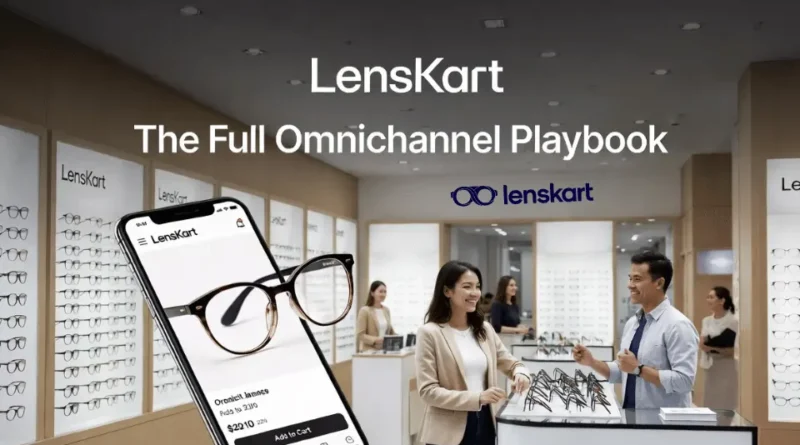
Lenskart Omnichannel Strategy: How a Contact Lens Website Became India’s Rs 6,600 Crore Eyewear Giant
2,700+ Stores, 30 Million Customers, Virtual Try-Ons, In-House Manufacturing, Global Expansion and IPO Filing. The Full Omnichannel Playbook.
In 2010, Peyush Bansal left his job at Microsoft in the US and came back to India to start an online contact lens store. Nobody around him thought selling eyewear on the internet was a good idea. You cannot try glasses online since you always need an eye test to be done. You need to see how the frame looks on your face before making the purchase. Every objection pointed to the same conclusion: eyewear is a physical-first category. Bansal agreed and that is exactly why the Lenskart omnichannel strategy worked.
Instead of fighting the reality that eyewear needs a physical experience, Lenskart built around it. It started online to prove the model, then invested heavily in physical stores, virtual try-on technology, home eye tests, and in-house manufacturing. Today, Lenskart operates 2,700+ stores globally, serves 30 million+ customers, generated Rs 6,652 crore in revenue in FY25, turned profitable with Rs 297 crore in net profit, and filed for an IPO targeting a $10 billion valuation.
The Lenskart omnichannel strategy is not just a D2C case study. It is possibly the most complete example of an Indian brand building a fully integrated omnichannel machine from scratch, Online as well as offline.
This is how they did it.
The Origin: From Microsoft to Contact Lenses to Omnichannel
Peyush Bansal, Amit Chaudhary, and Sumeet Kapahi founded the company that would become Lenskart. But the path was not straight.
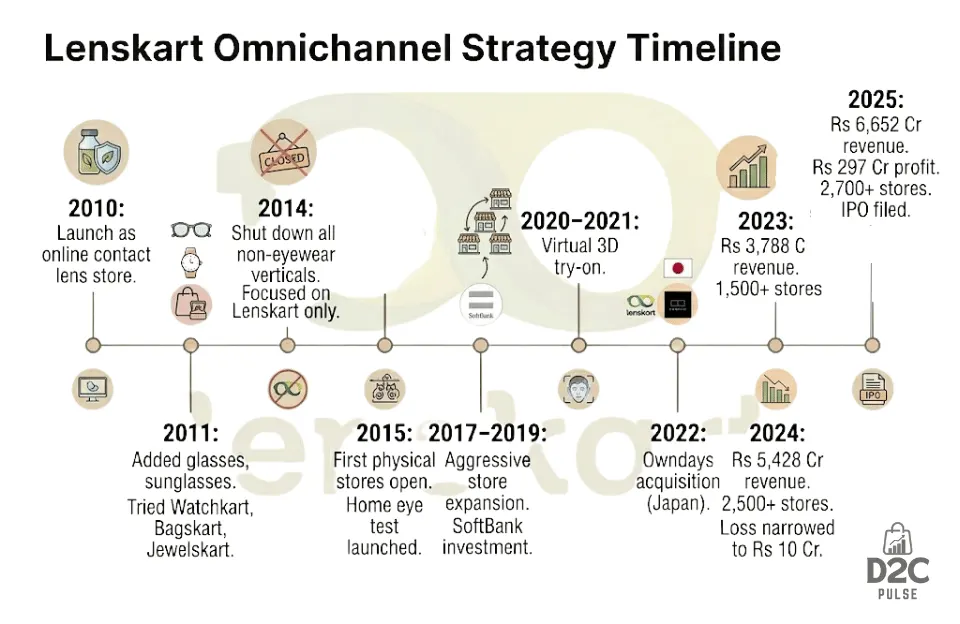
Bansal first launched Valyoo Technologies in 2008, running a college classifieds site called SearchMyCampus.com. When that did not scale, they pivoted to Flyrr.com, an eyewear ecommerce platform targeting the US market. That did not work either. In November 2010, they shut both sites and launched Lenskart.com, selling contact lenses in India. By early 2011, they had added prescription glasses and sunglasses.
Then came the diversification mistake. On advice from early investors, they launched Watchkart.com, Bagskart.com, and Jewelskart.com between 2011 and 2012, trying to replicate Titan’s multi-category model. By the end of 2014, all three had been shut down. The lesson was expensive but clear: focus wins. Only Lenskart.com survived.
That decision to go all-in on eyewear was the turning point. Every rupee, every team member, and every strategic decision from 2014 onward was about becoming India’s number one eyewear brand. That focus is what made the Lenskart omnichannel strategy possible.
Lenskart tried four different business models before finding the one that worked. Contact lenses, then glasses, then multi-category, then back to eyewear-only. The brands that succeed are not the ones that get it right on the first try. They are the ones that cut their losses fast and double down on what works.
Why Eyewear Demanded an Omnichannel Strategy From the Start
Eyewear is one of the few product categories where omnichannel is not optional. It is structurally necessary. Here is why.
First, customers need to see how frames look on their face. No matter how good the product photos are, fit and appearance are personal. A frame that looks great on a model may look wrong on you. This is why eyewear has always been a physical-trial category.
Second, prescription eyewear requires an eye test. You cannot buy prescription glasses the same way you buy a T-shirt. The customer needs a current prescription, and many Indian consumers get their eye test done at the same place they buy their glasses.
Third, India’s eyewear market was almost entirely unorganised. In 2010, the market was dominated by local opticians with inconsistent pricing, limited variety, and no brand presence. Titan Eye+ was the only organised player, and it had under 900 stores. The total organised market penetration was tiny. Only about 25% of Indians who needed glasses actually wore them.
The Lenskart omnichannel strategy was designed to solve all three problems at once. The website and app handled discovery, education, and ordering. Physical stores handled eye tests, try-ons, and fulfilment. Technology (virtual try-ons, home eye tests) bridged the gap for customers who wanted an online experience with offline confidence.
The Numbers: Lenskart’s Revenue and Profitability
| Year | Revenue (Rs Cr) | Net Profit/Loss | Stores | Key Event |
| FY21 | ~1,500 (est.) | Loss | ~700 | COVID impact. Accelerated online. |
| FY22 | ~1,560 | Loss Rs 102 Cr | ~1,000 | Store expansion resumes post-COVID. |
| FY23 | 3,788 | Loss Rs 64 Cr | ~1,500 | 142% YoY growth. Owndays acquired. |
| FY24 | 5,428 | Loss Rs 10 Cr | ~2,500 | 43% growth. Near breakeven. $5B valuation. |
| FY25 | 6,652 | Profit Rs 297 Cr | 2,700+ | IPO filed. $10B target valuation. |
The trajectory tells the story of the Lenskart omnichannel strategy paying off. Revenue went from under Rs 2,000 crore to Rs 6,652 crore in three years. Losses shrank from Rs 102 crore (FY22) to Rs 10 crore (FY24) to a Rs 297 crore profit in FY25. The store count more than tripled from ~700 to 2,700+. And the IPO filing at a potential $10 billion valuation makes Lenskart one of the most valuable Indian consumer brands.
For comparison: Titan Eye+, Lenskart’s closest organised competitor, had roughly 900 stores and Rs 796 crore in revenue as of FY25. Lenskart’s revenue is over 8x larger. That gap is almost entirely explained by the Lenskart omnichannel strategy and its technology investments.

Also Read: Understanding Unit Economics for D2C brands and how to keep costs in check
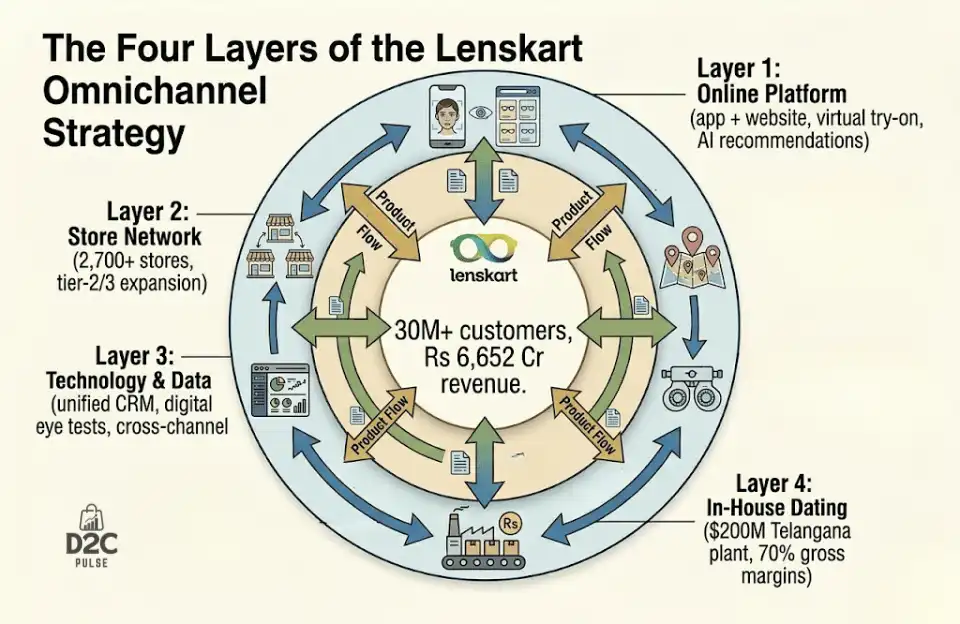
The Four Layers of the Lenskart Omnichannel Strategy
Layer 1: The Online Platform (Website + App)
Lenskart’s online platform is not a simple product catalogue. It is a technology-driven discovery and conversion engine.
The 3D virtual try-on feature lets customers see how frames look on their face using their phone camera. This was not a gimmick. It directly addressed the biggest objection to buying glasses online: “I need to see how it looks on me.” AI-powered recommendation engines suggest frames based on face shape, preferences, and browsing history.
The website and app serve as the top of the funnel. Customers discover frames online, use virtual try-on to shortlist, then either order directly or walk into a store to try them physically. The online and offline journeys are connected through a unified CRM and inventory system. A customer can save favourites online and find those exact frames waiting at their nearest store.
Layer 2: The Store Network (2,700+ and Growing)
Physical stores are the backbone of the Lenskart omnichannel strategy. As of FY25, Lenskart operates 2,723 stores globally, with 2,067 in India. The stores serve three functions: eye testing, physical try-on, and order fulfilment.
Lenskart uses two store models. COCO (Company Owned, Company Operated) stores give Lenskart full control over the customer experience. FOFO (Franchise Owned, Franchise Operated) stores allow faster expansion, especially in tier-2 and tier-3 cities, with lower capital requirements for Lenskart.
The tier-2 and tier-3 expansion is where the Lenskart omnichannel strategy gets interesting. In smaller cities, the local optician is the default. No brands or consistency and no standardised pricing either. A Lenskart store in a tier-2 town offers something those customers have never had: branded, consistent, fairly priced eyewear with a professional eye test. That is why store density in smaller cities is growing faster than in metros.
Lenskart allocated Rs 591 crore for lease payments on company-owned stores and Rs 320 crore for brand-building as part of its IPO filings. These are not small numbers. They signal that physical retail is not a side channel. It is the primary growth engine.
Layer 3: Technology and Data Integration
The Lenskart omnichannel strategy is glued together by technology. Without it, online and offline would be two separate businesses that happen to share a name.
- Unified inventory system. Every store and the online platform share the same inventory data. A frame shown as available online is actually in stock at the nearest store. No disconnects.
- Computerised eye testing. In-store eye tests use digital equipment that feeds prescription data directly into the ordering system. Faster, more accurate, and no manual transcription errors.
- 3D virtual try-on. Customers try frames on their face using AR through the app. This reduced the uncertainty of online eyewear purchases and increased online conversion rates.
- AI recommendation engine. Frame recommendations based on face shape analysis, past purchases, and browsing behaviour. This drives higher average order values and better product-customer fit.
- Cross-channel CRM. A customer’s online browsing history, store visits, prescriptions, and purchase history are all in one profile. Store staff can see what a customer browsed online before they walk in.
Layer 4: In-House Manufacturing
This is the layer that most people miss when they study the Lenskart omnichannel strategy. Lenskart does not just sell eyewear, It makes them.
The company invested $200 million in a manufacturing hub in Telangana. This facility produces frames and lenses at scale, giving Lenskart control over quality, cost, and supply chain speed. When you control manufacturing, you can offer lower prices than competitors who source from third-party suppliers. Lenskart’s gross margins sit at approximately 70%, far above what most eyewear retailers achieve.
In-house manufacturing also enables faster new product launches. A trend in frame design can go from concept to stores in weeks, not months. For a fashion-adjacent category like eyewear, this speed matters.
The Lenskart omnichannel strategy works because all four layers are connected. The online platform drives discovery. The stores handle experience and trust. Technology connects them. Manufacturing controls cost and quality. Remove any one layer, and the model breaks.
Global Expansion: The Lenskart Omnichannel Strategy Goes International
In 2022, Lenskart acquired a majority stake in Owndays, a Japanese eyewear brand with a strong presence across Southeast Asia. The deal was valued at approximately $400 million and gave Lenskart instant access to Japan, Singapore, Thailand, and Taiwan.
By FY24, approximately 42% of Lenskart’s revenue came from international markets. That is a number most Indian D2C brands cannot even imagine. Lenskart expanded into the UAE and Saudi Arabia, combining offline store openings with online ecommerce in each market.
In 2025, Lenskart acquired an 80% stake in Meller, a Spanish eyewear brand, for over €40 million. The global expansion is not an experiment. It is a core pillar of growth.
The Lenskart omnichannel strategy translates well internationally because the fundamental model (online discovery + physical stores + technology integration) works in every market where eyewear needs physical trial. The Owndays acquisition gave Lenskart the playbook for expanding the model outside India without starting from zero.
Also Read: Cross-Border Expansion Strategies for Indian D2C Brands
Marketing: How Peyush Bansal Turned Eyewear into a Lifestyle Category
Lenskart’s marketing shifted the perception of eyewear from a medical necessity to a fashion accessory. This repositioning is central to the Lenskart omnichannel strategy because it increases purchase frequency. If glasses are a prescription product, you buy one pair every two years. If they are a fashion product, you buy multiple pairs to match outfits and moods.
Campaigns with Kiara Advani encouraged consumers to recycle and refresh their frames frequently. A campaign featuring founder Peyush Bansal alongside Karan Johar hammered home the fair pricing message: luxury-quality frames at factory prices.
Bansal’s appearance as a judge on Shark Tank India was not just a personal brand move. It was the single most effective brand-building tool for Lenskart. Every episode put the Lenskart founder in front of millions of aspiring entrepreneurs and consumers. The brand awareness that Shark Tank generated would have cost hundreds of crores in traditional advertising.
Also Read: Types of D2C Business Models in India and what types of D2C models are out there
Challenges and Risks in the Lenskart Omnichannel Strategy
No case study is complete without the hard parts.
- Franchise tensions. In 2024, some FOFO franchise owners in Karnataka accused Lenskart of opening competing COCO stores near their outlets, along with allegations of revenue discrepancies. An FIR was filed. Lenskart secured a stay order from the Karnataka High Court. Managing the COCO-FOFO balance is a real operational challenge when expanding at this speed.
- Profitability arrived late. Despite massive revenue growth, Lenskart posted losses from FY22 through FY24. The Rs 297 crore profit in FY25 is encouraging, but it came after over a decade of operations and $1 billion+ in total capital raised. The path to profitability was long.
- Competition is growing. Titan Eye+ is expanding aggressively. EssilorLuxottica (Ray-Ban, Oakley) is entering India. Local opticians still dominate rural markets. Lenskart commands roughly 90% of the organised eyewear market, but organised eyewear is still a small fraction of the total market.
- International execution risk. Running 2,700+ stores across India, Japan, Singapore, UAE, and Europe is operationally complex. Each market has different consumer preferences, pricing expectations, and regulatory environments.
What Founders and Marketers Can Learn from the Lenskart Omnichannel Strategy
The Lenskart omnichannel strategy carries lessons for any D2C brand thinking about its channel mix, even if you are not in eyewear.
First, respect the category’s physical reality. Bansal did not pretend you could sell glasses without physical trial. He built an entire store network to solve for it. If your product category demands touch, trial, or experience, fighting that reality online-only will cap your growth. Build the physical layer. It is expensive. It is also necessary.
Second, technology is the connective tissue of omnichannel. Without a unified CRM, shared inventory, and cross-channel data, your online and offline stores are just two separate businesses with the same logo. The investment in virtual try-on, AI recommendations, and computerised eye testing is what makes the Lenskart experience feel seamless across channels.
Third, vertical integration gives you pricing power and speed. Lenskart’s in-house manufacturing delivers 70% gross margins and the ability to launch new products in weeks. If you can control your supply chain, you can undercut competitors on price while maintaining better margins. That is a structural advantage, not a temporary one.
Fourth, focus kills faster than diversification. Lenskart tried watches, bags, and jewellery. All failed. The moment they went all-in on eyewear, growth accelerated. Pick your category. Own it completely. Do not spread thin.
And fifth, the founder’s personal brand is a marketing multiplier. Peyush Bansal’s Shark Tank presence gave Lenskart brand awareness that no ad budget could match. If you are a founder-led brand, your visibility is the brand’s visibility. Use it.
Key Takeaways
- The Lenskart omnichannel strategy has four connected layers: online platform, physical stores, technology integration, and in-house manufacturing. All four must work together.
- Revenue: Rs 6,652 crore in FY25. 43% CAGR over the past three years. 8x larger than Titan Eye+. Profitable at Rs 297 crore.
- 2,700+ stores globally, 2,067 in India. COCO for control. FOFO for speed. Tier-2 and tier-3 expansion is the growth frontier.
- Technology connects it all. 3D virtual try-on, AI recommendations, computerised eye tests, unified CRM, and shared inventory across online and offline channels.
- In-house manufacturing ($200M plant) delivers 70% gross margins. Control over cost, quality, and speed that competitors who source externally cannot match.
- Global expansion: 42% of revenue from international markets. Owndays (Japan), Meller (Spain), UAE, Singapore, Thailand. The omnichannel model translates across borders.
- IPO filed targeting $10 billion valuation. One of the most valuable Indian consumer brands. Validates that building an omnichannel D2C brand in India can produce massive outcomes.
- Focus is the lesson. Lenskart tried four categories and failed at three. Going all-in on eyewear is what created a Rs 6,600 crore business.
Frequently Asked Questions
What is the Lenskart omnichannel strategy?
The Lenskart omnichannel strategy combines an online platform (website and app with virtual try-on and AI recommendations), 2,700+ physical stores globally (for eye tests, physical try-on, and fulfilment), technology integration (unified CRM, shared inventory, cross-channel data), and in-house manufacturing (Telangana plant with 70% gross margins). All four layers are connected to deliver a seamless customer experience across online and offline channels.
How many stores does Lenskart have?
As of FY25, Lenskart operates 2,723 stores globally, with 2,067 in India. The remaining stores are across Japan, Singapore, Thailand, Taiwan, UAE, Saudi Arabia, and Europe. Store formats include COCO (Company Owned, Company Operated) and FOFO (Franchise Owned, Franchise Operated).
What is Lenskart’s revenue?
Lenskart’s operating revenue was Rs 6,652 crore in FY25, a significant increase from Rs 5,428 crore in FY24 and Rs 3,788 crore in FY23. The company turned profitable in FY25 with Rs 297 crore in net profit. Approximately 58% of revenue comes from India and 42% from international markets.
Who founded Lenskart?
Lenskart was founded by Peyush Bansal, Amit Chaudhary, and Sumeet Kapahi. Bansal, a former Microsoft employee, is the CEO and the most visible founder, known for his role as a judge on Shark Tank India. The company was originally founded in 2008 as Valyoo Technologies and pivoted to Lenskart.com in 2010.
Is Lenskart going for an IPO?
Yes. Lenskart converted to a public limited company (Lenskart Solutions Limited) in May 2025 and filed its Draft Red Herring Prospectus (DRHP). The IPO aims to raise approximately $828 million at a potential valuation of $8–10 billion. Founder Peyush Bansal is also reportedly buying a 1.5–2% stake from existing investors ahead of the listing.t ut integer non vestibulum eros, diam in in et hac mauris maecenas sed sapien fermentum et eu.