
Mamaearth Growth Story: From a Baby’s Eczema to India’s Largest Digital-First BPC Brand
The Full D2C Breakdown — How Ghazal and Varun Alagh Built a Rs 2,000 Crore Brand, Went Public, Hit a Wall, and Found Their Way Back
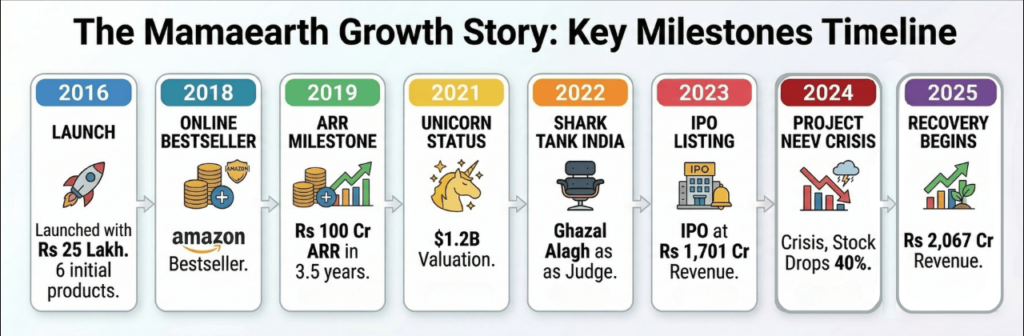
In 2016, Ghazal and Varun Alagh’s newborn son Agastya was diagnosed with eczema. His skin turned red and itchy when exposed to chemicals. The couple searched for safe, toxin-free baby care products in India, but found almost nothing. The products on shelves were loaded with chemicals and the safe alternatives were imported from the US — expensive and inconvenient. This frustration led to creation of a brand. They invested Rs 25 lakh and launched Mamaearth in December 2016 with six products. Nine years later, the Mamaearth growth story includes Rs 2,067 crore in FY25 revenue, an IPO on the Bombay Stock Exchange, India’s third-largest skincare brand status, a house of six brands, and 2.36 lakh retail outlets.
But it also includes a bruising 2024 — a stock crash, a distribution crisis, a loss quarter, and hard lessons about what breaks when a D2C brand grows too fast offline. This is the full Mamaearth growth story. The highs, the lows, and the playbook in between.
Also Read: Lessons from Failed D2C Startups that you can learn from and grow your own D2C startup
The Mamaearth Growth Story Begins: A Personal Problem Becomes a National Brand
Varun Alagh had spent 12 years in FMCG — at Hindustan Unilever, Diageo, and Coca-Cola. He knew how consumer brands worked. Ghazal was a corporate trainer turned artist. Together, they brought a rare combination: deep industry knowledge and creative instinct.
When they could not find safe baby products for Agastya, they did not just complain. They researched. They discovered that certain toxins banned in the US and Europe were still widely used in Indian baby care products. Nobody was talking about it. Nobody was solving it.
They launched Mamaearth as Asia’s first MadeSafe-certified brand. Every product was free from over 8,000 known toxins. The ingredients were listed transparently on every pack. The positioning was simple and powerful: safe, natural, toxin-free. The first products went live on Amazon. Within three months, they were bestsellers. The Mamaearth growth story had begun — not with a marketing budget, but with a parent’s promise.
Ghazal Alagh once wrote: “I still personally try every single product before it opens up for sale. When we started Mamaearth, it was for our child and all the babies of India. We would never launch something we won’t use on our baby. That paranoia has stayed with us as our core value.”
The Moment That Changed Everything: When Mamas Asked for Products for Themselves
Here is a story from the early days that shaped the entire Mamaearth growth story. By 2018, Mamaearth had a loyal base of mothers buying baby care products. The founders were talking to 30 to 40 customers every month through one-on-one calls. These were not surveys. They were real conversations. And one theme kept coming up. Mothers would say: “Your baby products are amazing. Why don’t you make something for us?”
Ghazal and Varun had not planned to expand beyond baby care. The brand was called Mamaearth. It was built for babies, but the customer was asking for more, and the founders listened. They launched their first adult skincare products — face washes, shampoos, and serums. The same toxin-free promise. The same ingredient transparency. But now for the mother, not just the child. The response was explosive. Adult skincare quickly overtook baby care as the primary revenue driver. Mamaearth went from a niche baby brand to a full personal care powerhouse. By FY21, the company had 140+ SKUs across baby care, skincare, and haircare.
Then came the next customer signal. Men started asking: “Why don’t you make toxin-free products for us?” So they did and that worked too. This pattern — listening to customers, then expanding based on what they actually want — is the engine behind the Mamaearth growth story. The founders did not sit in a boardroom and decide to expand. They listened. The customers told them where to go.
The Mamaearth playbook: launch with one hero category. Build trust. Listen to customers. Let them tell you where to expand next. The brand’s entire product roadmap was customer-led, not strategy-led.
Also Read: Key Characteristics of Successful D2C Brands in India for the full traits framework
The D2C Growth Engine: How the Mamaearth Growth Story Scaled So Fast
Digital-First, Content-Heavy Marketing
Mamaearth was born digital. It sold through its own website, Amazon, Flipkart, and Nykaa. It invested heavily in Instagram content, influencer partnerships, and educational marketing about ingredient safety. By FY21, over 65% of revenue came from online channels. The brand partnered with 500+ bloggers and micro-influencers. It did not just promote products, but also educated parents about toxins, ingredients, and safety standards. This content-first approach built trust in a way that traditional advertising could not.
Founder Visibility: Shark Tank India
In 2022, Ghazal Alagh appeared as a judge on Shark Tank India Season 1. The show was a massive hit and Ghazal’s personal story — a mother who built a brand to protect her baby — resonated deeply with millions of viewers. Mamaearth’s brand awareness surged and the founder became the brand’s most powerful ambassador, just as Aman Gupta did for boAt.
Celebrity Investment: Shilpa Shetty
Bollywood actress Shilpa Shetty Kundra joined as both brand ambassador and investor. Her endorsement gave Mamaearth mainstream credibility and accelerated growth.
Speed of Product Innovation
Mamaearth launched over 120 products in a single year (2023). From onion hair oil to vitamin C face wash to ubtan face masks, the brand moved fast. It used small production batches (4,000–5,000 units) to test new products. If a product worked, it scaled. If not, it was pulled. Minimal waste, maximum learning.

Revenue and Financials: The Mamaearth Growth Story in Numbers
| Year | Revenue (Rs Cr) | YoY Growth | Net Profit/Loss | Key Event |
| FY18 | 17 | — | Loss | Early traction. Amazon bestseller. |
| FY19 | 112 | 559% | Loss | Rs 100 Cr in 3.5 years. |
| FY20 | 461 | 312% | Loss | COVID boost. D2C demand spikes. |
| FY21 | 700+ | 52% | Rs 14 Cr profit | Unicorn status. 140+ SKUs. |
| FY22 | 1,310 | 87% | Rs 14 Cr profit | Shark Tank. Multi-brand push. |
| FY23 | 1,701 | 30% | Rs 151 Cr loss | IPO preparation. Heavy spend. |
| FY24 | 1,920 | 13% | Rs 110 Cr profit | IPO listed. First full public year. |
| FY25 | 2,067 | 8% | Rs 73 Cr profit | Project Neev crisis. Profit drops 34%. |
The Mamaearth growth story in numbers is striking. Revenue grew from Rs 17 crore in FY18 to Rs 2,067 crore in FY25 — a compound annual growth rate of over 46% across seven years. The company reached Rs 100 crore in annual revenue in just 3.5 years. It reached unicorn status (over $1 billion valuation) in 2021.
But the growth was not without pain. FY23 saw a Rs 151 crore loss as the company spent aggressively ahead of its IPO. FY24 brought profits back (Rs 110 crore). Then FY25 saw profits drop 34% to Rs 73 crore as Project Neev disrupted distribution.
Project Neev: The Distribution Crisis That Nearly Derailed the Mamaearth Growth Story
This is the part of the Mamaearth growth story that every D2C founder needs to study carefully. It is a cautionary tale about what happens when a digital-first brand tries to rebuild its offline distribution too fast. In mid-2024, Honasa launched Project Neev — a major overhaul of its offline distribution. The plan was bold: remove super-stockists (the middlemen between the company and retailers) and replace them with direct distributors in India’s top 50 cities.
The logic was sound. Direct distribution would give Mamaearth better control over inventory, real-time sales data, and stronger relationships with retailers. It would eliminate a costly middle layer and improve margins over time, but the execution was brutal. The company estimated a one-time hit of around Rs 50 crore from inventory correction, the actual impact was far worse. Distributors and super-stockists were left with unsold stock. Reports suggested inventory worth hundreds of crores was stuck in warehouses. Some products were nearing expiry and the Distributor trust collapsed.
The Q2 FY25 results told the story with revenue falling 7% year-on-year. The company posted a loss of Rs 18.6 crore after a Rs 40 crore profit in Q1 and EBITDA margin turned negative. The stock crashed 40% in a matter of weeks which led to Honasa briefly losing its unicorn status. Varun Alagh was candid on the analyst call: “We did not anticipate the high impact on margins from the renewed offline distribution strategy.” He admitted the brand had “gone too wide” with too many SKUs and needed to “narrow focus and go deep with hero products.”
How Mamaearth Recovered
The recovery was methodical. By Q4 FY25, direct distributors accounted for 71% of offline sales (up from 38% in FY24). Retail distribution expanded 26% to 2.36 lakh outlets. Over 1 lakh unique outlets were billed in FY25. Revenue grew 13% in Q4 FY25 and 16.5% in Q2 FY26 and the profits returned. The lesson from Project Neev is clear: offline distribution requires patience, not speed. A D2C brand cannot rebuild its entire supply chain in two quarters without breaking things. The idea was right, just the timeline was wrong.
Project Neev is the most important chapter in the Mamaearth growth story for D2C founders to study. It proves that offline expansion is essential but dangerous. The brand that moves to offline too fast, without building retail demand first, risks destroying distributor trust and sitting on dead stock. Build pull before you push.
Also Read: D2C vs Marketplace vs Omnichannel: Which Model Wins in India? for the channel strategy framework
House of Brands: How Mamaearth Became Honasa Consumer
The Mamaearth growth story is not just about one brand. Honasa Consumer now operates six brands:
- Mamaearth — the flagship. Toxin-free, natural personal care. India’s third-largest skincare brand.
- The Derma Co. — active-ingredient, science-led skincare for millennials. Reached Rs 100 crore ARR in offline retail.
- Aqualogica — hydration-focused skincare. 30%+ growth in FY25.
- BBlunt — salon-quality haircare acquired in 2022.
- Dr. Sheth’s — dermatologist-formulated skincare.
The multi-brand strategy lets Honasa target different consumer segments without diluting Mamaearth’s identity. The Derma Co. captures the growing demand for active ingredients (vitamin C, salicylic acid) that Mamaearth’s natural positioning cannot address. Aqualogica targets Gen Z. BBlunt captures the haircare segment.
In FY25, the emerging brands (The Derma Co., Aqualogica, BBlunt, Dr. Sheth’s) grew over 30% year-on-year, offsetting Mamaearth’s slowdown. Focus categories (sunscreens, face washes, serums) now contribute over 75% of total revenue.
Marketing Strategy: What Made the Mamaearth Growth Story Go Viral
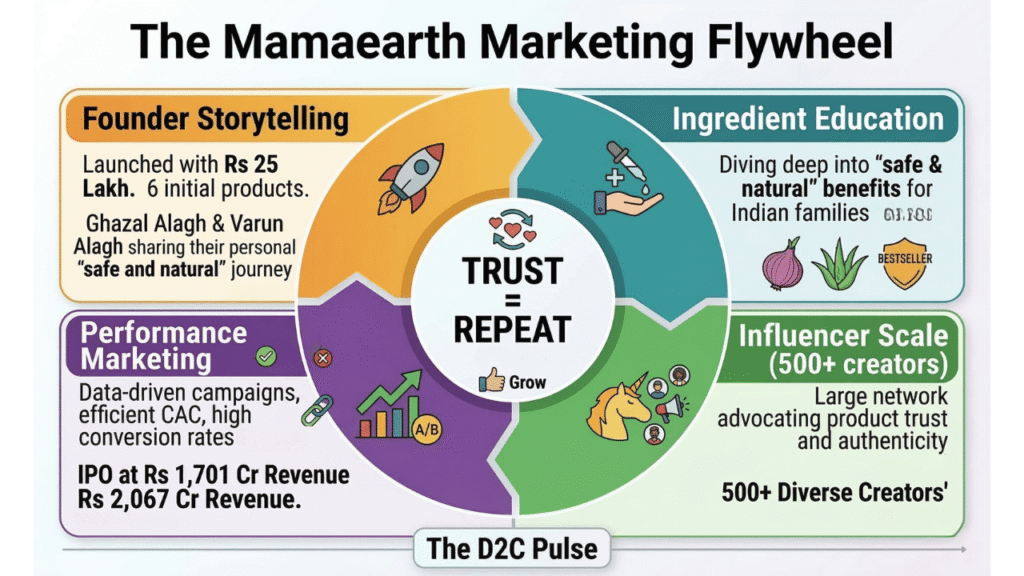
Mamaearth’s marketing strategy has four pillars that powered the growth story:
- Founder storytelling. Ghazal and Varun’s personal story — a mother who could not find safe products for her baby — is the most powerful marketing asset. It is authentic. It is emotional. And it costs nothing to tell.
- Ingredient education. Mamaearth does not just sell face wash. It explains why parabens are bad, what vitamin C does for skin, and how to read an ingredient label. This content builds trust and positions the brand as an authority, not just a seller.
- Influencer scale. Over 500 bloggers, micro-influencers, and creators partner with Mamaearth. 43% of Indian shoppers are influenced by content from creators. Mamaearth understood this early and built one of the largest creator networks in Indian D2C.
- Heavy ad investment. Honasa spent Rs 183 crore on advertising in Q2 FY25 alone — nearly 40% of that quarter’s revenue. This is significantly higher than the industry norm of 20%. Critics argue this shows weak organic demand. Defenders argue it is how you build a mass-market brand. The truth is probably both.
Also Read: Customer Acquisition Strategies for D2C Brands in India for the full playbook
Eight Lessons from the Mamaearth Growth Story for D2C Founders
- Start with a personal problem. The most powerful D2C brands begin when the founder is also the customer. Ghazal and Varun’s story is their brand’s strongest asset.
- Listen to your customers obsessively. Mamaearth’s expansion from baby care to adult skincare was customer-led. Monthly 1-on-1 calls with 30–40 customers shaped the product roadmap.
- Test small, scale fast. Production batches of 4,000–5,000 units let Mamaearth test products with minimal risk. Successful products scaled. Failures were pulled. This is the Mamaearth growth story in a formula.
- Build a house of brands, not a house of SKUs. When the flagship brand cannot serve a new segment (e.g. active-ingredient skincare), launch a new brand. The Derma Co. exists because Mamaearth’s natural positioning would have been diluted.
- Founder visibility is the cheapest marketing. Ghazal’s Shark Tank India appearance was worth crores in brand value. The founder’s story, told authentically, is the highest-ROI marketing a D2C brand can invest in.
- Do not overhaul distribution in one quarter. Project Neev was strategically correct. But executing it in two quarters caused a stock crash, distributor backlash, and a loss quarter. Offline transitions need 12–18 months, not 6.
- Watch your marketing spend ratio. Spending 40% of revenue on ads is a warning sign. It means organic pull is weak and the brand depends on paid traffic. The best D2C brands shift from rented attention to owned attention over time.
- Category focus beats breadth. Varun Alagh admitted that Mamaearth “went too wide.” The recovery came from narrowing focus to hero SKUs in key categories. Depth beats width.
Challenges Ahead: What the Mamaearth Growth Story Must Still Resolve
- Brand perception shift. Consumers are moving towards active-ingredient products (vitamin C, hyaluronic acid, salicylic acid). Mamaearth’s “natural and toxin-free” positioning needs to evolve or risk losing relevance to science-led competitors.
- High marketing dependency. Advertising spend remains around 40% of revenue in peak quarters. Reducing this without losing growth is the biggest financial challenge.
- Offline execution. Project Neev is 70% complete. The last 30% will test whether Mamaearth can build a durable offline distribution engine that rivals legacy FMCG companies.
- Quick commerce disruption. Platforms like Blinkit and Zepto are changing how urban consumers buy personal care. Mamaearth must adapt its channel strategy for 10-minute delivery.
- Stock market pressure. The stock is down over 40% from its 52-week high. Institutional investors demand consistent growth. FY26 needs to show double-digit revenue growth with stable margins.
Key Takeaways from the Mamaearth Growth Story
- The Mamaearth growth story is still being written. From Rs 25 lakh to Rs 2,000+ crore in nine years. A public company. Six brands. 2.36 lakh retail outlets. Challenges remain, but the arc is remarkable.
- A personal problem can become a national brand. Baby Agastya’s eczema led to a Rs 2,067 crore company. Authenticity is the strongest brand foundation.
- Customer-led expansion is the safest growth path. Mamaearth moved from baby care to skincare to haircare because customers asked for it.
- Digital-first D2C works in India. Mamaearth built the largest digital-first BPC brand in India through content, influencers, and marketplace dominance.
- Offline is essential but treacherous. Project Neev proves that distribution overhauls can break trust and destroy value if rushed. Go slow.