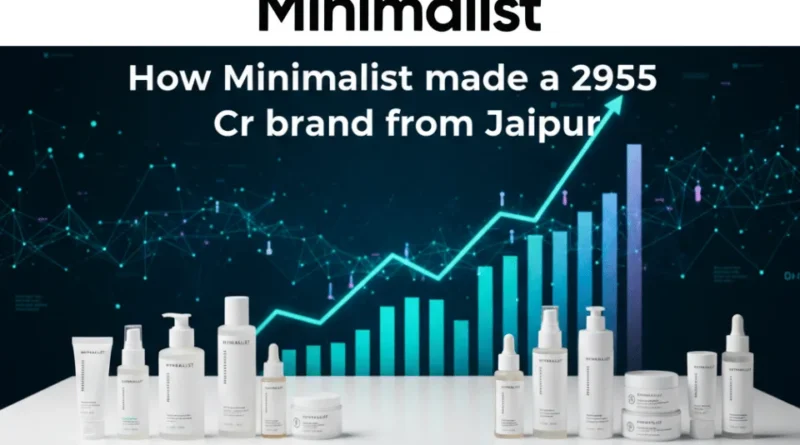
Minimalist Brand Strategy: How Two Brothers from Jaipur Built a Rs 2,955 Crore Skincare Brand in Four Years
The Complete Story. Ingredient Transparency, Science-First Positioning, Profitable Growth from Month One, and the Rs 2,955 Crore HUL Acquisition.
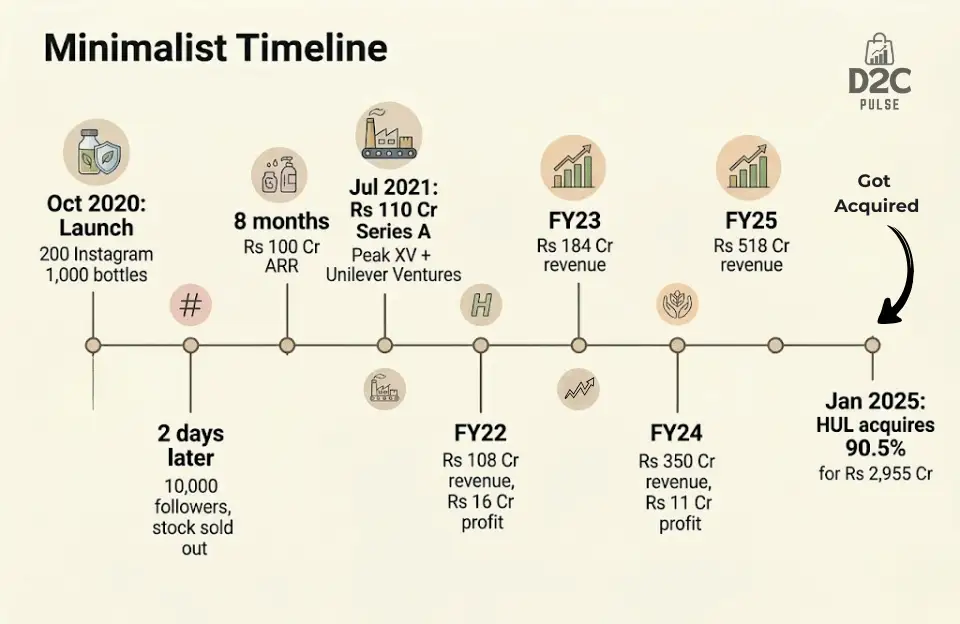
In October 2020, Mohit and Rahul Yadav posted a skincare product on an Instagram account with 200 followers. He did this with no ads, no influencers, not even a launch event, but just a post. Within two days, they had 10,000 followers. Their initial stock of 1,000 bottles sold out. Within eight months, they hit Rs 100 crore in annual revenue. Within four years, they crossed Rs 500 crore ARR. In January 2025, Hindustan Unilever acquired 90.5% of the company for Rs 2,955 crore. The brand was Minimalist.
The Minimalist brand strategy broke nearly every rule in Indian skincare. No celebrity endorsements and no “chemical-free” claims and specially without any Bollywood face on the bottle. Instead: ingredient percentages printed on the front along with clinical data backing every product. They used education as marketing and even became profitable from the first month.
This is the full Minimalist brand strategy case study. How two brothers from Jaipur built one of India’s most valuable D2C skincare brands, what made their approach work, and what founders and marketers can take away from it.
The Founders: Twelve Years of Startup Experience Before Minimalist
The Minimalist brand strategy did not come out of thin air. Mohit and Rahul Yadav had been building startups together for over a decade before they launched a single serum. Mohit, a CA, worked at Credit Suisse in investment banking. When the bank offered him a role in London or Hong Kong, he turned it down. He did not want to be away from family. Rahul, a chemical engineer from IIT Roorkee, joined him in Jaipur.
In 2008, they co-founded Scopial Fashion, an online T-shirt store that was later rebranded as Mangostreet, a kids’ fashion platform that crowdsourced designs. They sold Mangostreet to Hushbabies in 2012. Next, they joined CarDekho in Jaipur, where Mohit led business operations and Rahul led product. They spent several years learning how to build at scale.
Then they launched Freewill, a personalised hair care brand. Freewill gave them their first deep exposure to the beauty and personal care (BPC) space. It taught them about formulations, active ingredients, and what consumers actually care about in skincare. Freewill struggled to scale, but the learning was invaluable.
By the time they started Minimalist in October 2020, they had 12 years of startup experience across four ventures, a deep understanding of BPC, Rahul’s chemical engineering background, and a network of global researchers and formulators.
Most people see Minimalist as an “overnight success” that went from zero to Rs 100 crore in eight months. The reality is that the founders spent 12 years failing, learning, and compounding experience before they launched the brand that worked. The Minimalist brand strategy is the result of a decade of preparation meeting a market that was ready.
The Core Insight Behind the Minimalist Brand Strategy
Here is what Mohit and Rahul saw in 2020: Indian skincare was full of vague claims and zero transparency. If you walked into any store and picked up a face cream, the label said “natural” or “herbal” or “chemical-free”. But nobody told you which ingredients were inside, at what concentration, or what clinical evidence supported them. Consumers were buying on trust, celebrity endorsement, or packaging, not on information.
Meanwhile, a global shift was happening. The Ordinary, a Canadian brand, had popularised ingredient-first skincare. Products named “Niacinamide 10% + Zinc 1%” with clinical-style packaging. Consumers loved it. But The Ordinary was expensive in India due to import duties. And it was not formulated for Indian skin or humidity levels.
The Minimalist brand strategy was built on one idea: give Indian consumers The Ordinary’s transparency, formulated for Indian conditions, at Indian prices, with Indian availability. Do not hide anything and print the ingredient name and concentration on the front of the bottle while backing it with data. Educate, do not advertise.
The founders called their philosophy #HideNothing. It was not a tagline but the operating system of the entire brand.
The Numbers: Minimalist’s Revenue Growth, Year by Year
| Year | Revenue (Rs Cr) | Net Profit (Rs Cr) | Key Milestone |
| FY21 | ~21 | Profitable | Rs 100 Cr ARR in 8 months. 40+ products launched. |
| FY22 | 108 | 16 | Series A: Rs 110 Cr from Peak XV + Unilever Ventures. |
| FY23 | 184 | 5 | Profit dipped due to hiring (80 to 650 employees). Ad spend Rs 65 Cr. |
| FY24 | 350 | 11 | 89% YoY growth. Profit doubled. Ad spend Rs 117 Cr (~35% of revenue). |
| FY25 | 518 | Loss (Rs 31 Cr)* | Rs 500 Cr+ ARR. Exceptional items related to acquisition. |
*FY25 loss attributed to exceptional items tied to the HUL acquisition process. Operating profitability remained intact across the first four years.
Look at the trajectory. Rs 21 crore to Rs 518 crore in five years. Profitable from month one. That is rare in Indian D2C. Most brands burn through funding to hit these numbers. Minimalist did it while making money.
Compare that to peers: WOW Skin Science hit Rs 340 crore in FY22 but posted losses, with 40% of revenue going to advertising. Mamaearth reached Rs 943 crore in FY22 but ran at a 0% net margin with 42% ad spend. Minimalist kept its ad spend around 30–35% and still turned a profit in FY22, FY23, and FY24.

The Five Pillars of the Minimalist Brand Strategy
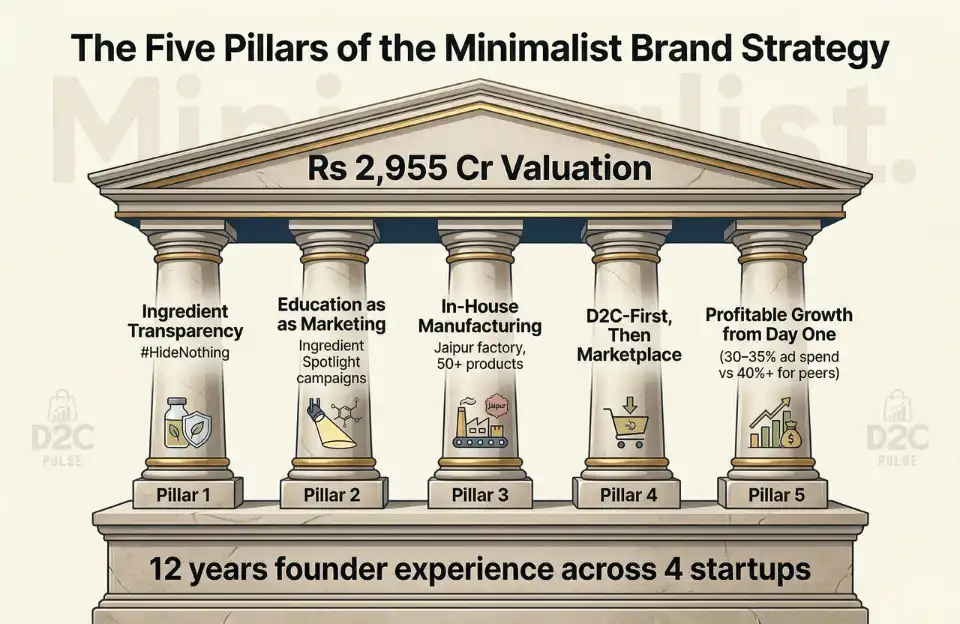
Pillar 1: Ingredient Transparency as the Entire Brand Identity
This is the core of the Minimalist brand strategy. Every product puts the active ingredient and its concentration on the front label. Niacinamide 10%, Salicylic Acid 2%, Vitamin C 10% and Hyaluronic Acid 2%.
This was a direct challenge to every other Indian skincare brand. When your competitor’s label says “skin brightening cream,” and your label says “Vitamin C 10% Face Serum,” you are speaking a different language. You are treating the consumer as an informed adult, not a passive buyer.
The founders published consumer studies on their website showing clinical results. They explained what each ingredient does, at what concentration it is effective, and what skin type it suits. Their Instagram feed looked more like a chemistry class than a beauty brand.
This attracted a specific consumer: the “skintellectual.” Urban, 22–35, informed, and tired of being sold vague promises. This consumer reads ingredient lists. This consumer cross-references products on Reddit. And this consumer tells 10 friends when they find a brand they trust.
Also Read: How can a D2C Brand use Influencer Marketing to grow and make it big in India
Pillar 2: Education as Marketing
Minimalist spent its marketing budget differently from most D2C brands. Instead of celebrity endorsements or generic Instagram ads, they invested in education content.
Their social media explained why parabens are controversial, what Niacinamide does for acne scars, how to layer serums correctly, and why SPF 50 matters. They ran “Ingredient Spotlight” campaigns that teased a new active ingredient for two weeks before revealing the product. The tease was educational, not promotional. By launch day, their audience already understood why they should care.
This approach created something that paid ads cannot buy: organic word of mouth. Customers who learned from Minimalist became evangelists. The 60% product retention rate (customers repurchasing every quarter) was driven not by discounts, but by trust and education.
Mohit said in a podcast: “One of the reasons we grew so fast is because our initial customers spread the word about us. Word of mouth continues to get us new customers even today.” In a market where most D2C brands pay Rs 300–500 per customer acquisition, Minimalist’s education-driven word of mouth gave them a structural CAC advantage.
Pillar 3: In-House Manufacturing for Quality Control
Most Indian D2C skincare brands contract-manufacture their products. Minimalist built its own manufacturing unit in Jaipur.
This was a deliberate choice. In-house manufacturing meant full control over formulations, ingredient sourcing, batch quality, and production speed. When a product needed tweaking based on customer feedback, they could change the formulation in days, not months. When demand spiked (10,000 orders per day at peak), they could scale production without depending on a third-party factory’s schedule.
Rahul’s chemical engineering background from IIT Roorkee, combined with a dedicated R&D team of 10–12 people, gave Minimalist a product development speed that contract-manufactured brands could not match. They launched over 50 products across skincare, haircare, body care, and baby care within four years.
Pillar 4: D2C-First, Then Marketplace for Volume
The Minimalist brand strategy started with their own website. The D2C site gave them customer data, full margin, and the ability to educate consumers before they bought. Product pages were dense with ingredient information, usage guides, and clinical data. This was not a typical ecommerce product page. It was a research document that happened to have an “Add to Cart” button.
Once brand pull was strong, they expanded to Amazon, Nykaa, and Flipkart for volume. The marketplace presence brought scale, but the D2C site remained the heart of the brand. It was where the story was told, where trust was built, and where the highest-margin transactions happened.
By FY24, the brand was available across all major platforms. But the positioning, the education, the ingredient-first messaging all originated from the D2C site and flowed outward.
Also Read: D2C vs Marketplace vs Omnichannel: Which Model Wins in India? for the channel strategy framework
Pillar 5: Profitable Growth, Not Growth-at-All-Costs
This is what separates the Minimalist brand strategy from most Indian D2C stories. They were profitable from the first month. Not break-even – Profitable.
How? They kept COGS low through in-house manufacturing and curbed ad spend to 30–35% of revenue (compared to 40–42% for peers). There was a focus on not chasing vanity metrics or burn money on unprofitable customer acquisition. They grew organically through word of mouth and educational content.
The founders chose not to do flash sales or deep discounting. That discipline preserved margins and brand perception. A brand that discounts 30% every month is not a premium brand. It is a brand with a pricing problem. Minimalist avoided that trap.
When they raised their Series A (Rs 110 crore from Peak XV Partners and Unilever Ventures in July 2021), they were already profitable. They did not raise money to survive. They raised money to accelerate.
The Ordinary Comparison: Copycat or Local Innovator?
It needs to be addressed. Minimalist’s clinical packaging and ingredient-forward naming looked a lot like The Ordinary. The comparison followed the brand from day one. Critics called it a copy. Social media debated it.
Mohit acknowledged the influence directly. He said The Ordinary shaped their initial packaging and approach, but stood by the purpose: offering high-quality, science-based skincare at affordable prices specifically for Indian customers. Formulations were designed around Indian skin types, humidity levels, and price sensitivity.
The practical reality gave Minimalist a structural edge. The Ordinary’s products become expensive in India because of import duties. Local manufacturing let Minimalist offer comparable quality at lower prices with faster restocking and distribution. By being honest about the inspiration and differentiating on formulation, price, and availability, Minimalist moved the narrative from “copycat” to “local innovator filling a gap.”
The HUL Acquisition: Rs 2,955 Crore and What It Means
In January 2025, Hindustan Unilever announced the acquisition of 90.5% of Minimalist for Rs 2,955 crore (approximately $340 million). HUL will acquire the remaining 9.5% within two years. HUL also made a Rs 45 crore primary investment in Uprising Science, Minimalist’s parent company.
Why did HUL buy Minimalist? Three reasons.
- The premium beauty gap. HUL’s beauty and wellbeing division contributes 21% of its revenue. India’s skincare market is Rs 68,000 crore, with half sitting in the affluent segment. HUL needed a premium skincare brand that spoke to young, digital-first consumers. Minimalist was exactly that.
- The D2C audience HUL could not reach. Minimalist had built a loyal base of skintellectuals who specifically avoided mass-market FMCG brands. HUL could not build that audience organically. It was faster and cheaper to acquire it.
- Offline distribution as the growth lever. Minimalist had strong digital presence but limited offline retail. HUL has the deepest distribution network in India. The combination gives Minimalist access to premium retail stores across the country.
HUL’s CFO Ritesh Tiwari framed it clearly: Minimalist sits in the affluent skincare segment, and HUL wants to be the number one beauty portfolio in India. Minimalist gives them another tool to get there.
Mohit and Rahul will continue running the brand for two years post-acquisition, ensuring continuity. The deal also opens a path for Minimalist to expand internationally, using HUL’s global infrastructure.
The Offline Question: Why Minimalist Moved Slowly
Unlike Mamaearth, which rushed into offline distribution with Project Neev and faced distributor backlash and stock pile-up, Minimalist took a deliberately cautious approach to offline retail.
Mohit raised a specific concern in interviews about the limitations of physical retail for a transparency-first brand. Online, a customer can read detailed ingredient information, usage guides, and clinical studies on the product page. In a physical store, all they have is the front and back label. The sales staff may not be trained well enough to explain why Niacinamide 10% is different from a generic moisturiser. If the store recommends products based on incentives rather than fit, the brand’s core promise of transparency breaks.
This was a mature strategic call. Rather than chasing offline revenue, Minimalist spent time thinking about how to translate their transparency-first experience into a retail format without losing what makes the brand work. The HUL acquisition solves this problem. HUL knows how to do offline retail at scale. Minimalist knows how to do brand transparency. Together, they can build the offline experience the right way.
Also Read: Mamaearth Growth Story for the Project Neev cautionary tale on offline expansion
What Founders and Marketers Can Learn from the Minimalist Brand Strategy
The Minimalist brand strategy is not a playbook you can copy and paste. You cannot just print ingredient percentages on a bottle and expect Rs 500 crore in revenue. What you can take from it is a set of principles that apply across categories.
- Transparency is a competitive weapon, not a risk. Most brands are afraid to show what is inside their product. Minimalist showed everything and built trust that no amount of advertising can buy. If your product is genuinely good, telling the truth about it is the cheapest and most powerful marketing strategy available.
- Education creates customers that discounts cannot. The Minimalist brand strategy invested in teaching consumers about ingredients, routines, and skin science. Those educated consumers became organic advocates with a 60% repeat rate. Discounts attract bargain hunters but education attracts loyal customers who stay because they understand the value.
- Profitability from day one changes everything. When you are profitable early, you raise money from a position of strength. Minimalist raised Rs 110 crore after they were already profitable, not before. That discipline gave them negotiating leverage and ultimately led to a Rs 2,955 crore exit, not a distressed fire sale.
- Founder experience compounds. Twelve years and four startups before Minimalist. Each failure taught the Yadav brothers something that made the next venture better. If your first D2C brand does not work, the experience is not wasted. It is investment in the brand that will.
- Build for acquisition optionality even if you are not planning to sell. Minimalist built a brand that HUL could not replicate. That irreplaceability is what drove the Rs 2,955 crore valuation. Build something that a large company would rather buy than compete with. That is the highest form of brand moat.
Key Takeaways
- The Minimalist brand strategy is built on ingredient transparency. Print what is inside. Show the concentration. Back it with clinical data. Treat consumers as informed adults.
- Education is marketing. Instead of celebrity endorsements, Minimalist taught consumers about active ingredients. This built trust, word of mouth, and a 60% repeat purchase rate.
- In-house manufacturing enabled speed and quality. Building a factory in Jaipur gave the founders full control over formulations, faster iteration, and independence from contract manufacturers.
- D2C first, marketplace second. The own website was the trust-building engine. Amazon and Nykaa came later for volume. The D2C site stayed the brand’s core.
- Profitable from month one. 30–35% ad spend vs 40%+ for peers. No deep discounting. No flash sales. This discipline preserved margins and brand perception.
- Revenue growth: Rs 21 Cr (FY21) to Rs 518 Cr (FY25). Five-year CAGR of roughly 90%. Profitable in each of the first four years. One of the fastest and healthiest growth trajectories in Indian D2C.
- HUL acquired 90.5% for Rs 2,955 crore. India’s largest D2C skincare exit. The brand was too valuable and too differentiated for HUL to build in-house.
- 12 years of founder experience preceded the launch. Four startups, including Mangostreet, CarDekho, and Freewill, built the skills and industry knowledge that made Minimalist possible.
Frequently Asked Questions
What is the Minimalist brand strategy?
The Minimalist brand strategy is built on five pillars: ingredient transparency (#HideNothing), education-first marketing, in-house manufacturing for quality control, D2C-first distribution, and profitable growth from day one. The brand puts active ingredient names and concentrations on the front of every product, backs claims with clinical data, and educates consumers instead of relying on celebrity endorsements.
Who founded Minimalist?
Minimalist was founded in October 2020 by brothers Mohit Yadav (a CA, former Credit Suisse and CarDekho) and Rahul Yadav (a chemical engineer from IIT Roorkee). They are based in Jaipur and had 12 years of startup experience across four ventures before launching Minimalist.
How much was Minimalist acquired for?
Hindustan Unilever acquired 90.5% of Minimalist for Rs 2,955 crore (approximately $340 million) in January 2025. This is the largest D2C skincare acquisition in Indian startup history. HUL will acquire the remaining 9.5% within two years.
What made Minimalist different from other Indian skincare brands?
Minimalist was the first major Indian skincare brand to adopt an ingredient-first approach, printing active ingredient names and percentages on every product. While other brands used vague claims like “natural” or “herbal,” Minimalist told consumers exactly what was in the bottle and at what concentration. This built trust with a specific audience of informed, ingredient-conscious consumers.
Was Minimalist profitable?
Yes. Minimalist was profitable from its first month of operations. It maintained profitability through FY22 (Rs 16 Cr profit), FY23 (Rs 5 Cr profit), and FY24 (Rs 11 Cr profit). FY25 showed a loss of Rs 31 Cr due to exceptional items related to the HUL acquisition. Operating profitability was a core principle of the Minimalist brand strategy from inception.