boAt Case Study: How a Rs 30 Lakh Startup Became India’s No. 1 Audio Brand
The Full Business Breakdown — From D2C Launch to Rs 3,100 Crore Revenue, IPO Filing, and the Playbook Every Indian Founder Can Learn From
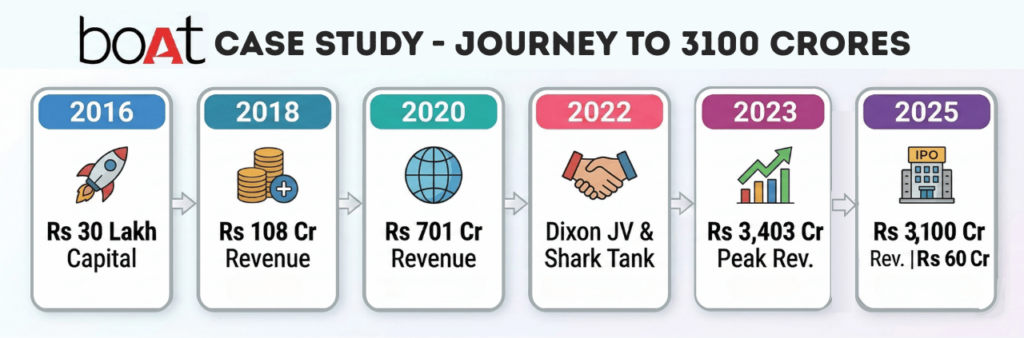
This boAt case study tells the story of two founders, Rs 30 lakh in savings, and a simple frustration: why did Apple charging cables keep breaking? That question led Aman Gupta and Sameer Mehta to launch boAt in 2016. Ten years later, boAt is India’s number one audio brand. It has served over 5 crore customers and has posted Rs 3,100 crore in revenue in FY25 with a Rs 60 crore net profit. It also holds a 34% volume share in India’s branded personal audio market. And it has filed for an IPO worth Rs 2,000 crore.
This is not just a boAt success story. It is a D2C playbook. boAt cracked every problem that Indian D2C brands face: low brand trust, high customer acquisition costs, thin margins, marketplace dependency, and the leap from online to offline. It solved them one by one. And it did it faster than almost any Indian consumer brand in history.
In this boAt case study, we break down exactly how. The business model, the marketing strategy, the revenue journey, the unit economics and also the omnichannel expansion along with the challenges faced while growing their brand. We’re also going to discuss the lessons that every D2C founder in India can apply to their own brand.
The boAt Case Study Begins: Spotting a Gap Nobody Else Saw
In 2014, Aman Gupta was working with JBL. He saw something that bothered him. The Indian audio market was split in two. On one side, global brands like JBL, Sony, and Bose sold premium products. They were expensive and most young Indians could not afford them. On the other side, cheap local brands sold flimsy products that broke in weeks. There was no middle ground and no brand offered stylish, durable audio gear at an affordable price.
Gupta and his co-founder Sameer Mehta started with charging cables — Apple-compatible cables that were tough and affordable. They invested Rs 30 lakh from their own savings. The cables sold well, but the real opportunity was in audio. In 2016, boAt officially launched its first earphones and headphones. The positioning was clear from day one: affordable audio that looks good and sounds good. Not premium, not cheap, but just the sweet spot in between.
This category edge — filling a gap between expensive global brands and unreliable local ones — is what the boAt case study teaches first. The best D2C brands do not just make products. They spot a gap in the customer’s mind and own it.
boAt did not compete with Sony on sound quality. It did not compete with local brands on price. It created a new category: lifestyle audio. That is the category edge that made everything else possible.
Also Read: Key Characteristics of Successful D2C Brands in India for the full traits framework
The boAt Business Model: Asset-Light, Speed-First, Community-Driven
The boAt business model has three pillars that every D2C founder should study:
Pillar 1: Asset-Light Manufacturing
boAt does not own factories. It uses contract manufacturers in India and China. In 2022, it entered a 50:50 joint venture with Dixon Technologies to produce audio products domestically. By FY25, over 70% of boAt’s production volumes were manufactured in India. This move reduced import costs, improved margins, and aligned with the government’s PLI scheme.
The asset-light model lets boAt launch new products fast without heavy capital expenditure. In FY25, it launched over 100 new products. In Q1 FY26 alone, it launched 25 more. That speed is only possible when you do not own the factory.
Pillar 2: Speed of Product Launches
boAt launches products at a pace that traditional electronics companies cannot match. It offered over 250 products across price points as of mid-2025. This rapid SKU expansion lets boAt capture trends fast. When TWS (true wireless stereo) took off, boAt was among the first Indian brands to flood the category with affordable options. When smartwatches boomed, boAt entered immediately.
Speed is a strategic weapon. In this boAt case study, it is the single biggest operational advantage the brand has over slower global competitors.
Pillar 3: The boAtheads Community
boAt calls its customers “boAtheads.” This is not just a label. It is a community strategy. Over 2 crore engaged customers identify as boAtheads. The brand treats them as a tribe — not just buyers. This drives word-of-mouth, repeat purchases, and fierce brand loyalty in a category where switching costs are low.

Revenue Growth: What the boAt Case Study Reveals About Scaling
The numbers tell a remarkable story:
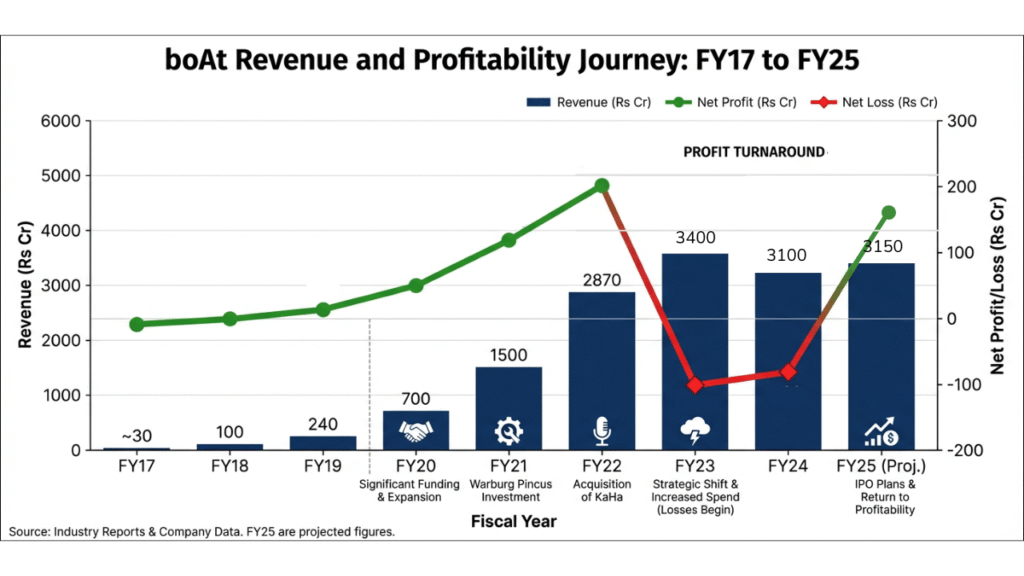
| Year | Revenue (Rs Cr) | YoY Growth | Key Milestone |
| FY17 | 27 | — | Launch year. Cables + earphones. |
| FY18 | 108 | 4x | Fireside Ventures funding. Rs 60 Cr. |
| FY19 | 239 | 121% | #1 earwear brand. 27.3% share. |
| FY20 | 701 | 193% | 5th largest wearable brand globally. |
| FY21 | 1,512 | 116% | Pandemic boom. TWS explosion. |
| FY22 | 2,873 | 90% | Warburg Pincus $100M investment. |
| FY23 | 3,403 | 18% | Peak revenue. Growth matures. |
| FY24 | 3,122 | –8% | First dip. Wearables decline 44%. |
| FY25 | 3,100 | –1% | Back to profit. Rs 60 Cr PAT. |
The boAt case study shows a classic D2C growth arc: explosive rise, peak, plateau, and recalibration. Revenue grew from Rs 27 crore in FY17 to Rs 3,403 crore in FY23 — a 38% compound annual growth rate over five years, but then growth slowed. Revenue dipped slightly in FY24 and FY25 as the wearables segment declined.
But the real story in FY25 is profitability. boAt posted a net profit of Rs 60.4 crore after two years of losses (Rs 129 crore loss in FY23, Rs 80 crore loss in FY24). EBITDA jumped to Rs 142 crore — a near 10x improvement from Rs 14 crore in FY24. And working capital days dropped from 71 to 36. The message is clear: boAt traded topline growth for bottom-line discipline. That is the trade-off every maturing D2C brand in India must make.
boAt Marketing Strategy: The Playbook Behind India’s Most Recognised Audio Brand
The boAt marketing strategy is a masterclass in building a D2C brand in India. It has four layers:
Layer 1: Celebrity and Influencer Partnerships
boAt was one of the first Indian D2C brands to treat influencer marketing as a core channel, and not an experiment. It partnered with cricketers like Hardik Pandya and Shikhar Dhawan while it also signed Bollywood actors like Kiara Advani and Kartik Aaryan. It sponsored IPL teams and music festivals to get celebrity-influencers involved.
But the real genius was micro-influencers. boAt worked with hundreds of smaller creators — college students, gym-goers, musicians, gamers — who felt authentic. These creators built trust at the grassroots level. The boAt case study proves that influencer marketing works best when it feels organic, not transactional.
Layer 2: Founder-Led Brand Building
Aman Gupta’s appearance as a judge on Shark Tank India in 2022 was a turning point. It made him one of the most recognised startup founders in India. Sales of boAt products reportedly surged during the show. The founder became the brand’s most powerful marketing asset — visible, accessible, and aspirational.
This is a pattern in the boAt case study and in successful D2C brands broadly: the founder’s personal brand amplifies the company’s brand at near-zero cost.
Layer 3: Digital-First, Performance-Driven
boAt spent Rs 390 crore on advertising and promotions in FY25 — about 12.7% of revenue. Its marketing is primarily digital: Instagram, YouTube, Google, and marketplace ads. Every campaign is measured. Every rupee is tracked against sales. This performance-first approach keeps customer acquisition costs disciplined even at massive scale.
Layer 4: Lifestyle Positioning, Not Tech Positioning
boAt never positioned itself as an electronics company. It positioned itself as a lifestyle brand. Products are designed to look fashionable, colours are bold, packaging is trendy. The brand shows up at fashion weeks and music festivals, not tech expos.
This positioning decision is crucial to the boAt case study. It allowed boAt to charge a premium over Chinese imports while still being affordable compared to Sony or JBL. It created an emotional connection that specs alone cannot build.
boAt did not just sell earphones. It sold a vibe. A generation of young Indians chose boAt not because of technical specifications but because the brand felt like it belonged to them. That emotional moat is harder to copy than any product feature.
Also Read: Customer Acquisition Strategies for D2C Brands in India for the full marketing playbook
From D2C to Omnichannel: What the boAt Case Study Teaches About Offline Expansion
boAt started as an online-only brand. It sold through Amazon, Flipkart, and its own website. This D2C-first approach let it build brand awareness fast with minimal capital. But boAt did not stay online. By FY25, it had expanded to over 12,000 offline retailers across 25 states and 5 union territories, supported by 112 distributors. It partnered with Croma, Vijay Sales, and Reliance Digital.
The split tells the story. In FY25, online channels contributed Rs 2,166 crore (70.6% of revenue). Offline contributed the remaining 29.4%. The offline channel is growing fast. Why did boAt go offline? Three reasons:
- Trust in tier-2 and tier-3 cities. Many consumers in smaller cities still prefer to see and touch a product before buying. Physical stores build trust that ads cannot.
- Reduced dependence on marketplaces. Amazon and Flipkart charge 15–30% commissions. Every offline sale diversifies revenue away from marketplace dependency.
- Lower blended CAC. Once a brand has strong offline presence, not every customer needs to be acquired through paid ads. Walk-in traffic is free.
The boAt case study confirms the pattern we see across India’s most successful D2C brands: start online, build the brand, then expand offline when brand pull is strong. This is the same playbook Mamaearth, Lenskart, and Sugar Cosmetics followed.
Also Read: D2C vs Marketplace vs Omnichannel: Which Model Wins in India? for the full comparison
Unit Economics and Profitability: How boAt Turned the Corner in FY25
For two years, boAt lost money. Rs 129 crore loss in FY23. Rs 80 crore loss in FY24. Rising competition, price wars in wearables, and heavy marketing spend ate into margins.
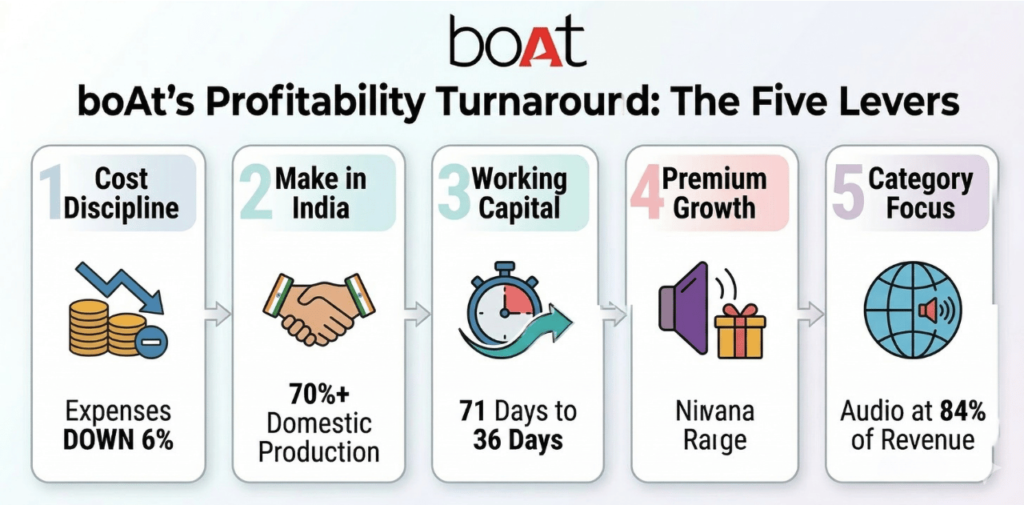
In FY25, boAt turned profitable. Here is how:
- Cost discipline. Total expenses fell 6% to Rs 3,040 crore. Stock-in-trade purchases dropped 9%. The company right-sized its workforce and cut capital expenditure from Rs 60 crore (FY23) to just Rs 6.4 crore (FY25).
- Make in India. Over 70% of production volumes are now manufactured domestically via the Dixon Technologies joint venture and 13+ Indian contract manufacturers. This reduced import dependency, lowered costs, and improved supply chain resilience.
- Working capital efficiency. Working capital days dropped from 71 in March 2024 to 36 in March 2025. That is a massive improvement in cash flow. Faster cash cycles mean less capital tied up in inventory and receivables.
- Premium segment growth. The Nirvana premium audio range grew with strong double-digit numbers. Higher average selling prices improved margins. boAt is moving upmarket even while holding its mass-market base.
- Wearables rationalisation. Wearables revenue fell 40% to Rs 330 crore in FY25. But audio — which carries better margins — now accounts for 84% of revenue. Concentrating on the higher-margin core category improved overall profitability.
The boAt case study on profitability is a lesson every D2C founder needs: sometimes shrinking strategically is smarter than growing recklessly. boAt shrank wearables, tightened costs, and focused on profitable audio. The result was a Rs 60 crore net profit and Rs 142 crore EBITDA.
Market Position: boAt vs JBL, Noise, and the Global Competition
Where does boAt stand today?
- India’s #1 branded personal audio brand for five consecutive years.
- 34% volume share and 26% value share in FY25 (per UDRHP filing).
- #4 globally by volume in branded personal audio.
- Over 5 crore customers served and 3.4 crore units sold in FY25 alone.
Its closest domestic competitor is Noise, which posted Rs 1,439 crore revenue in FY24 — about half of boAt’s scale. Global competitors like JBL and Sony operate at higher price points and do not match boAt’s volume in the affordable segment.
But the boAt case study also reveals challenges. The wearables segment is brutally competitive. Noise leads in smartwatches. OnePlus, Realme, and Xiaomi are pushing hard. And audio, while strong, is a Rs 6 billion market that boAt already dominates — further growth requires either taking market share from premium players or expanding internationally.
boAt has begun expanding into GCC markets (UAE, Saudi Arabia) and has subsidiaries in Singapore and Shenzhen. But international revenue remains marginal. The next chapter of the boAt case study will depend on whether the brand can replicate its Indian success abroad.
The boAt IPO: What It Means for Indian D2C Brands
boAt filed its draft red herring prospectus (DRHP) with SEBI in April 2025, using the confidential pre-filing route. The IPO aims to raise Rs 2,000 crore — Rs 500 crore in fresh issue and the rest through an offer for sale. Of the fresh issue, Rs 225 crore is earmarked for working capital. Rs 150 crore goes to brand and marketing expenses. The rest is for general corporate purposes.
Key shareholders as of the filing: Aman Gupta (37.1%), Sameer Mehta (37.1%), and Warburg Pincus (23.1%). The company’s last known valuation was approximately Rs 7,752 crore (around $955 million). If successful, boAt will become one of the first pure-play Indian D2C consumer electronics brands to go public. That makes this boAt case study significant beyond the brand itself. It signals to the market that D2C brands born online can reach IPO scale in India.
Eight Lessons from the boAt Case Study for Every Indian D2C Founder
- Spot a category gap, not just a product idea. boAt did not invent earphones. It invented “affordable lifestyle audio” as a category in India. Find the gap between what exists and what your customer actually wants.
- Stay asset-light as long as possible. boAt used contract manufacturers for years before co-investing with Dixon. Do not build factories. Build brands. Manufacture through partners.
- Speed beats perfection. boAt launched 100+ products in a single year. Not every product will be a hit. But the ones that work — and the data from the ones that do not — are worth more than a perfect product that takes 18 months to ship.
- Build a community, not just a customer base. boAtheads is not a marketing gimmick. It is a retention strategy. When customers identify with your brand, they come back without being re-acquired.
- Use the founder as the brand’s media channel. Aman Gupta’s visibility on Shark Tank India was worth crores in brand value. The founder’s personal brand is the cheapest, most effective marketing a D2C brand can have.
- Start online, go offline when brand pull exists. boAt built its brand through Amazon and Flipkart. It expanded to 12,000+ retail points only after millions of Indians already knew and wanted the brand. Going offline too early burns cash.
- Know when to prioritise profit over revenue. boAt’s FY25 revenue dipped. But profit returned. The company cut costs, reduced working capital days, and focused on higher-margin segments. Growth at all costs is a phase, not a strategy.
- Localise manufacturing to improve margins and resilience. The Dixon JV and 70%+ domestic production gave boAt cost advantages, PLI benefits, and protection from supply chain disruptions. For hardware D2C brands, Make in India is a margin lever, not just a slogan.
Challenges Ahead: What the boAt Case Study Does Not Solve Yet
No case study is complete without addressing the risks. boAt faces several challenges going forward:
- Revenue stagnation. Revenue has been flat at around Rs 3,100 crore for two consecutive years. Profitability came from cost-cutting, not topline growth. Sustained cost-cutting has limits.
- Wearables decline. Wearables revenue fell 40% in FY25 and 44% in FY24. Audio now accounts for 84% of revenue. That concentration is a risk if the audio market saturates.
- Intense competition. Noise, OnePlus, Realme, Xiaomi, and new entrants are all fighting for the same young Indian consumer. Price wars compress margins.
- Supply chain dependency. Around 90% of overseas purchases in Q1 FY26 came from China (including Hong Kong). Geopolitical risks or tariff changes could hit costs.
- IPO execution risk. boAt withdrew its first IPO attempt in 2022. The current P/E ratio of 312x is far above industry benchmarks (25–60x). The market will demand sustained growth to justify this valuation.
- Limited international revenue. Despite subsidiaries in Singapore and Shenzhen, international revenue is marginal. Expanding abroad is harder than defending a strong domestic position.
The boAt case study is not a fairy tale. It is a real business with real pressures. The next phase — post-IPO, post-profitability, post-India — will test whether boAt can evolve from a D2C success story into a durable global consumer brand.
Key Takeaways from the boAt Case Study
- Rs 3,100 crore in 9 years from Rs 30 lakh. The boAt case study is one of Indian D2C’s most remarkable scaling stories. And it is still being written.
- The category gap matters more than the product. boAt created “lifestyle audio” as a mental category. Find your gap.
- Asset-light manufacturing lets D2C brands move fast. Contract manufacturing + the Dixon JV gave boAt speed and scale without heavy capex.
- Influencer marketing at scale works. From cricketers to micro-creators, boAt made influencer-led growth a core strategy, not an experiment.
- The D2C-to-omnichannel playbook is proven. Online-first, 12,000+ offline retailers, and 70/30 revenue split. This is the pattern for serious Indian brands.
- Profitability requires hard trade-offs. boAt shrank wearables, cut costs, and reduced working capital. Revenue dipped. Profit returned. That discipline matters.