How Instagram, WhatsApp, and Video Are Rewriting the Rules of Selling Direct in India
A $29 Billion Market That Is Changing Where Discovery Happens, How Trust Is Built, and Where the Transaction Closes. The Full Playbook for D2C Brands.
Here is the number that should reframe how you think about selling direct in India. The Indian social commerce market hit ~$11 billion in 2025. It is growing at 48.5% CAGR. By 2030, it will reach ~$70 billion. That is not a side channel. That is a structural rewiring of how commerce works in India.
Social commerce is not the same as social media marketing. Social media marketing means running ads on Instagram to drive traffic to your website. While Social commerce means the customer discovers, evaluates, and sometimes buys the product without ever leaving the platform. The entire purchase journey, from scroll to payment, happens inside Instagram, WhatsApp, YouTube, or a creator’s page.
For D2C brands, this creates both an enormous opportunity and a strategic tension. Social commerce can lower your CAC, shorten the purchase cycle, and reach consumers in tier-2 and tier-3 cities where your website has no brand awareness. But it can also strip you of customer data, margin, and control.
This guide breaks down the impact of social commerce on D2C in India. The five channels that matter. What D2C brands gain and lose from each. How to use social commerce to acquire customers without becoming dependent on platforms you do not own. And how the smartest brands are bridging social discovery with owned-channel conversion.
What Social Commerce Actually Means for D2C Brands (It Is Not Just Running Ads)
Social media marketing and social commerce are different things. The distinction matters.
Social media marketing: You run an ad on Instagram. The customer clicks through to your Shopify store. They browse your product page. They check out on your website. You own the data. You own the transaction. Instagram was the traffic source. Your website was the store.
Social commerce: The customer sees a product on Instagram. They tap “Shop Now”, view product details, pay inside Instagram (or through a linked checkout) but never visit your website. The platform mediated the entire transaction.
The impact of social commerce on D2C is this: the platform is becoming the store. Not just the billboard. When Instagram, WhatsApp, and YouTube add native shopping features, they are not helping D2C brands drive traffic. They are replacing the need for traffic altogether. The customer stays on the platform. The brand becomes a supplier to the platform’s ecosystem.
This is powerful for reach. And dangerous for independence.
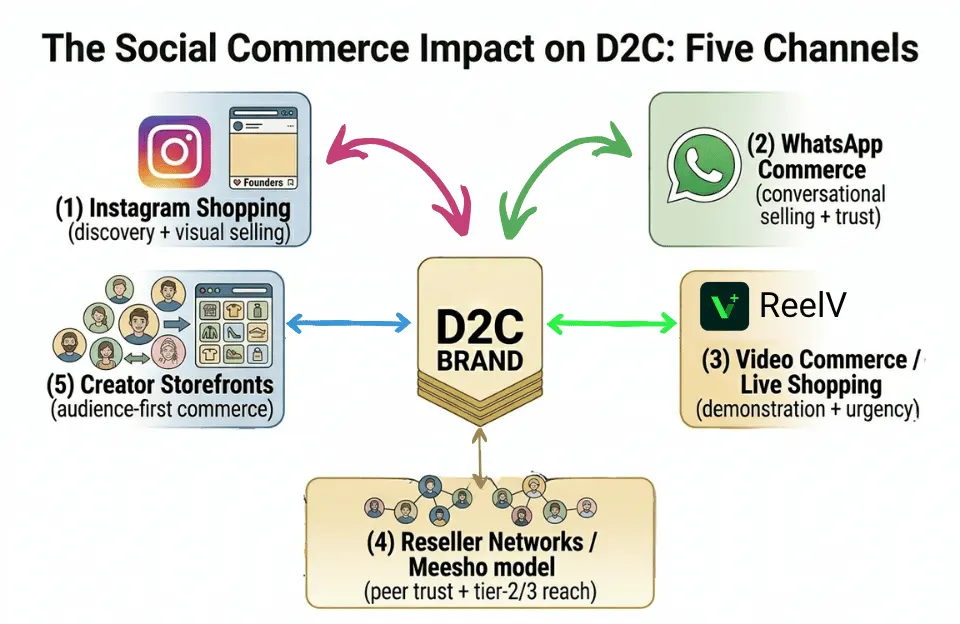
The Five Social Commerce Channels Reshaping D2C in India
Channel 1: Instagram Shopping. Where Discovery Becomes Purchase.
Instagram is the number one product discovery platform for Indian D2C brands. 491 million social media users in India. Instagram Shopping lets brands tag products in posts, Reels, and Stories. Customers can view product details and price without leaving the app.
For D2C brands, Instagram serves two functions. First, organic discovery through Reels. A 15-second product demo can reach 100,000 people without spending a rupee on ads. Second, Trust. when they see their beloved creator support a brand or use some brand’s product, they too wish to use it themselves. The ROI of Influencer Marketing is too high when used well
The impact of social commerce on D2C through Instagram is clearest in fashion, beauty, and jewellery. Sugar Cosmetics built its early community through Instagram tutorials. GIVA’s jewellery gains traction through visual content. Snitch launches new menswear drops that sell out through Instagram-driven traffic.
What D2C brands gain: Free discovery. Visual selling. Impulse purchase conversion. Lower CAC for first-time customers.
What D2C brands lose: Customer email and phone data (Instagram owns it). Control over the purchase experience. Dependency on algorithm changes.

Channel 2: WhatsApp Commerce. Trust-Based Selling at Scale.
WhatsApp has 500+ million users in India. Open rates are 85–95%. This is not a marketing channel. It is India’s primary communication layer. And it is becoming a commerce layer.
WhatsApp Business catalogues let brands showcase products inside chat. Click-to-WhatsApp ads (CTWA) on Instagram and Facebook drive users into a WhatsApp conversation with the brand. From there, the brand can share product details, answer questions, and close the sale, all inside the chat. Payment can happen via UPI links sent in the chat.
The impact of social commerce on D2C through WhatsApp is most visible in high-consideration purchases. A customer considering a Rs 3,000 skincare set wants to ask questions before buying. A WhatsApp conversation builds trust in a way that a product page cannot. CTWA ads reduce CAC by 25–40% compared to standard click-to-website ads because the conversational format builds trust faster.
What D2C brands gain: Direct customer relationship. Phone number for retention. Conversational selling that handles objections in real time. 85–95% open rates for follow-up.
What D2C brands lose: Scale. Each conversation requires human or AI-driven responses. It is hard to process 10,000 orders a day through chat without automation. Tools like Interakt and Wati help, but the channel is inherently more labour-intensive than a website.
Also Read: Retention Marketing Strategies for D2C Brands for the complete WhatsApp post-purchase playbook
Channel 3: Video Commerce and Live Shopping. The Real-Time Selling Floor.
Video commerce captured 43% of global social commerce transactions in 2025. It is the fastest-growing format. In India, platforms like Instagram Live, YouTube Live Shopping, and Meesho’s live sessions are turning content into real-time storefronts.
The format works because it solves the biggest problem of online shopping: uncertainty. A live video shows the product in real light, on a real person, with real-time Q&A. The viewer can ask “Does this shade look different in daylight?” and get an answer in seconds. That interaction collapses the trust gap that static product pages cannot close.
Fashion creators are already converting Instagram Live sessions into sellouts within hours. Beauty brands host live demos where viewers watch a serum being applied and buy it during the stream. The urgency of “live” combined with the authenticity of video drives impulse purchases.
But live commerce has a limitation for D2C brands: the content is ephemeral. Once the live session ends, the selling moment is gone. This is where on-site shoppable video becomes the bridge. The smart D2C play is to record live sessions, edit the best moments, and place them as shoppable videos on your own product pages using tools like ReelV. That way, the live session converts in real time, and the recording converts forever.
Video commerce is the fastest-growing format in social commerce. It captured 43% of global social commerce sales in 2025. D2C brands that combine live selling on social platforms with permanent shoppable video on their own website get the best of both worlds: real-time urgency and evergreen conversion.
Channel 4: Reseller Networks. The Meesho Model That Reaches Where D2C Cannot.
Meesho processes millions of orders annually with a 35% share of India’s social commerce market. Its model is simple: micro-entrepreneurs (often homemakers and students in tier-2 and tier-3 cities) share product catalogues on WhatsApp. Their contacts browse, order through the reseller, and the product ships from the supplier.
For D2C brands, the reseller network represents distribution without stores. It reaches pin codes that your website never will. Over 50% of social commerce sales come from beyond tier-1 cities. These are consumers who trust a personal recommendation from someone they know more than an Instagram ad from a brand they have never heard of.
The trade-off: you become a supplier, not a brand. The reseller sets the markup. You lose control over pricing, messaging, and customer data. The customer knows the reseller, not you.
What D2C brands gain: Volume in tier-2/3/4 cities. Distribution without capital investment. Access to trust-based networks.
What D2C brands lose: Brand control. Customer data. Pricing power. Margin (the reseller takes a cut).
Also Read: Types of D2C Business Models in India and which one wins in which segment
Channel 5: Creator Storefronts. Audience-First Commerce.
Creators are not just promoting products. They are selling them. Amazon launched Creator Central in November 2024, giving influencers dedicated storefronts. Instagram enables product tagging in creator content. YouTube is testing shopping integration in Shorts.
For D2C brands, this means a creator’s page is becoming a sales channel. A beauty creator with 200,000 followers who tags your serum in a Reel is not just giving you exposure. They are running a storefront for you. Their audience trusts them. The product tag converts that trust into a transaction.
The impact of social commerce on D2C through creator storefronts is most significant for new brands. A new skincare brand with zero brand awareness can generate its first 1,000 orders entirely through creator storefronts without any paid advertising. The creator provides the trust. The platform provides the transaction infrastructure.
What D2C brands gain: Trust-by-proxy. Near-zero CAC for initial sales. Access to niche audiences.
What D2C brands lose: Dependency on the creator. If the creator stops posting, the sales stop. Customer relationship is with the creator, not the brand.
Also Read: The Rise of Influencer-Led D2C Brands in India for the full creator economy analysis
The Strategic Tension: Social Commerce Gives D2C Brands Reach but Takes Away Data
This is the core issue that defines the impact of social commerce on D2C in India.
Every social commerce channel gives you something valuable: discovery, reach, trust, conversion. But most of them take away something equally valuable: your customer’s email, phone number, browsing history, and purchase data.
When a customer buys through Instagram Shopping, Instagram owns the relationship. If they buy through a reseller on Meesho, the reseller owns the relationship. If the transaction is done through a creator’s storefront, the creator owns the relationship. In each case, the D2C brand is a supplier, not a brand owner.
The brands that understand this tension use social commerce for acquisition and their own website for retention. Social platforms discover the customer. The brand’s website (or WhatsApp) captures the data. The owned channels drive repeat purchases, where the real profit lives.
| Channel | Discovery | Data Ownership | Best D2C Use |
| Instagram Shopping | Excellent | Low (platform owns) | Top-of-funnel discovery. Drive to own site for conversion. |
| WhatsApp Commerce | Good (CTWA ads) | High (you get phone number) | Full-funnel: discovery to conversion to retention. |
| Video / Live Commerce | Excellent | Low if on social; High if on own site | Social for live reach. Own site for evergreen shoppable video. |
| Reseller Networks | High (tier-2/3 reach) | None (reseller owns) | Volume play. Not a brand-building channel. |
| Creator Storefronts | Excellent (trust-based) | Low (creator owns) | Launch-phase acquisition. Drive to own channels fast. |
The impact of social commerce on D2C is a trade: reach for data. The brands that win use social commerce for the first transaction and owned channels for every transaction after. Social platforms rent you the customer. Your website and WhatsApp let you own them.
How Smart D2C Brands Bridge Social Commerce to Owned Channels
The most profitable D2C brands in India don’t treat social commerce and their own website as separate worlds. Social platforms provide the discovery while the brand’s website provides the conversion and the long-term relationship.
Here is how that bridge works in practice:
- Use Instagram for discovery, but drive to your website for purchase. Run Reels that build interest. Use Instagram’s product tags for awareness. But include a clear CTA to visit the brand’s site for the full product experience, educational content, and exclusive offers. Capture the email and phone number on the website. Now you own the relationship.
- Use CTWA (Click-to-WhatsApp) ads instead of click-to-website ads for high-consideration products. The customer enters a WhatsApp conversation where you answer questions, build trust, and sell. You collect the phone number and retarget via WhatsApp for repeat purchases. CAC drops 25–40%.
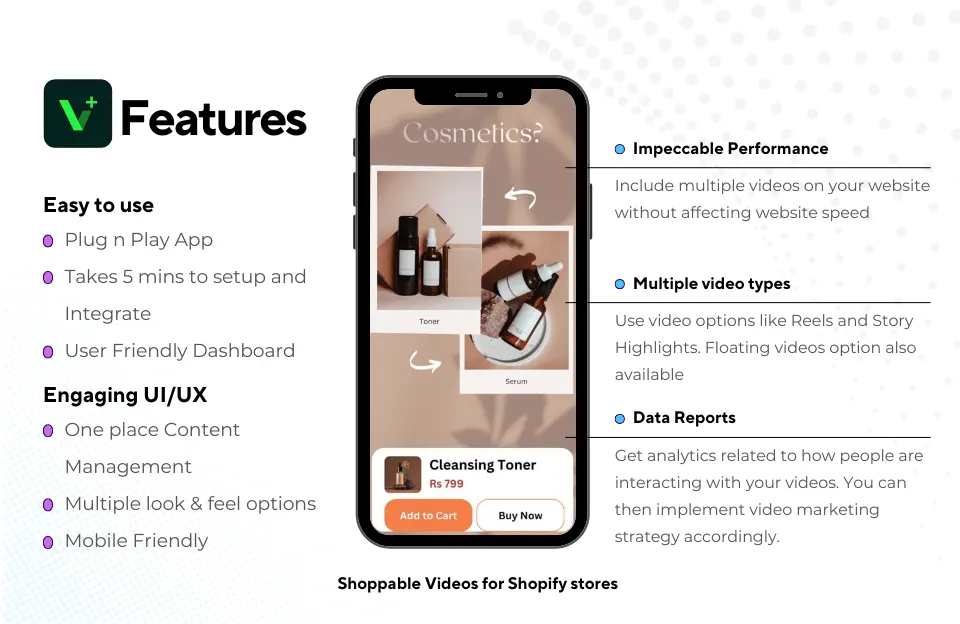
- Bring social video onto your own website. The best content from Instagram Reels, creator reviews, and live sessions should not die on social media after 48 hours. Place it on your product pages as shoppable video. Tools like ReelV let you embed Floats (single PDP demos), Stories (organised creator testimonials), and Reels (carousel with add-to-cart) on your Shopify store. The video builds the same trust as social content, but the conversion happens on site.
- Use reseller networks for volume, but build brand awareness in parallel. If you sell through Meesho resellers, run parallel brand campaigns so that the end consumer starts recognising your brand name. Over time, some of those consumers will search for you directly.
- Capture creator audiences with post-purchase retention. A creator drives the first sale. Your post-purchase WhatsApp flow, email sequence, and loyalty program drive the second, third, and fourth. The creator rents you the customer while your retention system owns them.
Also Read: Customer Acquisition Strategies for D2C Brands in India for the full channel-by-channel playbook
Social Commerce in India: The Numbers That Matter for D2C Brands
| Metric | Data Point |
| India social commerce market size (2025) | $29.3 billion |
| Projected market size (2030) | $144 billion (37.5% CAGR) |
| Social media users in India | 491 million (2025) |
| Meesho social commerce market share | 35% |
| Video commerce share of global social commerce | 43% of transactions (2025) |
| Social commerce buyers citing peer influence | 80% |
| Sales from beyond tier-1 cities | 50%+ of social commerce transactions |
| WhatsApp open rates | 85–95% |
| CTWA ad CAC reduction vs click-to-website | 25–40% lower |
| Indians who purchased directly from a brand website | 65% (PwC) |
| Fastest-growing social commerce segment | Beauty & personal care (39% CAGR) |
Also Read: Evolution of D2C Brands in India and how you can grow yours
What the Impact of Social Commerce Means for Your D2C Strategy in 2026
If you are a D2C founder, here is the practical takeaway from all of this.
- Social commerce is not optional. A $29 billion market growing at 37.5% CAGR is not a channel you can ignore. If your brand is not present on Instagram Shopping, WhatsApp Business, and creator ecosystems, you are invisible to a large and growing segment of Indian consumers.
- But social commerce alone is not a business. If 100% of your sales happen on social platforms, you own nothing. No customer data, email list or WhatsApp database. Which means no repeat purchase engine. You are a tenant on someone else’s platform. The platform can change the algorithm tomorrow.
- The winning model is hybrid: social for acquisition, owned channels for retention. Use Instagram for discovery. WhatsApp for conversations. Creators for trust. Then drive customers to your website for the data capture, the deeper brand experience, and the post-purchase retention flows that generate 60–70% of your lifetime revenue.
- Video is the connective tissue. Social commerce runs on video. Your website should too. Shoppable video on your product pages (using tools like ReelV) creates consistency between the social experience and the website experience. The customer who watched a Reel on Instagram should find the same energy and evidence on your product page.
- Invest in WhatsApp as your primary owned social channel. Unlike Instagram, WhatsApp gives you the phone number. That is first-party data and is retargetable. WhatsApp commerce is the one social channel where the impact on D2C is positive for both reach and data ownership.
- Do not ignore reseller networks for tier-2/3 reach, but protect your brand. Meesho and Shopsy provide volume in cities your website will never reach. Use them for distribution. But build brand awareness separately so that the end consumer eventually searches for you directly.
Key Takeaways
- India’s social commerce market is $29.3 billion (2025) and growing to $144 billion by 2030. This is a structural shift, not a trend. D2C brands must have a social commerce strategy.
- Social commerce reshapes where discovery, trust, and transactions happen. Instagram for visual discovery. WhatsApp for conversational trust. Video for demonstration. Resellers for tier-2/3 reach. Creators for audience-first selling.
- The core tension: social commerce gives reach but takes data. Brands that sell only through social platforms do not own their customers. The winning model uses social for acquisition and owned channels (website, WhatsApp, email) for retention.
- Video commerce is the fastest-growing format (43% of social commerce). Live selling on social + shoppable video on owned website = the best of both worlds. ReelV bridges this gap for Shopify D2C brands.
- WhatsApp is the only social channel where D2C brands own the data. 85–95% open rates. CTWA ads reduce CAC 25–40%. Phone numbers are first-party data. WhatsApp commerce is the most D2C-friendly social channel.
- 80% of social commerce buyers cite peer influence as a factor. Trust is built through people, not platforms. Creator partnerships, UGC, and community-driven content are the fuel of social commerce growth.
Frequently Asked Questions
What is the impact of social commerce on D2C in India?
Social commerce is reshaping D2C by moving discovery, trust-building, and transactions onto social platforms like Instagram, WhatsApp, and creator pages. The Indian social commerce market hit $29.3 billion in 2025 and is growing at 37.5% CAGR. For D2C brands, this creates massive reach (491 million social media users) but also a data-ownership trade-off: social platforms own the customer relationship unless brands actively bridge social discovery to owned channels.
How big is the social commerce market in India?
India’s social commerce market reached $29.3 billion in 2025 and is projected to hit $144 billion by 2030 at a 37.5% CAGR. Beauty and personal care is the fastest-growing segment at 39% CAGR. Over 50% of transactions come from beyond tier-1 cities. Meesho leads with 35% market share.
Should D2C brands sell through social commerce platforms?
Yes, but strategically. Social commerce is too large to ignore. However, brands that sell exclusively through social platforms do not own customer data and are dependent on algorithm changes. The best approach is hybrid: use social commerce for discovery and first-time acquisition, then drive customers to owned channels (your website, WhatsApp, email) for data capture and retention.
What is the difference between social media marketing and social commerce?
Social media marketing uses platforms to drive traffic to your website. Social commerce completes the entire purchase journey within the platform. In social media marketing, the brand’s website is the store. In social commerce, the platform is the store. The distinction matters because social commerce can reduce your control over customer data, pricing, and the purchase experience.
How does video commerce affect D2C brands?
Video commerce captured 43% of global social commerce transactions in 2025. It drives conversion by showing products in real use, answering questions in real time, and creating urgency through live selling. For D2C brands, the best strategy is to combine live selling on social platforms (for real-time reach) with permanent shoppable video on their own product pages (for evergreen conversion). Tools like ReelV enable this on Shopify.