Fairdeal Funding: $15 Million to Build the B2B Quick Commerce Layer India’s Kirana Network Needs
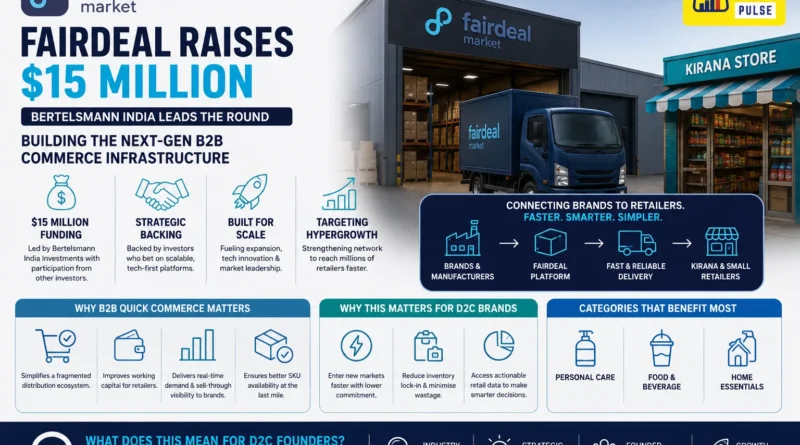
Fairdeal funding $15 million signals a structural shift in how D2C and FMCG brands think about last-mile B2B distribution — not as a logistics problem, but as a commerce infrastructure play.
The Bertelsmann India-led round arrives at a moment when the lines between B2B distribution and quick commerce are blurring fast. For D2C founders watching channel economics closely, this deal deserves more than a passing glance.
What Happened: The Fairdeal Funding Breakdown
B2B quick commerce startup Fairdeal has closed a $15 million funding round led by Bertelsmann India Investments, with participation from other investors. The Fairdeal Funding positions the company as a serious contender in the B2B commerce infrastructure space, which connects manufacturers and distributors directly to kirana stores and small retailers.
Bertelsmann India has a track record of backing platform businesses with strong unit economics and network effects — previous bets include Pepperfry, Licious, and Eruditus. Their Fairdeal Funding signals conviction in the B2B quick commerce model as a scalable, margin-defensible business.
Why B2B Quick Commerce Is Having Its Moment
India’s retail distribution has always been fragmented. There are an estimated 12–13 million kirana stores across the country, and the traditional distributor-stockist-retailer chain is slow, opaque, and expensive.
What B2B quick commerce startups like Fairdeal are doing is collapsing this chain. By offering same-day or next-day delivery to retailers, digital ordering interfaces, and direct brand-to-retailer pipelines, they eliminate two to three layers of the traditional trade stack.
This matters because:
- Working capital improves for small retailers who no longer need to hold excess inventory
- Brands get real-time sell-out data instead of lagged sell-in numbers
- SKU availability at the last mile becomes predictable, not accidental
The B2B quick commerce model is not new — Udaan, ElasticRun, and Jumbotail have been building versions of this. But the new generation of players is going narrower, faster, and more tech-first. Fairdeal appears to be part of this sharper cohort.
Gross Margins for D2C Brands: The Number That Decides Whether You Survive or Die
Zepto and Blinkit Expansion: The Race to 2,000 Dark Stores in 2026

The Future of Indian Consumer Brands: 10 Forces That Will Shape the Next Decade
The Budget Split That Separates Brands That Scale from Brands That Stall
The D2C Connection: Why This Funding Matters to You
Most D2C brands in India start online — Shopify store, quick commerce listings, maybe a brand.com. But growth eventually demands offline distribution, and that’s where many D2C brands hit a wall.
Traditional GT (general trade) requires heavy distributor margins, large minimum order quantities, and months of relationship-building before reliable shelf presence. It is expensive and slow to scale.
B2B quick commerce platforms like Fairdeal offer an alternative: a leaner, faster, data-connected path to retail shelves.
For D2C brands, this model offers three concrete advantages:
- Faster market entry — test a city or zone without committing to full distributor networks
- Lower inventory lock-in — smaller, more frequent replenishment cycles reduce wastage
- Actionable retail data — sell-through visibility at the store level, not just dispatch numbers
Brands in personal care, food and beverage, and home essentials — categories where D2C founders are most active — stand to benefit most. These are high-frequency, low-ticket categories where kirana penetration remains essential to volume.
The Competitive Landscape: Who Fairdeal Is Up Against
Fairdeal enters a space that is both validated and contested.
Udaan remains the dominant B2B commerce platform by GMV, though it has faced profitability headwinds and strategic pivots. ElasticRun, backed by SoftBank, plays in rural and semi-urban last-mile. Jumbotail focuses on the food and grocery segment.
What differentiates the new entrants is the speed promise — the “quick” in B2B quick commerce. Traditional B2B platforms operated on 48–72 hour fulfilment cycles. Platforms promising same-day or next-day restocking to kiranas are creating a new service tier that incumbents are struggling to match.
Bertelsmann’s backing gives Fairdeal both capital and strategic credibility to compete in this space aggressively.

What to Watch Next
Three signals worth tracking as Fairdeal deploys this capital:
- City expansion velocity — will they go deep in a few metros or spread across Tier 2 markets?
- Brand partnerships — which D2C and FMCG brands sign on as supply-side partners?
- Unit economics disclosure — contribution margins in B2B distribution are thin; how Fairdeal manages fulfilment costs will define its long-term viability
The Bigger Pattern
This funding is part of a broader thesis: distribution infrastructure in India is being rebuilt from the ground up, and the winners will be platforms, not intermediaries. For D2C brands, the strategic question is no longer whether to go offline — it is which infrastructure partner to bet on when you do.
Fairdeal’s $15 million round just made that conversation more relevant.