Types of D2C Business Models: Eight Operational Architectures Indian Brands Use to Sell Direct
From Vertically Integrated Manufacturers to Asset-Light Curators. How the Revenue Engine Actually Works Inside Each Model.
Not all D2C brands are built the same way. boAt does not own a single factory, while Lenskart owns a $200 million manufacturing plant, and Country Delight controls the entire supply chain from farm to doorstep. Snitch goes from Instagram trend to warehouse in 21 days while Mosaic Wellness operates two separate brands under one roof. Each of these brand calls itself D2C. But the type of D2C Business models and the operational architecture behind each one is completely different.
The types of D2C business models matter because they determine your margins, your speed, your capital requirements, and your defensibility. A vertically integrated brand and an asset-light brand both sell directly to consumers. But one needs Rs 5 crore to launch. The other needs Rs 50 lakh. One has 70% gross margins. The other has 40%. One can launch a new product in two weeks. The other takes three months.
This guide breaks down eight types of D2C business models used by Indian brands. Not by channel (we covered that in our D2C vs Marketplace vs Omnichannel guide). Not by category (we covered that in Fastest Growing D2C Categories). By operational architecture: how the business actually makes, sources, prices, delivers, and monetises its products.
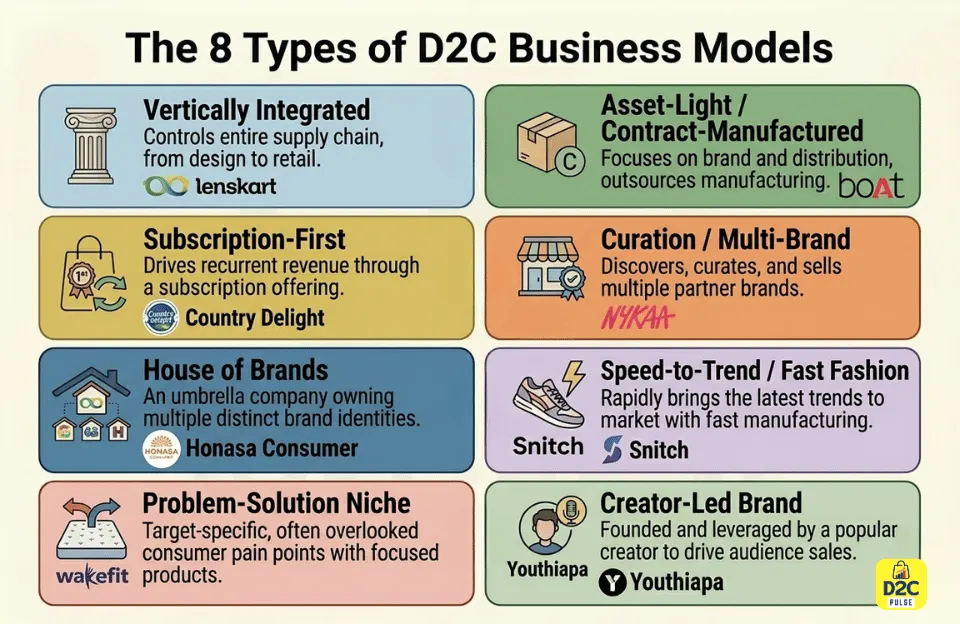
Model 1: Vertically Integrated. You Make It, You Sell It.
How it works: The brand controls the entire value chain. Product design, raw material sourcing, manufacturing, quality control, packaging, distribution, and retail. Nothing is outsourced. The brand owns the factory, the warehouse, and the customer relationship.
Indian examples: Lenskart (eyewear manufacturing in Telangana, 2,700+ stores), Minimalist (in-house formulation and manufacturing in Jaipur), DaMENSCH (in-house fabric innovation for innerwear), Wakefit (own mattress factory in Bangalore).
Economics: Gross margins are the highest of all types of D2C business models, often 65–75%. COGS is lower because you cut out contract manufacturer margins. But upfront capital is heavy. A manufacturing setup costs Rs 2–20 crore depending on category. Break-even takes longer. The payoff is long-term pricing power and product quality control.
Best for: Categories where product quality is the moat (eyewear, skincare with active ingredients, mattresses, speciality food), and founders with technical or manufacturing backgrounds.
Risk: Capital locked in fixed assets. Slow to pivot. If the product does not sell, the factory still has costs.
Also Read: How Lenskart built it’s omnichannel strategy and became a 6600 Cr giant
Model 2: Asset-Light / Contract-Manufactured. You Brand It, Someone Else Makes It.
How it works: The brand focuses on design, marketing, and distribution. Manufacturing is outsourced to contract manufacturers (OEMs/ODMs). The brand owns the intellectual property, the customer data, and the brand identity. It does not own the production line.
Indian examples: boAt (audio products manufactured by Dixon Technologies and Chinese OEMs), Sugar Cosmetics (contract-manufactured, focus on branding and distribution), Bombay Shaving Company (outsourced manufacturing, in-house brand building), Bacca Bucci (marketplace-first footwear).
Economics: Gross margins are moderate, typically 40–55%, because the contract manufacturer takes a cut. But capital requirements are low. You can launch a D2C brand with Rs 20–50 lakh. Iteration speed depends on your manufacturer’s flexibility. Marketing is your biggest cost and your biggest lever.
Best for: Founders who are strong at brand-building and marketing but do not have manufacturing expertise. Categories where the product itself is not deeply technical (fashion, accessories, basic personal care, home goods).
Risk: Lower defensibility. If your contract manufacturer supplies five other brands, your product differentiation is limited. You are in a brand war, not a product war. Quality control is harder when you do not own the factory.
The asset-light model is how most D2C brands in India start. It is fast. It is cheap. But it creates a specific trap: if your product is not meaningfully different from what the same manufacturer makes for your competitors, your only moat is marketing spend. And marketing spend is not a moat. It is a cost.
Also Read: boAt Case Study for how asset-light D2C can scale to Rs 3,100 Cr
Model 3: Subscription-First. Recurring Revenue by Design.
How it works: The customer subscribes to receive products at a regular frequency. The brand ships automatically. Revenue is predictable. CAC is paid once, but the customer generates value over months or years. The entire business is built around retention, not one-time transactions.
Indian examples: Country Delight (daily milk and grocery delivery via app subscription), Blue Tokai Coffee (customised coffee subscriptions with grinding and frequency options), Furlenco (furniture rental on monthly subscription), Sid’s Farm (subscription-based dairy with daily testing).
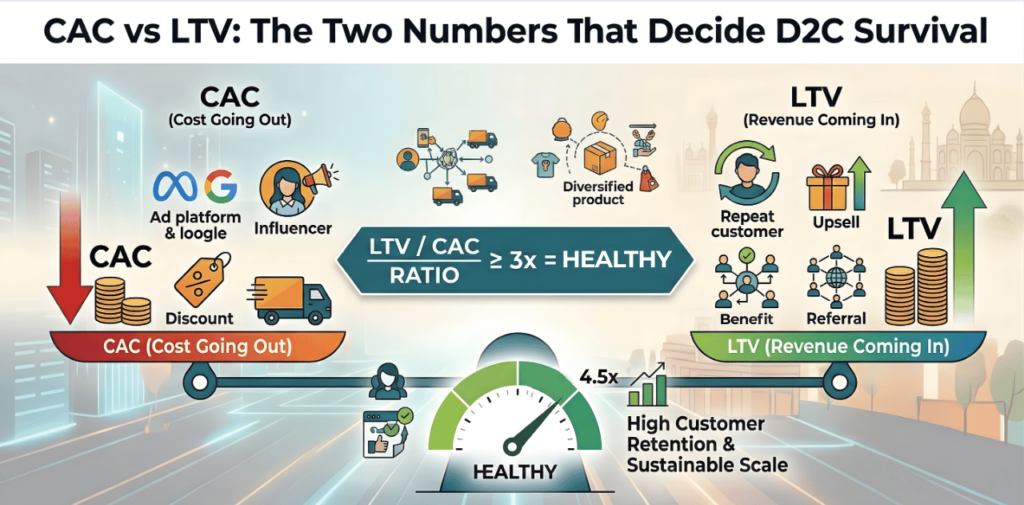
Economics: The subscription model has the best LTV-to-CAC ratio of all types of D2C business models when it works. Churn rate is the make-or-break metric. A 5% monthly churn means you lose half your subscribers in a year. A 2% monthly churn means subscribers stay an average of 50 months. Revenue predictability lets you plan inventory, cash flow, and staffing with confidence. Indian subscription ecommerce is projected to reach $374.24 billion by 2033 at a 45.13% CAGR.
Best for: Consumable products with regular replenishment cycles (dairy, coffee, supplements, personal care refills, pet food). Products where the customer does not want to think about reordering.
Risk: Indian consumers dislike rigid commitments. If cancelling or pausing is hard, churn spikes. Logistics for daily or weekly delivery (especially cold chain) are operationally complex and expensive. COD subscriptions add cash flow risk.

Model 4: Curation / Multi-Brand Retail. You Pick the Best, Sell It Under Your Roof.
How it works: The brand does not manufacture anything. It curates products from multiple brands and sells them through a D2C platform, adding value through selection, editorial content, and customer experience. The margin comes from wholesale-to-retail markup and data-driven merchandising.
Indian examples: Nykaa (curated beauty platform with 4,000+ brands plus own private labels), The Label Life (curated fashion, celebrity-designed collections), Scooboo (curated stationery from 200+ global brands), Something’s Brewing (curated speciality coffee equipment and beans).
Economics: Gross margins are lower (25–40%) because you are reselling other brands’ products. The advantage is breadth: you offer variety without manufacturing anything. Private-label additions (Nykaa has its own skincare and makeup lines) significantly boost margins. Revenue scales with catalogue size and traffic.
Best for: Founders who understand a specific consumer niche deeply and can curate better than the alternatives. Categories with product fragmentation where consumers want a trusted editor (beauty, stationery, speciality food, home decor).
Risk: Low defensibility unless you build private labels or exclusive partnerships. Any brand you sell can also sell directly. Your value is curation and trust, not product ownership.
Model 5: House of Brands. Multiple Brands, One Company.
How it works: One parent company operates multiple D2C brands, each targeting a different consumer segment or category. Brands share backend infrastructure (logistics, technology, finance) but have separate identities, positioning, and marketing strategies.
Indian examples: Honasa Consumer (Mamaearth, The Derma Co., Aqualogica, BBlunt, Dr. Sheth’s, Ayuga), Mosaic Wellness (Man Matters for men, Be Bodywise for women), Good Glamm Group (MyGlamm, St. Botanica, The Moms Co., Sirona), Emcure’s consumer brands (multiple health and wellness brands under one corporate umbrella).
Economics: The house of brands model spreads risk across multiple brands and captures adjacent consumer segments without diluting any single brand’s identity. Shared infrastructure lowers per-brand operating costs. But each new brand requires its own marketing investment. The complexity of managing five brands is not five times one brand. It is more. Coordinating inventory, teams, positioning, and P&Ls across brands is operationally demanding.
Best for: Companies that have already built one successful brand and want to capture more market share across segments. Requires strong operational leadership, shared tech infrastructure, and clear brand boundaries.
Risk: Cannibalisation. If The Derma Co. and Mamaearth target overlapping consumers, one brand eats the other’s share. Resource dilution is real. Most house of brands attempts in India have struggled to make all brands profitable simultaneously.
Also Read: Mamaearth Growth Story for how the house of brands model works in practice
Model 6: Speed-to-Trend / Fast Fashion D2C. From Instagram Trend to Warehouse in Three Weeks.
How it works: The brand monitors fashion and lifestyle trends in real time (Instagram, TikTok, Pinterest) and turns trending designs into products within 14–21 days. Manufacturing is either in-house or through highly responsive contract manufacturers. Speed, not brand storytelling, is the moat.
Indian examples: Snitch (menswear, trend-to-warehouse in under 21 days, vertically integrated supply chain), Bewakoof (trend-driven casualwear with fast turnaround), Urbanic (international fast fashion targeting Indian women), Libas (fast-fashion ethnic wear).
Economics: High inventory turnover means lower dead stock risk. Margins are moderate (40–50%) but volume is high. The key metric is sell-through rate: what percentage of produced inventory sells at full price within the first 30 days. Brands with strong trend-spotting sell 70–80% at full price. Those that miss trends discount heavily and erode margins.
Best for: Fashion and lifestyle categories where trends change fast and consumers buy based on what is current, not what is classic. Requires strong data analytics, responsive supply chain, and high-frequency product launches (50–100+ new SKUs per month).
Risk: Sustainability backlash. Fast fashion faces growing consumer pushback on environmental grounds. Also, trend-following is inherently volatile. One bad season of trend bets can result in significant unsold inventory.
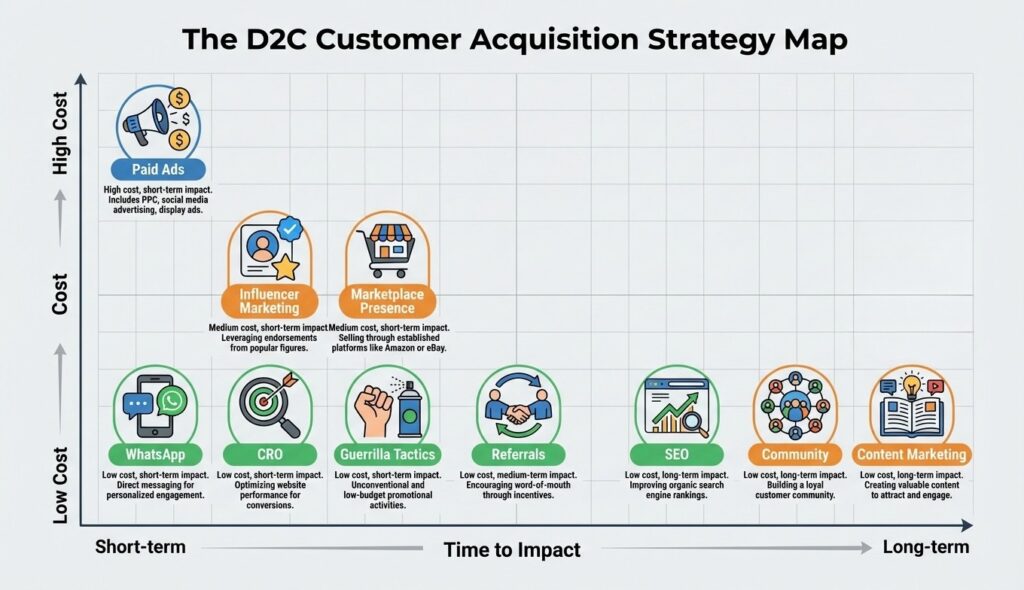
Customer Acquisition Strategies for D2C Brands in India: The Complete Playbook
CAC vs LTV: The Unit Economics Deep Dive Every D2C Brand Needs
Model 7: Problem-Solution Niche. One Problem, Deep Expertise, Complete Ownership.
How it works: The brand identifies a specific, underserved problem and builds a complete product-and-service solution around it. It does not try to be everything. It tries to be the definitive answer to one pain point. The product, the content, the community, and the post-purchase experience are all designed around that single problem.
Indian examples: Wakefit (sleep quality, from mattresses to pillows to bed frames to sleep tracking), Supertails (pet parent needs, from food to vet consultations to grooming), SuperBottoms (cloth diapers and kids’ bottomwear for rash-free baby care), DrinkPrime (safe drinking water through subscription water purifiers).
Economics: This model builds the deepest customer loyalty of all types of D2C business models. When you solve a specific problem completely, the customer does not look elsewhere. Repeat purchase rates are high. Cross-sell within the problem ecosystem works. But the addressable market is smaller by design. Wakefit can sell mattresses, pillows, and bed frames to every Indian household. But it cannot sell skincare.
Best for: Founders who have personal experience with a specific problem and can build a comprehensive solution. Categories where the existing options are fragmented, low-trust, or poorly designed (sleep, pet care, baby care, water quality, senior care).
Risk: Niche ceiling. At some point, you saturate the core problem and must decide: go deeper (more products for the same customer) or go wider (adjacent categories). Both paths carry execution risk.
Model 8: Creator-Led Brand. The Audience Comes Before the Product.
How it works: A content creator, influencer, or celebrity builds a personal brand and audience first, then launches a product line. The audience is pre-built & the trust is pre-established. Customer acquisition cost is near zero for the initial launch because the creator’s followers are the first customers.
Indian examples: Bhuvan Bam / Youthiapa (fashion brand from YouTube creator, site crashed on launch day), Gaurav Taneja / Rosier Foods (health food from fitness YouTuber), Tech Burner / Layers (lifestyle brand from tech creator), Masaba Gupta / House of Masaba (fashion from designer-turned-celebrity), Virat Kohli / WROGN (athleisure from cricket icon).
Economics: Initial CAC is the lowest of all types of D2C business models because the audience already exists. Launch-day revenue can be explosive. But long-term sustainability depends on whether the product stands on its own once the creator hype fades. Repeat purchase rates for creator-led brands are typically lower (1–3% of audience converts, repeat is 20–30%) unless the product genuinely solves a need.
Best for: Creators with 500,000+ engaged followers in a specific niche. The product must be aligned with the creator’s identity. A fitness creator launching health food works. A comedy creator launching financial products does not.
Risk: Single-point-of-failure dependency on the creator. If the creator faces controversy, the brand suffers. Scaling beyond the creator’s organic reach requires the same paid acquisition as any other brand. The creator advantage is temporary. Product quality must be permanent.
Also Read: The Rise of Influencer-Led D2C Brands in India for the full creator brand analysis
The Eight Types of D2C Business Models: Side-by-Side Comparison
| Model Type | Gross Margin | Capital Needed | Speed to Launch | Key Defensibility |
| Vertically Integrated | 65–75% | High (Rs 2–20 Cr) | Slow (6–12 mo) | Product quality + cost control |
| Asset-Light | 40–55% | Low (Rs 20–50L) | Fast (2–4 mo) | Brand + marketing |
| Subscription-First | 50–65% | Medium | Medium | Recurring revenue + habit |
| Curation / Multi-Brand | 25–40% | Medium | Fast | Trust + editorial taste |
| House of Brands | 50–65% | Very High | Slow | Portfolio breadth + shared ops |
| Speed-to-Trend | 40–50% | Medium | Very Fast (14–21 days) | Supply chain speed |
| Problem-Solution Niche | 55–70% | Medium–High | Medium | Deep expertise + loyalty |
| Creator-Led | 45–60% | Low–Medium | Fast | Audience trust (temporary) |
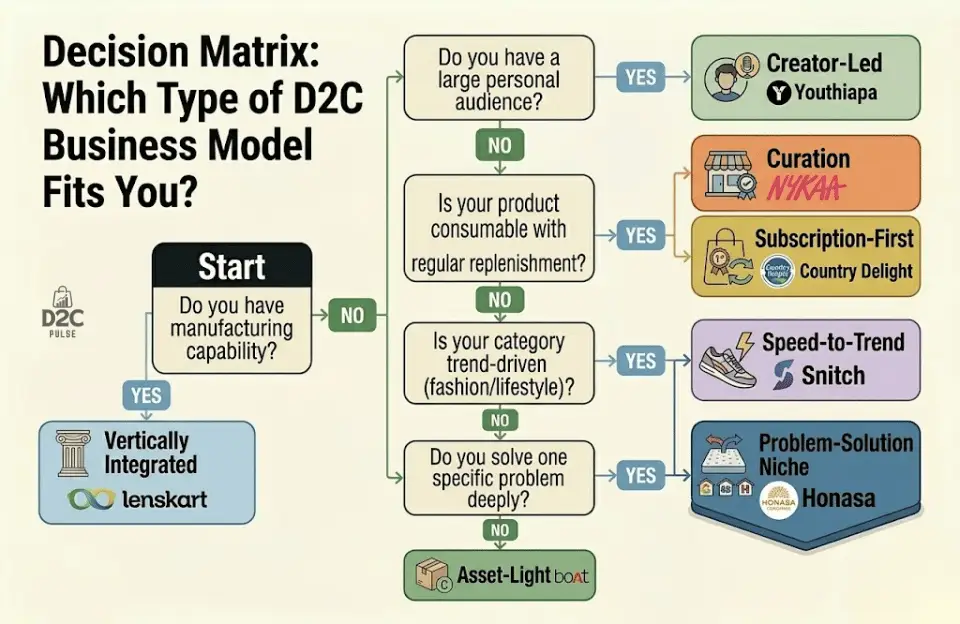
Most Successful Indian D2C Brands Are Hybrids
In practice, the types of D2C business models rarely exist in pure form. Most successful Indian D2C brands combine elements from two or three models.
Lenskart is vertically integrated (manufacturing) plus problem-solution niche (eyewear needs). Mamaearth is asset-light manufacturing plus house of brands. boAt is asset-light plus speed-to-trend (fast product launches in trending audio categories). Country Delight is subscription-first plus vertically integrated (owns the supply chain). Nykaa started as curation and added private labels to become a hybrid retailer-manufacturer.
The point is not to pick one model and stick to it forever. It is to understand which operational architecture fits your stage, your category, your capital, and your skills. Then evolve as the brand grows.
Key Takeaways
- There are eight distinct types of D2C business models: vertically integrated, asset-light, subscription-first, curation, house of brands, speed-to-trend, problem-solution niche, and creator-led. Each has different margins, capital needs, and defensibility.
- Vertically integrated brands have the highest margins (65–75%) and strongest defensibility, but require the most capital and the longest time to launch.
- Asset-light brands are the fastest and cheapest to launch, but have lower margins and weaker defensibility unless the brand itself becomes the moat.
- Subscription models deliver the best LTV-to-CAC ratio when churn is low. The key is flexibility. Indian consumers dislike rigid commitments.
- Creator-led brands have near-zero launch CAC but the creator advantage is temporary. Product quality must stand on its own after the initial hype fades.
- Speed-to-trend models win in fashion but require responsive supply chains and strong data analytics. One bad season of trend bets creates dead inventory.
- Most successful brands are hybrids. Lenskart, Mamaearth, boAt, and Nykaa all combine elements from multiple types of D2C business models. Start with one. Evolve as you grow.
Frequently Asked Questions
What are the main types of D2C business models?
The eight main types of D2C business models are: vertically integrated (you manufacture and sell), asset-light (contract-manufactured, brand-focused), subscription-first (recurring revenue), curation/multi-brand (curated retail), house of brands (multiple brands under one company), speed-to-trend (fast fashion, rapid product cycles), problem-solution niche (deep expertise in one domain), and creator-led (audience-first, product second).
Which D2C business model is most profitable?
Vertically integrated models have the highest gross margins (65–75%) because there is no contract manufacturer margin. Subscription models have the best LTV-to-CAC ratio when churn is controlled. Asset-light models have the lowest margins (40–55%) but also the lowest capital requirements. Profitability depends on execution, not just model type.
What type of D2C model is best for beginners in India?
Asset-light (contract-manufactured) is the most common starting point. It requires the least capital (Rs 20–50 lakh), launches fastest (2–4 months), and lets founders focus on brand-building and marketing before investing in manufacturing. Many brands start asset-light and move toward vertical integration as they scale.
Can a D2C brand use multiple business models?
Yes. Most successful Indian D2C brands are hybrids. Lenskart combines vertically integrated manufacturing with a problem-solution niche approach. boAt uses an asset-light model with speed-to-trend product launches. Nykaa started as curation and added private labels. The types of D2C business models are not mutually exclusive. They are building blocks.