
Lessons from Failed D2C Startups in India: What Every Founder Must Learn
Real Failures with actual numbers & Real Lessons. Why 90% of Failed D2C Startups Share the Same 10 Mistakes and What You Can Do Differently.
Nobody likes to talk about failure. In the D2C world, we study the ones who have amde it big, like boAt, Lenskart, Minimalist, Etc. Their stories fill conference stages. But the lessons from failed D2C startups are far more useful. They tell you what not to do. And in a market where 90% of D2C brands shut down by year five, studying failed D2C startups is the best insurance you have.
The numbers paint a blunt picture. In 2024, close to 3,900 Indian startups shut down. In 2025, about 730 more followed. Many were well-funded D2C startups that couldn’t do well, like Good Glamm Group, 10Club, Fipola, BeepKart & more. These brands had raised tens of millions of dollars. They had teams, offices, and brand awareness but still couldn’t make it.
India now has over 11,000 D2C companies. Only 233 have crossed Rs 150 crore in revenue. Around 60–65% are stuck in the Rs 1–50 crore band. A DSG Consumer Partners report found that most of these brands struggle with the same problems that killed the failed D2C startups before them: rising CAC, weak retention, discount dependency, and broken unit economics.
This article studies the lessons from failed D2C startups in India. We cover 10 failure patterns. Each one killed real brands. Each one is easy to avoid if you know what to look for. If you are a D2C founder, these lessons from failed D2C startups may save your business.
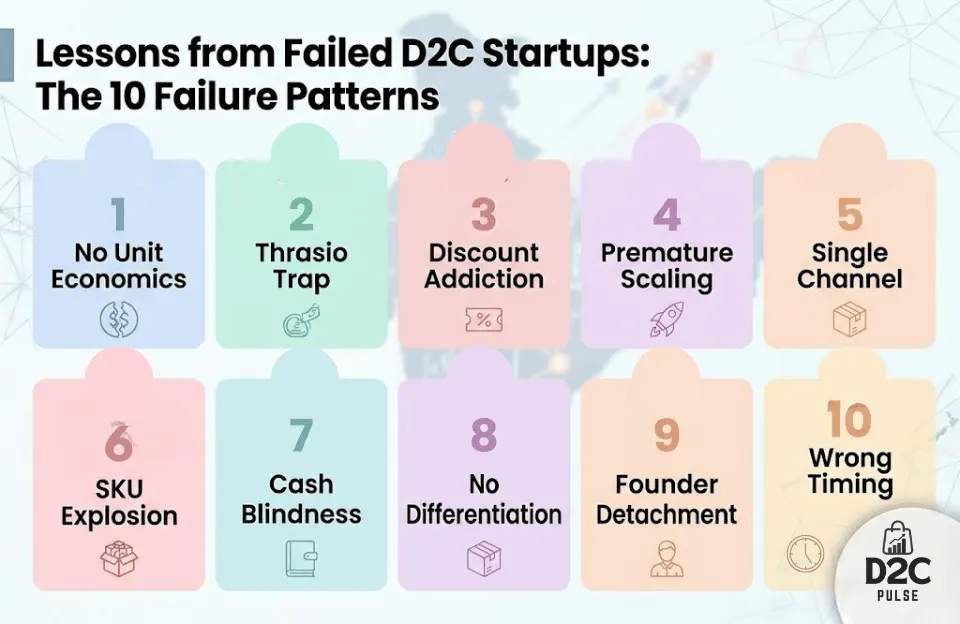
Failure 1: They Ignored Unit Economics. This Killed More Failed D2C Startups Than Anything Else.
This is the top killer. Most failed D2C startups in India never had positive unit economics. They lost money on every order. They thought scale would fix it. Scale made it worse.
A brand sells a product for Rs 800. COGS is Rs 300. That looks like Rs 500 margin. But add packaging (Rs 45), shipping (Rs 75), payment fees (Rs 16), COD handling (Rs 15), return costs (Rs 40), support (Rs 15), and tech (Rs 20). Real margin: Rs 274. Subtract Rs 350 CAC. Loss: Rs 76 per order.
Multiply that by 10,000 orders a month. That is Rs 7.6 lakh in losses every month from a brand that looks busy. This is the lesson every founder must take from failed D2C startups: revenue can grow while the business bleeds to death.
Founder lesson: Track CM1 and CM2 from day one. If CM2 is negative, do not scale. Fix the economics first. Every failed D2C startup that scaled with negative unit economics burned through funding and shut down.
Also Read: Understanding Unit Economics for D2C Brands in India for the full cost stack
Failure 2: The Thrasio Trap. Buying Brands Did Not Build a Business.
The Thrasio model promised: buy small D2C brands, run them under one roof, and grow them with shared operations. In India, this model created some of the most notable failed D2C startups of the era.
Good Glamm Group raised $221 million. It bought MyGlamm, The Moms Co., Baby Chakra, and others. Losses hit Rs 916 crore. Salaries were delayed. Brand assets were sold at discounts. The group collapsed in 2025.
GOAT Brand Labs raised $88 million. It acquired 20 brands. Combined FY22 revenue: Rs 80 lakh. 10Club raised $40 million and went into bankruptcy. Each of these failed D2C startups made the same bet: that acquisition equals growth. It does not.
Founder lesson: Build one brand well. Make it profitable. The lessons from failed D2C startups that followed the Thrasio model are clear: buying brands is easy, making them profitable is hard.

Also Read: Types of D2C Business Models that brands get built upon in India
Failure 3: Discount Addiction. They Trained Customers to Wait for Sales.
Discounting is the slow poison of failed D2C startups. It starts with a 30% launch discount. Then Diwali at 40% off. Then monthly flash sales. Soon the customer base only buys on sale.
When a brand tries to go back to full price, revenue drops. The founder panics. More discounts follow. Margins erode. The brand becomes a discount machine with no pricing power. This pattern has destroyed more failed D2C startups than any competitor ever could.
A DSG Consumer Partners report found that brands stuck below Rs 100 crore almost always had high discount dependency and low repeat rates. The two problems feed each other. Discount buyers do not return at full price.
Founder lesson: Cap launch discounts at 10–15%. Use trial-size SKUs (Rs 149–299) instead of percentage-off sales. Build value through content and brand story. If you need 40% off to sell, the product has a positioning problem, not a pricing problem.
The single most repeated pattern among failed D2C startups: brands that raced to the bottom on price never climbed back. Discounts attract deal-hunters. Trust attracts loyal customers. The first group costs money. The second makes money.
Failure 4: Premature Scaling. Spending Like a Rs 100 Crore Brand on Rs 10 Lakh Revenue.
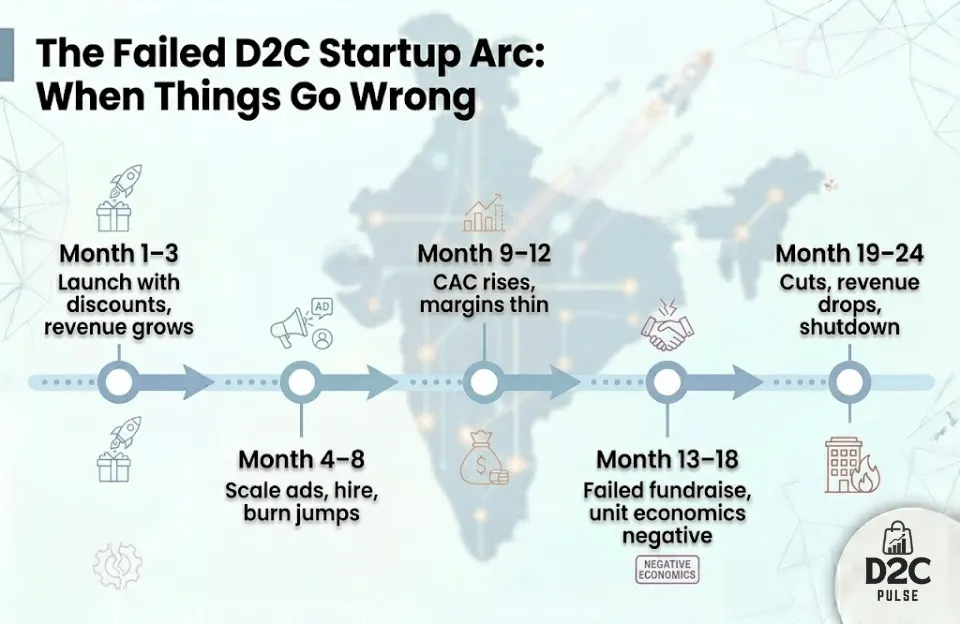
Funding makes this easy. A brand raises Rs 5 crore. The founder hires 20 people. Opens an office. Launches 15 SKUs. Runs ads on five channels. Monthly burn: Rs 40 lakh. Revenue: Rs 8 lakh. This is the script most failed D2C startups follow.
BeepKart raised $20 million. It opened multiple outlets close together. They ate into each other’s base. Thin margins and high costs forced a shutdown. The Blip app tried to build Zepto for fashion. It launched in October 2024 and closed shortly after.
Among failed D2C startups, premature scaling is the most expensive mistake because it burns the most cash in the least time.
Founder lesson: Keep the team at 2–4 people until Rs 25 lakh monthly revenue. Use freelancers. Work from home. Use 3PL warehouses. Scale expenses only after revenue covers them.
Failure 5: Single Channel Dependency. One Algorithm Change Away from Death.
Many failed D2C startups built 80%+ of revenue on one channel. Usually Meta ads. When Meta ad costs jumped 30–40%, these failed D2C startups had no fallback. CAC spiked. Margins collapsed.
The same happens with Amazon dependency. Commission changes, search shifts, or a new competitor can wipe out revenue overnight. The brand has no direct customer data. No email list or WhatsApp base, which means No moat!
Founder lesson: No single channel above 40% of revenue by month 18. Build your website. Invest in SEO. Build a WhatsApp list. Start email flows. Use marketplaces for discovery, not dependency.
Also Read: Customer Acquisition Strategies for D2C Brands in India for the full channel playbook
Failure 6: SKU Explosion. 50 Products in Year One. None Profitable.
A skincare brand starts with one face wash. Within a year, it has 30 products. Each one adds inventory cost, packaging, QC, and marketing. Most failed D2C startups that expanded SKUs too fast found that 5 products carried the business. 25 lost money. But blended numbers hid this.
The survivors did the opposite. Minimalist: one serum. boAt: one cable. Country Delight: milk. One product. Proven economics. Then expand.
Founder lesson: Launch with one hero SKU. Reach Rs 10–15 lakh monthly revenue. Then add a second. Track CM2 per SKU. Cut losers. Double down on winners.
Failure 7: Cash Flow Blindness. Revenue Grew. The Bank Account Did Not.
Revenue is a dashboard number. Cash pays bills. Many failed D2C startups were profitable on paper but ran out of cash. In India, the cash conversion cycle is 45–70 days. You pay your manufacturer in 30 days. COD settlements take 10–14 days. Seasonal inventory locks up cash for months.
Fipola raised $3 million. It could not raise a follow-on round. Cash ran out. It shut down. Among failed D2C startups, cash flow blindness is especially deadly because it strikes brands that look healthy.
Founder lesson: Plan for 60–90 days of working capital. Track cash weekly. Push for prepaid. Do not overstock for festivals unless you have the cash buffer.
Failure 8: No Real Differentiation. Same Product on the Same Shelf gives Same Result.
India has 11,000+ D2C brands. In BPC alone, hundreds sell the same vitamin C serum from the same contract manufacturer in the same Shopify template with the same Instagram look. When there is no real difference, the customer picks on price. Margins shrink. CAC rises.
Many failed D2C startups were not bad businesses. They were invisible. They had nothing that made a customer choose them over five identical options. Compare this with Minimalist (ingredient transparency), Whole Truth (clean labels), or boAt (celebrity lifestyle at accessible prices). Each had a clear one-sentence answer.
Founder lesson: Before you launch, answer: what can you say that no one else can? If your answer is “better quality” or “lower price,” you do not have differentiation. That is what every failed D2C startup said too.
Also Read: Brand Positioning Framework that helps build strong brands with great recall
Failure 9: Founders Who Stopped Selling and Started “Building.”
In the early days, the founder talks to customers. Reads reviews. Handles complaints. Then funding arrives. A marketing team is hired. The founder moves to “strategy.” Conferences. Podcasts. Team building. Customer contact drops to zero.
When the founder stops selling, the brand loses its best feedback loop. Product decisions become guesses. Marketing becomes generic. Several failed D2C startups lost their way because the founder lost touch with the buyer.
Founder lesson: Talk to 5 customers every week. Read every negative review. Handle some support tickets yourself. Never fully outsource your connection to the customer.
Failure 10: Wrong Category Timing. Too Early or Too Late.
Timing kills brands as often as bad execution. Some failed D2C startups entered before consumers were ready. D2C meat delivery (Fipola, others) launched when cold chain was weak and consumer trust was low. Other failed D2C startups entered too late. In 2024–2025, dozens of vitamin C serum brands launched into a market already owned by Minimalist, The Derma Co., Dot & Key, and ten others.
Founder lesson: Study category maturity. Too early = you pay to educate the market. Too late = you fight funded incumbents. The sweet spot: demand exists, but no brand has locked up the category yet.
Also Read: Retention Marketing Strategies for D2C brands that help increase loyalty and LTV
Failed D2C Startups vs Survivors: What Made the Difference
| Factor | Failed D2C Startups | Survivors |
| Unit Economics | Ignored. Scaled with negative CM2. | Tracked from day one. Fixed before scaling. |
| Pricing | Raced to the bottom. Heavy discounts. | Priced for value. Small welcome discounts. |
| SKU Strategy | Launched 20–50 SKUs in year one. | Started with 1 hero SKU. Added slowly. |
| Channel Mix | 80%+ from one channel. | Diversified. No channel above 40%. |
| Team Size | 20–50 people before Rs 50L/mo revenue. | 2–5 people until product-market fit. |
| Retention | Under 15% repeat. No retention stack. | 30%+ repeat. WhatsApp + email + loyalty. |
| Cash | Tracked revenue, not cash. Ran out. | 60–90 day working capital buffer. |
| Differentiation | Same product as 20 competitors. | Clear one-sentence brand position. |
| Founder Role | Stopped selling. Moved to strategy. | Talked to 5 customers a week. |
| Growth Model | Bought brands (Thrasio). Failed. | Built one brand well first. |
The lessons from failed D2C startups are consistent. They come down to the same handful of mistakes: ignoring unit economics, scaling too fast, discounting too much, depending on one channel, and losing touch with the customer. The fixes are not complicated. They require discipline.
Also Read: Funding Trends in Indian D2C Startups. What makes Indian D2C brands attractive.
12 Actions from the Lessons of Failed D2C Startups
These 12 actions come from studying what failed D2C startups did wrong. Each one is a concrete step you can take today.
- Model your unit economics before you spend your first rupee. Get manufacturer quotes, 3PL rates, build a full P&L per order beforehand. Most failed D2C startups skip this step.
- Launch with one hero SKU. Prove it works, reach Rs 10–15 lakh monthly. Then add a second and not before. Failed D2C startups launch 15 products at once.
- Keep the team at 2–4 until Rs 25 lakh monthly revenue. Use freelancers and work from home to save costs. Failed D2C startups hire 20 people first.
- Set a CAC ceiling and do not break it. CAC must be under one-third of first-order revenue. Failed D2C startups spend without limits.
- Build retention from month one. WhatsApp flows, Email lists and referral programme are a must. Failed D2C startups wait until it is too late.
- Cap discounts at 10–15%. Use trial sizes, not percentage-off sales. Failed D2C startups trained customers to wait for sales.
- Diversify channels by month 12. No single channel above 40%. Failed D2C startups depend on one platform.
- Track cash, not just revenue. Plan for 60–90 days of working capital. Failed D2C startups track dashboards while their bank accounts empty up.
- Talk to 5 customers every week. Read negative reviews and handle support tickets. Failed D2C startups outsource this too early.
- Track CM2 by SKU and channel. Your best-seller might be your biggest loser. Failed D2C startups use blended numbers that hide the truth.
- Do not raise money to cover losses. Raise to invest in growth. Failed D2C startups raise life support, not growth capital.
- Study failed D2C startups every quarter. Read post-mortems. Track which brands in your category are struggling. Learn from others before you make the same mistakes.
Key Takeaways from Failed D2C Startups
- 90% of D2C startups shut down by year five. Studying failed D2C startups is your best defence against being in the 90%.
- Negative unit economics at scale is the top killer. Revenue growth with negative CM2 is not growth. It is loss at higher speed. Every major failed D2C startup made this mistake.
- The Thrasio model failed in India. Good Glamm, GOAT Brand Labs, and 10Club were among the most funded failed D2C startups. Buying brands does not equal building a business.
- Discount addiction destroys brands slowly. Heavy discounts attract deal-hunters with zero loyalty. Among failed D2C startups, discount dependency is the most common self-inflicted wound.
- Premature scaling burns cash fastest. A 20-person team on Rs 8 lakh revenue is a countdown to shutdown. Most failed D2C startups scaled expenses before revenue.
- Channel diversification is survival insurance. No channel above 40% by month 18. Failed D2C startups that depended on one platform died when that platform changed.
- The brands that survived did the boring things right. One hero SKU. Every cost tracked. Small team. Value pricing. Retention focus. Cash management. None of this is exciting. All of it works.
Frequently Asked Questions
Why do most D2C startups fail in India?
Most failed D2C startups in India share the same mistakes: negative unit economics that worsen with scale, discount dependency, premature scaling of team and infrastructure, single-channel reliance, lack of differentiation, and cash flow mismanagement. About 90% close by year five. The root cause is almost always spending more to acquire customers than those customers are worth.
What are the biggest lessons from failed D2C startups?
Ten lessons stand out from failed D2C startups: track unit economics from day one, avoid the Thrasio model, never use heavy discounts, do not scale before proving economics, diversify channels, start with one hero SKU, manage cash not just revenue, build real differentiation, stay close to customers, and time your category entry.
How can new D2C founders avoid failure?
Model unit economics before launch. One product first. Small team. Set a CAC ceiling. Build retention from month one. Diversify by month 12. Track CM2 by SKU. Plan 60–90 days of working capital. Talk to 5 customers a week. And study failed D2C startups regularly. The mistakes that killed them are easy to avoid if you know what to watch for.
Which funded D2C startups have failed in India?
Major failed D2C startups include Good Glamm Group ($221M raised, Rs 916 Cr losses), GOAT Brand Labs ($88M raised, could not scale acquired brands), 10Club ($40M, entered bankruptcy), Fipola ($3M, cash crunch shutdown), and BeepKart ($20M, thin margins). High funding does not prevent failure when unit economics are broken.
Is D2C still viable in India in 2026?
Yes. But the rules have changed. The growth-at-all-costs era is over. boAt posted Rs 60 Cr profit in FY25. Lenskart posted Rs 297 Cr profit. Minimalist was profitable before its HUL acquisition. The lessons from failed D2C startups make it clear: the model works when unit economics are sound. Most failed D2C startups did not have bad products. They had bad financial discipline.