
Gross Margins for D2C Brands: The Number That Decides Whether You Survive or Die
Why Gross Margin Is the Most Important Metric in D2C. Category Benchmarks. The Real Cost Stack. 7 Levers to Improve Margins. And Why 70% Is the New Survival Threshold.
Two D2C brands launch on the same day. Same category, Same product quality and even same marketing budget. One sells at 65% gross margin. The other sells at 40% gross margin. Five years later, one is profitable, scaling, and getting acquired by HUL. The other is dead. The difference was not the product. It was not the team but the gross margins for D2C.
Gross margins for D2C brands are the single most important number in your business. They decide how much you can spend on marketing and how much you can absorb in returns. They also decide whether you can survive a funding winter and whether you can ever reach profitability. Every other D2C metric depends on this one.
Yet most Indian D2C founders launch without understanding their true gross margin. They calculate selling price minus COGS and call it 70%. They forget all other factors and costs. By the time they realise their real gross margin is 35%, they have already burned through their funding.
This article explains gross margins for D2C brands in detail. What they really mean. Category benchmarks for India. The full cost stack you must include. The seven levers to improve them. And why 70%+ is the new survival threshold for Indian D2C in 2026.
What Are Gross Margins for D2C Brands? (And What Founders Get Wrong)
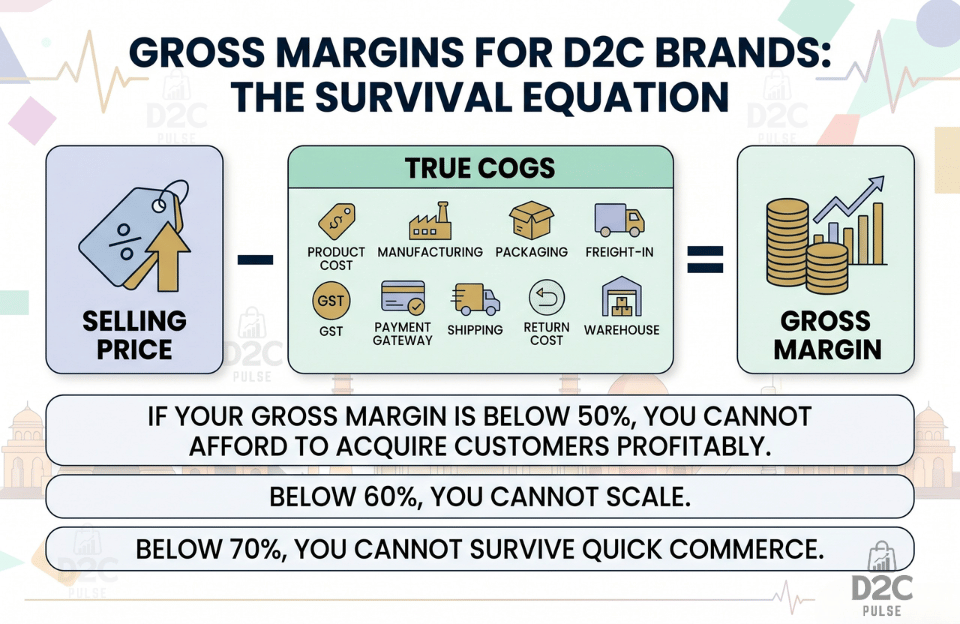
Gross margin is the percentage of revenue left after subtracting the direct cost of producing and delivering your product. The formula is simple: (Revenue – COGS) / Revenue x 100. A product that sells for Rs 1,000 with a true COGS of Rs 350 has a gross margin of 65%.
The problem is what founders include in COGS. Most founders count only the manufacturing cost. A serum that costs Rs 150 to manufacture and sells for Rs 500 looks like a 70% gross margin. But that calculation is wrong.
True gross margins for D2C brands include every variable cost tied to making and delivering one unit. Manufacturing cost. Packaging cost. Inbound freight from the manufacturer to your warehouse. GST and import duties (if applicable). Payment gateway fees (2–3%). Outbound shipping to the customer. Return shipping (because returns happen). The cost of the returned unit (if it cannot be resold). And warehouse pick-pack fees.
That same Rs 500 serum probably has a true COGS of Rs 220–250, not Rs 150. Real gross margin: 50–56%, not 70%. This is the gap that kills D2C brands. They plan with the 70% number. They live with the 55% number. The difference is the difference between profitable and dead.
Category Benchmarks: Gross Margins for D2C Brands by Vertical
| Category | Reported GM | True GM | Survival Floor | Why It Varies |
| Beauty & Skincare | 60–80% | 55–70% | 60% | High markup. Low return rate. Best margins in D2C. |
| Health & Wellness | 55–75% | 50–65% | 55% | Premium pricing. Subscription helps. Compliance adds cost. |
| Jewellery (Silver/Gold) | 50–70% | 45–60% | 50% | High AOV but raw material price volatility. |
| Men’s Grooming | 55–70% | 50–65% | 55% | Beauty-adjacent margins. Lower brand premium. |
| Pet Care | 45–65% | 40–55% | 50% | Food-heavy mix. Premium accessories help. |
| Fashion & Apparel | 50–70% | 35–55% | 50% | 20–25% return rate destroys reported margins. |
| Home & Sleep | 40–60% | 35–50% | 45% | High AOV. Heavy shipping. Long decision cycles. |
| Food & Beverages | 35–55% | 30–45% | 40% | Lowest D2C margins. Cold chain. Price sensitivity. |
| Audio & Electronics | 25–40% | 20–35% | 30% | Component costs. Spec wars. Volume game. |

Why Beauty Wins and Food Struggles
Beauty has the best gross margins for D2C brands in India. A 30 ml serum costs Rs 80–120 to manufacture and sells for Rs 500–700. That is a 75–85% gross markup before deductions. After packaging, shipping, returns, and gateway fees, true gross margins land at 55–70%. This is why HUL valued Minimalist at Rs 2,955 crore The math works. Foxtale’s $18 million Series B happened because beauty margins absorb high marketing spend.
Food and beverages have the lowest gross margins for D2C brands. A snack pack that costs Rs 40 to produce sells for Rs 80–100. Reported gross margin looks like 50%. But add cold-chain freight, shorter shelf life leading to wastage, packaging that has to be sturdier, and the true gross margin drops to 30–40%. This is why food D2C brands need either subscriptions (to lower CAC per repeat) or premium positioning (to lift price per unit). Volume alone does not save them.
Also Read: Fastest Growing D2C Categories in India for the full margin and growth rate breakdown
The Real Cost Stack: What True Gross Margins for D2C Brands Include
Take a Rs 500 product. Here is the full breakdown of what eats into your reported gross margin. Most founders count only the first three lines. The brands that survive count all of them.
| Cost Item | % of Revenue | Rs (on Rs 500) | Notes |
| Manufacturing cost | 20–25% | Rs 100–125 | The line every founder remembers. |
| Packaging (primary + outer) | 3–6% | Rs 15–30 | Branded boxes cost more. Worth it. |
| Inbound freight + handling | 1–2% | Rs 5–10 | Manufacturer to your warehouse. |
| GST input (net) | 2–4% | Rs 10–20 | Net of input credit. Often forgotten. |
| Payment gateway fees | 2–3% | Rs 10–15 | UPI is cheaper. Cards/COD are higher. |
| Outbound shipping | 6–10% | Rs 30–50 | Free shipping = brand absorbs cost. |
| Return shipping (RTO) | 3–7% | Rs 15–35 | 20–30% RTO in fashion. 5–8% in beauty. |
| Returned product loss | 2–5% | Rs 10–25 | Cannot be resold. Used or damaged. |
| Warehouse pick-pack | 1–2% | Rs 5–10 | 3PL fees. Or your own warehouse cost. |
| True COGS | 40–64% | Rs 200–320 | Most founders underestimate by 15–20%. |
| True Gross Margin | 36–60% | Rs 180–300 | This is the real number. |
The biggest mistake D2C founders make: they call the first three lines their COGS and report 75% gross margins. The investor sees 75%. The brand spends like it has 75%. Reality is 50–55%. The 20–25 percentage point gap is what kills the business 18 months later.
Also Read: Content Marketing for D2C Companies. How you can get customers without spending
Why 70%+ Gross Margins for D2C Brands Are the New Survival Threshold
In 2020, a 50% gross margin was enough to build a D2C brand. Meta CPMs were Rs 200–300. Repeat rates were higher. Quick commerce did not exist. Returns were lower. Today, the math has shifted.
Reason 1: CAC has almost doubled. Meta CPMs rose 40–60% since 2023. Average CAC for D2C brands jumped from Rs 400–600 in 2020 to Rs 750–1,000 in 2024. With a 50% gross margin and Rs 800 CAC, you need an AOV of Rs 1,600 just to break even on first purchase. Most D2C brands sell at Rs 500–800 AOV. The math no longer works at 50% gross margin.
Reason 2: Quick commerce takes 30–40%. Listing on Blinkit, Zepto, or Instamart costs 30–40% in platform fees. If your gross margin is 50%, you have 10–20% left for everything else: marketing, overheads, profit. If your gross margin is 70%, you have 30–40% left. That difference is the difference between using quick commerce profitably or losing money on every order.
Reason 3: Returns are higher. COD orders return at 25–30%. Fashion returns hit 20–25%. Every return costs you the original shipping (Rs 30–50), the return shipping (Rs 30–50), and often the product itself. A brand with 50% gross margin and 25% RTO loses money on every order. A brand with 70% gross margin survives.
Reason 4: Marketing costs are sticky. You cannot just stop spending on Meta. Your brand stops growing. You need to keep spending. Higher gross margins for D2C brands let you sustain marketing without burning cash. Lower margins force you to cut marketing, which kills growth, which kills the brand.
Also Read: Email Marketing Playbook for D2C companies in India that helps them grow fast
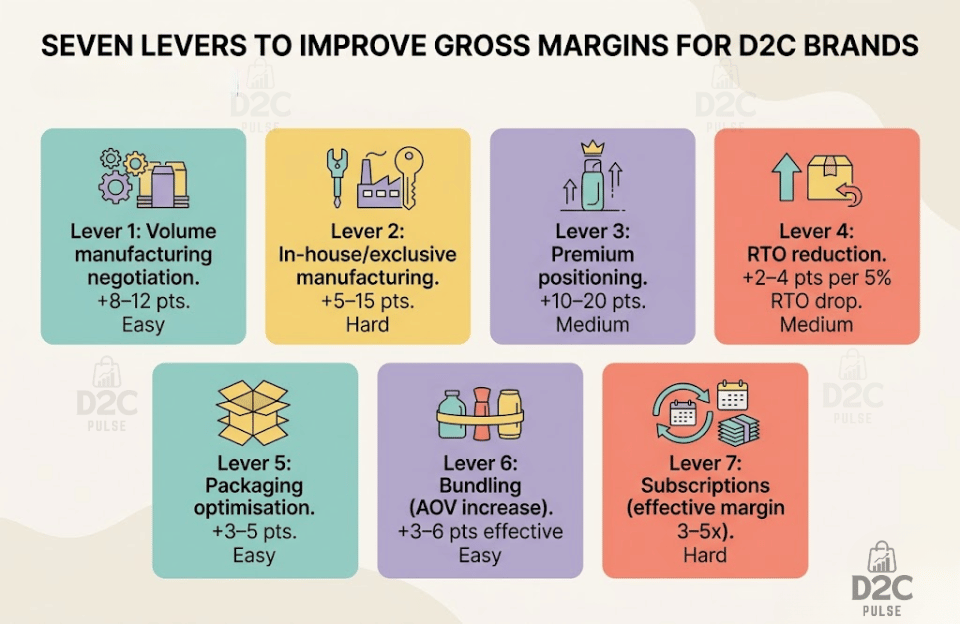
Seven Levers to Improve Gross Margins for D2C Brands
Lever 1: Negotiate Manufacturing Costs at Volume
Your first 1,000 units cost Rs 200 each. Your 10,000th unit can cost Rs 130 if you negotiate with the manufacturer at volume. A 35% reduction in manufacturing cost can lift gross margins for D2C brands by 8–12 percentage points. Always renegotiate at every order doubling. Manufacturers expect it.
Lever 2: Move Manufacturing In-House (or to Owned Contracts)
Once you cross Rs 5–1 crore monthly revenue, third-party manufacturing margins start hurting. Consider exclusive manufacturing contracts (ODM with no markup) or in-house manufacturing for your top SKUs. Innovist, Foxtale, and Minimalist all moved to controlled manufacturing as they scaled. This lifts gross margins for D2C brands by 5–15 percentage points.
Lever 3: Premium Pricing Through Brand Positioning
A Rs 500 serum and a Rs 800 serum can have the same COGS. The difference is positioning. Minimalist sells niacinamide at Rs 600–700. Generic brands sell the same niacinamide at Rs 199. Same product. Different brand. Different gross margins for D2C brands. Premium positioning is the highest-leverage way to lift margins. Spend on brand. Charge more. Justify it through education.
Lever 4: Reduce Returns (RTO Management)
Every 5% reduction in RTO lifts gross margins for D2C brands by 2–4 percentage points. Convert COD to prepaid (WhatsApp nudges work). Add detailed product information to PDPs. Use video on product pages to reduce buyer uncertainty. Add size guides (for fashion). Fashion brands that bring RTO from 25% to 15% see margin improvements that compound across every order.
Lever 5: Optimise Packaging Costs
Custom-printed boxes at low volumes cost 8–10% of revenue. At 5,000+ units per month, the same boxes cost 3–5%. Renegotiate packaging at scale. Switch to lighter materials for shipping. Reduce SKU variations to consolidate packaging orders. This can lift gross margins for D2C brands by 3–5 percentage points without touching the product.
Lever 6: Bundle and Increase AOV
Shipping cost per order is fixed (Rs 30–50). On a Rs 500 order, shipping is 6–10%. On a Rs 1,500 bundle, shipping is 2–3%. By bundling 2–3 products and increasing AOV, you spread fixed costs across more revenue. Gross margins for D2C brands improve without changing the underlying product economics. Bundle bestsellers with new launches. Offer 10% off for bundles. The math always favours the brand.
Lever 7: Subscription Models for Repeat Categories
Subscriptions reduce CAC per order to near zero (after the first purchase). They lock in revenue. They smooth cash flow. For consumable categories (food, supplements, skincare, pet food), subscriptions are the highest-impact lever. Country Delight built a Rs 1,000+ crore D2C business on subscriptions. Subscription customers have 3–5x better effective gross margins for D2C brands than one-time buyers.
Also Read: Understanding Unit Economics for D2C Companies that helps them stay afloat.
The Gross Margin Roadmap: Where Should You Be at Each Stage?
| Stage | Revenue | Target GM | Focus |
| Launch | Rs 0–25L/mo | 50–60% | Validate product-market fit. Calculate true COGS honestly. Do not optimise for margin yet. |
| Early Growth | 25L–1Cr/mo | 55–65% | Negotiate manufacturing at volume. Optimise packaging. Reduce RTO. Build brand premium. |
| Growth | 1–5Cr/mo | 60–70% | Move to exclusive contracts. Launch subscriptions. Bundle aggressively. Premium pricing. |
| Scale | 5Cr+/mo | 65–75% | In-house manufacturing for top SKUs. Quick commerce profitably. International expansion at premium prices. |
Key Takeaways
- Gross margins for D2C brands are the most important metric in your business. They decide marketing budget, return tolerance, profitability path, and survival in a funding winter. Every other D2C metric depends on this one.
- True gross margin includes everything, not just manufacturing. Add packaging, freight, GST, payment gateway, shipping, returns, return shipping, returned product loss, and warehouse fees. Most founders underestimate true COGS by 15–20%. The 70% they put on the deck is actually 50–55% in reality.
- Category benchmarks: beauty 55–70% true GM, health 50–65%, fashion 35–55% (returns kill it), food 30–45% (lowest), electronics 20–35%. Pick a category with structural margin advantage. The math is set by the category, not by your effort.
- 70%+ is the new survival threshold. CAC has doubled. Quick commerce takes 30–40%. Returns are higher. A 50% gross margin worked in 2020. It does not work in 2026. Brands that cannot reach 60%+ gross margins for D2C should rethink the business model.
- Seven levers to improve margins: volume negotiation, in-house/exclusive manufacturing, premium positioning, RTO reduction, packaging optimisation, bundling/AOV increase, and subscriptions. The highest-leverage one is premium positioning. The hardest one is in-house manufacturing. The fastest one is bundling.
- Plan for the stage. 50–60% at launch. 55–65% at early growth. 60–70% at growth. 65–75% at scale. If your gross margins for D2C brands do not improve as you scale, your unit economics will get worse, not better.
Frequently Asked Questions
What are good gross margins for D2C brands in India?
Good gross margins for D2C brands in India vary by category. Beauty and skincare lead with 55–70% true gross margins. Health and wellness sit at 50–65%. Men’s grooming and jewellery hit 50–65%. Fashion ranges 35–55% (returns drag it down). Food and beverages are the lowest at 30–45%. Above 60% true gross margin is healthy. Above 70% is excellent. Below 50% makes profitability very difficult in 2026.
How do you calculate true gross margins for D2C brands?
True gross margin = (Revenue – True COGS) / Revenue x 100. True COGS includes manufacturing, packaging, inbound freight, GST (net of input credit), payment gateway fees, outbound shipping, return shipping, returned product loss, and warehouse pick-pack costs. Most founders only count manufacturing and report inflated margins. The brands that survive count every variable cost from day one.
Why are gross margins so important in D2C?
Gross margins for D2C brands decide everything else. They decide how much you can spend on customer acquisition and how much return loss you can absorb. They also decide whether you can list on quick commerce profitably and whether you can survive a funding winter. A brand with 70% gross margin can spend 25–30% of revenue on marketing and still be profitable. A brand with 50% gross margin cannot.
What is the minimum gross margin a D2C brand should target?
In 2026, the minimum gross margins for D2C brands should be 60% true gross margin. Below this, you cannot sustain rising CAC, absorb returns, list on quick commerce profitably, or reach EBITDA breakeven. The best D2C brands target 65–75%. If your category structurally cannot reach 60% (commodity electronics, low-priced fashion), you need volume scale or vertical integration to make the math work.
How do you improve gross margins for a D2C brand?
Seven levers improve gross margins for D2C brands. (1) Negotiate manufacturing at volume (+8–12 percentage points). (2) Move to in-house or exclusive manufacturing as you scale (+5–15). (3) Premium brand positioning to charge more (+10–20). (4) Reduce returns through better PDPs and COD-to-prepaid conversion (+2–4 per 5% RTO drop). (5) Optimise packaging at scale (+3–5). (6) Bundle products to spread fixed shipping costs (+3–6). (7) Launch subscriptions for repeat categories (3–5x effective margin lift). Premium positioning is the highest-impact lever. It compounds with every other improvement.