Conversion Rate Optimization for D2C Websites: The Complete Playbook to Turn Visitors into Buyers
Why Most D2C Sites Convert Below 2%. The 8-Layer CRO Framework. How Video-Based CRO with ReelV Delivers 5–30% Lifts. And the Exact Fixes That Move the Needle.
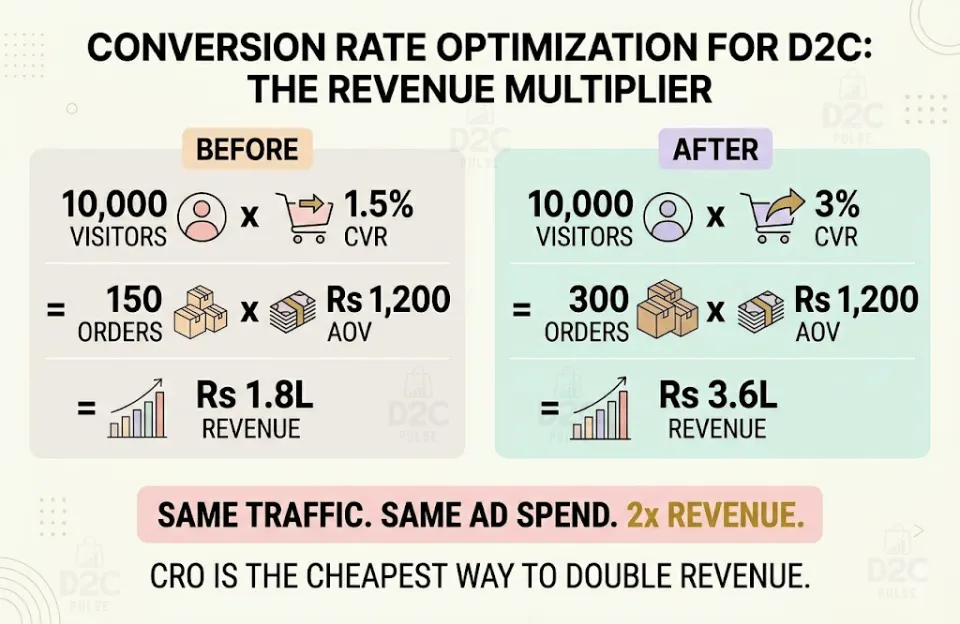
Your D2C website gets 10,000 visitors a month. You spend Rs 1 lakh on ads to get them. Your conversion rate is 1.5%. That is 150 orders. Now imagine you lift that to 3%. Same traffic. Same ad spend. 300 orders. Revenue doubles. Profit more than doubles because the ad cost stays flat. This is why conversion rate optimization for D2C websites matters more than almost anything else you can do. You do not need more traffic. You need more from the traffic you already have. A 1% improvement in conversion rate is worth more than a 20% increase in ad spend.
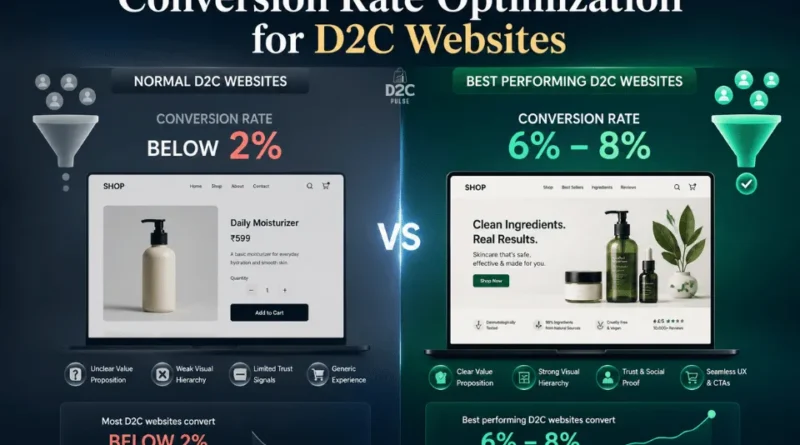
The average Indian D2C website converts at 1.5–2.5%. The best ones hit 4–5%. That gap is not luck. It is the result of systematic conversion rate optimization for D2C sites. Better product pages. Faster load times. Smarter checkout. Trust signals. And the single most under-used CRO lever: shoppable video on product pages.
This article gives you the complete conversion rate optimization playbook for D2C websites. Eight layers. Indian benchmarks. The exact fixes that move the needle. And a dedicated section on video-based CRO with ReelV, the tool that delivers 5–30% conversion lifts for 300+ Indian D2C brands.
Why Conversion Rate Optimization for D2C Websites Is the Highest-ROI Investment
It is cheaper than more traffic. Rs 1 lakh in ad spend gets you 10,000 visitors. Improving conversion rate from 2% to 3% is equivalent to getting 5,000 extra visitors for free. Conversion rate optimization for D2C costs less than buying traffic and delivers more.
It compounds with every channel. When you improve your product page, every visitor converts better. Paid traffic. Organic. Email. Social. WhatsApp. Conversion rate optimization for D2C lifts revenue across all channels at once. No other investment does this.
CAC is rising. CRO is the counter. Meta CPMs rose 40–60% since 2023. If your CAC is Rs 800 and you double your conversion rate, your effective CAC drops to Rs 400. Conversion rate optimization for D2C is the fastest way to fix rising acquisition costs.
Indian D2C Conversion Rate Benchmarks: Where Do You Stand?
| Category | Average CVR | Good CVR | Top CVR | Key Driver |
| Beauty & Skincare | 2.0–2.5% | 3.0–4.0% | 4.5–5.5% | Reviews. Ingredient education. Before/after content. |
| Fashion & Apparel | 1.2–1.8% | 2.0–2.5% | 3.0–4.0% | Size guides. Return policy trust. Video try-ons. |
| Food & Beverages | 3.0–4.0% | 4.5–5.5% | 6.0%+ | Repeat purchase. Subscriptions. Low price point. |
| Health & Supplements | 1.5–2.5% | 3.0–3.5% | 4.0–5.0% | Clinical proof. Expert endorsements. Trust content. |
| Home & Sleep | 0.8–1.5% | 1.5–2.5% | 3.0%+ | High AOV. Longer decision cycle. AR/video helps. |
| Electronics & Audio | 1.0–1.5% | 2.0–2.5% | 3.0%+ | Spec comparison. Lifestyle positioning. Reviews. |
If your conversion rate is below the average for your category, you have low-hanging fruit. Conversion rate optimization for D2C starts with knowing where you stand. Then fixing the biggest leaks first.
Also Read: Understanding Unit Economics for D2C Brands for how conversion rate impacts CAC and CM2
The 8-Layer Conversion Rate Optimization Framework for D2C Websites
Layer 1: Page Speed (The Silent Killer)
Pages loading in 2.4 seconds convert at 1.9%. Pages loading in 5.7 seconds convert at 0.6%. Every 1-second delay drops conversions by 7%. On mobile, a 1-second delay cuts conversions by 20%. Conversion rate optimization for D2C starts with speed.
Fix: Compress all images. Remove unused Shopify apps (each adds scripts). Use a fast theme. Target under 3 seconds on mobile. Check with Google PageSpeed Insights. If your LCP is above 3 seconds, you are losing sales every hour.
Layer 2: Product Page Optimization (Where Purchase Decisions Happen)
Most D2C product pages use a stock Shopify template, three photos, and a generic description. This leaves money on the table. Conversion rate optimization for D2C demands product pages that sell.
Fix: Lead with benefits, not specs. Add 5–10 high-quality images (lifestyle, close-up, size comparison, in-use). Add a 30–60 second product video. Show delivery estimates. Add trust badges (secure payment, easy returns). Show reviews with filters (by skin type, size, use case). Add social proof (X customers bought this week).
Also Read: Retention Marketing Strategies for D2C brands. How you can increase loyalty
Layer 3: Trust Signals (The Indian Context)
Indian consumers are sceptical online shoppers. COD exists because trust is low. Conversion rate optimization for D2C in India requires trust at every step.
Fix: Display return and refund policy on every PDP. Show COD availability. Add secure payment badges. Show real customer reviews (with photos). Display delivery timelines by PIN code. Add a WhatsApp chat button for instant support. Show certifications (FSSAI, dermatologist-tested, ECOCERT) where relevant.
Layer 4: Checkout Optimization
Cart abandonment in India hits 65–80%. Every extra step in checkout costs 10–15% of remaining customers. Conversion rate optimization for D2C must fix the checkout.
Fix: Offer guest checkout (no forced account creation). Show all costs upfront (no surprise shipping fees). Support UPI, credit cards, and COD. Add ShopFlo or GoKwik for optimised checkout. Show order summary with product images. Add trust signals at checkout (secure payment, money-back guarantee). Reduce fields to the minimum.
Also Read: The ROI from Influencer Marketing and how much you need to invest in Influencers
Layer 5: Mobile Optimization
85% of D2C traffic comes from mobile. Mobile converts at 1.8% versus desktop at 3.9%. That gap is a conversion rate optimization for D2C opportunity. Mobile visitors want to buy. The mobile experience stops them.
Fix: Test every page on a phone, not just in a design editor. Make buttons thumb-friendly. Reduce form fields. Use sticky add-to-cart buttons. Compress images for mobile load speed. Make product videos autoplay on mobile (muted). If your mobile conversion rate is below 2%, your mobile UX has friction.
Layer 6: Social Proof and Reviews
54% of shoppers abandon carts due to inconsistent product details. 48% leave if reviews are low. Conversion rate optimization for D2C requires social proof everywhere.
Fix: Automate review collection 14 days post-delivery. Offer a small incentive (10% off or loyalty points). Show review count on category pages and PDPs. Display UGC photos and videos alongside reviews. Show real-time purchase notifications (15 people bought this today). Add a Q&A section on PDPs.
Layer 7: Pricing and Offer Presentation
How you show the price matters as much as the price itself. Conversion rate optimization for D2C includes pricing psychology.
Fix: Show the original price crossed out next to the sale price. Show EMI options for products above Rs 1,500. Add free shipping thresholds (Rs 799 or Rs 999). Show savings in rupees and percentage. Use tiered pricing (buy 2 save 15%, buy 3 save 25%). Add bundle offers on the PDP.
Layer 8: A/B Testing (CRO as a Discipline)
Conversion rate optimization for D2C is not a one-time project. It is a weekly discipline. The highest-value things to test: CTA button copy, product page headline, hero image (lifestyle vs product-only vs UGC), pricing presentation, and review placement. Run one test at a time. Wait for statistical significance (2–4 weeks). Implement winners. Test again.
Tools: Google Optimize (free). Microsoft Clarity (free heatmaps). Hotjar. Shopify built-in analytics. For advanced testing: Intelligems, VWO, or Optimizely.

Video-Based Conversion Rate Optimization with ReelV: The What, Why, and How
This is the most under-used layer of conversion rate optimization for D2C websites. Most brands have images and text on their product pages. Very few have video. Yet the data is overwhelming: product pages with video see up to 80% higher conversions. 81% of consumers buy after watching a video. 93% of businesses using video commerce report stronger ROI. Video on PDPs is the highest-impact CRO lever available. And ReelV makes it effortless for Indian D2C brands on Shopify.
What Is ReelV and What Does It Do?
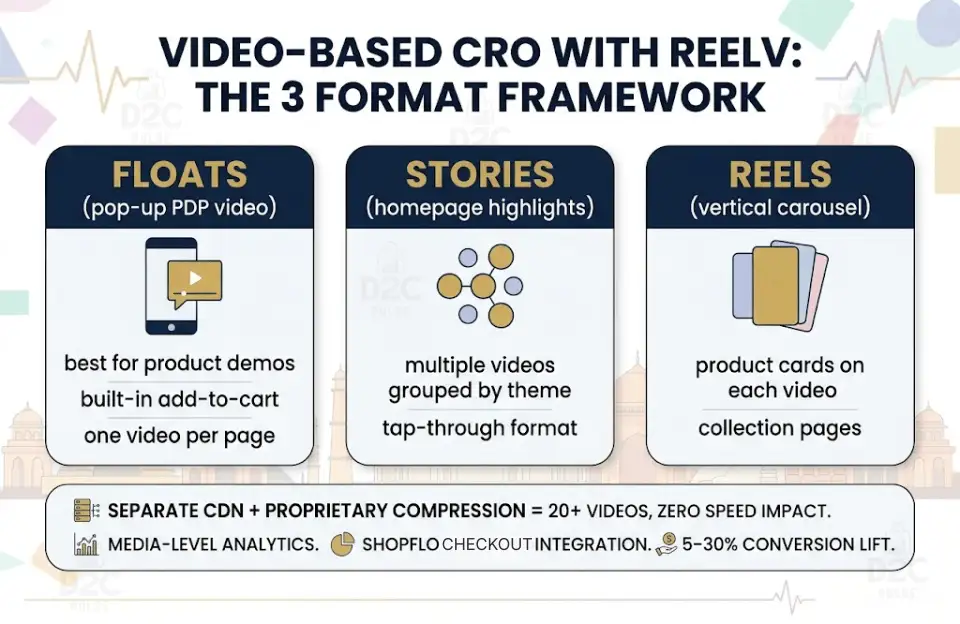
ReelV is a shoppable video app built for Shopify stores. It lets D2C brands add video to any page on their website in three formats.
Floats: A single pop-up video that plays on the bottom corner of a product page. The customer lands on the PDP and a short video plays automatically. It shows the product in use, a founder explaining the product, or a customer review. Built-in add-to-cart and buy-now buttons let the customer purchase without leaving the video. Best for targeted product demos on high-intent pages.
Stories: Instagram-highlights-style thumbnails on the homepage. Customers tap through short video clips grouped by theme: bestsellers, new arrivals, collections, how-to guides. Best for organising video content by category and driving exploration.
Reels: A scrollable vertical video carousel on any page. Multiple product videos displayed in sequence. Each video has a product card with direct add-to-cart. Best for homepage sections and collection pages where you want to showcase multiple products with video.
Why Video Is the Highest-Impact CRO Lever
Here is the core problem that conversion rate optimization for D2C solves with video. A customer lands on a product page. She sees 3 photos and a text description. She has questions. What does this look like in real life? How do I use it? Does the colour match the photo? Is it worth the price? In a store, a salesperson answers these. Online, the customer bounces.
Video answers every one of these questions. A 30-second product demo shows the product in real life. A founder video explains why it was created and who it is for. A customer testimonial provides social proof from a real person. A how-to-use video reduces uncertainty. Each video removes a reason to leave. Each removed reason lifts conversion.
The data backs this up. Pages with interactive video see up to 39% more cart additions. Landing pages with shoppable video boost conversions by up to 80%. Video reduces product returns by 35% because customers know what they are buying. Conversion rate optimization for D2C without video is leaving the biggest lever untouched.
Also Read: Achieving Profitability in D2C with various tips and tricks that has worked in the past. Learn here.
Why ReelV and Not Just Upload Videos to Shopify?
This is the question every founder asks. Why use a tool? Why not just upload videos directly to my Shopify store? Here is why.
Speed. Videos uploaded directly to your Shopify store load from the same CDN as your images, text, and buttons. They compete for bandwidth. Your page slows down. A 1-second delay costs 7% in conversions. ReelV uses a separate CDN and proprietary video compression. Your site loads fast. The videos load fast. Both happen without competing. ReelV lets you load 20+ videos on a single page with zero impact on Core Web Vitals. Direct upload cannot do this.
Shoppability. A video uploaded to Shopify is just a video. The customer watches and then has to scroll to find the add-to-cart button. ReelV embeds add-to-cart and buy-now buttons inside the video player. The customer watches, clicks, and buys. Fewer steps. Higher conversion. This is conversion rate optimization for D2C at the point of maximum intent.
Analytics. A video uploaded to Shopify gives you no data. ReelV gives you media-level analytics. Views per video. Add-to-cart clicks per video. Buy-now clicks per video. Per page, per product. You know exactly which video drives revenue and which does not. You can A/B test a founder video against a customer review on the same PDP and measure which converts better. Data-driven conversion rate optimization for D2C.
Checkout integration. ReelV integrates with ShopFlo and GoKwik, the two most popular checkout tools in Indian D2C. A customer clicks buy-now in the video and lands on an optimised checkout. Not Shopify’s default checkout. The fastest checkout flow available. Fewer drop-offs. Higher conversion.
How to Implement Video-Based CRO with ReelV: Step by Step
- Install ReelV from the Shopify App Store. Setup takes 15 minutes. No code required.
- Start with Floats on your top 5 PDPs. Pick your 5 highest-traffic product pages. Add one Float video per page. Use a product demo or customer review. This is where conversion rate optimization for D2C with video starts.
- Create 3 types of video. Product demo (show the product in use, 30 seconds). Founder story (why this product exists, 45 seconds). Customer testimonial (real person, real review, 30 seconds). You do not need a studio. A smartphone and good lighting are enough.
- Add Stories to your homepage. Group videos by theme: bestsellers, new arrivals, how-to guides. Customers browse like Instagram. This increases time on site and pages per session.
- Add Reels to collection pages. Vertical video carousel with product cards. Customers discover products through video, not just photos. Add-to-cart is one click away.
- Track everything. Use ReelV’s media-level analytics. Which video gets the most views? And which one drives the most add-to-carts? On what page there’s highest video engagement? Double down on what works. Replace what does not.
- Upgrade to the Plus plan for CRO service. ReelV’s Plus plan (Rs 299/month) includes monthly CRO reports and bi-weekly consultation calls. The ReelV team reviews your analytics, suggests placement changes, recommends new video types, and helps you optimise video strategy every month. This comes with a 5x ROI guarantee.
Also Read: Shift from Offline to Digital-First for the new age D2C Companies in the market
Results: What Brands See with ReelV
300+ D2C brands use ReelV. Brands report 5–30% conversion lift on pages with shoppable video. One brand generated Rs 20 lakh in extra monthly revenue. That is 167x ROI on the ReelV subscription. Clients include Two Brothers Organic Farms, Alpino Foods, PeeSafe, FemiSafe, Antinorm, and Boombay. Across food, personal care, wellness, and lifestyle.
ReelV pricing: Basic at Rs 29/month. Advanced at Rs 99/month (live support, unlimited customisation). Plus at Rs 299/month (CRO service, monthly reports, bi-weekly calls, 5x ROI guarantee). A 14-day free trial is available. No risk. Install. Add video. Measure. If it works, keep it. If it does not, remove it.
Key Takeaways
- Conversion rate optimization for D2C is the highest-ROI investment. Improving CVR from 2% to 3% doubles revenue from the same traffic. It costs less than buying more traffic and compounds across every channel. It is the fastest fix for rising CAC.
- Indian D2C benchmarks: average 1.5–2.5%, good 3–4%, top 4–5%+. If you are below average for your category, you have significant low-hanging fruit. Start conversion rate optimization for D2C with the biggest leaks first.
- The 8-layer CRO framework: page speed, product page optimisation, trust signals, checkout, mobile, social proof, pricing presentation, and A/B testing. Each layer removes friction. Each friction point removed lifts conversion.
- Video is the most under-used CRO lever. Pages with video see up to 80% higher conversions. 81% buy after watching. Yet most D2C PDPs have zero video. ReelV makes adding shoppable video effortless: 3 formats, separate CDN, zero speed impact, media-level analytics, checkout integration. 300+ brands. 5–30% conversion lift. 167x ROI case study.
- CRO is a discipline, not a project. Test one thing at a time. Wait for significance. Implement. Repeat. The best D2C brands run 2–4 CRO tests per month. Small improvements compound. A 1% lift per month is a 12% lift per year. That is the difference between a Rs 1 crore brand and a Rs 1.12 crore brand from the same traffic.
Frequently Asked Questions
What is conversion rate optimization for D2C websites?
Conversion rate optimization for D2C websites is the process of improving your website to turn more visitors into buyers. It covers page speed, product page design, trust signals, checkout flow, mobile experience, social proof, pricing presentation, and A/B testing. The goal: more orders from the same traffic. A 1% CVR improvement can double profit because ad costs stay flat.
What is a good conversion rate for an Indian D2C website?
For Indian D2C websites, 1.5–2.5% is average. 3–4% is good. Above 4% is top-performing. It varies by category: food and beverages convert highest (3–6%), beauty at 2–5%, fashion at 1.2–4%, and home and sleep at 0.8–3%. If your rate is below the average for your category, conversion rate optimization for D2C should be your top priority.
How does video improve conversion rates on D2C websites?
Video answers the questions that images and text cannot. What does this look like in real life? How do I use it? Is it worth the price? Product pages with interactive video see up to 39% more cart additions. Landing pages with shoppable video boost conversions by up to 80%. Video reduces returns by 35%. ReelV makes video-based conversion rate optimization for D2C effortless by adding shoppable video to Shopify stores with zero speed impact.
How does ReelV improve conversion rates?
ReelV adds shoppable video to Shopify stores in three formats: Floats (pop-up PDP videos), Stories (homepage highlights), and Reels (vertical carousels with add-to-cart). It uses a separate CDN and proprietary compression, so 20+ videos load with no speed impact. Built-in add-to-cart and buy-now buttons let customers buy from inside the video. Media-level analytics show which video drives revenue. 300+ brands use it. Results: 5–30% conversion lift. 167x ROI case study. Plans start at Rs 29/month.
What should I optimise first on my D2C website?
Start with the biggest leaks. Check page speed (target under 3 seconds mobile). Fix your top 5 product pages (add video, reviews, trust signals). Optimise checkout (guest checkout, UPI, no surprise fees). Then add video via ReelV on your highest-traffic PDPs. These four fixes alone can lift conversion rate by 30–50%. Then move to A/B testing for continuous improvement.