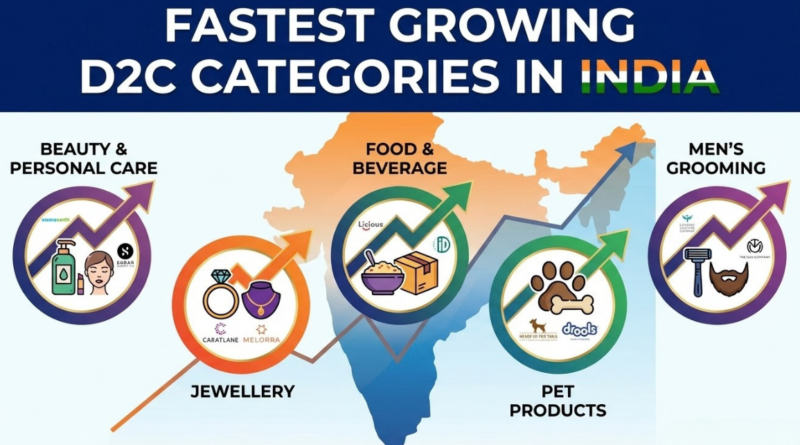
Fastest Growing D2C Categories in India: Where the Next Wave of Growth Is Coming From
A Data-Backed Breakdown of the 10 Hottest Categories — Market Size, Growth Rate, Key Brands, and Why Each One Is Exploding
India’s D2C market crossed $80 billion in 2024 and is racing toward $100 billion in 2025. But that headline number hides a more interesting story: the growth is not spread evenly. Some categories are exploding. Others are slowing down. And a few new ones are emerging from almost nowhere.
If you are a founder deciding what to build, an investor deciding where to put capital, or an operator deciding where to focus — knowing which are the fastest growing D2C categories in India right now is the most important market intelligence you can have.
This guide maps ten categories that are growing fastest. For each one, we cover the market size, growth rate, key D2C brands winning in the space, the structural forces driving growth, and the unit economics reality. No hype. No predictions pulled from thin air. Just data, patterns, and analysis you can act on.
These are the fastest growing D2C categories in India in 2025 and beyond. Sorted by a combination of growth rate, funding momentum, and the structural tailwinds that suggest sustained expansion — not just a temporary spike.
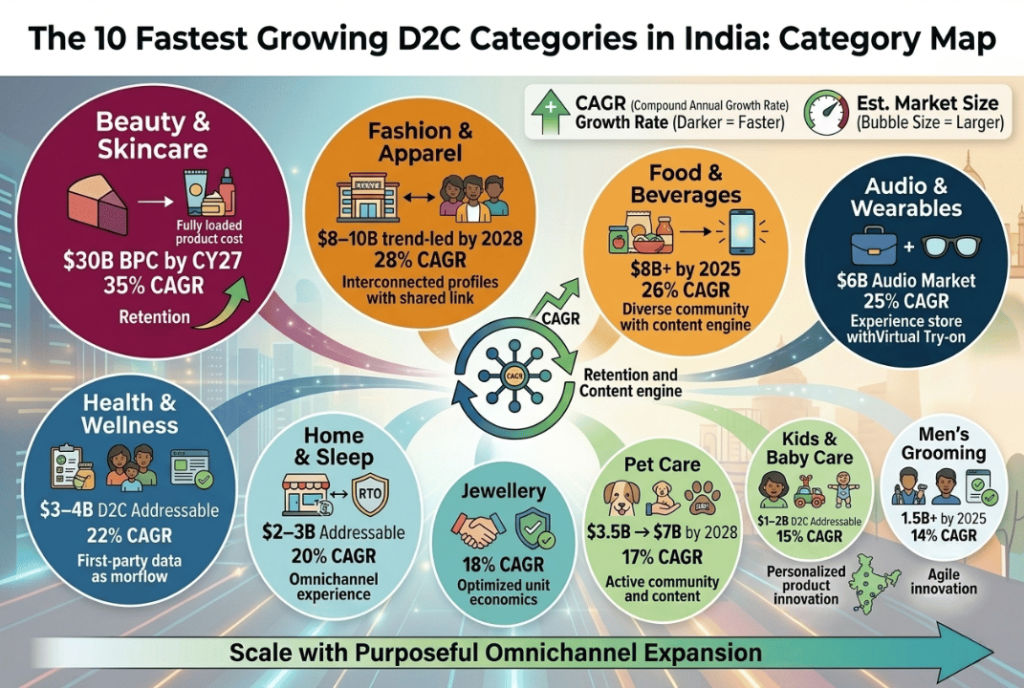
The Fastest Growing D2C Categories in India: At a Glance
Before we dive deep into each category, here is the summary table. This is the single most useful reference for understanding where growth is concentrated.
| Category | Est. Market Size | Growth Rate | Gross Margins | Key D2C Brands |
| Beauty & Skincare | $30B BPC by CY27 | ~25% CAGR | 60–80% | Minimalist, Mamaearth, Foxtale, Dot & Key, Plum |
| Fashion & Apparel | $8–10B trend-led by 2028 | 18–22% CAGR | 55–70% | Snitch, Bewakoof, Libas, The Souled Store |
| Food & Beverages | $8B+ by 2025 | 20–25% CAGR | 35–55% | Country Delight, Licious, Sleepy Owl, Farmley |
| Audio & Wearables | $6B audio market | 24% CAGR (2020–25) | 30–50% | boAt, Noise, GoBoult |
| Health & Wellness | $3–4B D2C addressable | 25–30% CAGR | 55–75% | HealthKart, Traya, Kapiva, WOW Life Science |
| Home & Sleep | $2–3B addressable | 15–20% CAGR | 40–60% | Wakefit, SleepyCat, Pepperfry |
| Jewellery | $2B+ D2C addressable | 25–30% CAGR | 50–70% | GIVA, CaratLane, BlueStone, Palmonas |
| Pet Care | $3.5B → $7B by 2028 | 25–30% CAGR | 40–55% | Supertails, Heads Up For Tails, Drools |
| Kids & Baby Care | $1–2B D2C addressable | 20–25% CAGR | 50–65% | Mamaearth, SuperBottoms, Slurrp Farm, The Moms Co. |
| Men’s Grooming | $1.5B+ by 2025 | 18–22% CAGR | 55–70% | Bombay Shaving Co., The Man Co., Ustraa, Beardo |
1. Beauty and Skincare: The Largest and One of the Fastest Growing D2C Categories in India
Beauty and personal care is the undisputed leader among the fastest growing D2C categories in India. The overall Indian BPC market is projected to reach a GMV of Rs 2.6 lakh crore (around $30 billion) by CY27. Skincare alone is growing at roughly 14.6% annually, with the broader personal care D2C segment compounding at nearly 25% CAGR through 2031.
What makes this category extraordinary for D2C founders is the margin structure. Gross margins of 60–80% give brands enough room to invest in marketing, absorb return costs, and still reach contribution margin positive. That is why beauty has attracted the most D2C funding of any category in India.
Why it is growing: A shift from mass-market products to ingredient-conscious, science-backed formulations. Indian consumers now read labels. They know what niacinamide, salicylic acid, and vitamin C do. This knowledge shift favours D2C brands that educate and sell, over legacy brands that just distribute.
Key signal: HUL acquired a 90.5% stake in Minimalist for Rs 2,955 crore in January 2025. Foxtale raised $30 million in Series B (April 2025). These are not small bets. Legacy giants and growth investors are both piling into D2C beauty.
2. Fashion and Apparel: Volume, Speed, and the Rise of Trend-Led D2C
Fashion held the largest share of India’s D2C e-commerce in 2025, at around 25% of total GMV. Trend-led fashion is projected to grow four times, reaching Rs 68,000–85,000 crore ($8–10 billion) by 2028, with over half of sales coming from online platforms.
The D2C fashion brands winning today are not the ones with the largest catalogues. They are the ones with the fastest product cycles. Snitch, the men’s fast-fashion D2C brand, raised $40 million in Series B in June 2025. It launches new collections weekly. Speed is the competitive moat.
Why it is growing: Young Indians want fresh styles at affordable prices, refreshed constantly. They do not want their grandfather’s formal-wear brand. D2C gives these consumers exactly what they want: trend-responsive, direct-priced, digitally native fashion.
The challenge: Return rates in fashion run 20–25%. Every returned order is a cost with zero revenue. RTO management is the difference between profitable and unprofitable fashion D2C brands in India.
3. Food and Beverages: Subscriptions, Fresh Delivery, and the Fastest Growing D2C Categories for Repeat Revenue
Food and beverages is one of the fastest growing D2C categories in India for a structural reason: food is consumed daily. That means repeat purchases are built into the product. No other D2C category has this natural advantage.
Country Delight raised around $25 million in fresh funding in 2025, powered by its subscription-based daily milk and grocery delivery. Licious targets a $2 billion valuation for a 2026 IPO. Farmley raised $40 million to scale its dry fruits and snacks business. Sleepy Owl is making specialty coffee mainstream.
Why it is growing: Consumers want healthier, cleaner, and more transparent food. They want to know where their milk comes from, what is in their protein bar, and whether their coffee beans are ethically sourced. D2C brands provide this transparency in a way that traditional FMCG cannot.
The challenge: Gross margins in food are lower (35–55%) than in beauty or fashion. Cold chain logistics add complexity and cost. Price sensitivity is high. To make food D2C work in India, you need strong subscriptions, high repeat rates, or premium positioning — ideally all three.
4. Audio and Wearables: A Maturing Category Still Among the Fastest Growing D2C Categories
India’s lifestyle electronics market has grown at a 24% CAGR between 2020 and 2025. boAt dominates with 34% volume share in branded personal audio. But the growth rate is slowing. Revenue for the category leader dipped slightly in FY25.
The opportunity now is in premiumisation and new form factors. boAt’s Nirvana premium range grew with double-digit numbers in FY25. Smart tags, dashcams, and connected accessories are expanding the addressable market beyond earphones and speakers.
Why it still qualifies: India’s core audio market is a $6 billion opportunity. Penetration of personal audio devices remains low compared to markets like China and the US. The category has room to grow — just not at the explosive pace of 2020–2022.
[Internal link: Read the boAt Case Study for the full breakdown of India’s largest audio D2C brand]
5. Health and Wellness: High Trust Barriers, High Margins, High Growth
Health and wellness is quietly becoming one of the fastest growing D2C categories in India. This includes nutraceuticals, supplements, hair loss treatments, Ayurvedic wellness, and functional health products.
Traya (hair loss solutions) is expanding into the UAE and targeting Rs 2,000 crore revenue. Kapiva has built a modern Ayurveda brand with strong D2C presence. HealthKart continues to dominate the supplements space. WOW Life Science bridges wellness and personal care.
Why it is growing: Post-COVID health consciousness is real and lasting. Indians are spending more on preventive health, immunity, gut health, and stress management. The wellness consumer is willing to pay premium prices — if the brand earns their trust.
The challenge: Trust is harder to build in health than in beauty or fashion. Claims need clinical backing. CAC is higher because consumers need more education before they buy. But once trust is established, repeat rates and LTV are among the highest of any D2C category.
6. Home and Sleep Solutions: High AOV, Low Frequency, Data-Driven Growth
Wakefit has built a Rs 1,000+ crore business selling mattresses and home solutions directly to consumers. It has entered the UAE market. SleepyCat and others are following. The category is growing at 15–20% annually.
Why it is growing: Urbanisation is creating millions of new households every year. Young professionals setting up their first homes want quality products without the 3x markup of traditional furniture retail. D2C eliminates the showroom cost and passes the savings to the customer.
The challenge: Mattresses and furniture are low-frequency, high-AOV purchases. You buy a mattress once every 5–10 years. That means LTV depends on category expansion (adding pillows, bed frames, sofas, desks) rather than repeat purchases of the same product. Wakefit’s expansion from mattresses to full home solutions follows this logic.
7. Jewellery: The Breakout Star Among Fastest Growing D2C Categories in India
Jewellery is the surprise entry in this list. GIVA raised Rs 530 crore ($61.5 million) in Series C in June 2025 — one of the largest pure D2C funding rounds of the year. BlueStone went public in August 2025 with Rs 1,770 crore revenue. CaratLane (a Titan subsidiary) reported Rs 3,583 crore revenue with 350+ stores.
Why it is growing: Young Indian women want affordable, everyday jewellery that matches their outfits — not traditional gold jewellery locked in a safe. GIVA started with silver, expanded to gold and lab-grown diamonds, and now operates 240+ stores. The category is shifting from occasion-based buying to everyday wearing. That frequency shift is what makes it one of the fastest growing D2C categories in India right now.
Key economics: Gross margins of 50–70% on design-led jewellery. High AOV. Growing repeat rates as customers add pieces to their collection. Low return rates compared to fashion.
8. Pet Care: The Newest Entry Among India’s Fastest Growing D2C Categories
India’s pet care market is projected to double from $3.5 billion in 2024 to $7 billion by 2028. Pet ownership rose from 26 million pets in 2019 to 32 million in 2024. And pet care D2C startups raised $124 million across 64 funding rounds between 2022 and November 2025.
Supertails has raised $63.8 million in total funding and is targeting Rs 250 crore ARR. Heads Up For Tails moved toward a $25 million Series B round in 2025. The category is being built from scratch — and it is being built D2C-first.
Why it is growing: Pet humanisation is the driving force. Urban millennials and Gen Z treat pets as family members. They spend on premium food, grooming, veterinary care, accessories, and even pet fashion. The emotional attachment creates a willingness to pay that most consumer categories cannot match.
Why D2C works here: Traditional retail has poor selection for pet products. Consumers need guidance on nutrition and health. D2C brands can bundle products, services (vet consultations), and content (pet care education) into an integrated experience that offline stores cannot replicate.
9. Kids and Baby Care: Trust-Driven, Safety-First, Repeat-Heavy
This is where the Mamaearth growth story began — a parent’s frustration at not finding safe products for their baby. That frustration is shared by millions. The kids and baby care D2C market is growing at 20–25% annually.
SuperBottoms (cloth diapers), Slurrp Farm (healthy kids food), The Moms Co. (natural baby care), and Mamaearth’s baby line all target parents who want toxin-free, certified-safe products. This is a trust-first category. Parents research obsessively before buying anything for their child.
Why it is growing: India has 25+ million births per year. Every new parent is a potential D2C customer. Rising awareness about ingredient safety, combined with higher disposable incomes, is pushing parents toward premium, natural, and certified-safe brands.
Why D2C works here: Parents trust transparent, educational D2C brands more than opaque mass-market alternatives. The ability to show certifications, list every ingredient, and provide customer reviews builds the trust that this category demands.
[Internal link: Read the Mamaearth Growth Story for how one baby care brand became a Rs 2,000 Cr company]
10. Men’s Grooming: The Category That Keeps Expanding Beyond Shaving
Bombay Shaving Company, The Man Company, Ustraa, and Beardo collectively built a men’s grooming market that barely existed a decade ago. The market is estimated at over $1.5 billion and growing at 18–22% annually.
What started with razors and shaving creams has expanded into skincare, beard care, body wash, fragrances, and even hair styling. Bombay Shaving Company now has products on Amazon, Flipkart, and in 30,000+ retail stores. It has expanded into women’s hair removal (under the Bombae sub-brand), which now accounts for 25% of business.
Why it is growing: Indian men, especially millennials and Gen Z, are spending more on personal grooming than any previous generation. Social media has normalised skincare routines for men. The stigma is gone. The demand is real.
Key trend: The fastest growing D2C categories in India tend to start in a narrow niche and then expand. Men’s grooming started with shaving. It now covers the entire personal care spectrum. The category expansion is where the growth comes from.
How Founders Should Use This Map of the Fastest Growing D2C Categories in India
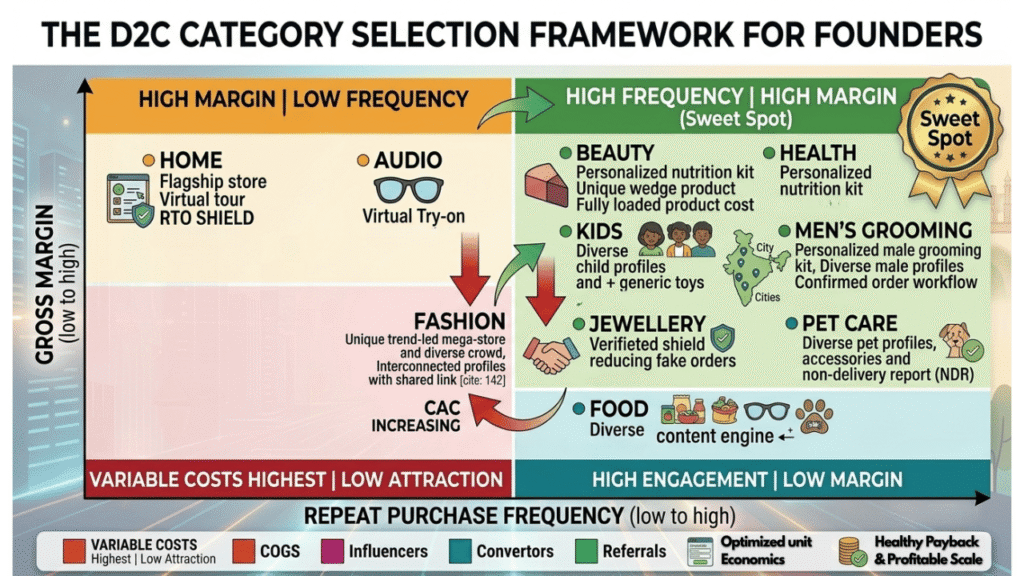
If you are deciding which category to build in, here is a simple framework:
- Match margins to marketing intensity. High-CAC categories (beauty, health) need high gross margins (60%+). Low-margin categories (food) need subscriptions or very high repeat rates.
- Check the repeat purchase structure. Consumable products (skincare, food, supplements) naturally drive repeat revenue. Durable products (mattresses, electronics) do not. If your product is a one-time buy, your first-order economics must work on their own.
- Follow the funding signal. Investors do deep research before writing cheques. When a category attracts concentrated funding (pet care in 2025, jewellery in 2025, food in 2024), it signals that the structural conditions for growth are in place.
- Look for trust gaps. The best D2C categories are the ones where consumers do not trust the existing options. Baby care (toxins), pet care (poor selection), health (unverified claims) — these trust gaps are where D2C brands win.
- Time the category lifecycle. Some of the fastest growing D2C categories in India are already crowded (beauty, audio). Others are early-stage with room for new entrants (pet care, jewellery, kids). Entering an early-stage category with fewer competitors can be more rewarding than fighting in a crowded one.
[Internal link: Read Understanding Unit Economics for D2C Brands in India for how to model the numbers before you launch]
Key Takeaways
For founders, the sweet spot is high margins plus high repeat — categories like beauty, health, kids, and pet care sit in this quadrant.
Beauty and skincare is the largest and fastest growing D2C category in India, with ~25% CAGR, 60–80% gross margins, and massive investor interest (Minimalist’s Rs 2,955 Cr acquisition, Foxtale’s $30M Series B).
Pet care is the newest breakout category — doubling from $3.5B to $7B by 2028, with $124M in startup funding and D2C-first brands like Supertails building integrated care ecosystems.
Jewellery is the surprise performer — GIVA’s Rs 530 Cr raise, BlueStone’s IPO, and a fundamental shift from occasion-based to everyday wearing are powering 25–30% growth.
Food and beverages drives the highest natural repeat rates but requires subscriptions or premium positioning to overcome lower gross margins.
The fastest growing D2C categories in India share four traits: rising consumer awareness, a trust gap in existing options, strong gross margins, and structural tailwinds from digital adoption and tier-2/3 city expansion.