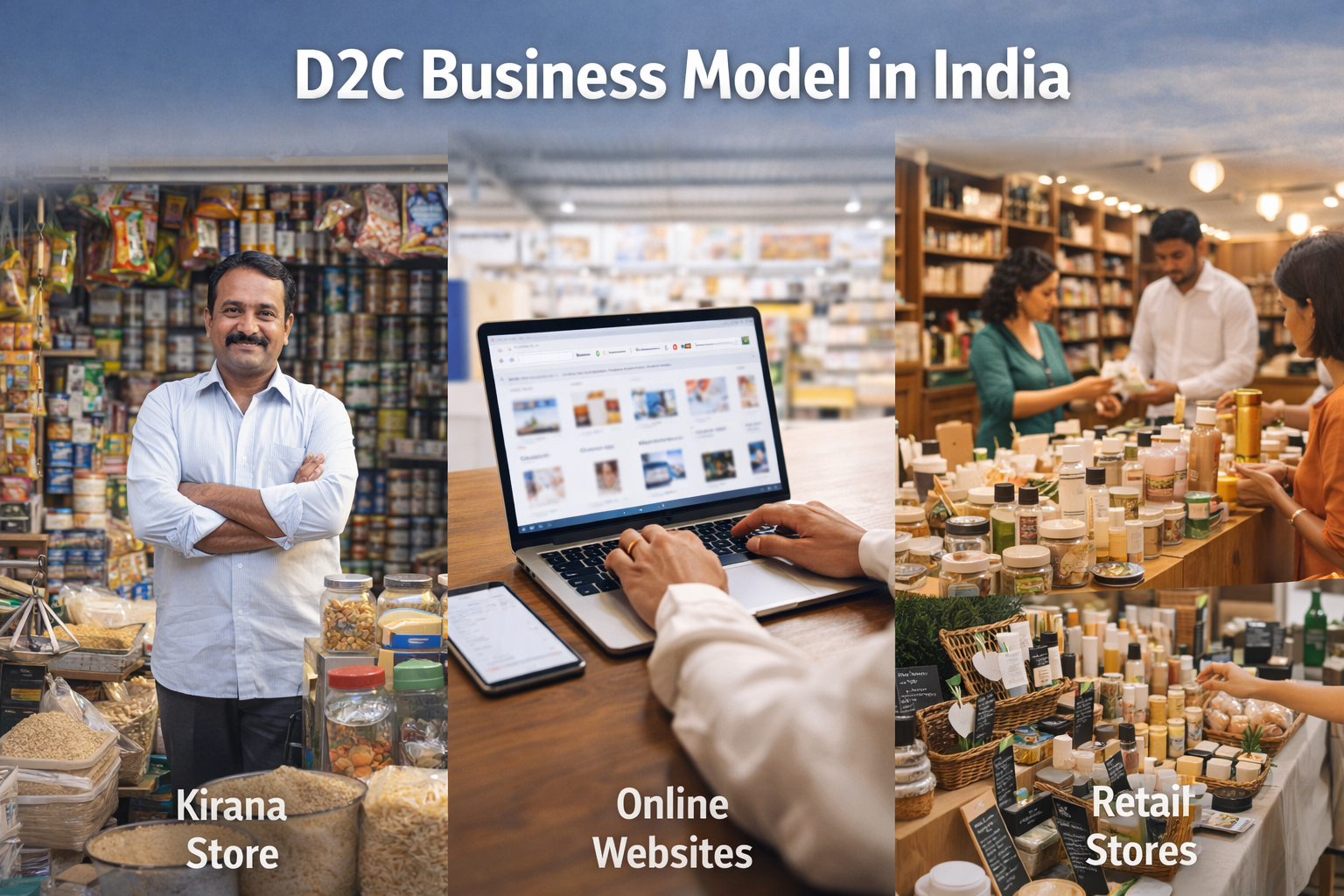
What is the D2C Business Model in India?
The Complete Guide for Founders, Operators, and Investors [2026]
India’s consumer market is going through its biggest structural shift in decades. Thousands of new brands are skipping the traditional route of distributors, wholesalers, and retail shelves. Instead, they’re selling directly to customers through their own websites, apps, and increasingly, their own stores. This is the D2C business model — Direct-to-Consumer. And it’s fundamentally changing how brands are built, scaled, and funded in India.
Whether you’re a founder exploring this model, an operator running a D2C brand, a SaaS company building tools for this ecosystem, or an investor evaluating the space — understanding how D2C actually works in the Indian context is essential.
This guide breaks it all down. No jargon. No fluff. Just a clear, structured explanation of what the D2C business model means in India, how it operates, why it’s growing, and what separates the brands that make it from those that don’t.
What Does D2C Actually Mean?
D2C stands for Direct-to-Consumer. At its core, it’s a business model where a brand sells its products directly to end customers — without relying on middlemen like distributors, wholesalers, or third-party retailers.
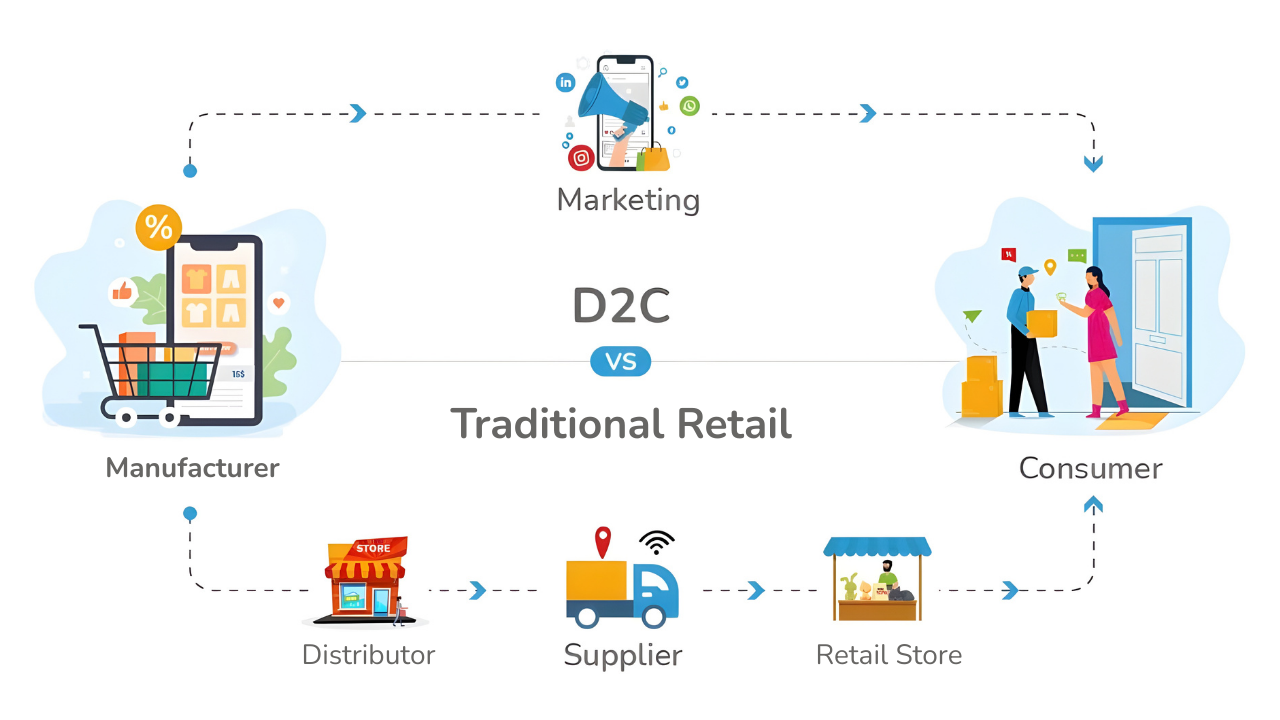
In a traditional setup, a product passes through multiple layers before reaching the customer: manufacturer → C&F agent → distributor → retailer → consumer. Each layer adds cost, reduces the brand’s control, and creates distance from the person who actually buys the product.
D2C flips this entirely. The brand owns the full relationship with the customer — from the first touchpoint to the final delivery and beyond.
Think of D2C as: “I control product, pricing, brand, data, and distribution — and nobody sits between me and the customer.”
In the Indian context, most successful D2C brands operate through their own website or app as the primary channel. They may use marketplaces like Amazon or Flipkart for discovery and reach, but the brand’s own platform remains the core revenue engine.
And here’s what makes the Indian D2C story interesting: most serious D2C brands don’t stay online-only. They start digital, build brand pull, and then expand into offline stores, modern trade, or franchise models. Think boAt, Lenskart, Mamaearth, and Nykaa — all started as digital-first D2C brands and are now present across multiple channels. This evolution from “online-only” to “omnichannel” is a defining pattern of D2C in India.
Why the D2C Model Is Booming in India
The growth of D2C in India isn’t accidental. It’s driven by a set of structural forces that have come together over the past five to seven years.
The Market Opportunity
India’s D2C market has grown from a niche segment to a significant force in e-commerce. Current estimates place the D2C channel at around USD 10–12 billion in e-commerce sales, with projections pointing toward USD 60 billion by 2030. Broader estimates that include omnichannel D2C revenue push the total market value above USD 100 billion by 2025.
These aren’t speculative numbers. They’re backed by real consumer behavior shifts and infrastructure improvements.
Key Growth Drivers
- Massive internet adoption: India has over 700 million internet users. Social-first discovery through Instagram, YouTube, influencers, and user-generated content has made it significantly easier for new brands to reach niche segments without massive upfront budgets.
- Millennial and Gen Z buying power: These consumers actively seek new, authentic, problem-solving brands. Clean beauty, health and wellness, sustainability, Indian aesthetics — these are categories where D2C brands have found strong product-market fit.
- Marketplace fatigue: Selling on Amazon and Flipkart has become expensive. High commissions, intense price competition, and increasing ad spend have pushed brands to build their own D2C channels where they control margins and customer data.
- Logistics infrastructure: Companies like Delhivery, Shiprocket, and Ecom Express have made pan-India shipping feasible even for small brands. What was once a major barrier to entry is now a solvable problem.
- Post-COVID consumer shift: The pandemic accelerated the move to online buying across categories — health, wellness, personal care, food, and home. D2C brands were perfectly positioned to capture this demand.
- Digital payments revolution: UPI, India Stack, and digital payment infrastructure have reduced friction in online transactions. COD is still significant, but prepaid orders are rising steadily, improving unit economics for D2C brands.

How the D2C Model Works in India (Operationally)
A D2C brand in India runs four tightly linked systems. Understanding these is essential if you’re building, operating, or investing in this space.
1. Product and Brand
Every strong D2C brand starts with a sharp wedge — a clearly defined problem or aspiration. Mamaearth started with toxin-free baby care. boAt built around affordable, design-led audio. Wakefit focused on better sleep at honest prices. The narrower the initial wedge, the stronger the brand’s positioning.
Manufacturing is typically done through contract manufacturers, especially in beauty, personal care, food, and nutraceuticals. Some brands own manufacturing at scale, but most start with third-party production and invest in formulation, quality control, and brand design.
2. Distribution Channels
This is where the D2C model in India gets nuanced. Most brands use a layered distribution approach:
- Own website or app (Shopify, WooCommerce, or custom stack) — the primary channel for margin, data, and brand experience.
- Marketplaces (Amazon, Flipkart, Nykaa, Blinkit) — used for volume, discovery, and reaching customers who default to these platforms.
- Own offline presence — experience stores, shop-in-shop setups, or kirana partnerships that come later when the brand has built pull.
The key principle: your own channel is for margin and data. Marketplaces are for reach. Offline is for trust and scale. The best D2C brands manage all three strategically.
3. Marketing Engine
Early-stage D2C brands lean heavily on performance marketing — Meta ads, Google ads, and marketplace advertising. As brands scale, the channel mix shifts toward:
- Content marketing and SEO for organic discovery.
- Influencer and creator partnerships for credibility and reach.
- Brand marketing to build recall and reduce dependence on paid channels.
- Retention marketing through email, WhatsApp, and SMS to drive repeat purchases.
The brands that survive long-term are the ones that successfully make this transition from paid-heavy to a balanced marketing mix.
4. Customer Experience and Retention
In D2C, the customer relationship doesn’t end at purchase. Fast delivery, no-hassle returns, proactive support, and lifecycle communication are what drive repeat purchases and lifetime value.
In India specifically, WhatsApp has become a powerful channel for order updates, product education, cross-selling, and reactivation. Brands that use it well see measurably better retention numbers.
The Typical Tech Stack of a D2C Brand in India
If you’re building a D2C brand, here’s the core technology infrastructure most Indian D2C brands operate on:
| Layer | Typical Tools / Solutions |
| Storefront | Shopify (most common), WooCommerce, or custom-built platforms |
| Payments | Razorpay, Cashfree, PayU — integrated with COD options |
| CRM & Data | Tools to track cohorts, repeat rate, LTV, funnel metrics, and audience segments |
| Logistics | 3PL partners (Delhivery, Shiprocket, Ecom Express) for warehousing + last-mile delivery |
| Marketing | Meta/Google ads, marketplace ad platforms, affiliate networks, influencer tools |
| Retention | Email (Klaviyo, WebEngage), WhatsApp (Interakt, Wati), SMS automation |
| Analytics | Google Analytics, Mixpanel, or platform-native dashboards for funnel and cohort tracking |
Also Read : Tech Stack of a ₹100 Cr D2C Brand
D2C vs Traditional Retail in India: How They Compare
Understanding how D2C differs from traditional retail is critical for anyone entering this space. Here’s a structured comparison:
| Aspect | D2C Model | Traditional Retail |
| Distribution | Brand’s own website/app + selective marketplace presence. Minimal intermediaries. | Multi-layer chain: manufacturer → C&F → distributor → retailer → consumer. |
| Brand Control | Full control over pricing, storytelling, packaging, and customer experience. | Moderate. Retailer influences pricing, shelf placement, and brand visibility. |
| Customer Data | Rich first-party data: behaviour, cohorts, feedback in real time. | Limited. Aggregated data from distributors and periodic market research. |
| Speed | Fast. Agile product launches into micro-segments and white spaces. | Slow. Requires distributor alignment, retailer incentives, and inventory pipeline reset. |
| Margins | Higher gross margin per unit (no middlemen), but CAC and logistics can eat into this. | Lower per-unit margin but high volume. Trade spend instead of digital CAC. |
| Reach | Strong in urban and semi-urban pockets. Rural reach improving via logistics. | Deepest reach into Bharat through kiranas, bazaars, and general trade. |
In practice, the winning formula in India is “D2C-first, omnichannel later” — validate and build brand online, then plug into offline once unit economics and brand recall are strong.
For a deeper comparison, read: D2C vs Marketplace vs Omnichannel: Which Model Wins in India?
D2C Success Stories in India: What They Did Right
Theory is useful. But patterns from real brands are where the actionable insight lives. Here are five brands that have defined D2C in India:
boAt
Built India’s largest audio accessories brand around aspirational design, influencer-driven marketing, and sharp pricing. Started online, scaled through marketplaces, then expanded into offline retail. boAt proved that D2C brands can compete with global incumbents in consumer electronics.
Mamaearth
Started with toxin-free baby care products when the founders couldn’t find safe options for their own child. Built trust through content, influencer education, and a strong “no nasties” brand narrative. Expanded from baby care into a full personal care brand. IPO-ready within seven years of launch.
Lenskart
D2C eyewear with heavy technology investment — virtual try-ons, home eye tests, and AI-driven recommendations. Built a large network of owned and franchise stores. Lenskart is the textbook example of how D2C brands can go deep into omnichannel without losing the data-first advantage.
Wakefit
Mattresses and sleep products sold directly, with home trials and deep education around sleep quality. Used the D2C model to undercut established players on both price and convenience, then expanded into the broader home and living category.
Minimalist
A skincare brand built entirely on science-led positioning and ingredient transparency. While most personal care brands in India marketed with emotions and celebrity endorsements, Minimalist went the opposite way — leading with active ingredient percentages, research references, and clinical claims. This created a new sub-category in Indian D2C skincare.
The pattern across all these brands: narrow wedge problem → strong brand point of view → heavy digital storytelling → omnichannel expansion.
Read the full: boAt Business Case Study | Mamaearth Growth Story | Minimalist Brand Strategy
Why Indian Brands Are Shifting to D2C
The move toward D2C isn’t just a startup trend. Even large conglomerates are launching D2C brands or acquiring digital-native ones. Here’s what’s driving this:
- Margin control. Cutting out intermediaries unlocks higher gross margins, which can be reinvested into product quality and marketing.
- Customer intimacy. Owning first-party data allows granular segmentation, personalised campaigns, and better product decisions based on real behaviour.
- Faster innovation. D2C brands use agile processes and rapid micro-launches to capture white spaces before incumbents can react.
- Brand narrative control. Digital-native consumers reward authenticity and storytelling. D2C lets brands craft this directly without retailer distortion.
- Platform risk hedge. Brands that are marketplace-heavy are vulnerable to policy shifts and commission hikes. D2C provides strategic insurance and long-term sustainability.
Challenges Every D2C Brand Faces in India
D2C is powerful, but it’s not easy. Here are the real challenges that separate the brands that survive from those that don’t:
Economics and Operations
- High customer acquisition cost (CAC): Competition on Meta and Google has driven up ad costs significantly, especially in metros and crowded categories like beauty and fashion.
- Logistics and COD burden: Last-mile delivery can consume up to 30% of the retail price. Cash-on-delivery adds complexity with high RTO (return-to-origin) rates and cash flow pressure.
- Returns and failed deliveries: Complex return logistics and NDR (non-delivery report) management hurt profitability and require dedicated operational systems.
- Scaling without breaking: Maintaining product quality, service standards, and margins becomes exponentially harder as order volumes grow.
Market and Competition
- Category clutter: Beauty, fashion, wellness, and food are crowded. Simply being “clean” or “sustainable” is no longer enough to differentiate.
- Regulatory overhead: Data protection, consumer rights, e-commerce regulations, and category-specific compliance add cost and complexity.
Also Read: Lessons from Failed D2C Startups in India for a deeper analysis of what goes wrong
Types of D2C Business Models in India
Not all D2C brands operate the same way. The model you choose depends on your category, target audience, and growth strategy:
- Pure-play D2C: Sell exclusively through your own website/app. Maximum control, but requires significant investment in acquisition and brand building. Works best in categories with strong repeat purchase behaviour.
- D2C + Marketplace hybrid: Own website for margin and data, marketplaces for volume and discovery. This is the most common model in India. Most brands operate here.
- Subscription D2C: Recurring delivery model for consumables — personal care, health supplements, pet food, coffee. Offers predictable revenue but requires strong retention mechanics.
- Omnichannel D2C: Digital-first brand that expands into owned offline stores, franchise models, or modern trade. Lenskart, Mamaearth, and boAt follow this trajectory.
- Marketplace-led D2C: Brands that derive majority revenue from marketplaces while maintaining a D2C presence. Common in electronics and fashion where marketplace traffic dominates.
For a complete breakdown:Types of D2C Business Models: Which One Fits Your Brand?
What Separates Successful D2C Brands from the Rest
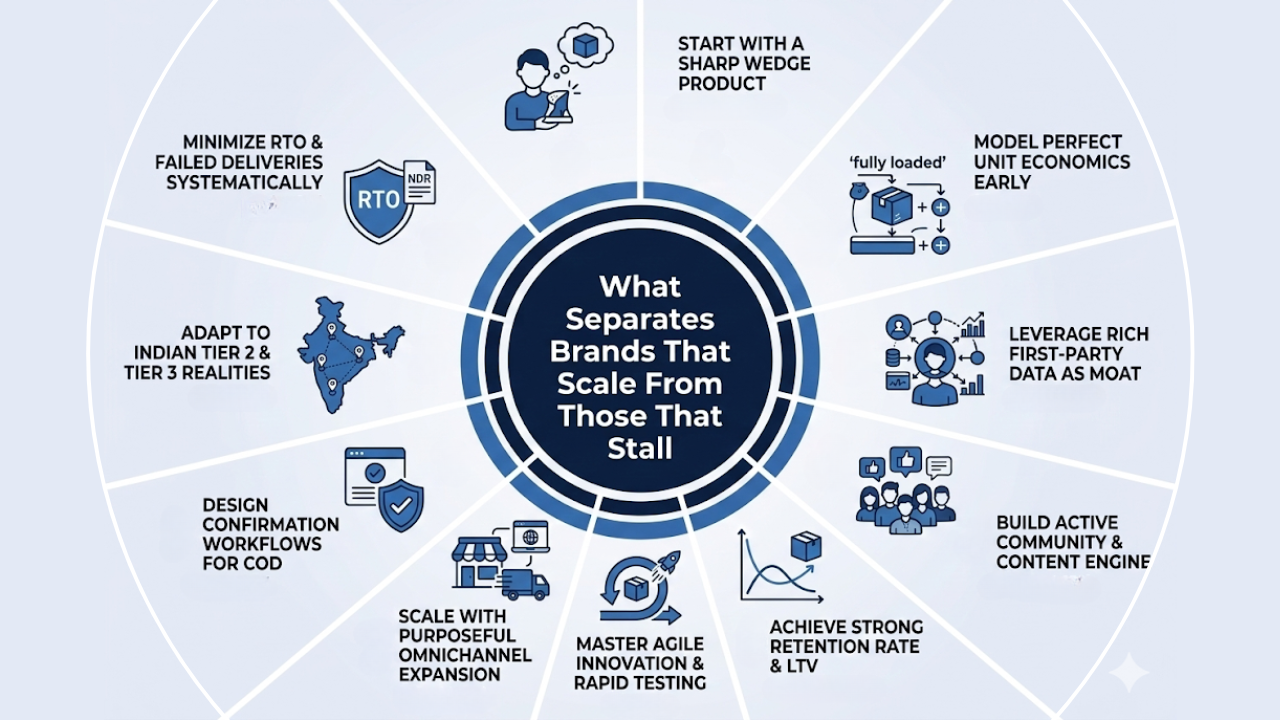
After analysing dozens of Indian D2C brands — both successes and failures — clear patterns emerge. The brands that win consistently do these things:
They start with an edge, not just a product
They don’t launch generic SKUs. They build around a sharply defined problem, persona, or cultural angle. PCOS-focused nutrition, Bharat-first formats, climate-specific formulations — the more specific the wedge, the stronger the initial pull.
They get unit economics right from day one
They model fully-loaded unit economics before scaling: COGS, packaging, payment gateway fees, platform commissions, logistics, COD costs, NDR/RTO, and marketing spend. Brands that ignore this maths early end up burning cash with no path to profitability.
They treat data and retention as the core moat
They build proper data infrastructure: cohort analysis, CAC by channel, payback periods, contribution margins, and retention curves. And they aim for strong repeat purchase rates — this is what justifies high acquisition costs.
They invest in content and community
They invest in storytelling and education around the problem they solve, not just “buy now” creative. They use niche-relevant creators rather than celebrity endorsements. And they build community layers — loyalty programs, WhatsApp groups, closed communities — where feedback and advocacy compound over time.
They design for Indian realities
They expect high COD rates and design confirmation workflows to reduce fake orders. They monitor NDR/RTO reasons closely and optimise packaging and address capture. And if their thesis includes tier-2 and tier-3 cities, they adapt product, messaging, and price points to those realities.
Also Read: 7 Key Characteristics of Successful D2C Brands in India for the complete framework
Where D2C in India Is Heading: The Next 3–5 Years
The D2C model in India is still maturing. Here’s what the trajectory looks like:
- Accelerated growth: D2C adoption is growing almost three times faster than overall e-commerce marketplace growth. The channel could touch USD 60 billion by 2030.
- Technology-heavy experiences: AR try-ons, AI-powered recommendations, and hyper-personalisation are becoming table stakes in premium categories.
- Omnichannel by default: Most strong D2C brands will not remain purely online. The future is hybrid brands with tight control over customer data and experience across all touchpoints.
- Global from India: Cross-border D2C from India to the US, EU, and Middle East will grow, leveraging Make in India positioning and India-specific intellectual property.
- Consolidation: Well-funded brands will acquire niche labels to expand categories and customer segments without proportional increases in marketing spend.
- Profitability focus: The era of growth-at-all-costs is ending. Investors and operators are now optimising for contribution margins, positive unit economics, and sustainable growth.
Key Takeaways
- D2C is not just “selling online.” It’s a business model where the brand controls product, pricing, data, distribution, and the entire customer relationship.
- India’s D2C market is massive and growing fast — projected to reach USD 60–100 billion in the mid-2020s, driven by internet adoption, Gen Z consumers, and infrastructure improvements.
- The operational model has four pillars: product and brand, distribution channels, marketing engine, and customer experience.
- Most successful Indian D2C brands evolve from online-only to omnichannel — this is the dominant pattern, not an exception.
- Unit economics, retention, and data are the moats — not just brand or product. The brands that get these right are the ones that survive and scale.
- Challenges are real: high CAC, logistics complexity, COD burden, and category clutter. But these are solvable problems for brands that approach them systematically.
Frequently Asked Questions
D2C (Direct-to-Consumer) is a business model where a brand sells its products directly to customers through its own channels — website, app, or stores — without relying on distributors, wholesalers, or third-party retailers. The brand controls the full customer experience from discovery to delivery.
E-commerce is a broad term for any online selling. D2C specifically means selling through your own brand channels. A brand selling on Amazon is doing e-commerce but not D2C. A brand selling through its own Shopify store is doing D2C e-commerce. The key difference is ownership of the customer relationship and data.
India’s D2C e-commerce channel is estimated at USD 10–12 billion currently, with the broader D2C market (including omnichannel revenue) projected to exceed USD 100 billion by 2025. Growth projections point to USD 60 billion for the pure D2C channel by 2030.
Some of the most successful Indian D2C brands include boAt (audio), Mamaearth (personal care), Lenskart (eyewear), Wakefit (home and sleep), Minimalist (skincare), Sugar Cosmetics (beauty), Country Delight (dairy), and Wow Skin Science (personal care). Each has built strong brand recall and scaled using the D2C-first approach.
D2C can be profitable in India, but it requires disciplined unit economics. The brands that achieve profitability are the ones that balance acquisition costs with strong retention, maintain healthy gross margins, and manage logistics costs effectively. Not every D2C brand is profitable — but the model itself supports profitability when executed right.