Logistics Challenges for D2C Brands in India: The Problems That Kill Brands and How to Solve Them
Why RTO Eats 20–30% of Your Revenue. The 8 Biggest Logistics Challenges for D2C Brands. Tier 2/3 Delivery. COD Cash Flow Pain. And the Solutions That Actually Work.
An Indian D2C brand ships 1,000 orders per month. 200 of them come back. That is a 20% return-to-origin (RTO) rate. On each returned order, the brand loses the outbound shipping (Rs 50), the return shipping (Rs 50), and often the product itself (Rs 150). That is Rs 50,000 lost every month on returns alone. Logistics challenges for D2C brands in India quietly eat into margins like this every single day.
For a brand doing Rs 15 lakh monthly revenue, that is over 3% of revenue gone to logistics failures. Multiply it over a year and you get Rs 6 lakh in losses that never showed up on the pitch deck. Logistics challenges for D2C brands in India are the silent killer of unit economics.
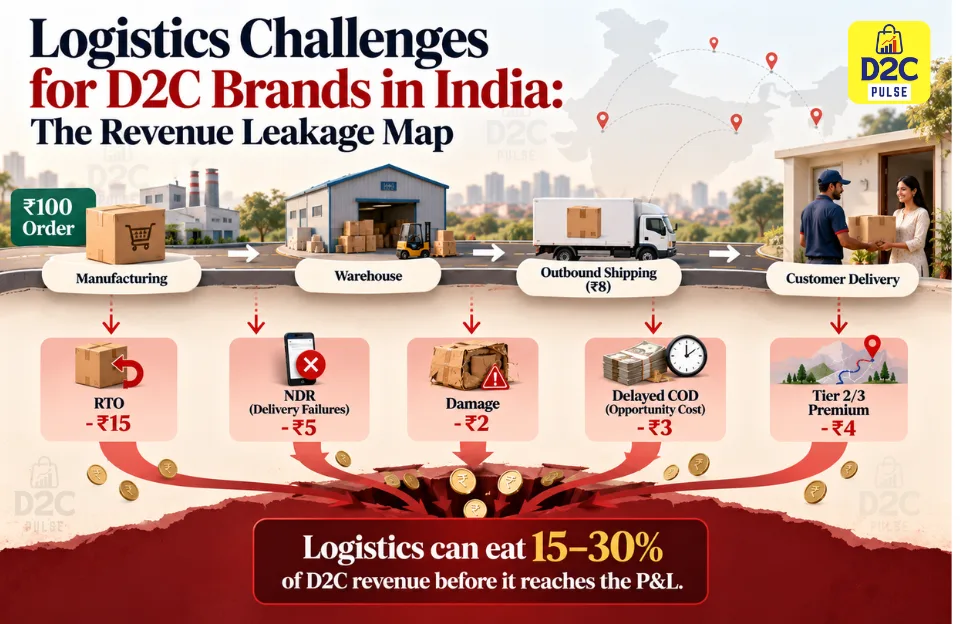
This is not an outlier. This is the norm. Products get made. Ads drive traffic. Customers buy. And then logistics quietly eats 15–30% of revenue through returns, delayed deliveries, damaged goods, and delayed COD remittance. Most founders only notice when the cash runs out.
India is a logistics-hard market. 19,000+ pin codes. Wildly uneven infrastructure across tier 1, 2, and 3 cities. 25–30% COD return rates. Multiple courier partners with inconsistent performance. The logistics challenges for D2C brands in India are structurally harder than in almost any other major market. A logistics partner that delivers in Mumbai may fail in Bhopal. The brand that plans for this survives. The brand that does not, does not.
This article maps the 8 biggest logistics challenges for D2C brands in India and the solutions that actually work. Not theory. Real fixes used by Indian D2C brands at every stage of growth.
Why Logistics Challenges for D2C Brands Are Bigger in India Than Anywhere Else
Most global D2C playbooks come from the US or UK. In those markets, logistics is a solved problem. Prepaid orders. Reliable postal systems. Standardised addresses. Low return rates. Predictable delivery windows. None of this applies to India. The logistics challenges for D2C brands in India look fundamentally different.
Cash-on-delivery dominates. According to Base. Still ~40–45% of Indian D2C orders are COD. COD orders have RTO rates 3–4x higher than prepaid. Customers refuse delivery. Addresses are wrong. Phones are switched off. Every COD order is a logistics gamble.
Addresses are not standardised. A delivery address in India may say “near the temple, behind the green building, ask for Raju.” Courier companies use AI address correction to parse these, but failures are common. Bad addresses drive a significant share of the logistics challenges for D2C brands operating at scale.
Infrastructure is uneven. Metro cities have dense delivery networks. Tier 2 cities have fewer. Tier 3 cities have almost none. Yet 60% of D2C revenue now comes from tier 2 and 3. You cannot skip these markets. But serving them creates new logistics challenges for D2C brands trying to maintain speed and reliability.
Customer expectations are high. 85% of shoppers will not return to a brand after a poor delivery experience – (found in a survey taken in 2023, but holds true today too). Indians compare every D2C delivery to Amazon and Flipkart. If your delivery takes 5 days when theirs takes 2, you lose the customer. Logistics is no longer back-end. It is a brand experience.
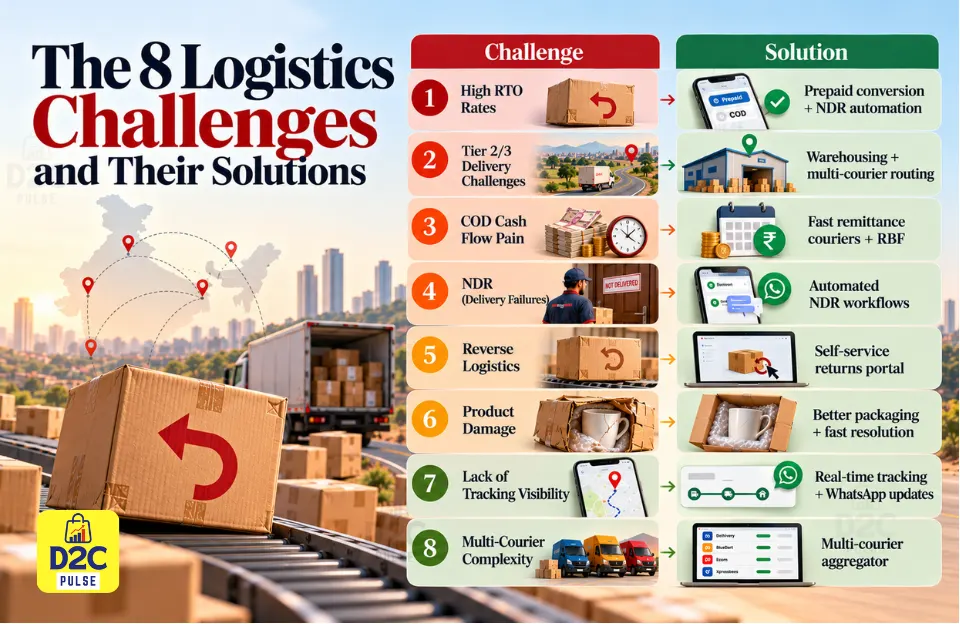
The 8 Biggest Logistics Challenges for D2C Brands (and How to Solve Them)
Challenge 1: High RTO Rates (The Silent Margin Killer)
The problem: RTO rates in India run 15–30% depending on the category. Fashion hits 25% or higher. Beauty runs 5–10%. COD orders return at 25–30%. Every returned order costs outbound shipping, return shipping, and often the product itself. For a brand shipping 1,000 orders per month at Rs 50 per return, that is Rs 15,000–30,000 in pure losses before product cost. This is the biggest of all logistics challenges for D2C brands in India.
The solution: Three moves reduce RTO significantly. First, convert COD to prepaid. Send a WhatsApp message after the order asking the customer to confirm delivery. Offer a small incentive (free shipping or 5% off) for prepaid. Brands that do this well cut COD from 30% to 15% of orders. Second, use AI-based fraud detection to flag suspicious COD orders before shipping (wrong PIN code, phantom phone numbers, unusually high order values from new customers). Third, use NDR automation: when a delivery fails, trigger a WhatsApp message to the customer within 30 minutes asking them to reschedule. NDR automation reduces RTO by up to 30%.
You can check which apps can help with this feature here —>
Challenge 2: Tier 2 and Tier 3 Delivery
The problem: Tier 2 and 3 cities contribute over 60% of Indian D2C revenue. But they are harder to serve. Longer delivery distances. Fewer fulfilment centres. Weaker courier networks. Higher delivery costs (Rs 70–120 vs Rs 40–60 for metros). Delivery times stretch from 2–3 days in metros to 5–7 days in tier 3. Tier 2 and 3 expansion creates some of the most expensive logistics challenges for D2C brands.
The solution: Two approaches. First, set up warehousing in tier 2 cities. Lucknow, Indore, Coimbatore, Jaipur, and Hyderabad are now serious fulfilment hubs. A warehouse in Indore can serve central India in 2 days instead of 5 from Mumbai. Pay-per-use 3PL models reduce the upfront cost. Second, use multi-courier aggregators (Shiprocket, NimbusPost, Shipway) that automatically route each order to the courier with the best performance in that specific PIN code. Delhivery may win in Delhi. DTDC may win in small-town Rajasthan. Ekart may win in Karnataka. Let the data decide.

Challenge 3: COD Cash Flow Delays
The problem: When a customer pays COD, the courier collects the cash. That cash does not reach the brand for 5–15 days, depending on the courier and remittance cycle. A D2C brand with 30% COD orders has 30% of its revenue stuck in remittance every month. For a brand doing Rs 50 lakh monthly revenue, that is Rs 15 lakh in working capital locked in transit. Cash flow is one of the most underrated logistics challenges for D2C brands at growth stage.
The solution: Three fixes. First, pick couriers with the fastest COD remittance cycles. Some couriers offer T+2 remittance for COD orders. Others take T+7 or longer. The difference is meaningful. Second, use revenue-based financing or working capital loans that advance 15–30% of monthly sales as quick liquidity. This is now a standard tool for scaling D2C brands facing cash flow pressure. Third, reduce COD share as much as possible through prepaid conversion incentives. Every percentage point of prepaid share improves cash flow immediately.
Challenge 4: NDR (Non-Delivery Report) Management
The problem: A delivery attempt fails. The customer was not home. The phone was switched off. The courier marks it NDR and the order enters a limbo: pending reattempt. Most brands never follow up. The courier tries again once or twice, fails, and sends the package back as RTO. An NDR that is ignored becomes an RTO. Manual NDR management is one of the most under-solved logistics challenges for D2C brands in India.
The solution: Automate the NDR workflow. The moment a delivery fails, trigger an automated WhatsApp or SMS to the customer asking them to confirm their availability and preferred delivery time. Give them a self-service link to reschedule. Courier aggregators like ClickPost, Shipway, and eShipz do this natively. Automated NDR workflows cut RTO rates by up to 30%. This is the highest-ROI fix for logistics challenges for D2C brands at any stage.
Challenge 5: Reverse Logistics and Returns
The problem: Returns are inevitable in fashion and beauty. A customer requests a return. The brand has to pick up the product, inspect it, quality-check it, restock it if possible, and process the refund. This reverse logistics flow is 3–4x more complex than forward logistics. Bad reverse logistics lead to lost products, delayed refunds, and angry customers who never return. Reverse logistics is one of the most under-fixed logistics challenges for D2C brands today.
The solution: Build a self-service returns portal on your website. Let customers initiate a return without contacting support. Use couriers that offer reverse pickup integrated with your warehouse management system. Automate label generation. Set a clear quality check process at the warehouse: items pass or fail within 48 hours. Process refunds within 5 days of receipt. A good reverse logistics process turns a bad experience into a trust-building moment.
Challenge 6: Last-Mile Damage and Lost Shipments
The problem: Packages arrive damaged. Fragile products break. Packaging tears. Occasionally, a package never arrives at all. Each damage case is a full refund plus a customer who will not return. Lost shipments are worse because the brand pays for something the customer never receives. Damage and loss are fixable logistics challenges for D2C brands that most founders underestimate.
The solution: Invest in packaging. Bubble wrap for fragile items. Corrugated outer boxes for everything. Tamper-evident seals. The cost is Rs 5–15 per order. Worth it. Use couriers with lower damage rates for fragile categories (Blue Dart, Delhivery, Ekart). Buy insurance on high-value shipments. Build a fast resolution process: when a customer reports damage, send a replacement within 24 hours without arguing.
Challenge 7: Lack of Real-Time Tracking and Transparency
The problem: A customer places an order. Three days later, they message support asking where their order is. The support team checks with the courier. The courier takes a day to respond. By then, the customer is frustrated. Multiply this by 100 customers a day and you have a support crisis driven by logistics opacity. Poor tracking generates 30–40% of all D2C customer support tickets. Tracking opacity is one of the easiest logistics challenges for D2C brands to fix.
The solution: Integrate real-time tracking into your Shopify store. Every major courier provides a tracking API. Aggregators like Shipway and ClickPost consolidate tracking across couriers into a single dashboard. Automate customer notifications at every stage: order confirmed, shipped, out for delivery, delivered. Use WhatsApp for notifications since open rates are 45–60% versus 15–25% for SMS. A customer who gets proactive updates does not raise a support ticket. This single fix cuts support load by 40–50%.
Challenge 8: Multi-Courier Complexity
The problem: To serve India well, a D2C brand needs multiple couriers. Delhivery for metros. DTDC for tier 3. Blue Dart for fragile. Ekart for Karnataka. Ecom Express for cost-sensitive orders. Each courier has its own API, pricing model, dashboard, and remittance cycle. Managing this manually is a full-time job. Most small brands pick one courier and limit their reach. Multi-courier complexity is one of the most underrated logistics challenges for D2C brands at scale.
The solution: Use a multi-courier aggregator. Shiprocket, NimbusPost, Shipway, ClickPost, and Pickrr all offer a single dashboard, API, and rate card across 15–25+ couriers. Orders are auto-routed to the best courier for each PIN code based on performance, cost, and speed. Brand Beyoung cut logistics expenses by 20% and scaled from 1,000 to 60,000 orders per month by partnering with Pickrr. This is the single biggest operational lever for growing D2C brands solving logistics challenges at scale.
The True Cost of Logistics Challenges for D2C Brands
Here is the hidden math behind logistics challenges for D2C brands in India. A brand doing Rs 50 lakh monthly revenue with typical RTO, damage, and delay numbers leaks Rs 3–7 lakh every month to logistics inefficiencies. That is 6–14% of revenue gone before the P&L is even calculated.
| Cost Item | % Revenue | Rs Impact* | Fix Priority |
| RTO losses | 3–8% | Rs 1.5–4L/mo | Highest. Prepaid conversion + NDR automation. |
| Damage/lost | 1–2% | Rs 50K–1L/mo | Medium. Better packaging + courier selection. |
| Delayed COD cash | Working capital | 15–20L stuck | High. Faster remittance + RBF. |
| Support load from tracking issues | Opportunity cost | Rs 30–50K/mo | Medium. Automated tracking + WhatsApp. |
| Tier 2/3 shipping premium | 2–4% | Rs 1–2L/mo | Medium. Regional warehousing. |
| Lost repeat buyers (bad experience) | 5–15% LTV loss | Compound | High. Fix all above. |
| TOTAL IMPACT | 15–30% | Rs 3–7L/mo* | *Based on Rs 50L monthly revenue. |
Also Read: Read Gross Margins for D2C Brands for how logistics costs compress true margins
Choosing a Logistics Partner: The Right Stack for Your Stage
The right logistics partner solves most logistics challenges for D2C brands. The wrong one creates new ones. The stack you need changes as you scale. What works at Rs 25 lakh per month breaks at Rs 2 crore per month.
| Stage | Revenue | Best Partner Type | Focus Areas |
| Launch | Rs 0–25L/mo | Aggregator (Shiprocket, NimbusPost) | Multi-courier access. Pay-per-use. No minimums. Simple dashboard. |
| Early Growth | 25L–1Cr/mo | Aggregator + 1 3PL warehouse (Emiza, WareIQ) | Negotiate bulk rates. Start NDR automation. Track RTO per courier. |
| Growth | 1–5Cr/mo | 2–3 regional 3PL warehouses + multi-courier | Tier 2 warehousing. Dedicated COD remittance. Reverse logistics process. |
| Scale | 5Cr+/mo | Own warehouse + direct courier contracts + aggregator backup | Optimise for cost and SLA. Quick commerce integration. International. |
Key Takeaways
- Logistics challenges for D2C brands in India can eat 15–30% of revenue. RTO losses, damaged shipments, delayed COD cash, and bad delivery experiences compound into margin destruction. Most founders underestimate the cost until it shows up in the bank account.
- The 8 biggest logistics challenges for D2C brands: high RTO rates, tier 2/3 delivery, COD cash flow delays, NDR management, reverse logistics, last-mile damage, lack of tracking, and multi-courier complexity. Each has a proven solution. The brands that solve them scale. The brands that ignore them stall.
- The single highest-ROI fix: NDR automation. When a delivery fails, trigger an automated WhatsApp message within 30 minutes asking the customer to reschedule. This alone cuts RTO by up to 30%. It is cheap, fast to implement, and pays for itself in weeks.
- Convert COD to prepaid aggressively. COD orders return 3–4x more than prepaid. Every percentage point of prepaid share directly improves gross margin and cash flow. Use WhatsApp nudges, prepaid incentives, and fraud detection on suspicious COD orders. Logistics challenges for D2C brands shrink dramatically when COD share drops below 20%.
- Use multi-courier aggregators. Shiprocket, NimbusPost, Shipway, ClickPost, and Pickrr give you access to 15–25+ couriers through a single dashboard. Orders auto-route to the best courier for each PIN code. This single tool solves 60% of operational logistics challenges for D2C brands under Rs 5 crore monthly revenue.
- Warehouse in tier 2 early. 60% of D2C revenue comes from tier 2 and 3 cities. Shipping from a metro warehouse to these markets is slow and expensive. Regional warehousing (Indore, Lucknow, Coimbatore, Hyderabad) cuts delivery time by 2–3 days and reduces shipping cost by 15–25%. Do this before you cross Rs 2 crore monthly revenue.
Frequently Asked Questions
What are the biggest logistics challenges for D2C brands in India?
The biggest logistics challenges for D2C brands in India are high RTO rates (15–30%), tier 2 and 3 delivery complexity, COD cash flow delays, NDR management, reverse logistics for returns, last-mile damage, lack of real-time tracking, and multi-courier operational complexity. These challenges can eat 15–30% of revenue if left unaddressed. The brands that solve them systematically build durable unit economics. The ones that ignore them never reach profitability.
What is a good RTO rate for an Indian D2C brand?
A good RTO rate for Indian D2C brands depends on the category. Beauty and skincare should target below 10%. Health and wellness below 12%. Fashion and apparel below 15–20% (fashion has structurally higher returns). Food and beverages below 5%. Anything above these is a logistics problem, not a customer problem. Most high-RTO brands can cut rates by 30–40% through prepaid conversion, NDR automation, and better PDP content.
How can D2C brands reduce RTO rates?
Three proven methods solve the biggest of the logistics challenges for D2C brands. First, convert COD orders to prepaid through WhatsApp nudges, prepaid discount incentives, and friction at checkout for COD. Second, automate NDR workflows so every failed delivery triggers a WhatsApp message to the customer within 30 minutes to reschedule. This alone reduces RTO by up to 30%. Third, use AI-based fraud detection on COD orders to flag suspicious patterns (wrong PIN codes, phantom phone numbers, unusually high orders from new customers) before shipping.
Should D2C brands use one courier or multiple couriers?
Multiple couriers, managed through an aggregator. No single courier performs well in every PIN code. Delhivery may dominate Delhi but underperform in small-town Rajasthan. DTDC may win in Karnataka but struggle in the Northeast. Multi-courier aggregators like Shiprocket, NimbusPost, Shipway, ClickPost, and Pickrr route each order to the courier with the best performance for that specific destination. This solves a major share of logistics challenges for D2C brands and reduces shipping cost by 10–20%.
When should a D2C brand set up a tier 2 warehouse?
Before Rs 2 crore monthly revenue. Tier 2 and 3 cities contribute over 60% of D2C revenue in India. Shipping from a single metro warehouse to these markets adds 2–5 days of transit and 15–25% in shipping cost. A regional warehouse in Indore, Lucknow, Hyderabad, or Coimbatore dramatically cuts delivery time and costs. Pay-per-use 3PL models (Emiza, WareIQ, Easyship) make this accessible without heavy capex. Early tier 2 warehousing is one of the most cost-effective solutions to logistics challenges for D2C brands targeting national scale.