Why Consumers Are Ready to Pay More and What It Means for D2C Brands
30% of FMCG Sales Are Now Premium. SUV Share Hit 60%. Specialty Coffee Outsells Instant. India Is Trading Up. Here Is What Is Driving the Shift and How D2C Brands Can Ride It.
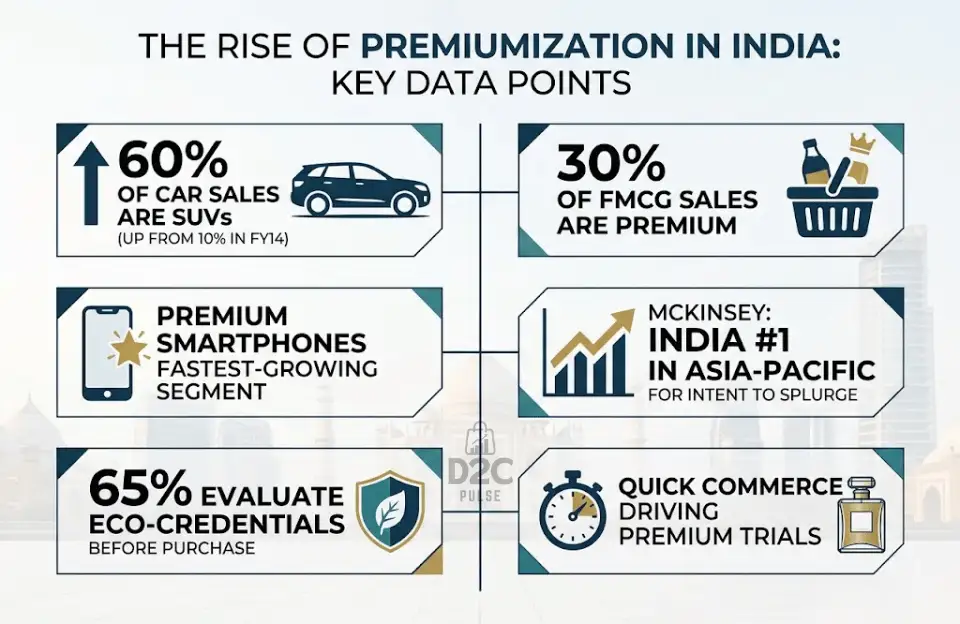
Something has changed in how Indians spend money. In FY24, 60% of all cars sold in India were SUVs. A decade ago, it was 10%. About 30% of FMCG sales now come from premium products. Premium smartphones (above Rs 30,000) are the fastest-growing segment. Specialty coffee outsells instant coffee in urban metros. And washing liquids saw a 50% jump in volume, replacing the humble detergent bar. This is the rise of premiumization in India.
Consumers are not just buying more. They are buying better, choosing Rs 700 face serums over Rs 150 face creams, picking Rs 500 artisanal coffee over Rs 100 instant coffee. They are paying Rs 5,000 for a Mokobara bag instead of Rs 500 for an unbranded one. The trade-up is happening across income levels and city tiers.
For D2C brands, the rise of premiumization in India is the single biggest tailwind of 2026. Premium products carry higher margins and premium customers have higher LTV. Premium brands also attract investors and acquirers. HUL paid Rs 2,955 crore for Minimalist because it was a premium, margin-rich, science-backed brand. Not because it was cheap.
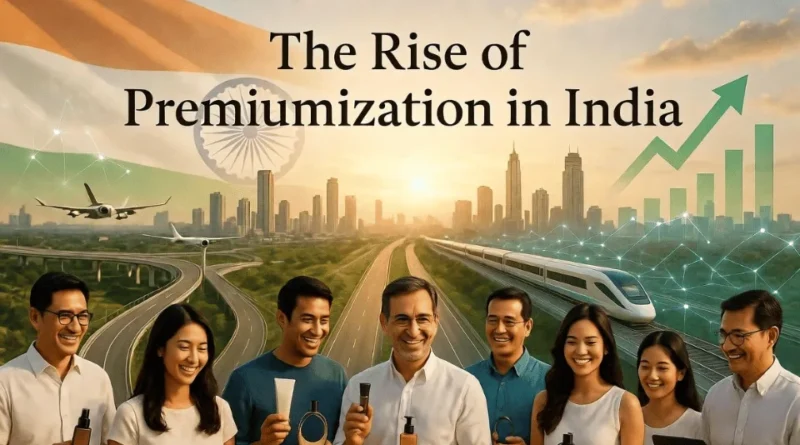
This article maps the rise of premiumization in India. We cover the seven forces driving the shift, the eight categories where it is strongest, D2C brands that are riding the wave, and a practical playbook for founders who want to position their brand for premium.
Seven Forces Driving the Rise of Premiumization in India
1. Rising Disposable Income
India’s middle class is expanding fast. Disposable income has risen steadily over the past decade. The top 40 million affluent households and the next 200 million aspirational middle-class households now have money to spend beyond basics. They are not choosing “expensive.” They are choosing “considered.” A Rs 800 protein bar instead of a Rs 20 biscuit. A Rs 1,200 serum instead of a Rs 99 cold cream. Premiumization in India is not about luxury. It is about upgrading everyday purchases.
2. Social Media and Global Exposure
Instagram, YouTube, and creator content have exposed Indian consumers to global standards. A 22-year-old in Jaipur watches the same skincare routines as someone in Seoul. She knows what niacinamide does, compares ingredient lists and reads reviews before purchase. This global exposure raises expectations. Consumers now demand the same product quality, packaging, and brand experience they see online. The rise of premiumization in India is partly a story of shrinking information gaps between Indian and global consumers.

3. Young Demographics
Millennials and Gen Z make up about 70% of India’s digital consumer base. These consumers value identity over price. They buy brands that reflect who they are, not just what they need. A Mokobara bag is not just a travel bag. It signals taste. A Minimalist serum is not just skincare. It signals that the user reads ingredient lists. This identity-driven consumption powers premiumization in India.
4. Quick Commerce Made Premium Accessible
Blinkit, Zepto, and Swiggy Instamart deliver premium products in 10–30 minutes. Artisanal coffee, Gourmet snacks, Imported cheese, Luxury matcha, Premium personal care. Quick commerce removed the discovery and access barrier. A consumer does not need to visit a specialty store. She opens an app, tries a Rs 400 cold-pressed juice and If she likes it, she reorders. Quick commerce has become a trial engine for premium products. Wellness-focused appliances like juicers and nutrient extractors saw 3x volume growth through these platforms.
5. Health and Wellness Consciousness
Post-COVID, Indian consumers are spending more on preventive health. Protein bars. Immunity supplements. Organic food. Clean-label snacks. Probiotic drinks. These are premium-priced categories. The consumer pays more because the product serves a health goal, not just a hunger need. This health-driven premiumization in India spans food, beverages, personal care, and wellness supplements. Brands like The Whole Truth (clean-label), Kapiva (Ayurveda), and Oziva (plant-based nutrition) are built on this wave.
6. Ingredient Transparency and Education
D2C brands changed how Indian consumers evaluate products. Before Minimalist, most consumers did not check ingredient percentages. Now they do. Before Whole Truth, most consumers did not flip the pack to check hidden sugars. Now they do. This education creates a willingness to pay more for products that are honest about what is inside. Premiumization in India is not just about paying for a brand name. It is about paying for transparency, science, and trust.
7. Premiumization in Tier-2 and Tier-3 Cities
This is the part most people miss. Premiumization in India is not just a metro story. Tier-2 and tier-3 cities are trading up faster than metros in several categories. A consumer in Indore who discovers a Rs 600 face serum through Instagram does not think “that is too expensive.” She thinks “that is what the girls in Mumbai use.” Digital access has collapsed the aspiration gap between cities. Quick commerce is expanding to 150+ cities. The next wave of premiumization in India will be driven by non-metro consumers.
Also Read: Regional D2C Growth Beyond Metros for how tier-2/3 consumers are reshaping D2C demand
Eight Categories Where Premiumization in India Is Strongest
| Category | Premium Shift | D2C Brand Example | Price Signal | Why Consumers Upgrade |
| Skincare | Ingredient-led, science-backed serums replacing basic creams. | Minimalist, Foxtale, The Derma Co. | Rs 500–900 serum vs Rs 99 cold cream. | Transparency. Clinical results. Ingredient education. |
| Coffee | Specialty, single-origin replacing instant. | Blue Tokai, Sleepy Owl, Third Wave | Rs 400–800 per 250g vs Rs 100 for instant. | Taste experience. Ritual. Identity signal. |
| Food & Snacks | Clean-label, protein-rich, organic replacing processed. | Whole Truth, Farmley, Yoga Bar | Rs 200–400 protein bar vs Rs 10 biscuit. | Health consciousness. Label reading. Clean ingredients. |
| Fashion | Design-led, brand-conscious replacing unbranded. | Mokobara, Snitch, Rare Rabbit | Rs 3,000–15,000 bag/outfit vs Rs 500 unbranded. | Identity. Instagram-worthiness. Quality materials. |
| Jewellery | Everyday, design-first replacing occasion-only gold. | GIVA, CaratLane, BlueStone | Rs 1,000–20,000 everyday pieces. | Self-expression. Everyday wear. Affordable luxury. |
| Audio | Premium TWS and ANC replacing basic earphones. | boAt Nirvana, Sony, Sennheiser | Rs 3,000–8,000 TWS vs Rs 500 wired. | Sound quality. Noise cancellation. Status. |
| Home & Sleep | Orthopaedic, memory foam replacing cotton mattresses. | Wakefit, SleepyCat, Duroflex | Rs 8,000–25,000 mattress vs Rs 3,000. | Sleep quality. Health. Long-term investment. |
| Pet Care | Premium food, grooming, vet care replacing generic. | Supertails, Heads Up For Tails | Rs 800–2,000/month premium food vs Rs 300 generic. | Pet humanisation. Emotional attachment. Willingness to pay. |
Why D2C Is the Best Vehicle for Premiumization in India
Premiumization in India and D2C are structurally linked. Here is why D2C brands are better positioned to ride this wave than traditional FMCG.
- Higher margins fund the premium story. D2C brands keep 60–80% gross margin. Traditional FMCG keeps 30–40% after distributor and retailer margins. Higher margins let D2C brands invest in education, content, packaging, and brand experience that justify premium pricing.
- First-party data identifies who will pay more. D2C brands know their customers. They can segment by purchase frequency, AOV, and product mix. They can target premium upsells to high-value segments and trial offers to price-sensitive ones. Traditional brands cannot do this because they have no customer data.
- Content builds perceived value. A Minimalist serum is worth Rs 600 because the brand educated the customer on what 10% niacinamide does. The education creates perceived value. D2C brands own the content channels (website, email, WhatsApp, Instagram) where this education happens. Traditional brands rely on 30-second TV ads that cannot build the same depth.
- Packaging and unboxing create premium experience. D2C brands control the full experience. From the website design to the box the product arrives in. Premium packaging signals quality. A handwritten thank-you card. A branded box. A product insert with usage tips. These small touches build perceived value that justifies a higher price.
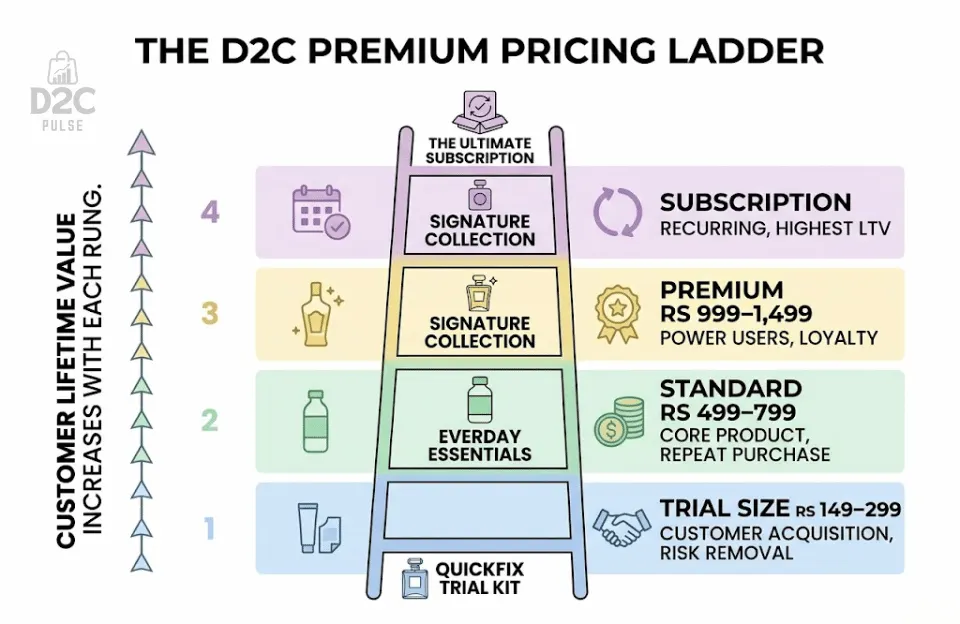
- Trial sizes lower the risk of premium purchase. The Rs 199 trial size is the D2C answer to price objection. A consumer unwilling to spend Rs 800 on a full-size serum will try a Rs 199 mini. If it works, she upgrades. This sachetisation strategy makes premiumization in India accessible to consumers at every income level.
The D2C Founder’s Playbook for Premiumization in India
If you are a D2C founder, here is how to position your brand for the premiumization wave.
- Price for value, not for competition. Do not set your price based on what the cheapest competitor charges. Set it based on what value you deliver. If your product is genuinely better, price it 2–3x above the mass-market alternative. The premiumization means consumers are ready to pay if you justify the price.
- Invest in education before sales. Premium consumers do not buy on impulse. They research, compare and read ingredient lists. Build content that educates: blog posts, Instagram carousels, YouTube explainers, founder videos. The brands that educate the best, sell the most at premium prices. This is how Minimalist, Whole Truth, and Blue Tokai built their categories.
- Build a tiered product line. Offer a Rs 199 trial size, a Rs 599 standard, and a Rs 999 premium. This captures consumers at every stage of the premiumization journey. The trial size acquires. The standard converts, the premium maximises LTV.
- Make the unboxing memorable. Premium is not just what is inside the box. It is the box itself. Branded packaging, clean design, a product insert and also QR code linking to a how-to video. These details cost Rs 20–50 per order but they create a premium perception worth Rs 200–300 in brand value.
- Use creator partnerships to signal premium. A micro-influencer with 50,000 followers who uses your product in a real routine is more powerful than a celebrity endorsement. When a creator uses a Rs 700 product and explains why it is worth the price, conversion follows.
- Do not discount. Bundle. Discounting destroys premium perception. A Rs 800 serum at 40% off signals “this product is not worth Rs 800.” A bundle (serum + moisturiser + sunscreen for Rs 1,799 instead of Rs 2,400) offers value without reducing the perceived worth of any single product. Bundles protect brand equity during premiumization in India.
- Expand to tier-2/3 through trials, not price cuts. Non-metro consumers want premium products. They just need a lower-risk entry point. A Rs 149 sachet of your hero product shipped to Jaipur or Surat is how you ride premiumization in India beyond the metros. Do not cut your price, cut the commitment size.
Key Takeaways
- Premiumization in India is a mass-market shift, not a luxury niche. 30% of FMCG sales are premium. 60% of car sales are SUVs. Specialty coffee outsells instant in urban metros. Consumers across income levels and city tiers are trading up.
- Seven forces drive premiumization in India: rising disposable income, social media exposure to global standards, young demographics that value identity over price, quick commerce making premium accessible, health consciousness, ingredient transparency, and tier-2/3 cities trading up faster than metros.
- D2C is the best vehicle for premiumization in India. Higher margins, first-party data, content-driven education, controlled packaging, and trial sizes make D2C brands better positioned than traditional FMCG to capture premium consumers.
- Eight categories are leading the premium shift: skincare, coffee, food and snacks, fashion, jewellery, audio, home and sleep, and pet care. Each has clear D2C brand winners.
- The founder playbook: price for value, invest in education, build tiered products, make unboxing memorable, use creator partnerships, bundle instead of discount, and expand to tier-2/3 through trial sizes. Do not cut price. Cut commitment size.
- Premiumization in India rewards brand builders, not price cutters. The brands that win this wave are the ones that justify their price through transparency, education, and experience. Not the ones that race to the bottom.
Frequently Asked Questions
What is premiumization in India?
Premiumization in India is the broad shift in consumer behaviour toward buying higher-quality, higher-priced products across categories. It is not limited to luxury. It includes a consumer choosing a Rs 600 serum over a Rs 99 cream, a Rs 500 specialty coffee over Rs 100 instant, or a Rs 5,000 design-led bag over a Rs 500 unbranded one. About 30% of FMCG sales are now premium. The shift spans metros and tier-2/3 cities.
What is driving premiumization in India?
Seven forces: rising disposable incomes, social media and global exposure, young demographics (70% of digital consumers are millennials and Gen Z), quick commerce making premium accessible, health and wellness consciousness, ingredient transparency and education led by D2C brands, and tier-2/3 cities trading up through digital access.
How can D2C brands benefit from premiumization in India?
D2C brands are best positioned for premiumization because they have higher gross margins (60–80%), own first-party customer data, control the content and education that justifies premium pricing, manage the full unboxing and brand experience, and can offer trial sizes that lower the risk of first premium purchase. The brands that educate best sell best at premium prices.
Is premiumization in India happening in tier-2 and tier-3 cities?
Yes. Digital access through smartphones and social media has collapsed the aspiration gap between metros and smaller cities. Quick commerce is expanding to 150+ cities. A consumer in Indore or Surat discovers premium brands through Instagram and orders them online. Tier-2/3 cities are trading up faster than metros in several categories. D2C brands can reach these consumers through trial-size SKUs at Rs 149–299.
Which categories are seeing the most premiumization in India?
Eight categories lead: skincare (science-backed serums), specialty coffee, clean-label food and snacks, design-led fashion, everyday jewellery, premium audio (ANC earbuds), home and sleep (orthopaedic mattresses), and pet care. Each has clear D2C winners: Minimalist, Blue Tokai, Whole Truth, Mokobara, GIVA, boAt Nirvana, Wakefit, and Supertails.