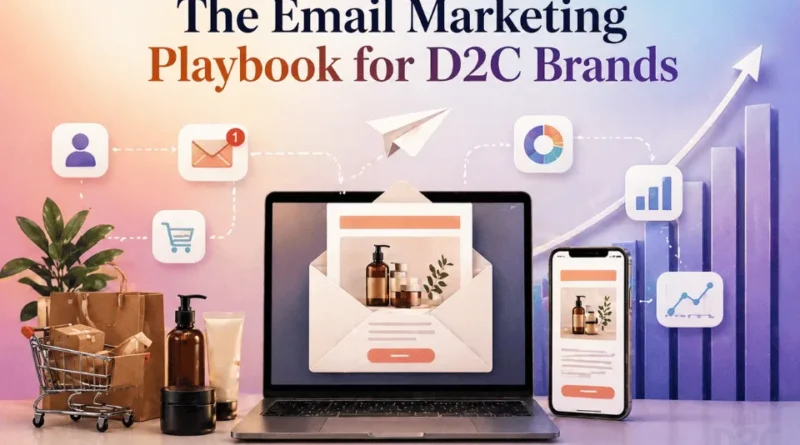
The Email Marketing Playbook for D2C Brands: 10 Flows That Drive Repeat Revenue on Autopilot
Why Email Is the Highest-ROI Channel. The 10 Automated Flows Every Indian D2C Brand Needs. Exact Timing, Triggers, and Sequences. Plus the Metrics That Matter.
Most Indian D2C brands treat email as a broadcast channel. They send a Diwali sale. A new launch email. Maybe a Republic Day offer. That is campaigning. It is not email marketing for D2C brands. The difference matters.
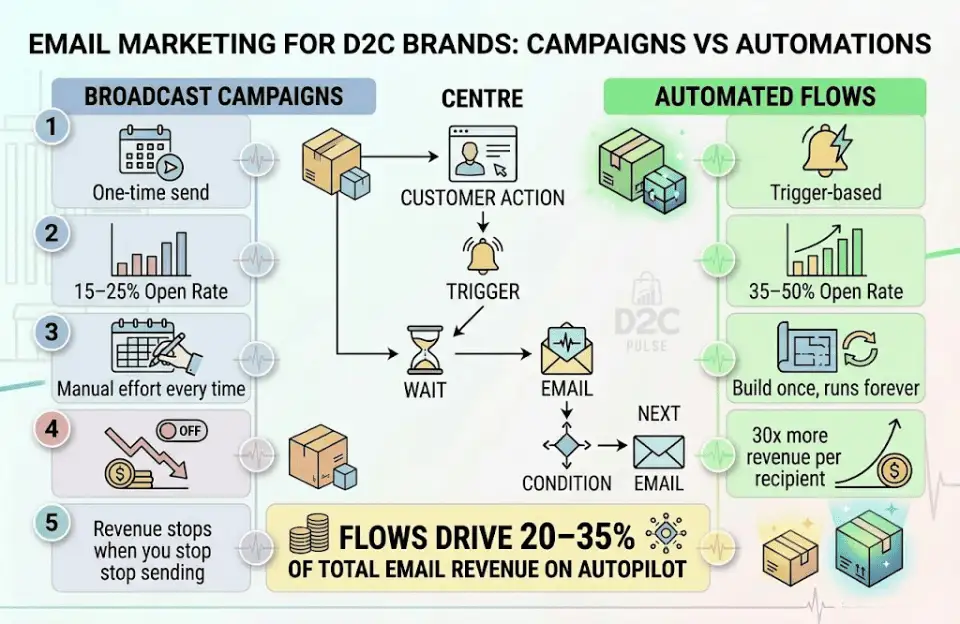
A campaign is a one-time send. You write it, blast it & you move on. An automation is a trigger-based flow. It runs every time a customer takes a specific action. You build it once & it runs forever sending the right message at the right time to every customer, without you touching a button.
Automated flows generate 30x more revenue per recipient than broadcast campaigns. They see 35–50% open rates compared to 15–25% for broadcasts. And the best email marketing for D2C brands drives 20–35% of total email revenue on complete autopilot.
Yet 55% of Indian D2C founders admit to under-investing in email and retention. They pour money into Meta ads to acquire new customers. They ignore the customers already in their database. A customer who already bought from you is 5–7x cheaper to convert again than a new customer. Email marketing for D2C brands is how you convert them again.
This playbook gives you the 10 email flows every Indian D2C brand needs. Each flow includes the trigger, the timing, the sequence, and the logic. Set these up once & they generate revenue while you sleep.
Why Email Marketing for D2C Brands Is the Highest-ROI Channel
Email marketing delivers an average ROI of 3,600%. That means every Rs 1 spent on email returns Rs 36. No other channel comes close. Meta ads return Rs 3–5 per rupee for most D2C brands. Google returns Rs 4–8. Email returns Rs 36.
Email marketing for D2C brands works because it is an owned channel. You do not pay Meta or Google to reach your own customers. Your email list is yours. No algorithm change can take it away. No CPM increase makes it more expensive. The cost per email is Rs 0.10–0.50. The cost per paid ad click is Rs 5–50.
For Indian D2C brands, email marketing is even more powerful when paired with WhatsApp. WhatsApp has 45–60% open rates in India. Email has 15–25% for campaigns and 35–50% for flows. Together, email and WhatsApp marketing for D2C brands create a retention engine that no paid channel can match.
Also Read: How to Reduce CAC and grow your profits. Things you can implement early on.
The 10 Email Marketing Flows Every D2C Brand Needs
Flow 1: Welcome Series (The Highest-ROI Flow in Email Marketing for D2C Brands)
Trigger: New subscriber or first-time customer.
Why it matters: New subscribers have peak interest. They just signed up or just bought. Their attention is yours to lose. The welcome series is the highest-ROI automation in email marketing for D2C brands.
Email 1 (Immediate): Thank you + brand story. Who you are. Why you exist. What makes your product different. Include the discount code if you promised one at signup.
Email 2 (Day 1): Bestseller spotlight. Show your top 3 products with customer reviews. Social proof converts better than descriptions at this stage.
Email 3 (Day 3): Behind the scenes. How your product is made. Your sourcing story. Your founder’s journey. Indian customers connect with authenticity.
Email 4 (Day 5): UGC roundup. Real photos from real customers. Instagram reposts. Reviews. This builds trust. Trust converts.
Email 5 (Day 7): First purchase nudge with a time-limited offer. This email converts the subscribers who were interested but hesitant.
Benchmark: Welcome flows see 35–50% open rates and 3–8% conversion rates. A personalised welcome series delivers 30% higher engagement than a generic one.
Flow 2: Abandoned Cart Recovery
Trigger: Customer adds to cart but does not complete purchase.
Why it matters: Indian D2C brands see 65–80% cart abandonment. Even recovering 10% generates significant revenue. This is the flow that pays for your entire email marketing for D2C brands investment.
Email 1 (45 minutes): Simple reminder. Show the exact product with image, price, and a direct cart link. No discount, just a nudge.
Email 2 (12 hours): Address the objection. Highlight your return policy, EMI options, or a specific customer review for that product. Remove the friction.
Email 3 (36 hours): Final nudge with urgency – Cart expires soon, or offer free shipping. Only discount here if needed. Email + WhatsApp together recover 2–3x more carts than either alone.
Benchmark: Cart recovery emails convert at 8–12% when sent within 45 minutes. At 3 days, they drop below 1%.
Flow 3: Post-Purchase Follow-Up
Trigger: Customer completes a purchase.
Why it matters: The post-purchase window is when the customer is most excited about your brand. The Email marketing for D2C brands uses this window to build loyalty, reduce returns, and set up the next purchase.
Email 1 (Immediate): Order confirmation with delivery timeline and a thank-you message.
Email 2 (Day 2–3): How to use the product. Tips. Guides. Video links. This reduces returns from wrong usage and builds product satisfaction.
Email 3 (Day 7–10): Ask for a review. Send a direct link to your review page. Offer a small incentive (10% off next purchase or loyalty points).
Email 4 (Day 14): Cross-sell. Recommend products that pair with what they bought. A customer who bought a serum gets a moisturiser recommendation. A customer who bought coffee gets a filter recommendation.
Benchmark: Post-purchase flows see 45–60% open rates because they are expected and relevant.

Flow 4: Replenishment Reminder
Trigger: Product expected to run out based on average usage.
Why it matters: This is the highest-LTV flow in email marketing for D2C brands. It turns one-time buyers into repeat buyers without ad spend. If your serum lasts 45 days, send a reminder on day 35.
Email 1 (Day 35): Your product is running low. Reorder now. Direct link to the exact product.
Email 2 (Day 42): Almost out? Order today for delivery by the time you finish. Add urgency.
Benchmark: Replenishment flows convert at 5–8% and drive repeat revenue with zero CAC.
Also Read: Performance vs Brand Marketing, which one is good and which is not.
Flow 5: Winback (Lapsed Customer)
Trigger: Customer has not purchased in 60–90 days (adjust for your category).
Why it matters: Reactivating a lapsed customer costs a fraction of acquiring a new one. Winback flows are essential email marketing for D2C brands with consumable products.
Email 1 (Day 60): We miss you. Here is what is new since your last order. Show new products or bestsellers.
Email 2 (Day 75): Exclusive offer. A one-time discount or free shipping. Make it feel personal, not desperate.
Email 3 (Day 90): Last chance. This is your final nudge before they go dormant. If they do not respond, move them to a less frequent send cadence.
Benchmark: Winback flows recover 5–10% of lapsed customers. A 5% winback rate on a 50,000-customer list recovers 2,500 customers with zero CAC.
Also Read: Pricing Strategies that D2C brands in India follow and which one you should choose
Five More Essential Email Marketing Flows for D2C Brands
Flow 6: Browse Abandonment
Trigger: Customer views a product page but does not add to cart.
Sequence: Email 1 (2 hours): Remind them of what they viewed. Show the product with social proof. Email 2 (24 hours): Show similar products in the same category. Email marketing for D2C brands captures demand even before the cart stage.
Flow 7: Price Drop Alert
Trigger: A product the customer viewed or wishlisted drops in price.
Sequence: Single email. The product they wanted is now cheaper. Direct link. This flow converts at 10–15% because the intent was already there.
Flow 8: Birthday and Anniversary
Trigger: Customer’s birthday or purchase anniversary.
Sequence: One email with a personal discount or gift offer. This builds emotional loyalty. Email marketing for D2C brands that personalises around milestones sees 2x higher open rates than generic campaigns.
Flow 9: VIP and Loyalty Tier
Trigger: Customer crosses a spending or purchase frequency threshold.
Sequence: Congratulate them. Offer early access to new launches. Exclusive discounts. Priority support. VIP customers spend 3–5x more than average. Email marketing for D2C brands should treat them differently.
Flow 10: Review and UGC Request
Trigger: 14 days after delivery (enough time to use the product).
Sequence: Ask for a review. Offer a small incentive. Ask if they want to share a photo. User-generated content from this flow feeds your ads, your product pages, and your social media. One flow powers multiple channels.
Also Read: Retention Marketing Strategies for D2C Brands. How to grow loyalty for your brand.
Email Marketing for D2C Brands: The 10-Flow Summary Table
| Flow | Trigger | Emails | Open Rate | Revenue Impact |
| Welcome Series | New subscriber / first buyer | 5 emails over 7 days | 35–50% | Sets up every future purchase. 30% higher engagement when personalised. |
| Abandoned Cart | Cart abandoned | 3 emails: 45min, 12h, 36h | 35–45% | Recovers 8–12% of carts. Pays for your entire email stack. |
| Post-Purchase | Order completed | 4 emails over 14 days | 45–60% | Reduces returns. Drives reviews. Sets up cross-sell. |
| Replenishment | Product running low | 2 emails at Day 35, 42 | 30–40% | 5–8% conversion. Zero CAC repeat revenue. |
| Winback | No purchase 60–90 days | 3 emails over 30 days | 20–30% | Recovers 5–10% of lapsed customers. |
| Browse Abandon | Viewed product, no cart | 2 emails: 2h, 24h | 25–35% | Captures pre-cart demand. |
| Price Drop | Viewed product drops in price | 1 email | 30–40% | 10–15% conversion. High-intent buyers. |
| Birthday | Customer birthday | 1 email | 40–50% | 2x open rate. Builds emotional loyalty. |
| VIP Tier | Spending threshold crossed | 1–2 emails | 35–45% | VIPs spend 3–5x average. Treat them like VIPs. |
| Review Request | 14 days post-delivery | 1–2 emails | 25–35% | Feeds UGC for ads, PDPs, and social. |
Email Marketing Tools for D2C Brands in India
| Tool | Best For | Starting Price | Key Feature | Limitation |
| Klaviyo | Shopify D2C brands with 5K+ contacts. | Free up to 250 contacts. Rs 1,650/mo paid. | Best-in-class segmentation. Predictive analytics. Native Shopify sync. | Expensive at scale. Rs 12,400/mo at 10K contacts. |
| WebEngage | Indian D2C brands needing email + push + WhatsApp. | Rs 5,000/mo. | Multi-channel (email, push, WhatsApp, SMS). Built for India. | Steeper learning curve. |
| Mailchimp | Early-stage brands with small lists. | Free up to 500 contacts. | Easy setup. Good templates. Low cost. | Weak segmentation. No Shopify-native. |
| CampaignHQ | Indian D2C brands wanting email + WhatsApp. | Affordable. AWS-powered delivery. | Drag-and-drop flows. WhatsApp + email in one platform. | Smaller ecosystem than Klaviyo. |
| MoEngage | Mid-size D2C brands needing analytics + engagement. | Custom pricing. | AI-powered segmentation. Multi-channel. Strong in India. | Enterprise-leaning. May be too much for early stage. |
The Email Marketing Metrics That Matter for D2C Brands
Revenue per recipient (RPR): The most important metric. How much revenue does each email generate per person who receives it? Flows should generate 30x more RPR than campaigns.
Open rate: Flows: 35–50% is healthy. Campaigns: 15–25%. Below these, check your subject lines, sender name, and send time.
Click-through rate (CTR): 2–5% for campaigns. 5–10% for flows. Low CTR means your content or CTA is weak.
Conversion rate: The percentage of email recipients who purchase. Cart recovery: 8–12%. Welcome: 3–8%. Replenishment: 5–8%.
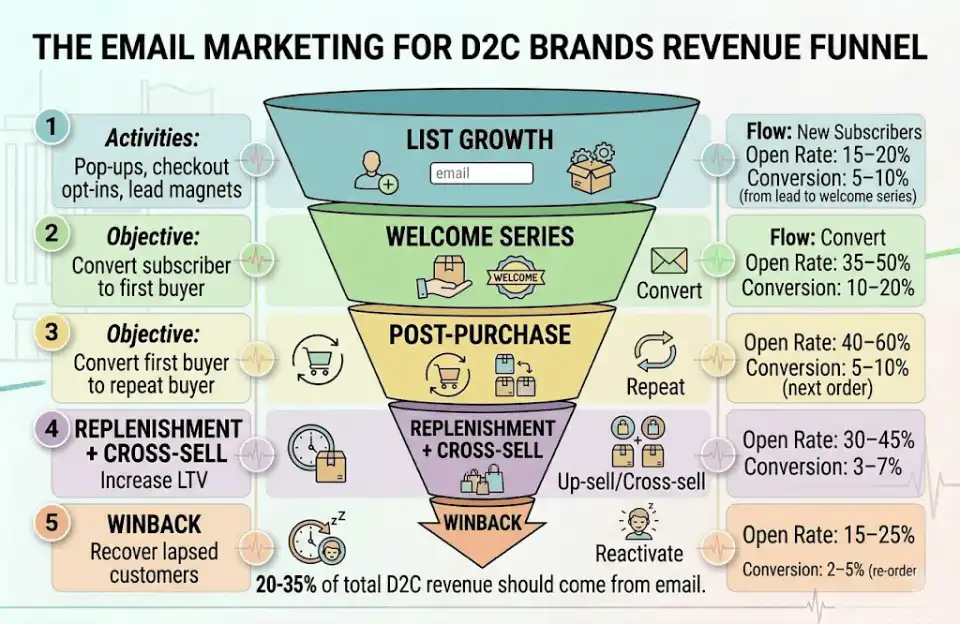
List growth rate: How fast your email list is growing. Target 10–15% growth per month through pop-ups, checkout opt-ins, and lead magnets.
Revenue attributed to email: What percentage of your total revenue comes from email marketing for D2C brands? Target 20–35%. If it is below 10%, your flows are missing or broken.
Key Takeaways
- Email marketing for D2C brands delivers 3,600% average ROI. Every Rs 1 spent returns Rs 36. No other channel comes close. Email is owned, free to reach your list, and compounds with list size.
- Automated flows generate 30x more revenue per recipient than campaigns. Flows see 35–50% open rates versus 15–25% for broadcasts. Build flows once. They run forever. This is the core of email marketing for D2C brands.
- Start with 3 flows: welcome series, abandoned cart, post-purchase. Welcome converts subscribers. Cart recovery recovers 8–12% of abandoned carts. Post-purchase builds loyalty and drives reviews. These three pay for your entire email stack.
- Add 7 more flows as your list grows: replenishment, winback, browse abandonment, price drop, birthday, VIP tier, and review request. Each captures a specific moment in the customer journey that broadcast campaigns cannot.
- Target 20–35% of total revenue from email. If email marketing for D2C brands drives less than 10% of your revenue, your flows are missing or broken. The best brands drive 30%+ from email and WhatsApp combined.
- Timing is everything. Cart recovery at 45 minutes converts at 8–12%. At 3 days, it drops below 1%. Replenishment at day 35 catches the customer before they run out. Email marketing for D2C brands is about the right message at the right moment. Automation makes this possible at scale.
Frequently Asked Questions
Why is email marketing for D2C brands important?
Email marketing for D2C brands delivers 3,600% average ROI. It is an owned channel. You do not pay per click or per impression. Automated flows run 24/7 and generate 30x more revenue per recipient than broadcast campaigns. For Indian D2C brands, email paired with WhatsApp creates a retention engine that reduces dependence on paid ads and drives 20–35% of total revenue.
What are the most important email flows for D2C brands?
The three most important flows in email marketing for D2C brands are the welcome series (converts subscribers), abandoned cart recovery (recovers 8–12% of carts at 45-minute trigger), and post-purchase follow-up (builds loyalty and drives reviews). These three flows alone can drive 15–20% of total email revenue. Add replenishment, winback, browse abandonment, price drop, birthday, VIP, and review flows as your list grows.
How much revenue should email drive for a D2C brand?
Target 20–35% of total revenue from email marketing for D2C brands. If email drives less than 10%, your flows are likely missing or poorly optimised. The best Indian D2C brands drive 25–35% from email and WhatsApp combined. Automated flows should contribute 60–70% of email revenue, with broadcast campaigns contributing 30–40%.
Which email marketing tool is best for Indian D2C brands?
Klaviyo is the best tool for Shopify-based D2C brands with 5,000+ contacts. It has the strongest segmentation, predictive analytics, and Shopify integration. For smaller brands, Mailchimp’s free tier works. For brands wanting email + WhatsApp in one platform, CampaignHQ and WebEngage are strong Indian options. MoEngage is strong for mid-size brands needing AI-powered analytics.
Should D2C brands use email or WhatsApp for retention?
Both. Email marketing for D2C brands handles longer content, product education, and detailed flows. WhatsApp handles urgency, real-time engagement, and high open rates (45–60%). The best strategy: email first (at 45 minutes for cart recovery), then WhatsApp if no response (at 4–6 hours). Together, they recover 2–3x more carts and drive 2x the retention revenue of either channel alone.