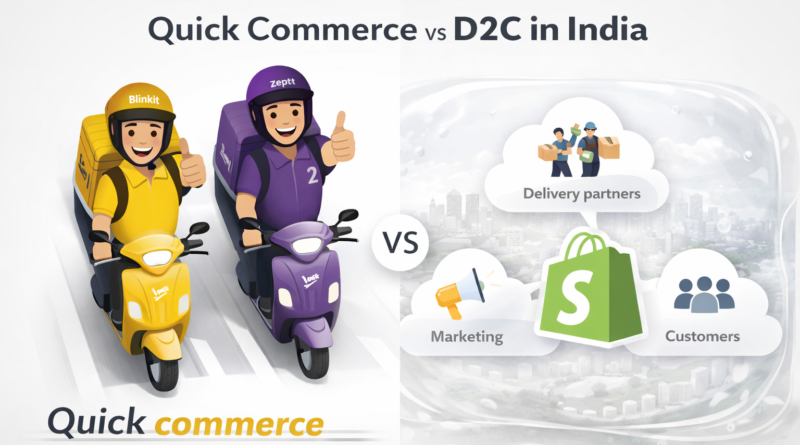
Quick Commerce vs D2C in India: Friend, Foe, or Both?
How Blinkit, Zepto, and Instamart Are Reshaping the D2C Playbook. What D2C Brands Win, What They Lose, and How to Play the Game in 2026.
What happened to a D2C snack brand in Bangalore last year clearly shows how a brand should look at quick commerce vs D2C. The brand had built a solid website business, with good margins and growing repeat customers. Then Blinkit called and within weeks, they were on the platform.
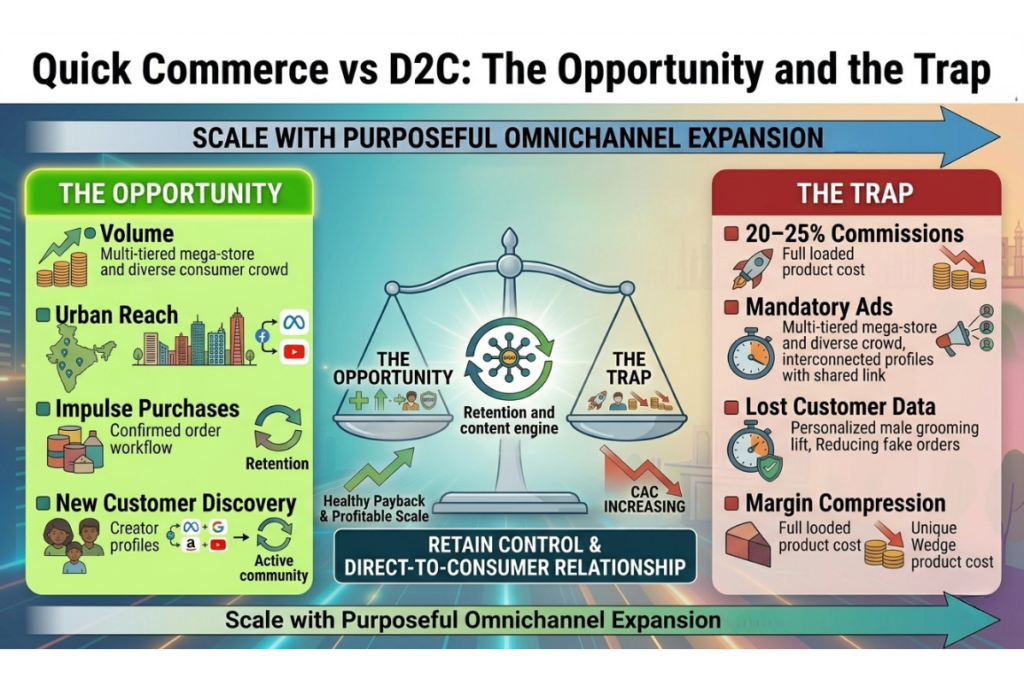
Orders doubled, then tripled with the whole team and the founder feeling thrilled. Six months later, the founder looked at the numbers more carefully. Quick commerce now accounted for 65% of their online sales. But between the 20% commission, the mandatory ads, and the listing fees, their contribution margin on Blinkit was almost zero. Meanwhile, their own website traffic had dipped. Customers who used to buy directly were now buying through Blinkit instead. The brand had gained volume but lost margin and customer data.
That story captures the quick commerce vs D2C tension that every Indian brand founder is wrestling with right now and it does not have a simple answer.
For D2C brands, this creates a question that does not have a neat answer: is quick commerce a growth channel or a margin trap? A friend or a foe? This article breaks down the quick commerce vs D2C relationship in full. The opportunity, the cost, the strategy, and what smart brands are doing in 2026.
What Quick Commerce Actually Is (And Why It Matters for D2C Brands)
Quick commerce means delivery in 10 to 30 minutes. Platforms like Blinkit, Zepto, and Swiggy Instamart operate networks of “dark stores” — small, strategically located warehouses packed with fast-moving products. A customer orders on the app and the order is picked from the nearest dark store. A delivery partner brings it to the doorstep in minutes.
India’s quick commerce market crossed $3 billion in FY24, nearly doubling from $1.6 billion in FY23. It is projected to reach $6 billion or more by 2026 and could touch $10 billion by 2029. Blinkit holds roughly 45% market share and Zepto has around 29%. Swiggy Instamart sits at about 25%. Together, these three platforms control 95% of the market.
What started with groceries has expanded fast. In 2026, quick commerce platforms carry personal care products, snacks, beverages, electronics accessories, pet food, baby care, and even premium beauty. Over 30% of products on some platforms are now from D2C and new-age brands.
For D2C brands, quick commerce vs D2C is not an abstract debate. It is a daily operational decision. Do you list on Blinkit? How much inventory do you send to dark stores? How much do you spend on platform ads? And what happens to your own website when customers can get your product in 15 minutes from someone else?
What D2C Brands Gain from Quick Commerce
Let us be fair. Quick commerce offers real advantages that a D2C website alone cannot match.
Instant Access to Urban Customers
Blinkit operates in 30+ cities, Zepto in 20+ and Instamart in 25+. These platforms have millions of active users who open the app multiple times a week. Getting your product on Blinkit puts it in front of shoppers who might never have found your website. For a new D2C brand, this is instant distribution without building your own logistics.
Impulse Purchase Behaviour Works in Your Favour
A survey found that 75% of online grocery buyers increased their unplanned purchases in the last six months. Over 53% place five or more quick commerce orders per month. People open Blinkit to buy milk, they see your protein bar and involuntarily add it to the cart. That impulse discovery is hard to replicate on a D2C website where customers need to actively search for you.
Higher ROAS Than Traditional Digital Ads
This surprised a lot of people. Quick commerce platforms now offer advertising that delivers 1.5–2x higher ROAS than Meta and Google ads, with sales conversion rates of 3–8% compared to 1.5–3% on traditional platforms. The reason is simple: the customer is already in a buying mood. They are on a shopping app with their wallet open. Ads here convert at the point of intent, not the point of discovery.
Testing Ground for New Products
Want to know if your new flavour sells? List it on Zepto in one city. Track sales for two weeks. If it works, scale. If not, pull it. Quick commerce gives D2C brands a fast, low-risk testing channel without committing to large production runs.
Quick commerce is not the enemy of D2C. It is a channel. And like any channel, it works if you understand the economics and set the right boundaries. The trouble starts when brands let quick commerce become the business instead of a part of the business.
What D2C Brands Lose to Quick Commerce: The Real Cost
Now here is the other side. The side that does not show up in the sales dashboard but shows up in the bank account.
Commissions That Eat Your Margin
Blinkit, Zepto, and Instamart charge 18–25% commission on product price. On top of that, platforms charge listing fees (up to Rs 25,000 per SKU per state on Blinkit) and push mandatory advertising packages ranging from Rs 2–9 lakh for three months. Some brands report total platform costs reaching 35–50% of their product’s selling price. For a D2C brand with 60% gross margin, that could leave single-digit contribution margin. For a brand with 40% gross margin? The maths does not work.
You Lose Your Customer
This is the one that hurts most. When a customer buys your face wash on Blinkit, Blinkit owns the customer data, not you. You do not get the email, or the phone number and cannot even send a WhatsApp reorder reminder. This hampers your ability to build a referral loop or a reminder sequence. The customer develops loyalty to the platform, not to your brand. Next time, if Blinkit features a competing product with a better combo deal, your customer is gone.
Quick Commerce Cannibalises Your Own Website
Here is what multiple D2C founders have reported: after listing on quick commerce, their own website sales dipped. Customers who used to buy directly switched to buying through Blinkit because it was faster. The brand lost margin (commission to platform) and lost data (no direct customer relationship). The volume looked great. The economics looked worse.
Dark Store Inventory Demands Cash
Quick commerce platforms require D2C brands to maintain inventory in dark stores across multiple cities. That ties up working capital. If the product does not sell fast enough, you have dead stock sitting in warehouses you do not control. And if a platform decides to deprioritise your category, you are stuck with inventory and no distribution.
Quick Commerce vs D2C Website: The Full Comparison
| Factor | D2C Website | Quick Commerce |
| Commission / Cost | Zero platform commission. Payment gateway 1.5–2.5%. | 18–25% commission. Plus listing fees and mandatory ads. Total: 35–50%. |
| Customer Data | Full ownership. Email, phone, purchase history. | Platform owns data. No direct customer access. |
| Delivery Speed | 2–7 days (standard D2C logistics). | 10–30 minutes. |
| Discovery | Requires paid ads, SEO, or social to drive traffic. | Built-in. Millions of active shoppers on the app. |
| Impulse Purchases | Low. Customer came with intent. | High. 75% of buyers make unplanned purchases. |
| Retention Control | Full. Email, WhatsApp, referral, loyalty programs. | None. Platform controls the relationship. |
| Margin | Highest. You keep everything above COGS and fulfilment. | Lowest. After commission, ads, and listing fees. |
| Scale | Slow to build. Requires marketing investment. | Fast. Millions of eyeballs on day one. |
| Brand Building | Strong. You control the story, packaging, experience. | Weak. You are one SKU among thousands. |
| Best For | Margin, retention, brand equity, LTV. | Urban reach, impulse categories, volume, testing. |
The table makes the quick commerce vs D2C trade-off clear. Quick commerce gives you speed and volume. Your own website gives you margin and data. The question is not which one to choose. It is how to use both without letting one destroy the other.
[Internal link: Read D2C vs Marketplace vs Omnichannel: Which Model Wins in India? for the full channel strategy comparison]
The Quick Commerce vs D2C Unit Economics: A Rupee-by-Rupee Comparison
Let us compare the same product sold through both channels. A personal care product with an MRP of Rs 500.
| Line Item | D2C Website | Quick Commerce |
| Selling Price (MRP) | Rs 500 | Rs 500 |
| Less: GST (18%) | – Rs 76 | – Rs 76 |
| Less: Platform commission | – Rs 0 | – Rs 100 (20%) |
| Less: COGS | – Rs 150 | – Rs 150 |
| Less: Packaging + shipping | – Rs 60 | – Rs 20 (platform handles last mile) |
| Less: Payment gateway | – Rs 10 | – Rs 0 (included in commission) |
| Less: Platform ads (allocated) | – Rs 0 | – Rs 40 |
| Less: Listing fees (allocated) | – Rs 0 | – Rs 15 |
| Contribution Margin | Rs 204 (40.8%) | Rs 99 (19.8%) |
On a D2C website, you keep Rs 204 per order. On quick commerce, you keep Rs 99. That is a 51% drop in contribution margin. For the same product. At the same price.
Now multiply that across 10,000 orders a month. On your own website, that is Rs 20.4 lakh in contribution. On quick commerce, it is Rs 9.9 lakh. The volume might be higher on quick commerce. But the margin is half.
This is the maths that every D2C founder must do before going all-in on quick commerce. The quick commerce vs D2C economics are not subtle. They are night and day.
Brands need 55%+ gross margins to stay profitable on quick commerce after commissions, ads, and listing fees. If your gross margin is below 50%, quick commerce may generate revenue but not profit. Run the unit economics before you list.
[Internal link: Read Understanding Unit Economics for D2C Brands in India for the full P&L waterfall]
The Smart Way to Play Quick Commerce vs D2C: A Framework for 2026
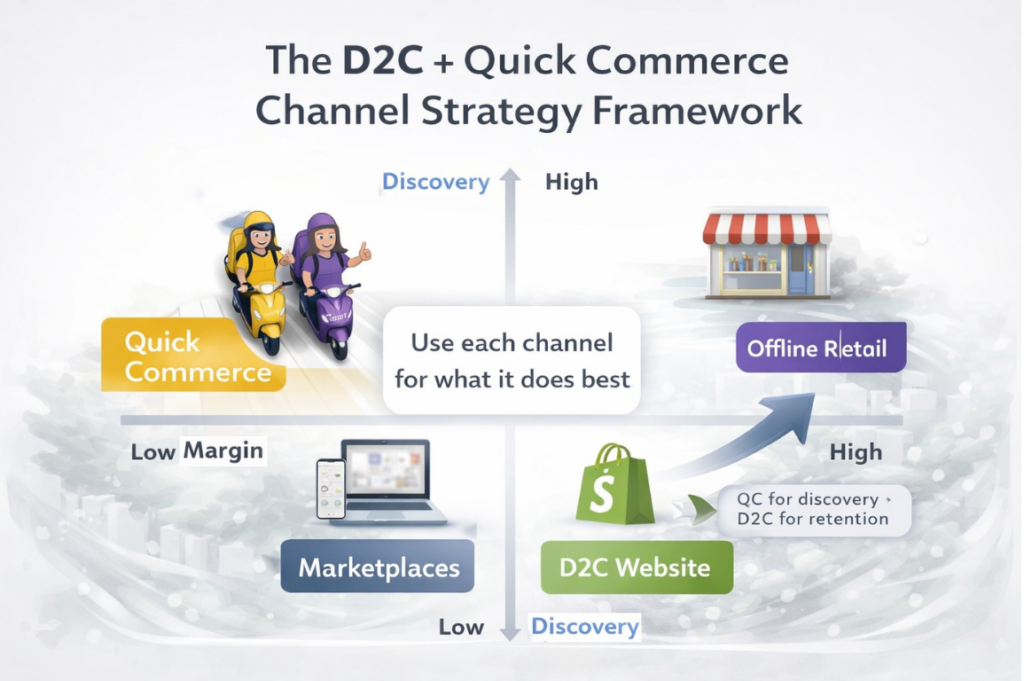
The brands doing this well are not choosing between quick commerce and D2C. They are using each channel for what it does best. Here is the framework.
1. Use quick commerce for discovery and volume. List your hero SKUs on Blinkit and Zepto. Let the platform introduce your brand to new customers in metros. Treat it as your discovery channel, not your profit channel.
2.Use your D2C website for margin and retention. Drive customers from quick commerce to your own website through packaging inserts, QR codes, and post-purchase nudges. Offer a 10% discount for direct orders. Build WhatsApp and email relationships, but your website is where you make money. Quick commerce is where you find customers.
3.Track unit economics by channel separately. Do not blend your quick commerce and D2C numbers. Track CM2 for each channel independently. Know exactly how much you make (or lose) on every order from every platform.
4.Set a volume cap for quick commerce. Decide in advance: quick commerce should not exceed 30–40% of total revenue. If it crosses that, you are over-exposed to platform risk. Diversify.
5.Advertise strategically, not blindly. Quick commerce ads convert well, but the cost adds up fast. Set a strict ROAS floor. If a campaign is not meeting your target, pause it. Do not let platform sales reps talk you into spending more than your economics can support.
6.List selectively, not everything. Not every SKU belongs on quick commerce. List high-frequency, impulse-friendly products (snacks, beverages, face wash, baby wipes). Keep your premium, high-margin, education-heavy products for your own website where you control the story.
7.Build brand loyalty that transcends platforms. The customer should remember your brand, not the platform they bought it on. Invest in packaging. Include a thank-you card. Make the unboxing experience memorable. When the customer thinks “I want that face wash again,” they should think of your brand first, then choose where to buy it.
Which D2C Categories Win on Quick Commerce? And Which Should Stay Away?
| Works Well on QC | Works Sometimes | Stay on D2C Website |
| Packaged snacks and beverages | Skincare (high-frequency items) | Premium skincare (needs education) |
| Daily-use personal care (face wash, shampoo) | Supplements (if impulse-priced) | Fashion and apparel |
| Baby essentials (wipes, diapers) | Pet food and treats | Jewellery |
| Instant coffee, tea | Men’s grooming basics | Electronics and audio |
| Ready-to-eat meals | Home cleaning products | Home and furniture |
The pattern: quick commerce works for products that are consumed frequently, bought impulsively, and do not need much explanation. If your product requires a 2-minute video to explain why it is worth Rs 800, it belongs on your website. If someone can add it to their Blinkit cart without thinking, quick commerce will work.
The Future of Quick Commerce vs D2C in India: What 2026 and Beyond Look Like
1.Quick commerce ad revenue will keep growing. Collectively, Blinkit, Zepto, and Instamart earned Rs 3,000–3,500 crore in ad revenue in 2025. This number will cross Rs 5,000 crore by 2027. That means more pressure on D2C brands to spend on platform ads just to maintain visibility.
2.2026 is the final land-grab year for quick commerce. All three major players are cash-rich. Dark store density in the top 8 cities will decide who wins. Regulatory risks around labour laws and zoning could slow expansion. But for now, quick commerce is growing faster than any other retail channel in India.
3.The quick commerce vs D2C lines will blur further. D2C brands are listing on quick commerce. Quick commerce platforms are launching private labels. Marketplaces like Flipkart have launched Flipkart Minutes for 10-minute delivery. The customer does not care about the channel distinction. They care about speed, price, and trust.
4.Owned channels become more valuable, not less. As quick commerce takes a bigger share of discovery, the brands that build direct customer relationships will have a compounding advantage. Your email list, your WhatsApp subscribers, your repeat buyers who order from your website. That is your moat. Quick commerce cannot take it away if you build it properly.
5.ONDC could change the maths. The Open Network for Digital Commerce caps commissions at around 3% and offers plug-and-play logistics. If ONDC scales in grocery and essentials, it could give D2C brands a quick-delivery option without the 20–25% commission.
6.The smart D2C brands will play both games. Not quick commerce vs D2C. Quick commerce and D2C. Use platforms for reach & owned channels for revenue. Build a brand that customers remember regardless of where they buy it.
The future is not quick commerce vs D2C. It is quick commerce plus D2C. The brands that win will be the ones that use quick commerce for what it does best (discovery, speed, volume) and their own channels for what those do best (margin, data, loyalty). The losers will be the ones who let any single channel own them.
Key Takeaways
1.Quick commerce in India crossed $3 billion in FY24 and could reach $10 billion by 2029. Blinkit (45%), Zepto (29%), and Instamart (25%) control 95% of the market.
2.D2C brands gain volume and discovery from quick commerce but lose margin (35–50% total platform costs), customer data, and retention control.
3.The unit economics tell the real story. The same Rs 500 product earns Rs 204 contribution on a D2C website and Rs 99 on quick commerce. That is a 51% drop in margin per order.
4.Brands need 55%+ gross margins to be profitable on quick commerce. Below that, you generate revenue but not profit.
5.The smart strategy is complementary, not exclusive. Use quick commerce for discovery and impulse products. Use your D2C website for margin, retention, and brand building. Cap quick commerce at 30–40% of revenue.
6.Build customer relationships that transcend any platform. Your email list, your WhatsApp subscribers, your repeat buyers. That is the moat no platform can take.
Frequently Asked Questions about Quick Commerce vs D2C
Is quick commerce good or bad for D2C brands in India?
Both. Quick commerce gives D2C brands instant access to urban customers, impulse-driven discovery, and higher ad conversion rates (3–8% vs 1.5–3% on Meta/Google). But it comes with 18–25% commissions, mandatory ad spend, lost customer data, and margin compression. The key is using quick commerce as one channel in a diversified strategy, not as your primary business.
How much does it cost to sell on Blinkit, Zepto, or Instamart?
Total costs can reach 35–50% of the product’s selling price. This includes 18–25% commission, listing fees (up to Rs 25,000 per SKU per state on Blinkit), and advertising packages (Rs 2–9 lakh for three months). Brands need 55%+ gross margins to remain profitable after these costs.
Should a new D2C brand list on quick commerce platforms?
It depends on your category and margins. High-frequency, impulse-friendly products (snacks, beverages, face wash, baby essentials) can benefit from quick commerce discovery. Premium, education-heavy, or high-involvement products (fashion, electronics, premium skincare) are better served through your own D2C website. If you list, set a volume cap and track unit economics separately.
What is the future of quick commerce vs D2C in India?
The lines are blurring. Quick commerce will keep growing (potentially $10 billion by 2029). D2C brands will increasingly use quick commerce for discovery and urban reach while building owned channels for margin and retention. ONDC could offer a lower-commission alternative. The winners will be brands that play both games well.
How can D2C brands protect their margins on quick commerce?
List selectively (only impulse-friendly hero SKUs). Set strict ROAS floors for platform ads. Cap quick commerce at 30–40% of total revenue. Drive customers from quick commerce to your own website through packaging inserts and QR codes. Track CM2 per channel separately. And make sure your gross margin exceeds 55% before listing.