6 Customer Acquisition Mistakes D2C Brands Keep Making in India
Indian D2C brands are bleeding money on customer acquisition. Not because they are not trying hard enough, but because they are making the same avoidable customer acquisition mistakes repeatedly. According to industry benchmarks, the average customer acquisition cost (CAC) for D2C brands in India ranges from ₹300 to ₹2,500 depending on the category. But many brands pay 2x to 3x more than they should, not due to market conditions, but due to fundamental errors in their acquisition strategy.
These mistakes compound over time. A 20% inefficiency in your acquisition funnel does not just waste 20% of your budget today. It means you acquire fewer customers, generate less revenue, raise less funding, and fall behind competitors who got the fundamentals right.
This article breaks down the six most common customer acquisition mistakes that D2C brands in India make, why they happen, and exactly how to fix them. These are not theoretical problems. These are patterns observed across hundreds of Indian D2C brands across beauty, fashion, food, electronics, and home categories.
If you recognize your brand in any of these mistakes, you are not alone. But now you know what to fix.
Mistake #1: Putting All Acquisition Spend on the Homepage
The Problem
Most D2C brands treat their homepage as the universal landing destination for all paid traffic. This is the biggest customer acquisition mistakes for any D2C Brand. Facebook ads, Google ads, influencer links, email campaigns—everything points to the homepage, or in some cases, the All collections page.
The logic seems sound: “Let customers explore our full catalog and choose what they want.”
But here is what actually happens:
- Visitor arrives on homepage → sees 20+ products → feels overwhelmed → bounces
- No message match between the ad they clicked and the page they land on
- Decision fatigue sets in within 3-5 seconds
- Conversion rate drops to 0.5%-1.2% when it should be 3%-5%
Sending paid traffic to your homepage is like running a billboard that says “Visit our store” and then making customers walk through the entire mall to find what you advertised.
Why This Happens
Brands underestimate how important message continuity is in the customer journey. If your Instagram ad shows a specific anti-acne face wash, the customer expects to land on a page about that anti-acne face wash, not your entire skincare catalog.
Many brands also lack the infrastructure to create dedicated landing pages for each campaign, so they default to the homepage out of convenience, not strategy.
The Fix
Create dedicated landing pages for every major acquisition channel and campaign.
- Paid social ads → Product-specific landing pages with the exact product featured in the ad
- Google Search ads → Category pages or collection pages matching search intent
- Influencer campaigns → Custom landing pages with influencer discount codes pre-applied
- Email campaigns → Targeted pages based on segment (new arrivals for engaged subscribers, bestsellers for dormant ones)
Message match is everything. The headline, visual, and offer on your landing page should mirror the ad that brought the visitor there.
Example: If your Facebook ad says “Get 20% off on organic honey,” your landing page headline should say “Organic Honey – 20% Off Today” with the product front and center, not buried under “Explore All Products.”
Brands that optimize landing pages for message match typically see conversion rates improve by 2x to 4x compared to homepage-only strategies.
Mistake #2: Ignoring Shoppable Videos on High-Intent Pages
The Problem
Many D2C brands now understand that video content is most important for engagement. They put money in Influencer Marketing, create Instagram Reels that work for them just for 48 hours or so, and maybe even embed a video or two in their “About Us” section.
But here is the critical mistake: They ignore putting video on the pages where purchase decisions actually happen.
There are other set of brands that place shoppable videos on just their homepage, where traffic is often cold and exploratory. But leave those parts of the website where buying intent is highest.
This not only is one of the biggest customer acquisition mistakes but ends up costing without a proper ROI
Why This Happens
Brands assume that by the time a customer reaches a PDP, they have already made up their mind. They think product images and a bullet-point description are enough.
This is wrong. The PDP is not the end of the decision journey. It is where the final hesitation happens:
- “Does this actually work?”
- “Will this fit me / suit my skin tone / taste good?”
- “How do I use this product correctly?”
Static images and text cannot answer these questions as effectively as video can. Video shows the product in use, demonstrates results, and provides social proof—all of which reduce purchase hesitation and increase conversions.
The Fix
Place shoppable videos strategically on high-intent pages, not just your homepage.
Here is where video should be:
- Product Detail Pages (PDPs) – Show how-to videos, unboxing clips, user-generated content, or influencer reviews directly on PDPs
- Collection Pages – Use video carousels to showcase multiple products in a category
- Cart Page – Add a last-minute nudge video for cross-sells or related products
- Checkout Page – Build trust with testimonial videos or guarantee explanations
The key is to match the video type to the customer intent on each page:
- Homepage: Brand storytelling, new arrivals, bestsellers carousel
- PDPs: Product demos, reviews, how-to guides, before/after results
- Collection Pages: Category-level overviews, style guides, comparison videos
Why it matters: According to internal data from D2C brands using strategic video placement, conversion rates can increase by 5% to 30% when shoppable videos are placed on high-intent pages, compared to homepage-only video strategies.
Technical consideration: Many brands worry that adding videos will slow down their website. This was true when videos were uploaded directly to the website’s CDN, competing for bandwidth with images, text, and scripts. But modern shoppable video platforms use separate CDN infrastructure and proprietary compression mechanisms to ensure fast loading without affecting site speed.
For example, platforms like ReelV allow brands to load 50+ videos on a single page without impacting overall site performance, because the videos are served from a dedicated server infrastructure separate from the website’s core assets. This eliminates the speed-versus-engagement tradeoff entirely.
Shoppable videos are not a vanity metric. When placed strategically on high-intent pages, they directly impact conversion rates and reduce hesitation at the point of purchase. If you are not using shoppable videos on your PDPs, you are leaving conversions (and also revenue) on the table.
Mistake #3: Not Tracking CAC by Channel
The Problem
Many D2C brands track overall customer acquisition cost (CAC) as a single blended number. They know they spent ₹2 lakh on marketing last month and acquired 500 customers, so their CAC is ₹400. But they do not break it down by channel.
Here is why that is a problem:
- Instagram ads might be acquiring customers at ₹250 CAC with 40% repeat purchase rate
- Google Search ads might be ₹800 CAC but with 60% repeat rate and higher AOV
- Influencer campaigns might be ₹150 CAC but with 15% repeat rate (one-time discount hunters)
If you only look at the blended CAC of ₹400, you will miss the fact that some channels are gold mines while others are budget drains.
Why This Happens
Tracking CAC by channel requires proper attribution infrastructure, which many early-stage D2C brands do not have. They rely on Shopify’s default analytics or Google Analytics, which often undercount conversions (especially on iOS post-ATT) and do not attribute multi-touch journeys well. It is easier to look at total spend and total customers and call it a day.
The Fix
Implement proper channel-level CAC tracking with these steps:
- UTM tagging discipline – Every ad, influencer link, and email should have proper UTM parameters (source, medium, campaign, content)
- First-touch and last-touch attribution – Understand which channel brought the customer in and which channel closed the sale
- Channel-specific CAC calculation – CAC = (Channel Spend) / (Customers Acquired from Channel)
- Track LTV by channel too – CAC means nothing without knowing which channels bring high-LTV customers
Example framework:
| Channel | Spend | Customers Acquired | CAC | 90-Day LTV | LTV:CAC Ratio |
| Instagram Ads | ₹80,000 | 320 | ₹250 | ₹1,200 | 4.8:1 |
| Google Search | ₹1,20,000 | 150 | ₹800 | ₹2,800 | 3.5:1 |
| Influencer | ₹60,000 | 400 | ₹150 | ₹450 | 3:1 |
| Facebook Ads | ₹40,000 | 100 | ₹400 | ₹1,600 | 4:1 |
In this example, Instagram ads have the lowest CAC and highest LTV:CAC ratio. Google Search has the highest CAC but also the highest LTV. Influencer campaigns have the lowest CAC but terrible LTV (discount hunters who never return). Without this breakdown, you would just see a blended CAC of ₹400 and miss the strategic insights.
Action steps:
- Set up a CAC tracking dashboard (Google Sheets is fine to start)
- Review channel-level CAC weekly, not monthly
- Cut or restructure channels with LTV:CAC below 3:1
- Double down on channels with LTV:CAC above 4:1
Blended CAC hides the truth. Channel-level CAC reveals it.
Mistake #4: Over-Investing in Awareness Without a Retention Plan
The Problem
Many D2C brands fall into the trap of spending 80%-90% of their marketing budget on new customer acquisition while spending almost nothing on retention.
This creates a leaky bucket problem:
- You acquire 1,000 customers this month at ₹500 CAC = ₹5 lakh spend
- Only 15%-20% of them buy again in the next 90 days
- You need to keep acquiring new customers every month just to maintain revenue
- CAC keeps rising as the market saturates
- You never build a profitable, sustainable business
The math does not work. If you are acquiring customers at ₹500 and only 15% ever buy again, your LTV is ₹900 (assuming ₹600 AOV + one ₹300 repeat purchase). Your LTV:CAC ratio is 1.8:1. You are burning money.
Why This Happens
Acquisition feels like growth and every new customer is a dopamine hit. While retention is invisible, boring, and slow. This is very a common customer acquisition mistakes. Founders also overestimate how loyal their customers will be “if the product is good enough.” They assume customers will come back on their own. They will not, not in a market with 500 other D2C brands competing for their attention.
The Fix
Shift to a retention-first acquisition model:
- Allocate at least 20%-30% of marketing budget to retention – Email marketing, SMS, WhatsApp, loyalty programs, retargeting
- Build retention into acquisition from Day 1 – Use post-purchase email flows, subscription models, sample kits with full-size product offers
- Measure success by repeat purchase rate, not just acquisition volume – A brand with 40% repeat rate can afford higher CAC than one with 15%
- Calculate true LTV before deciding CAC limits – If your 90-day LTV is ₹1,500, you can afford ₹500 CAC. If it is ₹800, you cannot.
Example retention playbook:
- Day 1: Welcome email with usage tips and founder story
- Day 3: Educational content (how to get the most out of the product)
- Day 7: Customer review request
- Day 14: Personalized product recommendation based on first purchase
- Day 21: Reorder reminder (for consumables) or cross-sell offer
- Day 30: Loyalty program enrollment or referral incentive
- Day 60: Win-back offer for non-repeat purchasers
The best D2C brands in India—Mamaearth, Minimalist,BoAt—all have repeat purchase rates above 35%. They did not get there by accident but because they invested strategically in retention. Acquisition without retention is just renting customers. Retention turns them into assets.
Internal link: [Learn more about building aretention marketing strategy for D2C brands.]
Mistake #5: Running Performance Marketing Without Brand Building
The Problem
Many D2C brands operate on a 100% performance marketing model:
- All budget goes to Facebook/Instagram ads
- Every rupee spent must show immediate ROAS (Return on Ad Spend)
- If an ad does not convert within 7 days, it is killed
- Zero investment in brand awareness, content, influencer partnerships, or organic presence
This works in the short term. Performance marketing can drive revenue from Day 1.
But it breaks down over time:
- CAC keeps rising as competition increases for the same audiences
- Customer quality drops as you only attract discount hunters and impulse buyers
- No brand moat – customers have zero loyalty and will switch to whoever offers 10% more off
- Dependency on paid ads – the moment you stop spending, revenue drops to near zero
This is not a sustainable business. It is a paid-traffic arbitrage that collapses the moment unit economics stop working.
Why This Happens
Performance marketing is measurable, immediate, and feels safe. Brand building is fuzzy, long-term, and hard to attribute. Founders trained in digital marketing (or advised by performance marketing agencies) default to what they can measure and optimize daily. But brand building is not optional. It is the difference between a D2C business and a D2C brand.
The Fix
Adopt a 70/30 or 60/40 split between performance marketing and brand building.
Performance marketing (60%-70%):
- Facebook/Instagram ads
- Google Search ads
- Retargeting
- Affiliate marketing
Brand building (30%-40%):
- Content marketing and SEO
- Influencer partnerships (not just paid posts, but co-creation)
- YouTube product reviews and how-to content
- PR and ecosystem presence (podcasts, industry roundups, awards)
- Community building (WhatsApp groups, customer stories, UGC campaigns)
Why the split matters:
- Performance marketing drives short-term revenue and helps you hit monthly targets
- Brand building lowers CAC over time by creating organic demand and word-of-mouth
- Together, they create a compounding engine where brand awareness makes performance ads more efficient, and performance revenue funds more brand-building
Example: Minimalist (the skincare brand) does not just run Instagram ads. They invest heavily in educational content, dermatologist collaborations, and ingredient transparency messaging. This builds trust and authority, which makes their performance ads convert better because people already know and trust the brand.
Performance marketing buys customers but Brand building earns them.
Internal link: [Understand theperformance vs brand marketing balance for D2C.]
Mistake #6: Ignoring Post-Purchase Experience in Acquisition Strategy
The Problem
Most D2C brands think customer acquisition ends at checkout. They obsess over ad creative, landing pages, checkout optimization—but ignore everything that happens after the purchase. Here is the reality: Your post-purchase experience is part of your acquisition strategy.
A bad post-purchase experience does not just hurt retention. It actively kills acquisition by:
- Generating negative reviews that lower conversion rates on future ads
- Reducing referral rates because disappointed customers do not recommend you
- Lowering repeat purchase rates, which raises your effective CAC over time
- Triggering refund requests and returns, which erase the revenue from that acquisition
Every rupee you spent acquiring that customer is wasted if they have a bad experience and never return.
Why This Happens
Brands separate “acquisition” (marketing team) and “operations” (fulfillment team) into silos. The marketing team’s job ends at checkout. What happens after is someone else’s problem. This is organizational dysfunction, not strategy.
The Fix
Treat post-purchase as part of the acquisition funnel.
Your acquisition cost is only worthwhile if the customer:
- Receives the product on time
- Has a positive unboxing experience
- Uses the product correctly
- Sees the value and comes back
Here is how to fix it:
1. Optimize shipping and fulfillment:
- Set realistic delivery timelines and meet them (under-promise, over-deliver)
- Send proactive shipping updates via WhatsApp/SMS
- Use quality packaging that reflects your brand positioning
- Include a thank-you note or small surprise (sample, discount code, founder letter)
2. Guide product usage:
- Include a product usage guide in the package
- Send a “How to get the most out of your product” email on delivery day
- Create tutorial videos and link them in post-purchase emails
3. Close the feedback loop:
- Ask for reviews 7-10 days after delivery (not immediately)
- Respond to every review, positive or negative
- Use negative feedback to improve the product and experience
4. Incentivize referrals:
- Include a referral card in the package (“Give ₹200, Get ₹200”)
- Send a referral email 14 days post-purchase when satisfaction is highest
- Make sharing easy (WhatsApp, Instagram Stories)
Example: Brands like Mamaearth and The Whole Truth Foods are known for exceptional post-purchase experiences—beautiful packaging, thoughtful notes, proactive communication. This is not just “nice to have.” It directly improves repeat rates, referrals, and review scores, which all lower future CAC. Acquisition does not end at checkout, it ends when the customer becomes an advocate.
Key Takeaways about Customer Acquisition
Customer acquisition mistakes are expensive, but they are fixable. Here is what to remember:
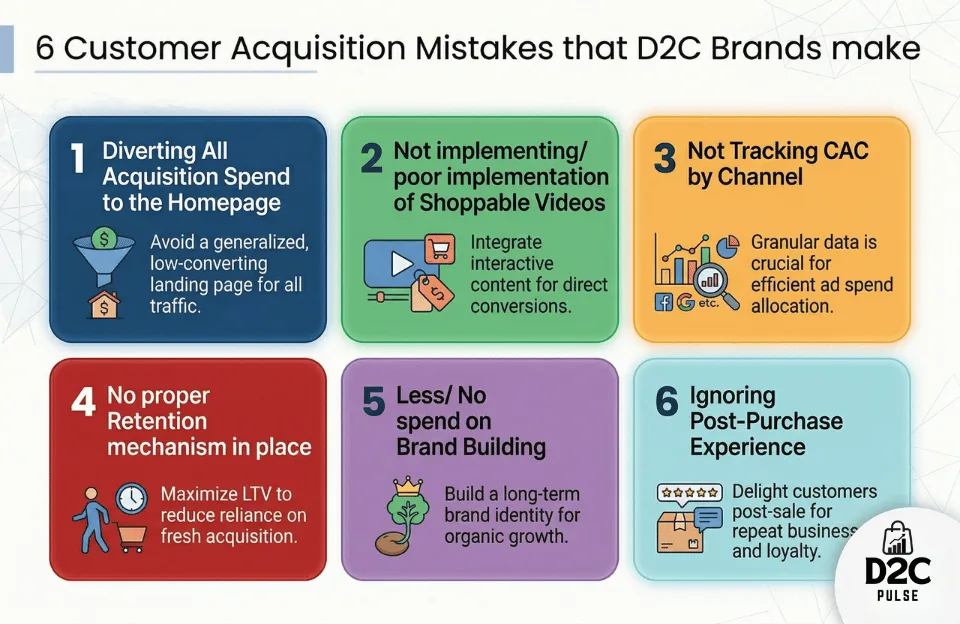
- Stop sending all traffic to your homepage. Create dedicated landing pages for every campaign and channel to improve message match and conversion rates.
- Place shoppable videos on high-intent pages, not just your homepage. Videos on PDPs, collection pages, and checkout can increase conversions by 5%-30% without slowing down your site if you use proper infrastructure.
- Track CAC by channel, not just blended CAC. Know which channels bring high-LTV customers and which bring one-time discount hunters. Optimize accordingly.
- Invest in retention from Day 1. A leaky bucket stays leaky no matter how much you pour into it. Build email flows, loyalty programs, and reorder campaigns before scaling acquisition.
- Balance performance marketing with brand building. A 70/30 or 60/40 split ensures short-term revenue while building long-term defensibility and lowering CAC over time.
- Treat post-purchase as part of acquisition. Your fulfillment, packaging, and customer experience directly impact reviews, referrals, and repeat rates—all of which affect your effective CAC.
These mistakes are common, but they are not inevitable. Fix them, and your acquisition engine becomes more efficient, more predictable, and more profitable.
Frequently Asked Questions about Customer Acquisition
What is a good customer acquisition cost (CAC) for D2C brands in India?
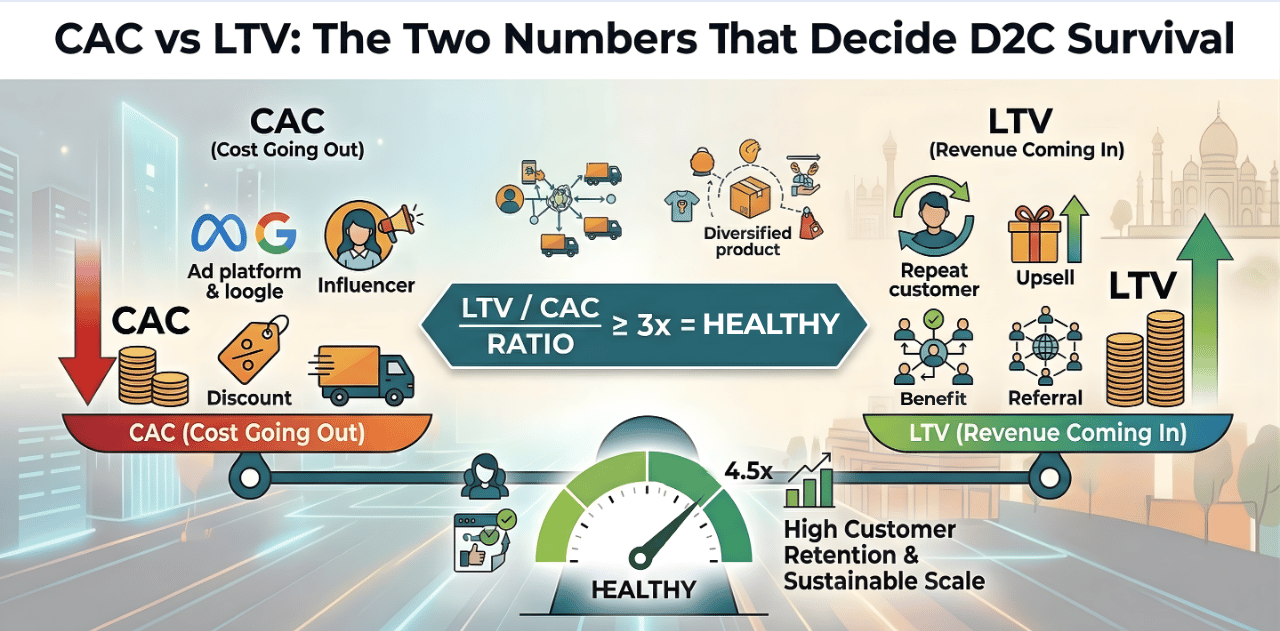
CAC varies widely by category. Beauty and personal care brands typically see ₹300-₹800 CAC. Fashion and apparel range from ₹400-₹1,200. Electronics and premium categories can go up to ₹1,500-₹2,500. The key metric is not absolute CAC, but your LTV:CAC ratio, which should be at least 3:1 for a healthy D2C business.
How do I know if my shoppable videos are working?
Track these metrics: (1) Video view rate (what % of page visitors watch the video), (2) Add-to-cart clicks from video, (3) Buy Now clicks from video, (4) Conversion rate on pages with video vs. without. Platforms like ReelV provide media-wise analytics so you know exactly which videos drive revenue and which do not.
Should I focus on acquisition or retention first?
Both, but with this priority: Build basic retention mechanisms (email flows, reorder campaigns) from Day 1, even if you are pre-revenue. Once you have 100+ customers, start measuring repeat purchase rate. If it is below 25%, fix retention before scaling acquisition. If it is above 35%, you can afford to invest more aggressively in acquisition.
How much should I spend on brand building vs performance marketing?
For early-stage D2C brands (first 12-18 months), a 70/30 split (70% performance, 30% brand) makes sense. As you scale, shift toward 60/40 or even 50/50. The key is to never go 100% performance—it creates unsustainable CAC inflation and zero brand defensibility.
What is the biggest customer acquisition mistake D2C brands make?
The biggest mistake is treating acquisition as a one-time event instead of a long-term system. Brands focus on “getting the customer” and ignore everything that happens after—retention, referrals, reviews, repeat purchases. This creates a leaky bucket where you keep spending to acquire new customers while old customers disappear. The fix: build retention into your acquisition strategy from Day 1.
Next Steps: Build a Smarter Acquisition Strategy
Customer acquisition is not just about spending money on ads. It is about building a system that attracts the right customers, converts them efficiently, and keeps them coming back. If you recognize your brand in any of these six mistakes, you now know what to fix. Start with the mistake that is costing you the most—whether that is ignoring video on PDPs, not tracking CAC by channel, or running acquisition without retention.
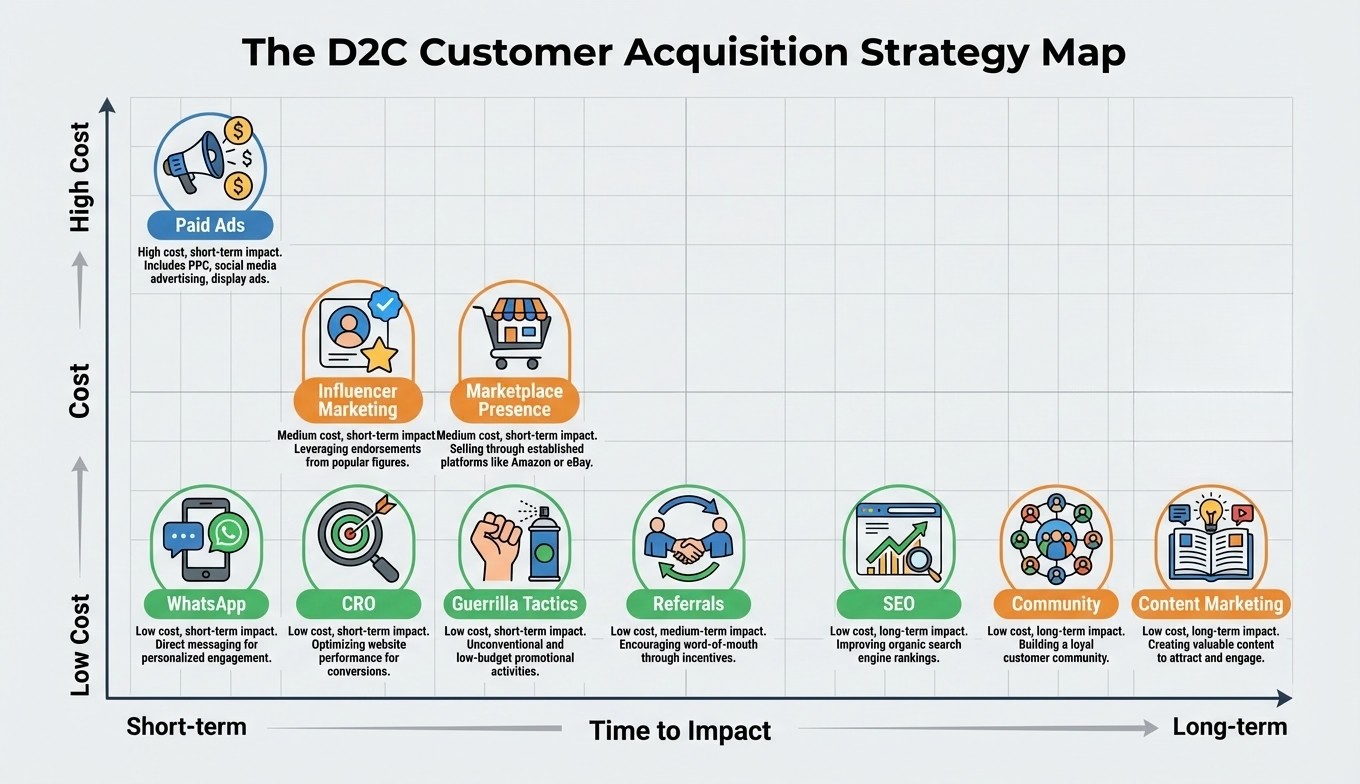
Want to dive deeper into customer acquisition strategies? Read our complete guide on Customer Acquisition Strategies for D2C Brands in India, learn how to Reduce CAC for D2C Brands, or understand the CAC vs LTV equation every founder needs to master.
Want to fix the shoppable video mistake today?
ReelV helps D2C brands implement shoppable videos the right way—on PDPs, collection pages, and checkout—without slowing down your website. With separate CDN infrastructure, proprietary compression, and deep analytics, you can see exactly which videos drive revenue. Learn more about ReelV or start your free trial today.