Amazon and Flipkart Battle for Quick Commerce Supremacy
Quick commerce discounts hit 55% as Amazon and Flipkart Minutes clash. Analyze the impact of this price war on D2C margins and brand loyalty.
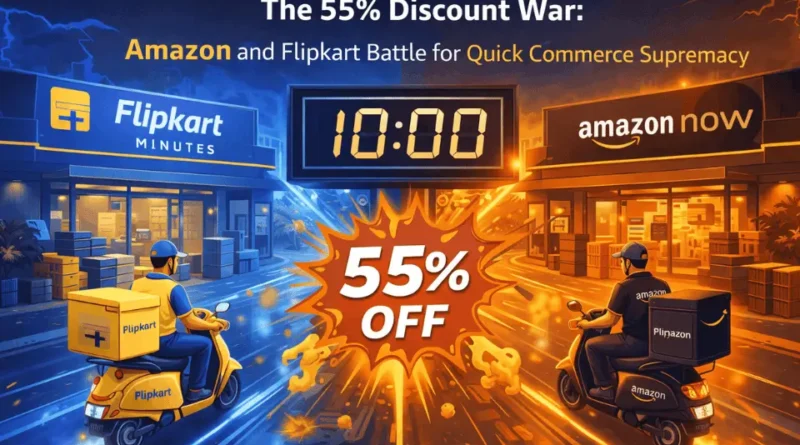
The “10-minute delivery” or “Quick Commerce” as we call it, has moved from a convenience feature to a high-stakes battlefield of attrition. As of March 20, 2026, Amazon Now and Flipkart Minutes have entered an aggressive price war, with sector-wide discounts reaching an unprecedented 55%. Amazon has reportedly ramped up its discounting to 57% on key categories, while Flipkart Minutes has successfully crossed the 400 dark store milestone, signaling that the infrastructure race is now a localized street fight.
The Economics of a 55% Discount
In any other industry, a 55% discount would be seen as a desperate liquidation. In Quick Commerce, it is a “Customer Acquisition Land Grab.” The incumbent leaders—Blinkit, Zepto, and Swiggy Instamart—are now facing a two-pronged attack from the e-commerce giants. While Blinkit recently posted its first-ever EBITDA profit, the entry of Amazon and Flipkart with deep pockets and massive logistics networks threatens to reset the clock on industry-wide profitability.
The surge in dark stores (with 2,000+ new facilities expected in 2026) means that the “Digital Shelf” is becoming increasingly crowded. For platforms, the goal is to become the “Default App” for everything from milk to MacBooks. The 55% discount acts as the “hook” to change consumer habits, moving them away from planned weekly shopping toward high-frequency, impulse-driven quick commerce.

The D2C Brand Dilemma
For D2C brands, this price war is a double-edged sword. On one hand, being listed on a platform that is aggressively discounting provides a massive “Top-of-Funnel” boost. On the other hand, it puts immense pressure on brand-led pricing. If a consumer gets used to buying your product at a 50% discount on Flipkart Minutes, they are unlikely to ever pay full price on your Brand.com site. This creates a “Discount Trap” that can permanently damage a brand’s premium positioning.
The “Quick Commerce” dependency problem
For founders, this news highlights the “Platform Dependency Risk.” You must decide whether you are building a “Platform Brand” or an “Independent Brand.” If you rely too heavily on quick commerce for volume, you lose control over your pricing and customer data. Marketers should focus on “Value-Added Bundling” that is exclusive to their own website to protect margins. The takeaway for 2026 is that while Quick Commerce is the fastest-growing distribution channel, it is also the most volatile. You must use the “Quick Commerce Surge” for discovery, but double down on Retention and Community to ensure your customers don’t just follow the deepest discount to a competitor.