Key Characteristics of Successful D2C Brands of India
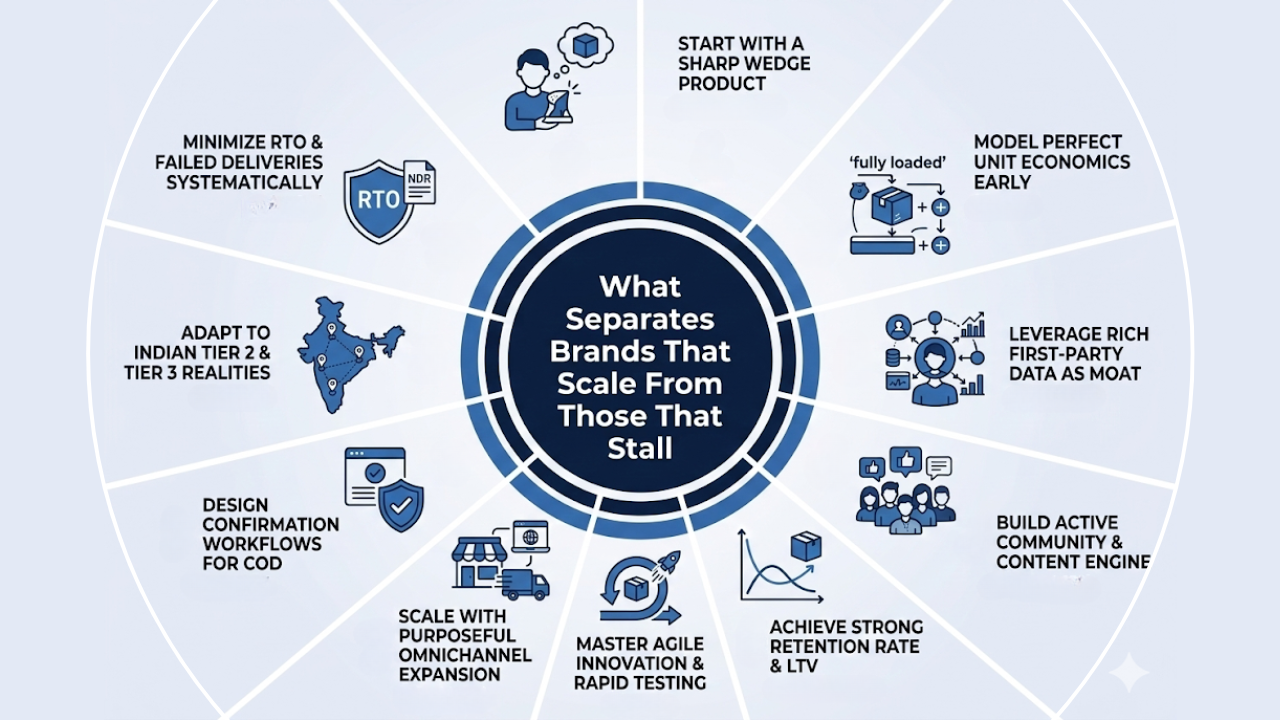
The 10 Traits That Separate D2C Brands That Scale, from Those That Stall
India has over 800 D2C brands, but most will not even survive five years. Studies suggest that roughly 90% of D2C startups in India close by their fifth year. About 30% fail in the first year itself. The reasons are familiar. Rising ad costs, thin margins, poor retention and no real differentiation. But some brands break through and are able to become Successful D2C brands of India. boAt went from zero to India’s number one audio brand. Mamaearth went from a baby care startup to IPO in seven years. Minimalist built a science-led skincare brand so strong that HUL acquired a 90% stake for over 2,600 crore rupees. Lenskart crossed 5,500 crore in revenue with over 2,000 stores.
What do these successful D2C brands in India have in common? Not luck. Not just funding. A set of characteristics that are visible, repeatable, and learnable. This guide breaks down the 10 key traits that separate D2C brands that scale from those that stall. Each trait comes with a real Indian brand example and a practical takeaway you can apply.
1. They Start with a Category Edge, Not Just a Product
The most successful D2C brands of India do not start by making a product. They start by spotting a gap in a category. This is a crucial difference as a product can be copied in weeks, but a category edge takes years to replicate.
What does a category edge look like?
- boAt spotted that affordable, stylish audio gear did not exist for young Indians. JBL was too expensive and local brands looked cheap. boAt filled the gap with sharp pricing, bold design, and influencer-led marketing.
- Minimalist saw that Indian skincare was full of vague claims and no transparency. It built a brand around ingredient percentages, clinical data, and science-first messaging. Nobody else was doing that in India.
- Country Delight identified that urban consumers did not trust the freshness of packaged milk. It built a farm-to-doorstep model with daily app-based delivery. The entire brand is built on one promise: fresh, pure, traceable.
The pattern is consistent. Every Successful D2C brands of India we studied started with a founder who saw a real problem — often from personal experience — and built around that gap.
A product sits on a shelf. A category edge sits in the customer’s mind. The best D2C brands do not compete for shelf space. They create a new mental category.
[Internal link: Read What is the D2C Business Model in India? Complete Guide for the foundational framework]
2. They Build a Brand, Not Just a Store
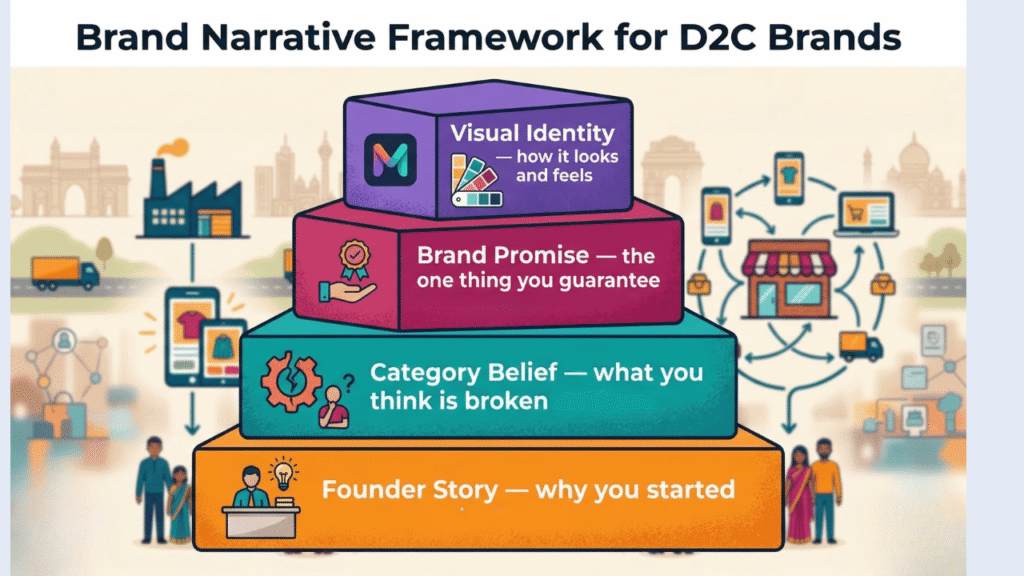
Anyone can set up a Shopify store but that is not a brand. A brand is a story, a point of view, and a feeling. The most successful D2C brands of India invest in brand narrative from day one. They do not start with a product page. They start with a reason to exist.
- Mamaearth: “Toxin-free, safe for your baby.” The founders told their personal story of searching for safe baby products in India and not finding any. That story became the brand.
- The Whole Truth: “No added sugar. No junk. Read the label.” The brand’s entire identity is built on radical transparency about ingredients. The name itself is the promise.
- Sugar Cosmetics: “Bold, unapologetic makeup for Indian women.” Sugar did not try to be a budget Lakme. It built a distinct identity for millennial women who wanted bold colours and cruelty-free formulas tailored for Indian skin and climate.
Brand narrative is not a logo or a tagline. It is the answer to one question: “Why should someone choose you over everything else?” If you cannot answer that in one sentence, you do not have a brand yet.
3. They Get Unit Economics Right Early
This is where most D2C brands fail. They chase revenue and ignore the maths underneath.
Successful D2C brands in India obsess over three numbers from the start:
- Customer Acquisition Cost (CAC): How much does it cost to get one new customer? This includes ad spend, influencer fees, and any discounts used to drive the first purchase.
- Average Order Value (AOV): How much does a customer spend per order? Low AOV with high shipping costs is a recipe for losses.
- Customer Lifetime Value (LTV): How much total revenue does one customer generate over their relationship with the brand? This is driven by repeat purchase rate and retention.
The rule of thumb: LTV should be at least 3x CAC. If you spend 500 rupees to acquire a customer, that customer should generate at least 1,500 rupees in lifetime value. If it does not, your economics are broken.
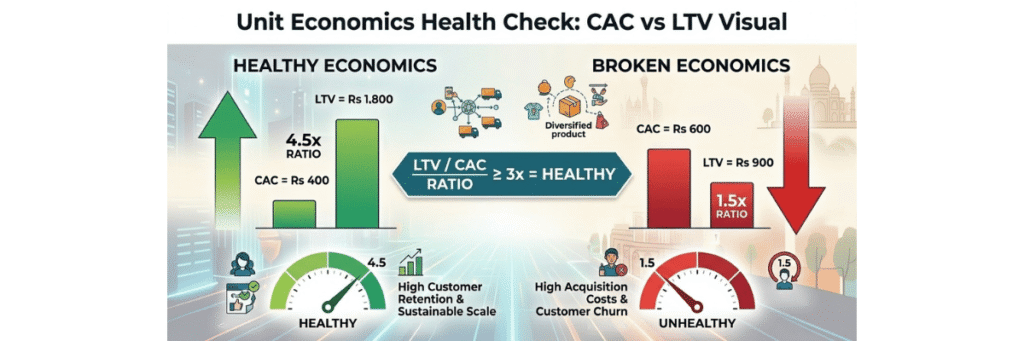
Investors now screen for this. The era of growth-at-all-costs is over. D2C funding in India dropped to 757 million dollars in 2024 from 930 million in 2023. Capital is now going to brands that show contribution margin discipline, not just revenue growth.
[Internal link: Read Understanding Unit Economics for D2C Brands in India for the full measurement framework]
4. They Treat Retention as the Real Growth Engine
Acquiring a customer is expensive. Keeping them is where D2C brands make money.
The most successful D2C brands in India shift from acquisition-heavy to retention-heavy within 12 to 18 months of launch. They know that repeat customers are cheaper to serve, spend more per order, and refer others.
How do they do it?
- WhatsApp retention loops: Brands like Mamaearth and Country Delight use WhatsApp for reorder reminders, delivery updates, product tips, and flash sale alerts. In India, WhatsApp is the highest-engagement retention channel.
- Email automation: Welcome flows, abandoned cart sequences, post-purchase follow-ups, and winback campaigns. Tools like Klaviyo and WebEngage power this.
- Subscription models: Country Delight’s daily milk subscription. The Whole Truth’s snack box subscription. Subscriptions lock in recurring revenue and reduce CAC to near zero for repeat orders.
- Loyalty programs: Point-based systems, VIP tiers, and referral rewards that incentivise repeat behaviour.
The key metric: repeat purchase rate. A strong Indian D2C brand should aim for 30–40% of revenue from repeat customers within 90 days of first purchase. The higher this number, the more sustainable the business becomes.
5. They Build Content and Community, Not Just Ad Campaigns
In the early days, most D2C brands in India grew through paid ads on Meta and Google. That still works. But it is no longer enough.
Ad costs have risen roughly 30% year-on-year in competitive categories. Brands that rely only on paid ads face a treadmill: the moment they stop spending, traffic stops.
Successful D2C brands break this cycle by investing in owned channels:
- Content marketing: Minimalist publishes detailed ingredient guides. Wakefit runs a sleep blog. These attract organic traffic that does not cost per click.
- Social community: Sugar Cosmetics built a massive Instagram community through tutorials, user-generated content, and creator collaborations. 43% of Indian shoppers are influenced by content from creators.
- SEO: Brands that rank for category searches (“best vitamin C serum”, “ergonomic office chair”) reduce their dependence on paid ads over time.
- Founder-led storytelling: Mamaearth’s founders on Shark Tank India. boAt’s Aman Gupta becoming a public figure. The founder becomes the brand’s most powerful marketing asset.
The smartest D2C brands shift from rented attention (paid ads) to owned attention (content, community, SEO). That is the shift from spending money to building an asset.
[Internal link: Read Customer Acquisition Strategies for D2C Brands in India for the full playbook]
6. They Use Data to Make Decisions, Not Just Collect It
Every D2C brand has data, the successful ones actually use it. This sounds obvious, but most brands drown in dashboards and never act on what the data says.
What data-driven D2C brands do differently:
- They track CAC by channel and if they come to know that Instagram costs 400 rupees per customer while Google costs 250, the spend shift happens accordingly.
- When they run cohort analysis and get to know that customers acquired in January have a 35% repeat rate while those from March have only 20%, they investigate why.
- There is monitoring done on product return rates by SKU, region, and payment method. A product with 25% returns in one city gets flagged immediately.
- They A/B test everything. From landing pages to email subject lines, from pricing to packaging. Every decision is a hypothesis to be tested, not a guess to be defended.
The analytics layer is the brain of the D2C operation. Google Analytics is the baseline. Mixpanel goes deeper into product analytics. Hotjar shows heatmaps. And CRM tools like WebEngage and CleverTap track the full customer lifecycle.
The brands that win are the ones that act on their data. Not the ones that simply have it.
7. They Evolve from Online-Only to Omnichannel
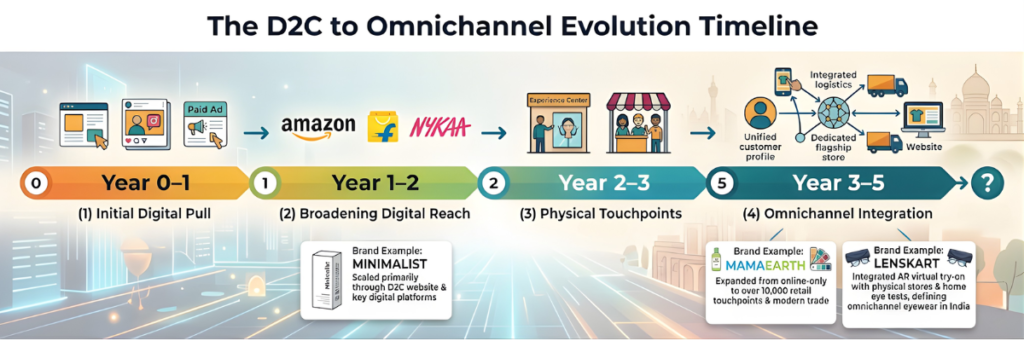
The biggest D2C success stories in India did not stay online forever. boAt started online. Now it sells in 20,000+ retail points across India. Mamaearth started on its website. Now it is in 40,000+ retail outlets. Lenskart started as a D2C eyewear brand. Now it has over 2,000 physical stores. Sugar Cosmetics expanded from D2C to marketplaces to offline beauty counters.
In the first half of 2025, D2C brands accounted for nearly 18% of total retail space leased in India. This is not a small trend, It’s a structural shift. Why do successful D2C brands go offline?
- Physical stores build trust. In India, many customers still want to see and touch a product before buying.
- Stores reduce return rates. When a customer tries before buying, RTO drops dramatically.
- Offline lowers blended CAC. Not every customer needs to be acquired through a paid ad.
- Omnichannel increases lifetime value. Customers who buy both online and offline spend significantly more.
The winning Indian pattern: start D2C, build the brand online, prove the economics, then expand into marketplaces and physical retail. That is the playbook.
[Internal link: Read D2C vs Marketplace vs Omnichannel: Which Model Wins in India? for the full comparison]
8. They Solve for Indian Realities, Not Western Playbooks
India is not the US. What works in American D2C does not automatically work here. The most successful D2C brands in India adapt to local realities:
- COD management: Cash-on-delivery still accounts for a large share of orders. Smart brands use WhatsApp nudges to convert COD to prepaid, cutting return rates by 10–20%.
- Price point sensitivity: India is a value-conscious market. Successful brands offer entry-level SKUs (sachets, trial sizes, starter kits) to lower the barrier to first purchase.
- Regional nuance: Over 60% of new D2C customers come from tier-2 and tier-3 cities. Brands like Meesho and DealShare have built entire models around serving non-metro India.
- WhatsApp as a channel: In the US, email is king. In India, WhatsApp has the highest open and engagement rates. Smart D2C brands use WhatsApp for marketing, support, and retention.
- UPI advantage: India’s UPI processed over 185 billion transactions in FY25. D2C brands that optimise for UPI checkout see higher conversion rates and fewer payment failures.
The brands that try to copy American D2C playbooks without adapting for Indian payment behaviour, logistics complexity, and price sensitivity are the ones that burn through cash fastest.
9. They Invest in the Right Tech Stack at the Right Stage
Successful D2C brands do not over-invest in technology early, and they do not under-invest when they scale. The pattern looks like this:
| Stage | What You Need | Common Tools |
| Launch (0–Rs 50L revenue) | Storefront, basic payments, one logistics partner, Meta ads | Shopify, Razorpay, Shiprocket, Meta Ads Manager |
| Growth (Rs 50L–Rs 5Cr) | Email/WhatsApp automation, analytics, CRM, SEO | Klaviyo or WebEngage, Google Analytics, Interakt (WhatsApp) |
| Scale (Rs 5Cr–Rs 50Cr) | Advanced CRM, multi-channel inventory, marketing automation, loyalty | MoEngage or CleverTap, Unicommerce, affiliate platforms |
| Omnichannel (Rs 50Cr+) | ERP, POS, unified inventory, advanced analytics, custom integrations | Custom ERP, Browntape, Mixpanel, dedicated data team |
The mistake most early-stage brands make: buying expensive tools before they need them. A brand doing 10 orders a day does not need a lot of expensive apps to get the work done. It needs a good Shopify website and a WhatsApp number. The mistake most scaling brands make: not investing in tools when complexity demands it. A brand doing 1,000 orders a day across three channels without proper inventory management is heading for operational chaos. A brand spending 50K a month on bringing traffic, not using ReelV to improve their CRO and get the best return.
[Internal link: Read Inside the Tech Stack of a Rs 100 Crore D2C Brand for the full breakdown]
10. They Have Founders Who Stay Close to the Customer
This is the hardest trait to quantify. But it shows up in every successful D2C brand we studied.
The founders of winning D2C brands in India are obsessively close to their customers. They read every review and respond to DMs too. Many of them call customers who had a bad experience while using their product to know more about the issues being faced by end consumers. They are the brand’s first customer and its most demanding critic.
- Aman Gupta (boAt) is publicly visible, accessible, and constantly engaging with the boAt community. His appearance as a Shark Tank India judge made him one of India’s most recognised startup founders.
- Ghazal Alagh (Mamaearth) built the brand’s early trust through personal storytelling about her own journey as a mother searching for safe baby products.
- Peyush Bansal (Lenskart) reimagined the entire eyewear experience — from virtual try-ons to home eye tests — because he understood customer frustration firsthand.
Founder proximity to the customer is not a soft skill. It is a strategic advantage. It drives faster product iteration, better marketing, and stronger brand trust.
In traditional retail, the CEO is far from the customer. In D2C, the best founders are one WhatsApp message away. That closeness is what makes D2C brands move faster and connect deeper.
The 10 Traits at a Glance
| # | Trait | What It Means | Indian Brand Example |
| 1 | Category Edge | Spot a gap, not just make a product | boAt, Minimalist, Country Delight |
| 2 | Brand Narrative | Build a story, not just a store | Mamaearth, The Whole Truth, Sugar |
| 3 | Unit Economics | Get CAC, AOV, and LTV right early | Minimalist (HUL acquisition proves it) |
| 4 | Retention Focus | Repeat customers are the real growth engine | Country Delight, Mamaearth |
| 5 | Content & Community | Own attention, do not just rent it | Sugar, Wakefit, Minimalist |
| 6 | Data-Driven | Act on data, not just collect it | Lenskart, boAt |
| 7 | Omnichannel Evolution | Start online, expand offline when ready | Lenskart, Mamaearth, boAt |
| 8 | Solve for India | Adapt for COD, UPI, WhatsApp, tier-2 reach | Country Delight, Meesho |
| 9 | Right Tech Stack | Match tools to stage, not hype | All successful brands at each stage |
| 10 | Founder Proximity | Stay close to the customer always | Aman Gupta, Ghazal Alagh, Peyush Bansal |
Key Takeaways
Solve for India, not Silicon Valley. COD, UPI, WhatsApp, tier-2 cities, and price sensitivity define the Indian D2C playbook.
Success starts with a category edge, not a product. The best D2C brands create a new mental category for their customers.
Brand narrative is not optional. A clear story and point of view separate brands from stores.
Unit economics must work early. LTV should be at least 3x CAC. Investors and the market will not wait.
Retention is the real growth engine. Repeat customers lower CAC and increase profitability. WhatsApp, email, and subscriptions drive this in India.
Content and community replace ad dependency. The shift from rented attention to owned attention is what separates scalable brands from treadmill brands.
Omnichannel is the destination. The most successful D2C brands in India eventually sell online, on marketplaces, and offline.
Frequently Asked Questions
Latest posts
- Marmeto, India’s First Shopify Premier Partner, Pivots From Services to Product-First Technology Company
- L’Oréal in Talks to Acquire D2C Beauty Startup Innovist
- Anveshan and the Rs 1,000 Crore Farm-to-Fork Valuation Leap
- Assiduus Global Raises $25 Million to Scale AI-Powered Middleware for Cross-Border D2C Commerce
- The Budget Split That Separates Brands That Scale from Brands That Stall