The EleFant Raises $1 Million: What a Toy Subscription Model Reveals About India’s Next D2C Frontier
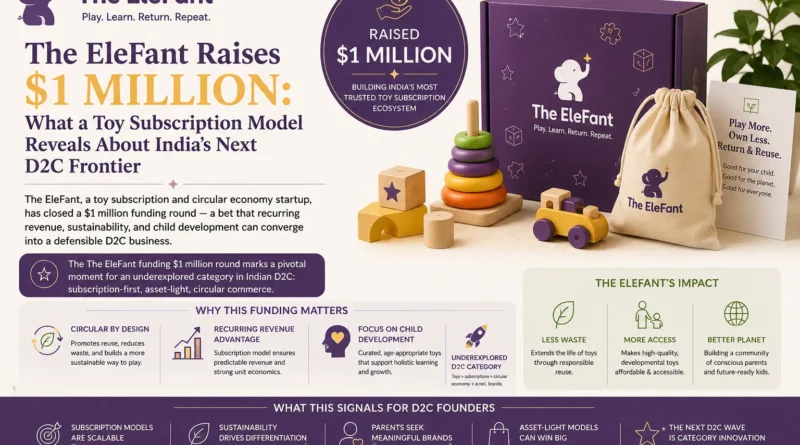
India’s D2C toy market just got a notable signal. The EleFant, a toy subscription and circular economy startup, has closed a $1 million funding round — a bet that recurring revenue, sustainability, and child development can converge into a defensible D2C business. The the elefant funding $1 million round marks a pivotal moment not just for the company, but for an underexplored category in Indian D2C: subscription-first, asset-light, circular commerce.
What The EleFant Actually Does (And Why It’s Different)
The EleFant operates at the intersection of three high-signal trends: toy subscriptions, circular economy logistics, and early childhood development (ECD).
The model is straightforward but operationally complex. Families subscribe to curated toy kits delivered at regular intervals — aligned with the child’s developmental stage. After use, toys are returned, sanitized, and recirculated to the next subscriber. This means the company owns inventory, manages reverse logistics, and maintains product quality across multiple usage cycles.
This is not a marketplace. This is not a gifting brand. It’s a managed subscription loop — which changes the unit economics entirely.
Frido Opens First Mumbai Store: An Education-Led D2C Retail Model
Why Consumers Are Ready to Pay More and What It Means for D2C Brands
Customer Acquisition Strategies for D2C Brands in India: The Complete Playbook

Mamaearth Growth Story: From a Baby’s Eczema to India’s Largest Digital-First BPC Brand

Why $1 Million in This Category Matters
The EleFant Funding of $1 million is a seed-stage check. But in the context of Indian D2C, it signals something larger: investors are beginning to take subscription-first D2C models seriously beyond food, beauty, and nutraceuticals.
The toy category in India is historically fragmented — dominated by unorganized retail, occasional gifting occasions (birthdays, festivals), and low repeat purchase behaviour. A subscription model directly solves the low frequency problem by converting a one-time buyer into a monthly recurring revenue unit.
For investors, the appeal is clear:
- Predictable LTV over a child’s early years (0–8 age window)
- Lower CAC amortization across a longer customer relationship
- Circular inventory reduces restocking costs over time
The bet here is that the EleFant can build a strong enough subscription base to make the reverse logistics cost worthwhile — and that’s the core operational challenge.

The Circular Economy Angle: Sustainability or Unit Economics?
India has seen sustainability-led D2C brands struggle with consumer willingness to pay a premium. But The EleFant’s circular model isn’t primarily a sustainability pitch — it’s a margin protection strategy.
By recirculating toys across multiple subscribers, the effective cost-per-use drops significantly with each cycle. A toy that costs ₹800 to source but is used by four subscribers over its lifecycle generates ₹800 in cost spread across four revenue-generating cycles. That’s fundamentally different from a buy-once model.
This is the hidden insight in the circular D2C model: sustainability becomes economically rational when the asset (toy) has a long usable life and can be quality-controlled between uses. The EleFant’s operational moat, if it scales well, is its ability to manage this cycle efficiently.
Strategic Implications of the EleFant Funding for D2C Founders
1. Subscription is not just for consumables.
Most Indian D2C subscription plays are in consumables — coffee, protein, skincare. The EleFant is proving that durable goods subscription is viable if you control the full loop. Founders in categories like books, baby gear, fitness equipment, or kitchenware should pay attention.
2. Reverse logistics is the new last-mile.
Building reverse logistics capability is expensive and complex — which is exactly why it creates a defensible moat. Once The EleFant optimizes its return-sanitize-redeploy cycle, replication becomes very difficult for a pure-play D2C brand.
3. LTV thinking over CAC obsession.
India’s D2C ecosystem has been obsessed with CAC efficiency. Subscription models reframe the question: what’s the lifetime value of a parent subscriber across 3–5 years of a child’s early development? That’s a fundamentally different — and potentially more valuable — customer equation.
4. Category education is the real acquisition cost.
Toy subscription is not an established habit in India. The EleFant’s biggest challenge isn’t logistics or product — it’s behavioural change at scale. This is where this $1 million will matter most: building the content, community, and trust infrastructure to normalize the subscription toy category.
The Broader Pattern: India’s Circular D2C Ecosystem Is Just Beginning
The EleFant Funding isn’t an isolated event. It fits into a slowly emerging pattern of Indian D2C brands building closed-loop commerce models — where the product journey doesn’t end at delivery. As consumers become more cost-conscious and sustainability-aware, and as D2C brands search for better LTV structures, circular subscription models will become a serious strategic option.
Watch this space. The toy aisle is getting smarter.