
8 Structural Advantages That Attract Venture Capital
First-Party Data, Higher Margins, Faster Iteration & Multiple Exit Paths. The Reasons Investors Love D2C Brands Go Far Beyond Hype.
Between 2020 and 2024, investors poured over $4.5 billion into Indian D2C startups. India ranked second globally for D2C startup funding, behind only the United States. Even after the funding correction of 2023–2024, capital keeps flowing into D2C. Not at 2021 peak levels. But with more conviction. Bigger cheques into fewer brands. Why? Because investors love D2C brands for reasons that go deeper than trends and hype. There are structural advantages that make D2C one of the most attractive business models for investors in India today.
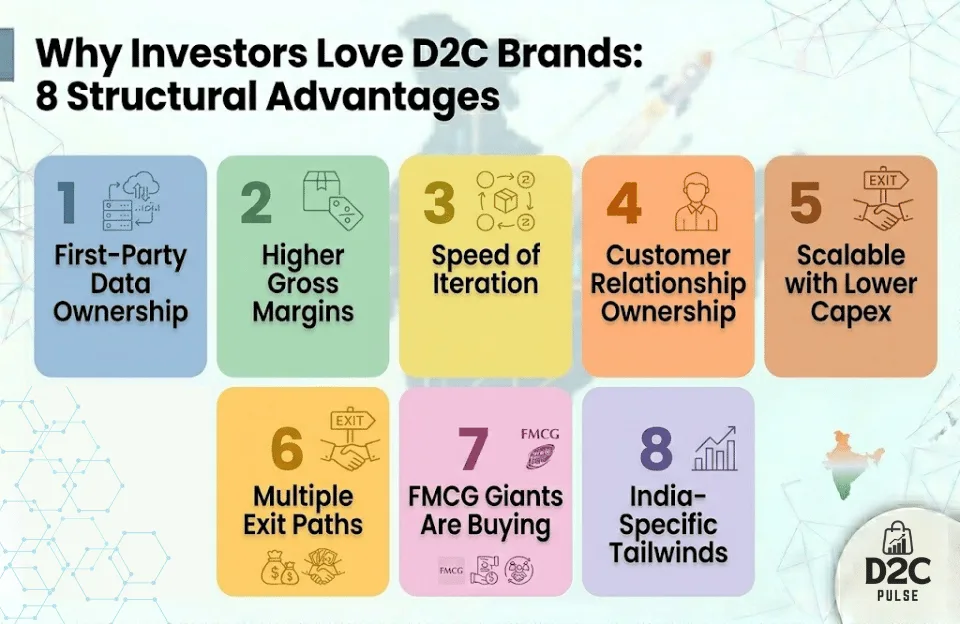
This article breaks down the eight reasons why investors love D2C brands. Not theory. Specific, measurable advantages with Indian examples. If you are a founder, this is what you need to build into your business to attract capital. If you are studying the market, this is the investment thesis behind every major D2C deal.
Reason 1: First-Party Data Ownership. D2C Brands Know Their Customers.
This is the number one reason why investors love D2C brands. When a consumer buys from a D2C website, the brand captures the name, email, phone number, location, purchase history, browsing behavior, and payment method. The brand owns this data. It can use it for retargeting, product development, and loyalty programs.
Compare this with traditional retail. When a consumer buys a Dove shampoo from a kirana store, HUL knows nothing about that customer. No name, phone number, purchase frequency or feedback. The retailer sits between the brand and the buyer. The data wall is total.
Investors love D2C brands because first-party data creates a compounding advantage. With each order, the brand gets smarter. It learns which products work, which customers repeat, which channels convert, and which regions respond. This data feeds better marketing, better products, and better retention. Over time, the brand with the best data wins.
Minimalist used purchase data to identify that customers who bought one serum often bought two more within 90 days. That insight shaped their product bundles, their email flows, and their cross-sell strategy. It is the kind of decision that is impossible without first-party data. This data advantage is a core reason why investors love D2C brands over traditional consumer businesses.

Reason 2: Higher Gross Margins. No Middlemen Means More Margin.
In traditional FMCG distribution, a product passes through four hands: manufacturer to distributor to wholesaler to retailer. Each one takes a margin. By the time the product reaches the consumer, the brand keeps 30–40% of the MRP.
In D2C, the brand sells straight to the consumer. No distributor margin, wholesaler cut or retailer share. Gross margins in D2C beauty and skincare are 60–80%. In fashion, 55–70%. Even in food, 35–55%. These are meaningfully higher than traditional distribution.
Investors love D2C brands because higher margins mean more room for marketing investment, more room for R&D, and a faster path to profitability. A brand with 70% gross margin can spend 20% on marketing and still retain 50%. A traditional FMCG brand with 35% margin has almost no room to manoeuvre.
This margin advantage also makes D2C brands more resilient. When ad costs rise or a competitor enters, a high-margin brand can absorb the pressure. A low-margin brand cannot. Investors understand this. It is another reason why investors love D2C brands as a category.
Also Read: Understanding Unit Economics for D2C companies in India.
Reason 3: Speed of Iteration. D2C Brands Move 10x Faster Than FMCG.
A traditional FMCG company takes 12–18 months to launch a new product. Consumer research. Focus groups. Manufacturing setup. Distributor onboarding. Retailer negotiations. Shelf space allocation. The process is slow by design.
A D2C brand can test a new product in weeks. Minimalist launched new serums within 6–8 weeks of identifying demand through customer search data. boAt launched 100+ new products in FY25 alone. Foxtale reformulated a sunscreen within 60 days after customer feedback on texture.
Investors love D2C brands because this speed creates a feedback loop that traditional brands cannot match. Launch, measure, fix & Relaunch. Each cycle makes the product better and the customer happier. Slow-moving incumbents cannot compete with this pace.
Speed also means capital efficiency. Instead of spending Rs 50 lakh on consumer research before a launch, a D2C brand spends Rs 5 lakh on a test batch and reads real purchase data. The market itself becomes the focus group. Lower upfront investment & faster learning. Investors value this lean approach.
Reason 4: Customer Relationship Ownership. The Brand Owns the Bond.
When a customer buys from a D2C brand, the brand controls the entire experience. The website, the checkout, the packaging, the delivery updates & also the post-purchase follow-up. The WhatsApp message three days later asking if the product works. Every touchpoint is an opportunity to build loyalty.
In marketplace selling, Amazon owns the relationship. The customer searches for “face serum” and picks from 200 options. They barely register the brand name. Repeat purchases go to whatever ranks highest, not whatever delivered the best experience. The brand is disposable.
Why do investors love D2C brands over marketplace sellers? Because owned customer relationships create moats. A customer who buys from your website, follows your WhatsApp channel, and uses your loyalty programme is far harder for a competitor to steal than a customer who found you through an Amazon search. This loyalty converts into higher LTV, lower churn, and stronger word-of-mouth.
Country Delight’s subscription model is the best Indian example. Customers interact with the brand every day. The app. The delivery notification. The quality scorecard. That relationship is nearly impossible to replicate. Investors love D2C brands that own the customer bond, because it is the most durable competitive advantage.
Also Read: Consumer Behavior Trends Driving D2C Growth to help your team with Customer Relationship
Reason 5: Scalable with Lower Capex. Capital-Light Growth Is Possible.
Traditional FMCG brands need factories, warehouse networks, distributor agreements, and retail relationships to scale. That requires hundreds of crores in capital expenditure before a single product reaches the consumer.
D2C brands can scale with contract manufacturing, 3PL logistics, and a Shopify store. The infrastructure is rented, not built. A founder with Rs 25 lakh can launch a D2C brand. The same founder would need Rs 2–3 crore to enter traditional retail with the same product.
Investors love D2C brands because lower capex means faster returns. The capital goes into marketing and inventory, not factories and distribution infrastructure. If the brand works, returns come in 2–3 years. In traditional FMCG, the payback can take 5–10 years.
boAt is the prime example. The brand used an asset-light model from the start. Contract manufacturing in China (and later India). No owned factories until it reached scale. This let boAt reach Rs 3,100 crore in revenue on relatively modest early capital. Investors love D2C brands that can scale capital-efficiently. It multiplies returns.
Why do investors love D2C brands? Because Rs 10 crore invested in a D2C brand can generate Rs 100 crore in revenue within 3–4 years. The same Rs 10 crore in a traditional FMCG business might generate Rs 15–20 crore. The return math is fundamentally different.
Reason 6: Multiple Exit Paths. IPO, M&A, or PE Buyout.
D2C brands in India now have three proven exit paths. This is a recent development, and it is a major reason why investors love D2C brands today more than even three years ago.
Exit Path 1: IPO
boAt filed for a Rs 1,500 crore IPO (SEBI approved). Lenskart filed for a $1 billion listing. Mamaearth’s parent Honasa Consumer listed in October 2023 at a Rs 10,000 crore+ market cap. BlueStone listed in August 2025. The IPO pipeline is active. D2C founders can now credibly plan for a public listing as a capital exit event.
Exit Path 2: Strategic Acquisition by FMCG Giants
HUL acquired Minimalist for Rs 2,955 crore. Nykaa acquired Dot & Key (Rs 265 crore for 90% stake). Zydus Wellness acquired Max Protein for $46 million. Marico acquired Beardo and Just Herbs. ITC invested in Mother Sparsh. Legacy FMCG companies are actively buying D2C brands to access digital-first capabilities, younger consumer segments, and first-party data.
This trend is why investors love D2C brands with strong category positions. Even if a brand does not reach IPO scale, a Rs 200–500 crore D2C brand with healthy margins is a prime acquisition target for an HUL, ITC, Marico, or Godrej.
Exit Path 3: PE Buyout or Secondary Sales
Private equity firms like L Catterton, Premji Invest, and Kedaara Capital are investing in growth-stage D2C brands. Secondary sales (existing investors selling stakes to new investors) are also becoming common, providing liquidity without a full exit.
Three clear exit paths. That is why investors love D2C brands as an asset class. Exits are no longer theoretical. They are happening, with real numbers, in the Indian market.
Also Read: D2C Funding Trends in India: What Investors Want in 2026 for the full deal data
Reason 7: FMCG Giants Are Validating the Model by Buying D2C Brands.
This is a signal that should not be missed. India’s largest consumer companies are not competing with D2C brands. They are buying them. HUL paid Rs 2,955 crore for Minimalist. That is a 7x revenue multiple for a 4-year-old brand. It tells the market that FMCG giants believe D2C brands have something they cannot build themselves: digital-native DNA, first-party data capabilities, and direct consumer relationships.
Nykaa’s acquisition of Dot & Key and Earth Rhythm. Marico’s acquisition of Beardo, Just Herbs, and True Elements. Tata Consumer’s investment in Soulfull. ITC’s interest in Yoga Bar and Mother Sparsh. Reliance’s acquisition of Tagz Foods. The pattern is clear: FMCG companies are using D2C acquisitions to enter new categories, access digital customers, and import innovation.
This acquisition wave is a powerful reason why investors love D2C brands. Every D2C investment now has a built-in buyer pool. If the brand builds category leadership and healthy margins, an FMCG giant will come knocking. The exit is practically pre-built into the thesis.
| Acquirer | D2C Brand | Deal Value | Year |
| HUL | Minimalist (90.5% stake) | Rs 2,955 Cr | Jan 2025 |
| Nykaa | Dot & Key (90% stake) | Rs 265 Cr | Aug 2024 |
| Zydus Wellness | Max Protein | $46.4M | 2024 |
| Marico | Beardo, Just Herbs, True Elements | Multiple deals | 2020–2023 |
| Reliance Consumer | Tagz Foods | $3.3M | 2024 |
| Nykaa | Earth Rhythm | Majority stake | 2024 |
Also Read: Customer Acquisition Strategies for D2C brands to grow customer list
Reason 8: India-Specific Tailwinds Make D2C a Structural Opportunity.
India is not just another market. It has specific conditions that make D2C unusually attractive. These tailwinds are why investors love D2C brands in India more than in most other countries.
- 700 million+ internet users. The addressable market is enormous and still growing. Smartphone penetration is expected to hit 1 billion by 2026. Every new smartphone user is a potential D2C customer.
- UPI changed payments. India processed over 16 billion UPI transactions per month in 2025. Digital payments are frictionless. This solved the biggest barrier to online commerce. D2C brands benefit directly from this infrastructure.
- 60%+ new D2C customers come from tier-2/3 cities. The next 200 million online shoppers are not in Mumbai and Bangalore. They are in Jaipur, Surat, Indore, Lucknow, and Coimbatore. D2C brands that reach these consumers capture a market that traditional retail barely serves.
- Young population. Millennials and Gen Z make up approximately 70% of India’s digital consumer base. They discover brands on Instagram, trust creator recommendations, and prefer direct relationships with brands over anonymous retail shelves.
- Policy support. Angel tax removal in Budget 2024. Capital gains tax reduction from 20% to 12.5%. PLI schemes for electronics and textiles. ONDC’s 3% commission cap as an alternative discovery channel. The government is making it cheaper to invest in and build D2C brands.
- The market is projected to reach $100 billion by 2025 and $300 billion by 2030. India’s D2C market has reached an estimated $85 billion. The growth runway is long. Investors love D2C brands because the category is not a niche bet. It is a core consumption play in the world’s most populated country.
India’s D2C market is structural, not cyclical. The combination of digital payments, smartphone penetration, young demographics, and rising discretionary income makes India one of the best D2C markets in the world. This is the macro reason why investors love D2C brands in India: the tailwinds are strong and durable.
What Makes a D2C Brand Investor-Ready in 2026
Understanding why investors love D2C brands is step one. Building a brand that meets their criteria is step two. Here is what investors screen for in 2026.
| Metric | What Investors Want | Why It Matters |
| CM2 | Positive. Non-negotiable. | Proves the growth engine works. No one funds negative CM2 anymore. |
| CAC Payback | Under 6 months. Under 3 is ideal. | Shows capital efficiency. Fast payback = lower funding risk. |
| Gross Margin | 60%+ in BPC/fashion. 40%+ in F&B. | High margins fund marketing and absorb shocks. |
| Repeat Rate | 30%+ within 90 days. | Proves customer loyalty. Drives LTV. |
| Channel Mix | No single channel above 40%. | Reduces platform risk. Shows diversified growth. |
| Category Position | #1 or #2 in a defined sub-category. | Category leaders get funded. Number five does not. |
| Exit Path | IPO-ready or acquisition-attractive. | Investors need to see how they get their money back. |
| Founder-Market Fit | Deep domain expertise. | Domain founders make better products and attract better capital. |
Also Read: Achieving Profitability in D2C for the stage-by-stage guide to hitting these metrics
D2C vs Traditional FMCG: Why Investors Prefer the D2C Model
| Factor | D2C Brand | Traditional FMCG |
| Customer Data | Full first-party data. Name, email, phone, purchase history. | No direct data. Retailer sits between brand and buyer. |
| Gross Margin | 60–80% in BPC. 55–70% in fashion. | 30–40% after distributor/wholesaler/retailer margins. |
| Launch Speed | Weeks. Test, measure, fix. | 12–18 months. Research, develop, distribute. |
| Customer Relationship | Brand owns it. WhatsApp, email, loyalty. | Retailer owns it. Brand is anonymous. |
| Capex to Start | Rs 25L–1Cr. Contract manufacturing + 3PL. | Rs 5–50 Cr. Factory + distribution + retail. |
| Feedback Loop | Real-time. Reviews, returns, chat. | Slow. Quarterly retailer reports. |
| Exit Options | IPO, FMCG acquisition, PE buyout. | Limited. Mostly PE or strategic. |
Key Takeaways
- Investors love D2C brands for structural reasons, not hype. First-party data, higher margins, speed of iteration, customer relationship ownership, lower capex, multiple exits, FMCG acquisition trends, and India’s macro tailwinds make D2C one of the most attractive models for investment.
- First-party data is the single biggest advantage. D2C brands know their customers. Traditional brands do not. This data compounds into better products, better marketing, and better retention. It is why investors love D2C brands over traditional consumer companies.
- Higher gross margins give D2C brands room to invest and survive. 60–80% margins in BPC vs 30–40% in traditional distribution. That margin gap is the reason D2C brands can afford to spend on marketing, absorb shocks, and reach profitability faster.
- FMCG giants buying D2C brands is the strongest signal. HUL, Nykaa, Marico, ITC, Reliance, and Zydus are all acquiring D2C brands. This creates a built-in exit path for investors and validates the model at the highest level.
- India’s tailwinds are structural. 700M+ internet users, UPI, tier-2/3 growth, young demographics, and policy support make India one of the best D2C markets globally. The $100 billion market is projected to reach $300 billion by 2030.
- To attract investors in 2026, D2C brands need: positive CM2, CAC payback under 6 months, 60%+ gross margins, 30%+ repeat rate, diversified channels, category leadership, a credible exit path, and founder-market fit. Revenue growth alone is no longer enough.
Frequently Asked Questions
Why do investors love D2C brands?
Investors love D2C brands for eight structural reasons: first-party data ownership, higher gross margins (60–80% vs 30–40% in traditional FMCG), speed of product iteration, direct customer relationship ownership, lower capital requirements to scale, multiple exit paths (IPO, M&A, PE buyout), FMCG giants actively acquiring D2C brands, and India-specific macro tailwinds including UPI adoption, 700M+ internet users, and a young consumer base.
How much funding have D2C brands raised in India?
Indian D2C startups raised over $4.5 billion between 2020 and 2024. Funding peaked at $1.6 billion in 2022 and corrected to $757 million in 2024. In 2025–2026, capital is flowing to proven brands in categories like beauty (Foxtale $30M), jewellery (GIVA Rs 530 Cr), food (The Whole Truth $51M), and pet care (Supertails $30M). India ranked second globally for D2C funding in 2024.
Which FMCG companies are buying D2C brands in India?
HUL acquired Minimalist for Rs 2,955 crore. Nykaa acquired Dot & Key and Earth Rhythm. Marico acquired Beardo, Just Herbs, and True Elements. Zydus Wellness acquired Max Protein. ITC invested in Mother Sparsh. Reliance Consumer acquired Tagz Foods. This acquisition wave is a major reason why investors love D2C brands in India: the exit path through FMCG buyout is proven and active.
What makes a D2C brand attractive to investors in 2026?
Eight metrics: positive CM2, CAC payback under 6 months, gross margins above 60%, repeat purchase rate above 30%, diversified channel mix (no single channel above 40%), clear #1 or #2 position in a defined sub-category, a credible exit path, and strong founder-market fit. Revenue growth alone no longer attracts capital.
Is D2C investment in India still growing?
Yes, selectively. The 2021–2022 boom is over, but investor interest in D2C brands is structural. Fewer deals are happening, but cheque sizes are larger for proven brands. IPO filings (boAt, Lenskart), M&A activity (Minimalist, Dot & Key), and large rounds (GIVA, Whole Truth) all signal that investors love D2C brands with strong fundamentals. The market has matured from hype to discipline.