
Content Marketing for D2C Brands: The Playbook That Turns Content into a Revenue Engine
Why Content Is the Only Channel That Compounds. The 6-Layer Content Stack. 8 Indian D2C Brands That Built Content Engines. And the Step-by-Step Framework to Build Yours.
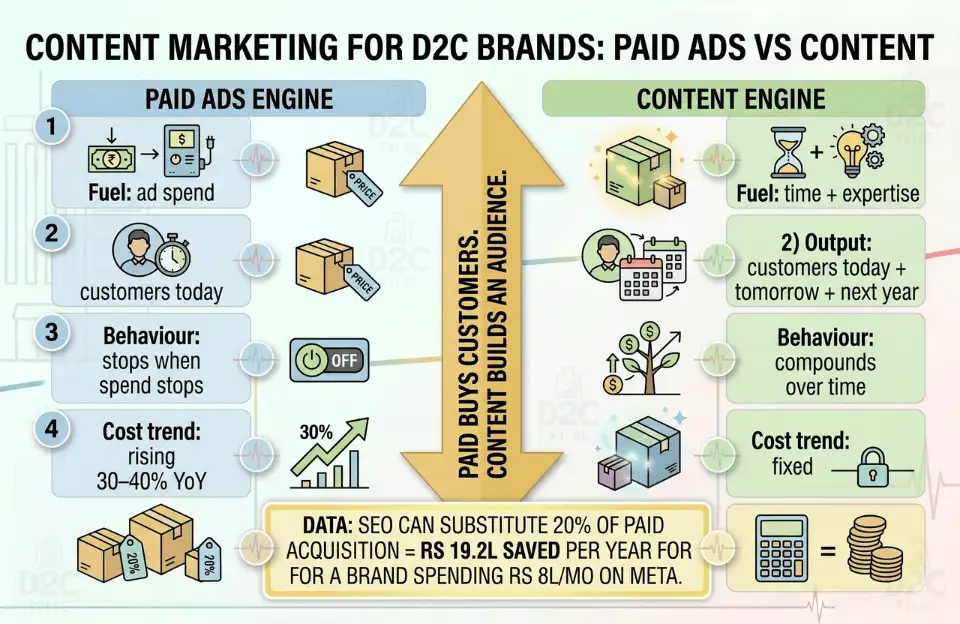
A Meta ad gets you a customer today. It costs Rs 500–1,000. Tomorrow, you pay again. And again. And again. The cost goes up every quarter. If you stop paying, the customers stop coming. That is rented attention. A blog post that ranks for “best vitamin C serum for oily skin India” gets you a customer today. And tomorrow. And next month. And next year. For free. Content marketing for D2C brands is the only channel where the cost is fixed and the returns compound.
Yet 55% of Indian D2C founders under-invest in content and retention. They pour 70–80% of their budget into performance ads. They get stuck on the paid-ads treadmill. CAC rises. ROAS falls. And they have no organic traffic to fall back on. Content marketing for D2C brands breaks this cycle. It builds an asset. Paid ads rent attention. Content owns it.
This article gives you the complete content marketing playbook for D2C brands. Six content layers. Eight Indian D2C brands that built real content engines. Not the usual suspects. These are emerging brands that used content to grow when they could not outspend the big players. Plus a step-by-step framework to build your own content engine from scratch.
Why Content Marketing for D2C Brands Is No Longer Optional
CAC is rising. Content is the counter. Meta CPMs have risen 40–60% since 2023. Google Shopping is more crowded every quarter. If your average CAC on Meta is Rs 800 and organic search could deliver even 20% of your customers, that saves Rs 19.2 lakh per year. Content marketing for D2C brands delivers zero-marginal-cost customer acquisition. Paid does not.
AI search rewards content-rich brands. When a consumer asks ChatGPT or Perplexity “best protein bar for gym in India,” the AI recommends brands based on blog content, reviews, and structured data. Not ad spend. Content marketing for D2C brands is how you get cited by AI search engines. Brands with deep content get recommended. Brands with only ads get skipped.
Content builds trust before the first click. 43% of Indian shoppers discover brands through creator content. A consumer who reads your buying guide, watches your founder video, and sees your ingredient breakdown arrives at your product page with trust already built. Her conversion rate is 2–3x higher than a cold ad click. Content marketing for D2C brands is pre-selling.
Content compounds. Ads do not. A blog post published in January still brings traffic in December. A Reel shared in March still gets discovered in September. Content marketing for D2C brands builds an asset that grows in value every month. Paid ads deliver value only on the day you pay.
The 6-Layer Content Stack for D2C Brands
Layer 1: SEO Blog Content (The Zero-CAC Acquisition Engine)
SEO blog content is the foundation of content marketing for D2C brands. It captures customers who are actively searching for solutions. These are high-intent queries: “best face serum for acne-prone skin,” “protein powder for beginners India,” “how to choose a mattress.” A brand that ranks for these queries gets free, high-intent traffic every day.
What to create: Buying guides (best X for Y). Comparison posts (X vs Y). Ingredient and material explainers. How-to guides. Category education. Aim for 20–50 SEO pages in the first 6 months. Target keywords with 1,000–10,000 monthly searches and low to medium difficulty.
Why it works: Organic search visitors cost Rs 0 after the initial content investment. A single blog post ranking on page one for a 5,000 search-per-month keyword can drive 500–1,000 visitors per month. If 2% convert, that is 10–20 customers per month from one article. Content marketing for D2C brands at its most efficient.
Layer 2: Social Media Content (The Discovery Engine)
Instagram Reels, YouTube Shorts, and carousel posts are where consumers discover D2C brands. 78% of consumers make purchase decisions based on social media. Content marketing for D2C brands uses social as the top of the funnel. Not to sell. To be seen.
What to create: Behind-the-scenes Reels. Product-in-use videos. Founder story clips. Customer testimonial carousels. Trend-driven content that shows the product in real life. Post 4–7 times per week on Instagram. 2–3 Reels per week.
Why it works: A Reel that goes viral costs Rs 0 and reaches 100,000+ people. Even non-viral posts build familiarity. When a consumer sees your brand 5–7 times on Instagram, she remembers you when she is ready to buy. Content marketing for D2C brands on social is about frequency and familiarity, not virality.

Layer 3: Video Content on PDPs (The Conversion Engine)
Product pages with video see up to 80% higher conversion rates. 81% of consumers buy after watching a video. A product demo, a founder explainer, or a customer review on your product page does what a store salesperson does. Content marketing for D2C brands extends to the point of purchase.
What to create: Product demo videos (30–60 seconds). How-to-use videos. Before-and-after results. Customer review videos. Founder story explaining why this product exists. Place these on every PDP.
Layer 4: Email and WhatsApp Content (The Retention Engine)
Content marketing for D2C brands does not stop at acquisition. Email and WhatsApp deliver content to customers who have already bought. Usage tips. Product education. New launch previews. Behind-the-scenes stories. This content builds loyalty. Loyal customers buy again without ad spend.
What to create: Welcome email series (brand story + bestsellers + UGC). Post-purchase tips (how to use, what to pair with). Replenishment reminders. New product launches. Founder notes. WhatsApp broadcasts with exclusive content. Target 20–35% of revenue from email and WhatsApp.
Layer 5: UGC and Creator Content (The Trust Engine)
User-generated content is the most trusted form of content marketing for D2C brands. A real customer showing your product in her home, on her skin, or in her routine is more persuasive than any brand-produced ad. 43% of Indian shoppers are influenced by creator content.
What to create: Seed product to 20–50 micro-creators per month. Ask for honest reviews, unboxing videos, and routine integrations. Repurpose UGC across ads, PDPs, social media, and email. One creator video becomes 5–7 content assets.
Layer 6: Founder Content (The Authority Engine)
The founder is the highest-converting content asset in content marketing for D2C brands. A founder video explaining why they built the product builds trust that no ad can buy. Founder posts on LinkedIn build industry credibility. Founder appearances on podcasts and panels build awareness.
What to create: One founder video per week (on Instagram, YouTube, or LinkedIn). One LinkedIn post per week (behind-the-scenes, lessons, industry insight). Podcast appearances. Shark Tank-style founder visibility. This is free. It compounds. And no competitor can copy it.
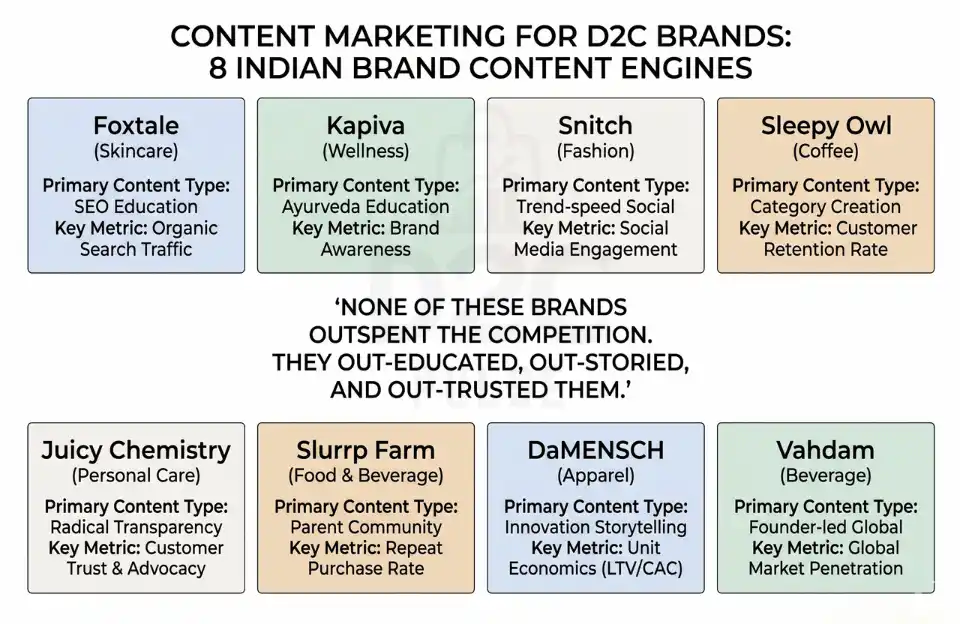
Eight Indian D2C Brands That Built Content Marketing Engines
1. Foxtale: SEO + Education Content That Drives Organic Growth
Foxtale, the skincare brand that raised $18 million in Series B (June 2024), built its content marketing for D2C brands around ingredient education for Indian skin types and climates. The brand creates detailed buying guides, skincare routine content, and ingredient deep-dives that rank on Google. Every product page includes educational content explaining what each active does and why it matters for Indian skin. The result: high organic traffic from women searching for skincare solutions, not just skincare products.
2. Kapiva: Ayurveda Education as the Content Moat
Kapiva built content marketing for D2C brands around making Ayurveda modern, accessible, and evidence-backed. The brand publishes health and wellness education content that explains ancient Ayurvedic ingredients with modern context. Blog posts on immunity, digestion, and daily health rituals rank for high-volume wellness searches. This education builds trust in a category where trust is hard to earn. Customers buy because Kapiva educated them first.
3. Snitch: Social-First Content and Trend Speed
Snitch, the men’s fast-fashion brand that raised $40 million in Series B (announced in June 2025), runs content marketing for D2C brands at the speed of social trends. New collections drop weekly. Each drop is supported by trend-driven Reels, influencer content, and FOMO-driven posts. Snitch’s Instagram is not a product catalogue. It is a style feed. The content makes the customer feel that if they do not buy now, the drop will sell out. This content-led urgency drives conversions without discounting.
4. Sleepy Owl: Category Creation Through Content
Sleepy Owl built content marketing for D2C brands around a simple idea: cold brew coffee is better than instant coffee. Every piece of content explains why. Blog posts on coffee brewing methods. Instagram content showing cold brew as a lifestyle. Recipe content (cold brew recipes, coffee cocktails). This education created a category. Sleepy Owl did not sell coffee. It sold a new way to drink coffee. And content was the teacher.
5. Juicy Chemistry: Radical Transparency Content
Juicy Chemistry, the ECOCERT-certified organic skincare brand from Coimbatore, built content marketing for D2C brands on radical ingredient transparency. Every product has detailed content about sourcing, ingredients, and formulation. The brand publishes content explaining why they reject certain chemicals and how they source organic ingredients. This transparency content converts customers who distrust mass-market labels. Juicy Chemistry’s content does not sell. It proves.
6. Slurrp Farm: Community-Led Content for Parents
Slurrp Farm, the millet-based kids’ food brand (Rs 73.2 crore revenue FY24), built content marketing for D2C brands around parenting and nutrition education. The brand creates content about millet benefits, healthy snacking for kids, and quick meal ideas. This content speaks to the mother’s anxiety about feeding her child well. Every blog post, every Instagram carousel, every email answers one question: is this good enough for my child? This trust-driven content engine powers a community of parents who recommend Slurrp Farm to other parents.
7. DaMENSCH: Product Innovation Storytelling
DaMENSCH built content marketing for D2C brands around fabric innovation storytelling. The brand does not just sell innerwear. It tells stories about why their Deo-Soft fabric cancels odour. Why their bamboo-based vests regulate temperature. Why their products carry a 500-day warranty. Every piece of content explains a technology. This turns a commodity product (underwear) into a considered purchase (performance innerwear). Content marketing for D2C brands in commodity categories must educate the customer on why they should care. DaMENSCH does this better than anyone in Indian menswear.
8. Vahdam Teas: Founder-Led Global Content
Vahdam Teas, founded by Bala Sarda, built content marketing for D2C brands that works across India and 130+ countries. The founder is the brand’s primary content asset. Bala tells the story of bringing Indian teas directly to global consumers without middlemen. The brand publishes tea education content, sourcing stories, and sustainability narratives. Vahdam won a Grammy gift bag placement and Oprah’s endorsement, not through ads but through a content-driven brand story that resonated globally. This is content marketing for D2C brands at its most powerful: a story so compelling that the media amplifies it for free.
The Content Marketing Map: What to Create at Each D2C Growth Stage
| Stage | Revenue | Content Priority | Volume | Goal |
| Pre-Launch | Rs 0 | Founder story. 5–10 blog posts. Instagram page. | 1 blog/week. 3 social posts/week. | Build awareness. Test messaging. Start SEO. |
| Launch | 0–25L/mo | SEO buying guides. PDP videos. UGC from first 50 customers. | 2 blogs/week. 5 social posts/week. 10 creator seedings/month. | Organic traffic. Social proof. First conversions from content. |
| Growth | 25L–1Cr/mo | Scale SEO to 50+ pages. Email flows. Founder on LinkedIn. 30–50 creators/month. | 3 blogs/week. Daily social. 2 email flows. Weekly founder post. | 20% of traffic from organic. Email drives 20%+ of revenue. |
| Scale | 1Cr+/mo | Content hubs. YouTube channel. AI search optimisation. Community. | 5+ blogs/week. 100+ creator pieces/month. Newsletter. | Content is primary growth driver. 30%+ of revenue from owned channels. |
Content marketing for D2C brands follows a simple rule: at launch, content supports ads. At scale, ads support content. The brands that cross Rs 100 crore all made this transition. The ones stuck below Rs 50 crore never did.
Five Content Marketing Mistakes D2C Brands Make
- Treating content as a side project. Content marketing for D2C brands only works as a system. Not a side project. One blog post per month will not move the needle. Twenty blog posts in six months, combined with social, email, UGC, and founder content, will. Commit or do not start.
- Creating content for the brand, not the customer. Nobody searches for your brand story. They search for solutions. “How to reduce dark circles” brings traffic. “Our brand’s journey” does not. Content marketing for D2C brands must answer the customer’s question first. Your brand story comes after.
- Ignoring SEO and publishing only on social. Social content disappears in 48 hours. A blog post ranks for years. Content marketing for D2C brands needs both. Social for discovery. SEO for compounding. Brands that only do social are on a content treadmill.
- Not repurposing content. One founder video becomes a Reel, a YouTube Short, a LinkedIn post, a blog quote, an email insert, and a PDP asset. One creator review becomes an ad, a social post, a testimonial on the product page, and an email asset. Content marketing for D2C brands is 1 piece of content into 5–7 assets.
- Expecting results in 30 days. SEO takes 3–6 months to show results. Social compounds over 6–12 months. Email delivers fast but needs a list. Content marketing for D2C brands is a 12-month bet that compounds into a 5-year asset. The brands that quit after 3 months never see the return.
Also Read: Performance vs Brand Marketing for D2C Brands for how to balance paid and content-driven growth
Key Takeaways
- Content marketing for D2C brands is the only channel that compounds. A blog post ranking on Google brings free traffic every day. A Reel discovered on Explore brings customers for months. An email flow runs forever. Paid ads stop the moment you stop paying. Content is the asset. Ads are the expense.
- The 6-layer content stack: SEO blog content (zero-CAC acquisition), social media (discovery), PDP video (conversion), email and WhatsApp (retention), UGC and creator content (trust), and founder content (authority). Each layer serves a specific job. Together, they form a content engine.
- Eight Indian D2C brands prove the model. Foxtale (SEO education), Kapiva (Ayurveda education), Snitch (trend-speed social), Sleepy Owl (category creation), Juicy Chemistry (radical transparency), Slurrp Farm (parent community), DaMENSCH (innovation storytelling), Vahdam (founder-led global). None outspent the competition. They out-educated it.
- At launch, content supports ads. At scale, ads support content. Start with 2 blogs per week, 5 social posts, and 10 creator seedings. Scale to 5+ blogs, daily social, 100+ creator pieces, and a newsletter. Target 30%+ of revenue from owned channels by the time you cross Rs 1 crore per month.
- Content marketing for D2C brands is a 12-month bet. SEO takes 3–6 months. Social compounds over 6–12. Email works fast but needs a list. Invest for 12 months. The compounding return shows up in months 6–12. The brands that quit after 3 months never see it.
Frequently Asked Questions
What is content marketing for D2C brands?
Content marketing for D2C brands is the use of blog content, social media, video, email, UGC, and founder content to acquire, educate, convert, and retain customers. Unlike paid ads, which stop working when you stop paying, content compounds over time. A blog post ranking on Google brings free customers every day. A creator video on your PDP converts every visitor. Content marketing for D2C brands builds an owned audience that reduces dependence on paid acquisition.
How much should a D2C brand invest in content marketing?
At launch, allocate 20–30% of your marketing budget to content marketing for D2C brands. This covers 2 blog posts per week, social content, founder videos, and 10–20 creator seedings per month. At growth stage (Rs 25L–1Cr per month), shift to 40–45% content. At scale (Rs 1Cr+ per month), content should drive 60%+ of the marketing effort. The brands that cross Rs 100 crore invest more in content than in paid ads.
Which Indian D2C brands do content marketing well?
Several emerging brands have built strong content engines. Foxtale uses SEO education for Indian skincare. Kapiva educates on modern Ayurveda. Snitch runs social content at trend speed. Sleepy Owl created a coffee category through content. Juicy Chemistry uses radical transparency. Slurrp Farm built a parent community. DaMENSCH tells fabric innovation stories. Vahdam Teas built a founder-led global brand story. None outspent the competition. They all used content marketing for D2C brands to out-educate and out-trust it.
How long does content marketing take to show results?
SEO blog content takes 3–6 months to rank and drive meaningful traffic. Social media compounds over 6–12 months of consistent posting. Email delivers fast results (2–4 weeks) but requires a list. Creator content produces results within 1–2 weeks per campaign. Overall, content marketing for D2C brands is a 12-month bet. The compounding return shows up between months 6 and 12. Budget for 12 months before evaluating ROI.
Should D2C brands do content marketing or paid ads?
Both. Content marketing for D2C brands and paid ads serve different purposes. At launch, paid ads drive 70% of acquisition and content drives 30%. At growth, the split shifts to 55/45. At scale, content drives 60%+ of the effort. Paid ads get you customers today. Content gets you customers today, tomorrow, and next year. The winning D2C brands use paid ads to fuel growth and content to make growth sustainable and profitable.