Retention Marketing Strategies for D2C Brands: How to Turn One-Time Buyers into Lifetime Customers
The Complete Post-Purchase Playbook. Eight Retention Strategies with Flows, Timelines, Tools, and Indian D2C Examples.
Here is a number that should change how you spend your marketing budget. Acquiring a new customer costs 5 to 7 times more than getting an existing customer to buy again. And yet, most D2C brands in India spend 80% of their budget on acquisition and 20% on retention. Also, 1 in every 7 D2C brands don’t have all the retention marketing strategies working for them.
The most profitable D2C brands in India have repeat purchase rates above 35%. The unprofitable ones sit below 15%. A 5% increase in retention can boost profits by 25–95%. Loyal customers spend 67% more than new customers. These are not abstract numbers, but the difference between a brand that grows profitably and one that burns through funding until the money runs out.
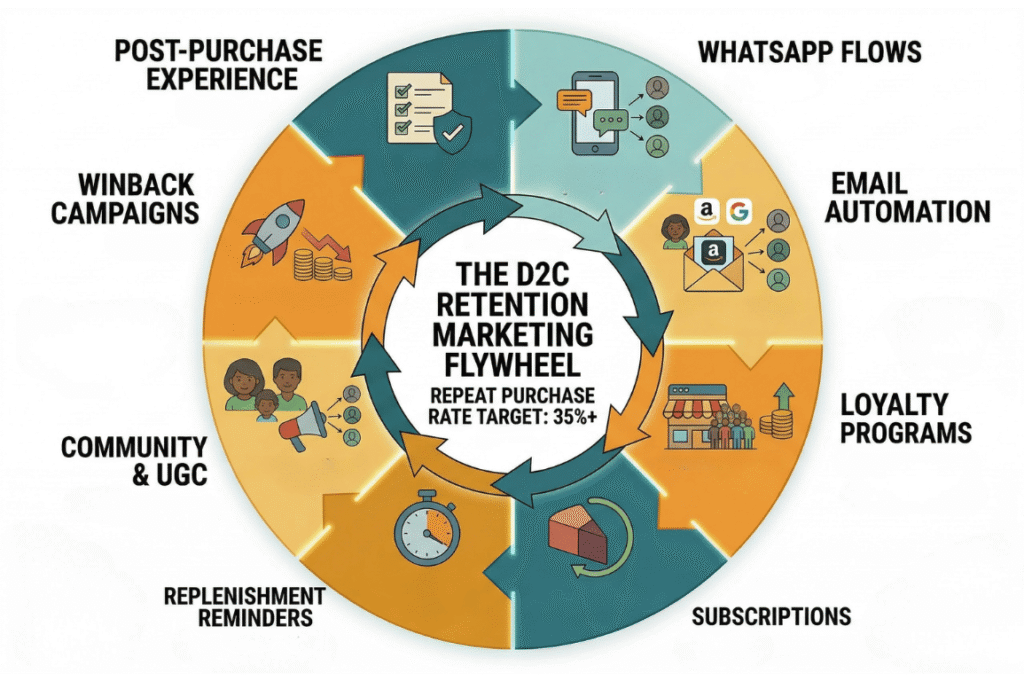
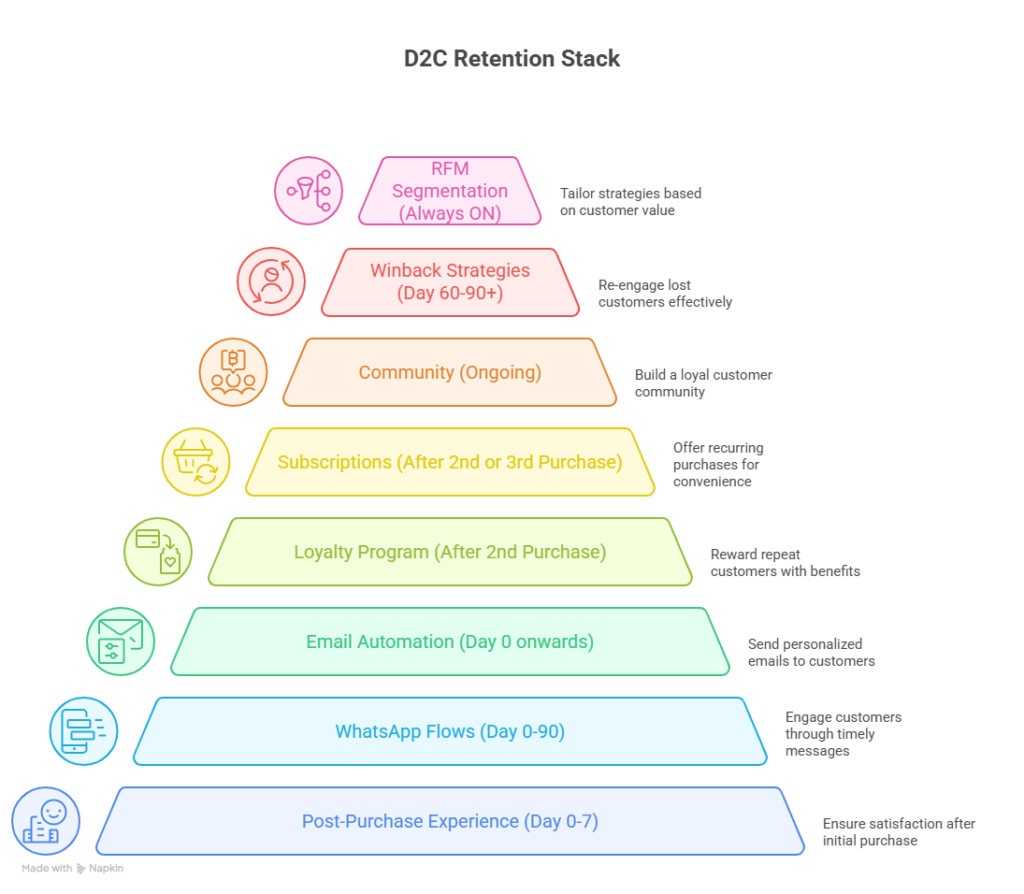
Retention marketing strategies for D2C brands are about what happens after the first purchase. Every one of the touchpoints either brings the customer back or lets them drift away. This guide covers eight retention marketing strategies for D2C brands in India. Not vague advice but specific flows, timelines, tools, and Indian brand examples. If you have customers who buy once and disappear, this is the playbook to bring them back.
Why Retention Marketing Strategies Matter More Than Acquisition for D2C Brands in 2026
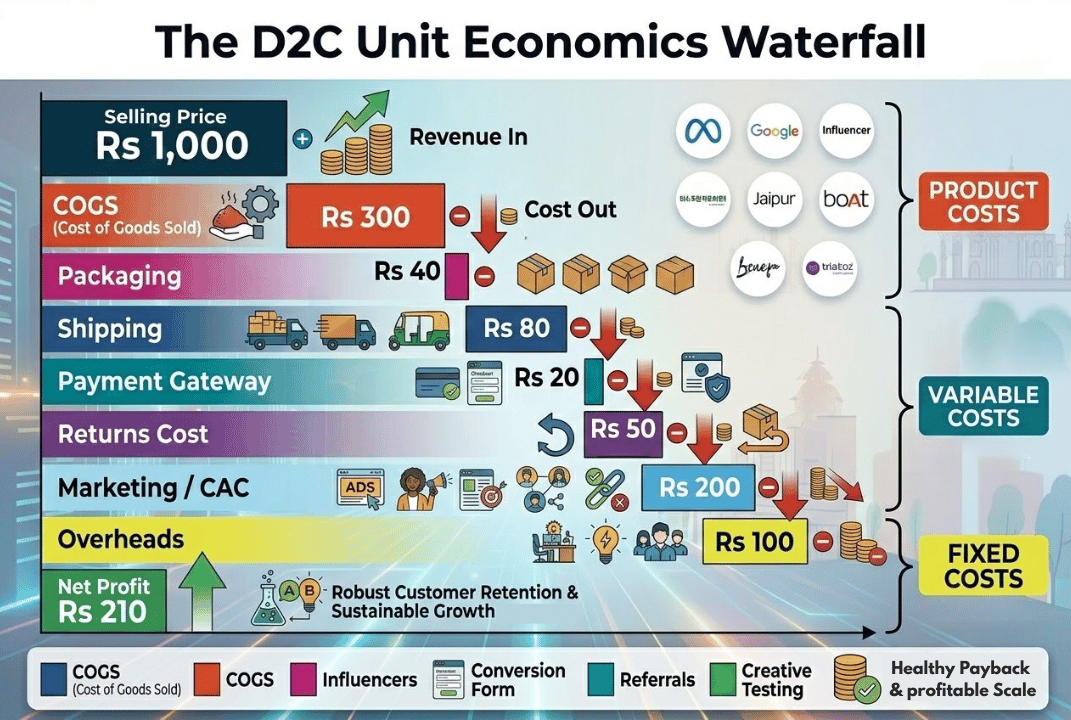
Let us do some quick maths. Say your D2C brand spends Rs 500 to acquire a customer. That customer buys once, spending Rs 800. Your contribution margin after COGS, shipping, and fees is Rs 200. But you spent Rs 500 and made Rs 200. You are Rs 300 down on that first order.
Now say that same customer buys two more times over the next six months. Your acquisition cost on those repeat orders? Close to zero. Maybe Rs 10 for a WhatsApp reminder, or maybe Rs 5 for an email. Your contribution margin on each repeat order is Rs 200 again, but without the Rs 500 acquisition cost.
By the third order, that customer has generated Rs 600 in total contribution margin against Rs 510 in total cost. You are finally profitable and every order after that is nearly pure margin.
That is why retention marketing strategies for D2C brands are not optional. They are the maths that makes the business model work. Without repeat purchases, most D2C brands cannot recover their acquisition cost. Period.
The average D2C repeat purchase rate in India is 16–22%. The most profitable brands hit 35%+. Moving from 20% to 35% can double your profitability without spending a single extra rupee on ads. Retention is the highest-ROI activity in D2C. Full stop.
[Internal link: Read CAC vs LTV: The Unit Economics Deep Dive for how retention drives the LTV-to-CAC ratio]
Strategy 1: The Post-Purchase Experience. Retention Starts in the First 48 Hours.
Most D2C brands think retention starts with a loyalty program. It does not, rather it starts the moment the customer receives their order. The unboxing, the packaging, a thank-you card, the delivery update, All those touchpoints in the first 48 hours set the tone for the entire relationship.
What to get right
– Branded packaging that feels premium. A plain brown box with a packing slip says “I am a transaction.” A branded box with a thank-you card, a usage tip, and a QR code to a video says “I am a brand that cares.” The difference costs Rs 15–25 per order. The impact on repeat rates is measurable.
– A delivery update flow on WhatsApp. Order confirmed. Shipped. Out for delivery. Delivered. Each update builds trust. When the customer checks their WhatsApp and sees your brand name four times in three days, you are no longer a stranger. You are a relationship.
– A follow-up message 24 hours after delivery. Not selling anything. Just asking: “Did everything arrive well? Here is a quick guide to get the best results from your product.” This single message can increase 30-day repeat rates by 10–15% because it shows care.
– A product usage tip on day 3–5. For a skincare brand: “Apply your serum on damp skin for better absorption.” For a coffee brand: “Try 92°C water for a smoother brew.” Education after purchase increases satisfaction, which increases the likelihood of a second order.
Strategy 2: WhatsApp Retention Flows. The Most Powerful Retention Channel in India.
WhatsApp open rates average 85–95%. Email open rates average 15–25%. That gap tells you where your retention marketing strategies for D2C brands should focus in India.
Here is a complete WhatsApp retention flow for D2C brands:
| Day | Message | Purpose |
| Day 0 | Order confirmation + expected delivery date | Set expectations. Build trust. |
| Day 2–3 | Shipped + tracking link | Reduce anxiety. Show reliability. |
| Day 4–5 | Delivered + “Here’s how to get the best results” | Educate. Increase satisfaction. |
| Day 7 | Ask for feedback or a photo review (10% off next order) | Collect UGC. Build engagement. |
| Day 21 | “Your wardrobe/skin/kitchen might need a refresh” + personalised recommendation | Trigger second purchase consideration. |
| Day 30–45 | Replenishment reminder (for consumable products) | Catch the reorder window before they buy from someone else. |
| Day 60 | Exclusive returning-customer offer (not a generic discount) | Re-engage before they go dormant. |
| Day 90+ | Winback message: “We miss you + special incentive” | Last attempt before the customer is considered lost. |
One D2C consumer products brand added a 3-part WhatsApp post-purchase flow and saw a 19% increase in reorders within 30 days. A fashion brand that retargeted buyers after 21 days with a personalised recommendation saw 37% repeat purchases from that cohort.
Tools to set this up: Interakt, Wati, WebEngage, and MoEngage all offer WhatsApp Business API integration with automated flow builders. Start with the first five messages in the table above. Add the rest once you see results.
The single most impactful retention marketing strategy for D2C brands in India is a well-timed WhatsApp flow. It is cheap & yet personal. It is where your customer spends 4 hours a day. If you build only one retention system, build this one.
Strategy 3: Email Automation Flows. The Retention Engine That Runs While You Sleep.
Email is not dead, it just works differently than WhatsApp. Use WhatsApp for urgency and personal nudges. Use email for longer content, storytelling, and product education.
The five email flows every D2C brand needs:
1. Welcome Series (3–5 emails over 7 days). Brand story. Founder’s journey. Product education. Social proof. Exclusive first-purchase offer. This sequence converts subscribers into buyers and buyers into fans.
2. Post-Purchase Series (3 emails over 14 days). Delivery confirmation. How-to-use guide. Review request. This builds product satisfaction and collects testimonials.
3. Abandoned Cart Recovery (3 emails over 48 hours). Reminder at 1 hour. Social proof at 24 hours. Last-chance offer at 48 hours. This recovers 10–15% of abandoned carts.
4. Replenishment Reminder (category-dependent). If a 100ml face wash lasts 40 days, send a reorder email on day 35. Time it before the product runs out, not after. Timed engagement is the backbone of retention marketing strategies for consumable D2C brands.
5. Winback Campaign (for customers who have not purchased in 60–90 days). “We noticed you have not ordered in a while. Here is what is new.” Include a personalised offer. Segment these customers separately from active buyers.
Email delivers an average 3600% ROI. That means for every Rs 1 you spend, you get Rs 36 back. Tools like Klaviyo, Mailchimp, and WebEngage handle the automation. Set up the flows once and they work for you forever.
[Internal link: Read How to Reduce CAC for D2C Brands for how retention reduces your blended acquisition cost]
Strategy 4: Loyalty Programs That Drive Repeat Purchases, Not Just Points Collection
Here is the problem with most loyalty programs: they are complicated. Customers earn points they never redeem and tiers they never reach. The program becomes a cost with no return.
The retention marketing strategies for D2C brands that work in India keep loyalty simple.
The structure that works
– Points per purchase. Spend Rs 100, earn 10 points. Simple maths. No confusion.
– Redemption that feels real. 100 points = Rs 50 off your next order. Not “unlock a badge.” Tangible rewards. Indian consumers respond to discounts and cashback. 87% prefer UPI cashback over abstract loyalty tiers.
– Referral baked in. Refer a friend, both get Rs 100. This turns the loyalty program into an acquisition channel too.
– Festival bonuses. Double points during Diwali. Triple points during New Year sales. This aligns with how Indian consumers actually shop.
Loyalty program members spend 25–40% more annually than non-members. Programs that work see 50%+ redemption rates. Programs that fail see under 20%. The difference is simplicity and tangibility.
Tools: Retenzy, Smile.io, and Yotpo for small and mid-size D2C brands. WebEngage and MoEngage for larger operations. Start simple and add tiers only after you have 10,000+ loyalty members.
Strategy 5: Subscription Models. The Ultimate Retention Marketing Strategy for Consumable D2C Brands.
Subscriptions lock in revenue since the customer commits to a recurring purchase. Your CAC on every repeat order is zero. Your revenue becomes predictable and the cash flow stabilises.
Where subscriptions work best in Indian D2C:
– Daily essentials. Country Delight’s daily milk and grocery delivery. The customer barely thinks about it. It just arrives.
– Coffee. Blue Tokai’s flexible coffee subscriptions with customised grinding and frequency options.
– Skincare. 30-day or 60-day replenishment cycles for cleansers, serums, and moisturisers.
– Pet food. Monthly pet food and treat boxes. Supertails and Heads Up For Tails both use subscription logic.
– Health supplements. Protein powders, vitamins, and wellness products with 30-day refill cycles.
The key is flexibility. Indian consumers dislike rigid commitments. Let them pause, skip, or cancel easily. A subscription that feels like a trap will churn fast. A subscription that feels like a convenience will stick.
Strategy 6: Community and User-Generated Content as Retention Marketing
When customers feel they belong to a community, they stay longer and also buy more. They tell their friends too and bring referrals. Community is the most undervalued retention marketing strategy for D2C brands.
How to build retention through community:
– Create a branded identity. boAt’s “boAtheads” is the gold standard. Over 2 crore customers identify with that name. It is not a gimmick. It is a tribe.
– Encourage UGC actively. After every delivery, ask for a photo or video review. Feature the best UGC on your social channels. Customers who see their content shared feel valued. They stay.
– Build a WhatsApp community for your top 100–500 customers. Early access to new products. Exclusive offers. Direct feedback channel. This inner circle becomes your most loyal repeat buyers and your loudest advocates.
– Run events or virtual meetups. A skincare brand hosting a live session on “winter skincare routine” with their founder. A coffee brand doing a virtual brewing workshop. These moments build emotional connection beyond the product.
Strategy 7: Winback Campaigns. Bringing Dormant Customers Back.
Every D2C brand has dormant customers. People who bought once or twice and then stopped. These are not lost causes as they already know your brand and trusted you once. Bringing them back is cheaper and easier than acquiring someone new.
The Winback Timeline
– 60 days silent: Send a “We miss you” email and WhatsApp with a personalised product recommendation based on their last purchase. No discount yet.
– 75 days silent: Send a “What’s new” message highlighting new products they have not seen. Fresh inventory can re-spark interest.
– 90 days silent: Send a last-chance offer. Rs 100 off or free shipping on their next order. This is the final nudge before they are classified as churned.
– Beyond 90 days: Move them to a separate segment. Reduce email frequency. Do not waste resources on customers who are unlikely to return. Focus your retention marketing budget on active and semi-active customers.
Strategy 8: RFM Segmentation. Treat Different Customers Differently.
Not all customers deserve the same retention effort. A customer who bought three times in the last month is not the same as a customer who bought once six months ago. Retention marketing strategies for D2C brands work best when they are segmented.
RFM stands for Recency, Frequency, and Monetary value. It groups customers into segments based on how recently they bought, how often they buy, and how much they spend.
| Segment | Profile | Retention Action |
| Champions | Bought recently. Buy often. Spend a lot. | VIP treatment. Early access. Personal thank-you. Referral asks. |
| Loyal Regulars | Buy often but not the highest spenders. | Loyalty program rewards. Upsell to bundles. Subscription offers. |
| Recent First-Timers | Bought once, recently. | Post-purchase education. Day-7 review request. Day-21 second-purchase nudge. |
| At Risk | Used to buy often. Have gone quiet (30–60 days). | Personalised re-engagement. “We noticed you’re due for a refill.” |
| Dormant | Haven’t bought in 60–90+ days. | Winback campaign. Last-chance offer. If no response, reduce frequency. |
| High-Value One-Timers | Spent a lot on one order. Never came back. | Priority winback. Personalised outreach. Ask what went wrong. |
The point of RFM is to stop treating everyone the same. The Champions need appreciation, not discounts. At-Risk customers need a nudge, not a newsletter. And the Dormant customers need a last-chance offer, not your weekly promo email.
Tools like WebEngage, MoEngage, and Klaviyo support RFM segmentation out of the box. You can set it up once and the system automatically routes customers into the right flow based on their behaviour.
[Internal link: Read Key Characteristics of Successful D2C Brands in India for how top brands build retention as a core trait]
The Retention Metrics Dashboard: What to Track Monthly
| Metric | Formula / Definition | Healthy Benchmark |
| Repeat Purchase Rate | Customers who bought 2+ times / Total customers | 25–35% good. 35%+ excellent. |
| Customer Retention Rate | Customers returning within 30/60/90 days | 30-day: 15–25%. 90-day: 25–40%. |
| Time to Second Purchase | Average days between order 1 and order 2 | Under 45 days ideal. Under 30 excellent. |
| Revenue from Repeat Customers | Repeat customer revenue / Total revenue | 30–40% of revenue from repeats within 6 months. |
| WhatsApp Open Rate | Messages opened / Messages sent | 85–95%. |
| Email Flow Revenue | Revenue attributed to automated email flows | 20–30% of total email revenue from flows. |
| Churn Rate | Customers who did not return in 90 days / Active base | Decreasing trend. Below 60% is acceptable. |
| Loyalty Redemption Rate | Points redeemed / Points earned | 50%+ is healthy. Under 20% means program is broken. |
Key Takeaways
1. Retention is the highest-ROI activity in D2C. A 5% improvement in retention can boost profits by 25–95%. Repeat customers cost almost nothing to re-acquire.
2. Retention starts in the first 48 hours after delivery. Branded packaging, WhatsApp delivery updates, and a day-1 follow-up set the tone for the entire relationship.
3. WhatsApp is the number one retention channel in India. 85–95% open rates. Build a 9-step flow from order confirmation to winback. This is non-negotiable for retention marketing strategies in D2C.
4. Email automation runs while you sleep. Five flows: welcome, post-purchase, abandoned cart, replenishment, and winback. Set them up once. They generate revenue forever. Average ROI: 3600%.
5. Loyalty programs must be simple. Points per purchase. Tangible redemption. Referral built in. Festival bonuses. 87% of Indian consumers prefer UPI cashback over abstract tiers.
6. Subscriptions are the ultimate retention play for consumable products. Zero CAC on repeat orders. Predictable revenue. Keep them flexible to reduce churn.
7. Segment customers using RFM. Champions, loyal regulars, at-risk, and dormant customers all need different messages. Stop treating everyone the same.
8. Target a 35%+ repeat purchase rate. The most profitable D2C brands in India hit this mark. If you are below 20%, retention should be your number one priority.
Frequently Asked Questions About Retention Marketing Strategies for D2C
What are the best retention marketing strategies for D2C brands in India?
The eight most effective retention marketing strategies for D2C brands are: post-purchase experience optimisation, WhatsApp retention flows, email automation, loyalty programs, subscription models, community building, winback campaigns, and RFM segmentation. WhatsApp is the most impactful single channel in India due to 85–95% open rates.
What is a good repeat purchase rate for D2C brands?
The average D2C repeat purchase rate in India is 16–22%. Good performance is 25–35%. Excellent is above 35%. The most profitable brands target 30–40% of revenue from repeat customers within 90 days of first purchase.
How does WhatsApp help with D2C retention?
WhatsApp offers 85–95% open rates compared to 15–25% for email. D2C brands use it for delivery updates, product education, replenishment reminders, review requests, exclusive offers, and winback messages. A 3-part WhatsApp post-purchase flow can increase 30-day reorders by 15–19%.
When should a D2C brand launch a loyalty program?
After you have at least 1,000 repeat customers and a functioning post-purchase email and WhatsApp flow. Loyalty programs work best when layered on top of a working retention system. Launching a loyalty program without basic post-purchase communication is putting the cart before the horse.
How do I win back dormant D2C customers?
Use a three-stage winback campaign. After 60 days dormant: a personalised re-engagement message with no discount. While at 75 days: highlight new products. At 90 days: a last-chance offer. Beyond 90 days, reduce contact frequency and focus resources on active customers.