The Budget Split That Separates Brands That Scale from Brands That Stall
How These Two Approaches Differ. What Worked in Each D2C Era. Which Stage Demands Which Type. And the Budget Framework That Actually Drives Profitable Growth.
Here is the pattern that kills D2C brands in India when we look at performance vs brand marketing. A founder launches a skincare brand. They put 80% of their marketing budget on Meta ads. Conversions come in and revenue grows. The dashboard looks green and they celebrate. But twelve months later, Meta CPMs have risen 40–60%. The same budget buys fewer customers. CAC is climbing, ROAS is declining and the founder responds by spending more on ads. It works for a quarter and then it stops working again. They are on a treadmill, running faster to stay in the same place.
Meanwhile, a competing brand spent those twelve months building an Instagram community, investing in SEO content, partnering with micro-influencers, and getting the founder on camera. Their CAC is half and their organic traffic grows every month without additional spend. Their brand is wellknown by now and customers search for them by name.
The first brand focused only on performance marketing while the second brand also invested in brand marketing. The performance vs brand marketing question for D2C brands is not about which is better. It is about which is right for your stage, and how to balance both for compounding growth.
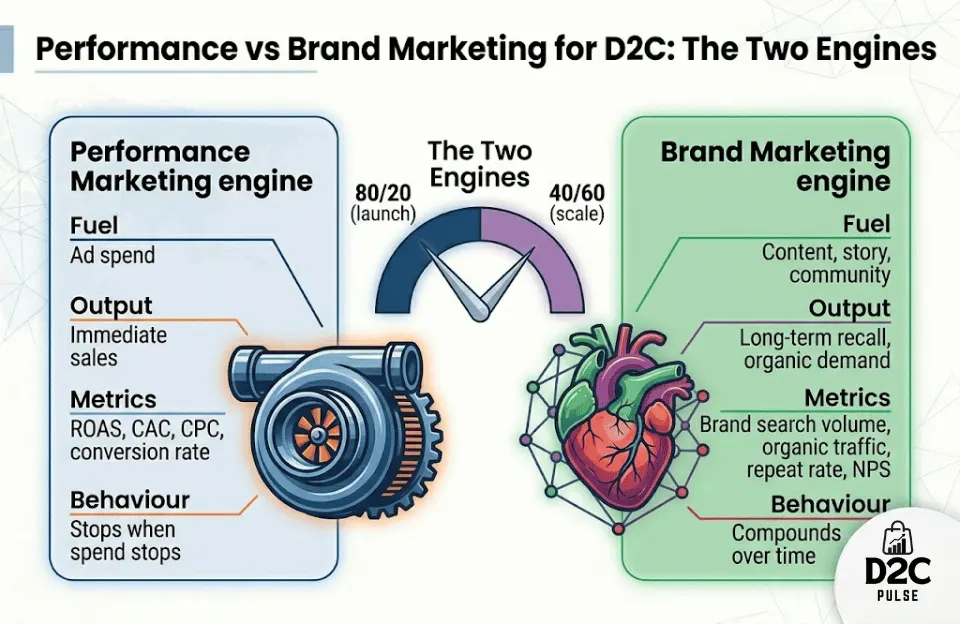
🖼 IMAGE PLACEHOLDER Title: Performance vs Brand Marketing for D2C: The Two Engines Description: A split visual. LEFT: Performance Marketing engine. Fuel: Ad spend. Output: Immediate sales. Metrics: ROAS, CAC, CPC, conversion rate. Behaviour: Stops when spend stops. RIGHT: Brand Marketing engine. Fuel: Content, story, community. Output: Long-term recall, organic demand. Metrics: Brand search volume, organic traffic, repeat rate, NPS. Behaviour: Compounds over time. CENTRE: A dial showing the balance shifting from 80/20 (launch) to 40/60 (scale). Clean, branded. Suggested dimensions: 1200 x 600 px (landscape) Alt text: Performance vs Brand Marketing for D2C: The Two Engines – The D2C Pulse
How Performance vs Brand Marketing Are Different. A Side-by-Side Comparison.
Performance marketing and brand marketing are not two versions of the same thing. They operate on different timelines, different metrics, and different principles. Understanding this difference is the first step to getting the balance right.
| Factor | Performance Marketing | Brand Marketing |
| Goal | Drive a specific action: click, add-to-cart, purchase. Measurable and immediate. | Build awareness, trust, and preference. Long-term and compounding. |
| Timeline | Days to weeks. Results visible within hours of launching an ad. | Months to years. Results build slowly, then compound. |
| Key Metrics | ROAS, CAC, CPC, CPM, conversion rate, CM2. | Brand search volume, organic traffic, repeat purchase rate, NPS, unaided recall. |
| Channels | Meta Ads, Google Ads, marketplace ads, affiliate marketing, retargeting. | Content marketing, SEO, founder storytelling, PR, community, organic social, shoppable video on own site. |
| Cost Model | Pay per result. Stop spending, results stop. | Investment over time. Results persist and grow even after spend pauses. |
| What It Builds | Transactions. Revenue today. | Trust. Preference. Organic demand that reduces future CAC. |
| Biggest Risk | CAC inflation. Platform dependency. Creative fatigue. Treadmill effect. | Slow results. Hard to attribute. Easy to cut during cash crunches. |
| Indian D2C Example | A brand running Rs 10 lakh/month on Meta Advantage+ with 3.5x ROAS. | Minimalist publishing ingredient education that ranks on Google and builds trust without ad spend. |
The core difference: performance marketing rents attention and you pay every time for it. Brand marketing builds an asset where you invest once, and it keeps returning value.
A Meta ad generates a sale today. A blog post that ranks for “best vitamin C serum India” generates sales every day for years. An Instagram Reel ad gets 10,000 views when you pay for it. A founder’s video explaining why they started the brand gets shared organically, placed as a shoppable video on the product page, and converts visitors indefinitely.
Performance marketing is oxygen. You need it to survive. Brand marketing is exercise. You need it to get stronger. The brands that only do performance marketing suffocate when ad costs rise. The brands that only do brand marketing run out of cash before the brand compounds. The answer is both. The question is how much of each, and when.
What Worked in the Past: The Rise and Fall of Performance-Only D2C in India
2016–2020: The Performance Marketing Golden Era
Between 2016 and 2020, performance marketing was all a D2C brand needed. Meta CPMs were cheap. Rs 50–100 per 1,000 impressions. A beauty brand could acquire a customer for Rs 150–250. Google Shopping was uncrowded. The competition was thin. You could spend Rs 5 lakh per month on ads and grow 50% quarter-on-quarter.
This is how most first-wave Indian D2C brands grew. Mamaearth, boAt, Sugar Cosmetics, mCaffeine. They all started with heavy Meta ad spend. It worked because the maths worked. Low CPMs plus high ROAS equalled profitable customer acquisition.
Brand marketing during this period was a nice-to-have. You could build a Rs 100 crore business on performance marketing alone. Few founders invested in SEO, content, or community because they did not need to. The ads were working.
2021–2023: The Inflection Point in Performance vs Brand Marketing Debate
Three things changed. First, Meta CPMs rose 40–60% as 800+ D2C brands entered the market and bid for the same audiences. Second, Apple’s iOS 14.5 update in 2021 broke ad tracking, making targeting less precise and attribution muddier. Third, the funding winter of 2023 forced brands to care about profitability, not just top-line growth.
The brands that had invested only in performance marketing suddenly found themselves stuck. CAC was rising. ROAS was falling. They had no organic traffic. No SEO. No brand recall. When they turned off ads, revenue dropped to near zero. They had built a business on rented attention, and the rent had doubled.
62% of D2C founders report creative fatigue: repeated ad creatives fail to sustain ROAS despite higher spend. 55% admit to under-investing in CRM and retention. 60–65% of Indian D2C brands remain stuck in the Rs 1–50 crore revenue band, unable to cross Rs 100 crore. The common thread: over-reliance on performance marketing without building the brand infrastructure that compounds.
The most common mistake D2C brands make at launch is skipping brand building and going straight to performance marketing. This works for 12–18 months. Then it stops working. And rebuilding a brand that was never built costs more than building it from the start.
What Will Work in the Future: The Integrated Model for 2026 and Beyond
The performance vs brand marketing debate is over. The winners in 2026 do both, deliberately, with clear allocation by stage. Here is what the next five years look like for D2C marketing in India:
Performance marketing is still the engine, but it is no longer the entire car
Meta and Google are still essential. But the optimal allocation has shifted from 80% Meta to 40–50% Meta, 25–30% Google, and 15–25% emerging channels. Performance marketing drives immediate revenue. But it is surrounded by brand assets that lower CAC over time.
Brand marketing is the compounding asset
SEO content that ranks brings free traffic every month. A founder video on the product page builds trust at the moment of purchase. A community of 10,000 loyal WhatsApp members generates repeat purchases without ad spend. Creator UGC repurposed as shoppable video on your website converts visitors who never saw your ads. These are brand assets. They compound. They reduce your dependence on performance marketing over time.
The brands that invest in brand marketing early have lower CAC later
A Dutch electric mobility brand ran a brand awareness campaign on YouTube alongside TV. A week after launch, brand search traffic increased 300%. Meta and Display CPCs dropped 30–45% without changing any ad settings. The brand investment reduced the cost of performance marketing. That is the compounding effect.
In India, Minimalist’s ingredient education content drives organic traffic that costs zero per click. Wakefit’s sleep blog ranks for dozens of keywords. boAt’s Shark Tank visibility lowered its CAC because consumers already knew the brand before they saw the ad. Brand marketing does not replace performance marketing. It makes performance marketing cheaper.
AI and owned channels accelerate the shift: Performance vs Brand Marketing
AI search engines (ChatGPT, Perplexity, Google AI Overviews) are becoming product discovery channels. When a consumer asks “best sunscreen for oily skin India,” the AI recommends brands based on website content, reviews, and structured data. This is not paid. This is brand presence. The brands that invest in content, reviews, and product page depth get cited. The brands that only run ads do not.
Shoppable video on your own website (through tools like ReelV) extends brand content into the conversion funnel. A founder story video, a creator review, or a product demo placed on the PDP is brand marketing that converts. It builds trust and drives sales simultaneously. That is the future: brand content that does the job of performance marketing.
[Internal link: Read The Evolution of D2C in India for how the marketing mix shifted across five phases]
The Stage-by-Stage Framework: Performance vs Brand Marketing by D2C Growth Phase
This is the practical answer to the performance vs brand marketing question. The right balance depends on where you are.
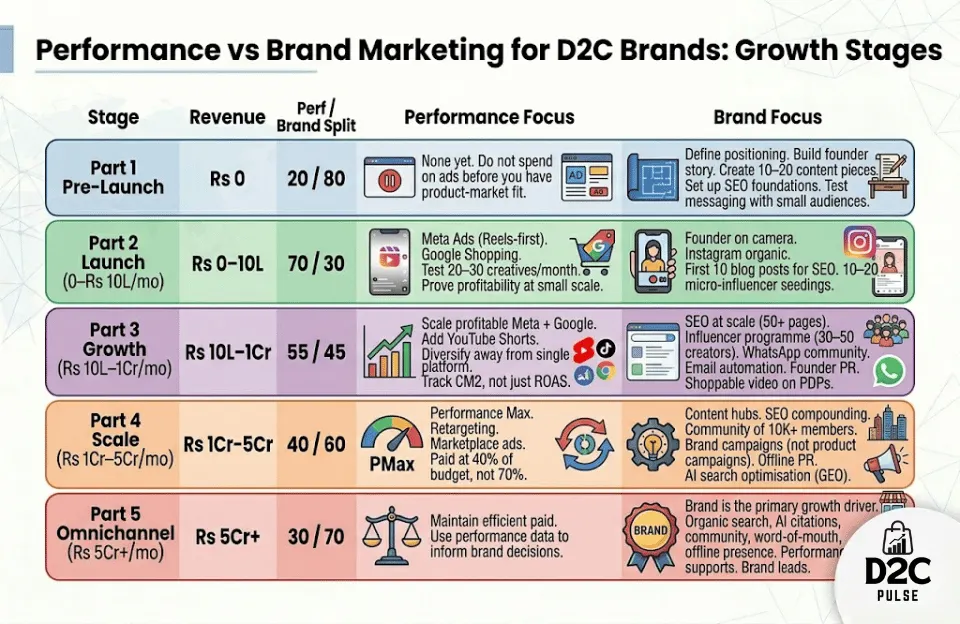
| Stage | Revenue | Perf / Brand Split | Performance Focus | Brand Focus |
| Pre-Launch | Rs 0 | 20 / 80 | None yet. Do not spend on ads before you have product-market fit. | Define positioning. Build founder story. Create 10–20 content pieces. Set up SEO foundations. Test messaging with small audiences. |
| Launch (0–Rs 10L/mo) | Rs 0–10L | 70 / 30 | Meta Ads (Reels-first). Google Shopping. Test 20–30 creatives/month. Prove profitability at small scale. | Founder on camera. Instagram organic. First 10 blog posts for SEO. 10–20 micro-influencer seedings. |
| Growth (Rs 10L–1Cr/mo) | Rs 10L–1Cr | 55 / 45 | Scale profitable Meta + Google. Add YouTube Shorts. Diversify away from single platform. Track CM2, not just ROAS. | SEO at scale (50+ pages). Influencer programme (30–50 creators). WhatsApp community. Email automation. Founder PR. Shoppable video on PDPs. |
| Scale (Rs 1Cr–5Cr/mo) | Rs 1Cr–5Cr | 40 / 60 | Performance Max. Retargeting. Marketplace ads. Paid at 40% of budget, not 70%. | Content hubs. SEO compounding. Community of 10K+ members. Brand campaigns (not product campaigns). Offline PR. AI search optimisation (GEO). |
| Omnichannel (Rs 5Cr+/mo) | Rs 5Cr+ | 30 / 70 | Maintain efficient paid. Use performance data to inform brand decisions. | Brand is the primary growth driver. Organic search, AI citations, community, word-of-mouth, offline presence. Performance supports. Brand leads. |
Notice the pattern. At launch, performance dominates because you need immediate revenue to survive. As the brand grows, the split inverts. At scale, brand marketing drives 60–70% of the effort because it compounds. The brands that stay at 70% performance forever are the ones stuck in the Rs 1–50 crore band. The brands that shift to 60–70% brand marketing are the ones that cross Rs 100 crore.
The biggest mistake at launch: skipping brand building entirely and going 100% performance. The biggest mistake at scale: staying at 70% performance when you should be at 40%. The balance shifts. Your budget allocation must shift with it.
How Brand Marketing Makes Performance Marketing Better (And Vice Versa)
The performance vs brand marketing comparison often frames them as competing for budget. They are not. They feed each other.
Brand lowers performance CAC
When consumers already know your brand name, your Meta ads convert at a higher rate. Your cost-per-click drops because the brand name in the ad is recognised. Your Google brand search is cheaper than generic category search. One brand awareness campaign can reduce performance CPCs by 30–45%. Lenskart’s Shark Tank visibility. boAt’s Aman Gupta becoming a public figure. Mamaearth’s Ghazal on Shark Tank India. Each brand move lowered the cost of every performance ad that followed.
Performance informs brand strategy
Performance marketing generates data. Which product pages convert best and which headlines stop the scroll while which price points trigger purchase and how audiences respond. That data should inform your brand marketing. If your best-performing ad features a founder explaining the product, your brand strategy should double down on founder visibility. If your top-converting landing page leads with a customer testimonial, your brand strategy should invest in UGC and community. Performance data is the feedback loop that makes brand marketing smarter.
Brand content becomes performance creative
The best-performing ad creatives in 2026 are not polished brand ads. They are UGC-style creator videos. Founder stories. Customer testimonials. Behind-the-scenes content. These are brand assets that perform as ads. A founder video explaining why they started the brand, recorded for brand-building purposes, outperforms a product-shot carousel ad by 20–40% on CTR and conversion. The brand content is the performance creative.
Smart D2C brands produce content once and deploy it everywhere. A founder video goes on Instagram (organic), then runs as a paid ad (performance), then sits on the product page as a shoppable video (conversion). One piece of brand content does three jobs. That is how the performance vs brand marketing line disappears at the execution level.
[Internal link: Read Customer Acquisition Strategies for D2C Brands in India for the full channel-by-channel playbook]
Indian D2C Brands That Got the Balance Right between Performance vs Brand Marketing
Minimalist: Brand-First from Day One
Minimalist spent 30–35% of revenue on marketing, compared to 40%+ for peers. The difference: Minimalist invested in education content (ingredient guides, transparency messaging, founder credibility) from launch. This built organic trust that reduced CAC. The brand was acquired by HUL for Rs 2,955 crore. That valuation was not built by Meta ads. It was built by a brand that consumers trusted because of consistent brand marketing.
boAt: Performance Engine + Brand Multiplier
boAt ran aggressive performance marketing through hundreds of micro-influencer campaigns and Meta ads. But it simultaneously built a brand through Aman Gupta’s Shark Tank presence, the boAtheads community, and a lifestyle positioning that made headphones feel like fashion. The brand awareness lowered performance CAC. Performance campaigns drove revenue. The flywheel spun.
Wakefit: Content as the Growth Engine
Wakefit invested early in a sleep blog, humorous viral campaigns (the Sleep Internship paying Rs 1 lakh to sleep), and founder-led PR. These brand investments built organic traffic and awareness that now generates a meaningful share of revenue without ad spend. When Wakefit runs performance ads, the consumer already knows the brand. That familiarity converts at a higher rate and a lower cost.
Sugar Cosmetics: Community as Brand Infrastructure
Sugar built its brand through an Instagram community of makeup enthusiasts, tutorials by real users, and creator collaborations (#BeYourOwnMuse). 50% of online revenue comes from its own website and app, driven by brand loyalty, not ad spend. Performance marketing acquires new customers. The community retains them. The brand is the retention engine.
Key Takeaways from Performance vs Brand Marketing
- Performance marketing and brand marketing are not competing. They are complementary. Performance drives immediate sales. Brand builds compounding trust. The brands that do both, in the right proportion at each stage, win.
- The performance-only era in Indian D2C is over. Meta CPMs are up 40–60% since 2023. 62% of founders report creative fatigue. 60–65% of brands are stuck below Rs 50 crore. Over-reliance on paid ads is the common cause.
- Brand marketing makes performance marketing cheaper. Brand awareness reduces CPCs by 30–45%. Consumers who recognise your brand convert at higher rates. Every rupee invested in brand reduces the cost of future performance spend.
- The budget split shifts by stage. Pre-launch: 20% performance / 80% brand. Launch: 70/30. Growth: 55/45. Scale: 40/60. Omnichannel: 30/70. If you are at scale and still spending 70% on performance, you are stuck.
- The future is integrated. Brand content becomes performance creative. Founder videos, creator UGC, and educational content perform as ads, sit on product pages as shoppable video, and build long-term organic traffic. One asset, multiple channels, compounding returns.
- The brands that crossed Rs 100 crore all invested in brand early. Minimalist (education), boAt (community + founder), Wakefit (content + virality), Sugar (community). Performance marketing got them started. Brand marketing got them to scale.
Frequently Asked Questions about Performance vs Brand Marketing
What is the difference between performance vs brand marketing for D2C brands?
Performance marketing drives specific measurable actions (clicks, purchases, sign-ups) through paid channels like Meta Ads and Google Ads. Results are immediate but stop when spending stops. Brand marketing builds long-term awareness, trust, and preference through content, SEO, founder storytelling, community, and organic social. Results are slower but compound over time. The best D2C brands combine both in proportions that match their growth stage.
What worked in the past for D2C marketing in India?
From 2016 to 2020, performance marketing alone was sufficient. Meta CPMs were low (Rs 50–100). Customer acquisition was cheap. Brands could grow to Rs 100 crore on paid ads alone. After 2021, CPMs rose 40–60%, iOS tracking broke, and 800+ brands competed for the same audiences. Performance-only brands hit a wall. The future requires an integrated approach combining performance marketing for immediate revenue with brand marketing for long-term compounding growth.
Which type of marketing should a startup focus on?
At pre-launch, focus 80% on brand (positioning, founder story, content foundations). When launching (Rs 0–10L/month revenue), shift to 70% performance / 30% brand. During growth phase (Rs 10L–1Cr), balance to 55/45. And at scale (Rs 1Cr+), invert to 40% performance / 60% brand. The pattern: performance dominates early for survival, brand dominates later for compounding. The biggest mistake is skipping brand building entirely at any stage.
How does brand marketing reduce customer acquisition cost?
Brand awareness reduces ad costs. When consumers recognise your brand, they click more, convert faster, and cost less to acquire. One brand awareness campaign has been shown to reduce Meta and Google CPCs by 30–45%. SEO content that ranks brings free organic traffic. Founder visibility on Shark Tank or social media creates recognition that lowers every subsequent ad’s conversion cost. Brand marketing is the long-term CAC reducer.
Can Performance vs Brand Marketing use the same content?
Yes, and the best D2C brands do this deliberately. A founder video explaining why they started the brand serves as brand content (organic social, website), performance content (paid ad creative with 20–40% higher CTR than product shots), and conversion content (shoppable video on PDP via tools like ReelV). One piece of content, three functions. This integration is how the performance vs brand marketing line disappears in practice.