How to Measure, What Good Looks Like, and Five Case Studies That Prove It Works
The Measurement Playbook. Six Metrics That Matter, Real Numbers from Indian D2C Campaigns, and the Mistakes That Drain Budgets.
The average influencer marketing ROI is $5.78 for every $1 spent. The best campaigns deliver $18–20 per dollar. And 74% of brands are increasing their influencer budgets in 2026. Those numbers sound fantastic. They also hide a lot of nuance.
Because the average includes the D2C skincare brand that paid Rs 2 lakh to a macro-influencer and got 47 orders. And the brand that spent Rs 50,000 across 15 nano-influencers and got 340 orders. And the brand that paid a celebrity Rs 25 lakh for a single Instagram post and cannot point to a single sale that came from it.
Influencer marketing ROI for D2C brands is not about whether influencers work. They do. 69% of consumers trust influencer recommendations over brand ads. 43% of Indian shoppers are influenced by creator content. 82% of marketers say influencer-acquired leads are higher quality than other channels. The question is not whether. It is how to measure, how to optimise, and how to avoid the mistakes that turn a high-ROI channel into a cash drain.
This guide is the measurement playbook. Six metrics that matter. How to calculate each one. What good looks like for Indian D2C brands. Five case studies with real numbers. And seven mistakes that destroy influencer marketing ROI.
Six Metrics That Actually Measure Influencer Marketing ROI for D2C Brands
Most brands report likes, comments, and impressions. Their CFO wants to know how much money the campaign made. The gap between what marketing reports and what finance needs is why influencer ROI feels like a black box. Here are the six metrics that close that gap.
Metric 1: Influencer ROAS (Return on Ad Spend)
Formula: Revenue attributed to influencer campaign ÷ Total campaign cost (influencer fee + product seeding + paid amplification).
Benchmark: 3:1 is acceptable for D2C. 5:1 is good. Above 8:1 is excellent. Top-performing campaigns hit 18–20:1. Below 1.5:1 signals misalignment between the creator and your audience.
How to track: Unique discount codes per influencer. UTM-tagged links. Shopify attribution. Without unique codes or links, you cannot attribute revenue to a specific creator.
Metric 2: Cost Per Acquisition (CPA)
Formula: Total influencer campaign cost ÷ Number of new customers acquired.
Benchmark: Influencer CPA should be 30–50% lower than your Meta ads CPA. If you pay Rs 600 to acquire a customer through Instagram ads, influencer CPA should be Rs 300–420. If influencer CPA is higher than paid ads, the campaign is not working.
Why it matters: ROAS can look healthy on low volume. CPA tells you the actual cost of winning a customer. A campaign with 5:1 ROAS but only 12 customers is not scalable. CPA plus volume is the real test.
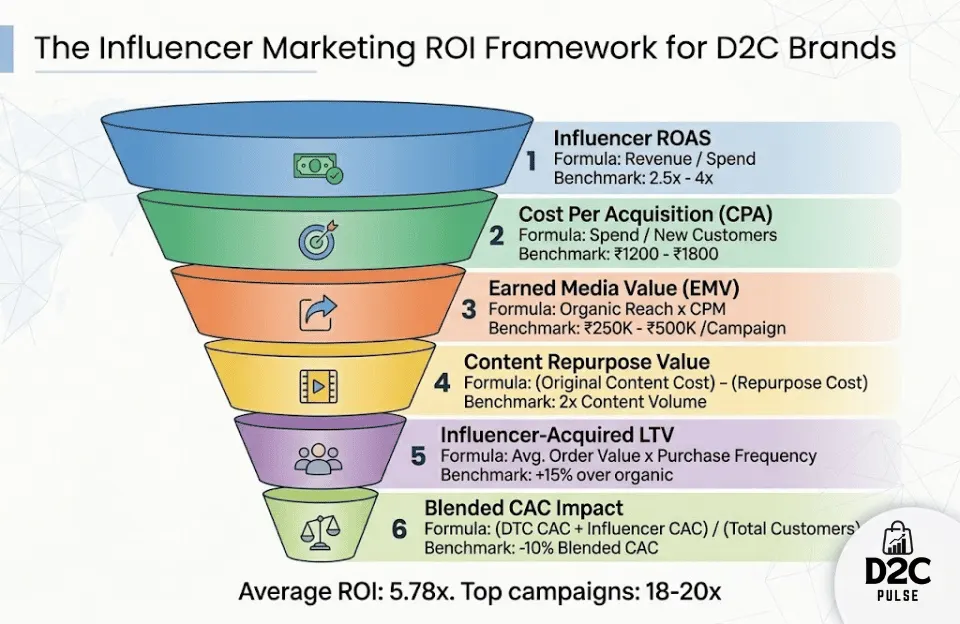
Metric 3: Earned Media Value (EMV)
Formula: (Impressions × Industry CPM) + (Engagements × Engagement value).
What it measures: The advertising equivalent of the organic exposure the influencer generated. A post with 100,000 impressions at a Rs 200 CPM represents Rs 20,000 in earned media that you did not pay for directly.
Caveat: EMV is a soft metric. It estimates exposure value, not actual revenue. Use it alongside ROAS and CPA, not instead of them.
Metric 4: Content Repurpose Value
What it measures: The additional ROI you get from using influencer-created content as paid ad creative, email content, website shoppable video, or product page testimonials.
Why it matters: This is the hidden multiplier of influencer marketing ROI for D2C brands. A single creator video can run as a paid ad (where UGC-style content outperforms brand-produced creatives by 20–40% on CTR), as a shoppable video on your product page (driving 5–30% conversion lifts via tools like ReelV), and as WhatsApp marketing content. One piece of creator content can generate value across five channels. Most brands only count the direct sales from the influencer’s post. They miss the repurpose value entirely.
Metric 5: Influencer-Acquired Customer LTV
What it measures: Whether customers who came through influencer campaigns have higher, lower, or equal lifetime value compared to customers from paid ads.
Benchmark: One UK pet food brand found that influencer-acquired customers had 15% higher LTV than customers from paid social. A skincare brand found 37% higher repeat purchase rates from micro-influencer-acquired customers. If influencer-acquired customers have higher LTV, the higher upfront CPA is justified.
How to track: Tag customers by acquisition source in your CRM (Shopify, Klaviyo, WebEngage). Compare 90-day and 180-day repeat rates and AOV by source cohort.
Metric 6: Blended CAC Impact
What it measures: How influencer marketing affects your overall blended CAC across all channels.
Why it matters: Influencer content does not just drive direct sales. It improves branded search volume (people Google your brand after seeing a creator mention it), increases ad creative performance (UGC as paid ad content), and drives organic social growth. The full impact of influencer marketing on your blended CAC is always higher than the direct attribution shows.
The biggest mistake D2C brands make when measuring influencer marketing ROI is counting only direct sales from the influencer’s post. The real value includes content repurpose, LTV uplift, branded search increases, and blended CAC reduction. Brands that measure only direct ROAS undervalue influencer marketing by 40–60%.
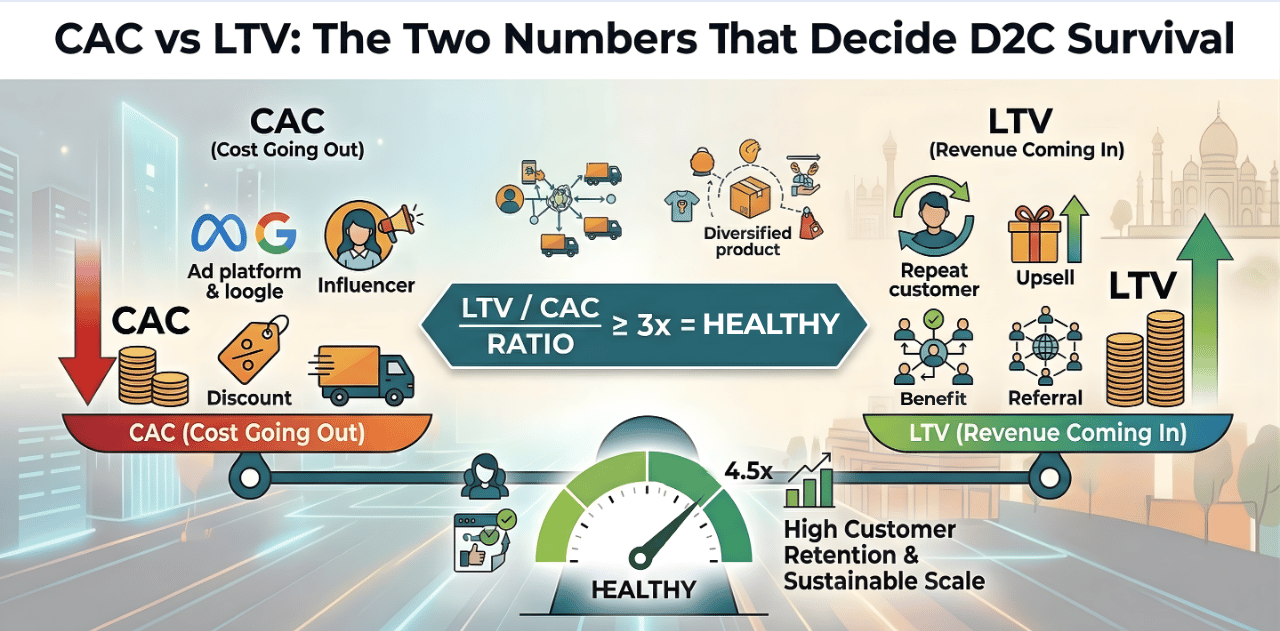
[Internal link: Read CAC vs LTV: The Unit Economics Deep Dive for how influencer CAC fits into the full economics framework]
The Micro vs Macro Economics: Where Influencer Marketing ROI Is Highest for D2C Brands
| Factor | Nano (1K–10K) | Micro (10K–100K) | Macro (100K+) |
| Avg engagement rate | 7–10% | 3–6% | 0.6–2.5% |
| Cost per post (India) | Rs 1,000–5,000 | Rs 5,000–50,000 | Rs 1–5 lakh+ |
| CPA vs paid ads | 50–70% lower | 30–50% lower | Often equal or higher |
| Audience trust | Highest (personal) | High (niche authority) | Moderate (perceived as ads) |
| Content quality | Variable | Good | Professional |
| Best for | Product seeding, UGC collection | Consistent acquisition, niche targeting | Awareness launches, credibility signals |
| ROI per rupee spent | Highest | High | Lowest (often) |
The data is consistent across every study. Micro-influencers (10K–100K followers) deliver the best balance of reach, engagement, and cost for D2C brands. Nano-influencers have the highest engagement per follower but limited scale. Macro-influencers have scale but the lowest engagement rates and highest costs. For brands spending under Rs 5 lakh per month on influencer marketing, a portfolio of 15–30 micro-influencers almost always outperforms one or two macro-influencers.
The practical strategy for Indian D2C brands: allocate 60–70% of influencer budget to micro-influencers for consistent acquisition. Use 20–30% on nano-influencers for UGC content collection (to repurpose as paid ads and shoppable videos). Reserve 10–20% for one macro-influencer campaign per quarter for awareness spikes.
Five Case Studies: Where Influencer Marketing ROI Worked for D2C Brands
Case Study 1: boAt — Hundreds of Micro-Creators, Rs 3,100 Crore Brand
boAt is the masterclass in influencer marketing ROI for D2C brands. From day one, Aman Gupta built the brand through hundreds of creators, not one or two celebrities. Cricketers, gym-goers, gamers, college students, musicians. Each creator reached a specific niche. The combined reach was massive, but the cost per creator was low.
The key insight: boAt treated influencer marketing as an always-on engine, not a campaign. There was no “influencer campaign Q3.” There were 200+ creators posting about boAt products every week. The constant drumbeat of UGC built social proof that no single ad campaign could match. By the time boAt hit Rs 3,100 crore in revenue, influencer marketing was not a line item. It was the brand’s DNA.
What founders can learn: Do not budget for one influencer campaign. Budget for an always-on creator program. 50–100 micro-influencers posting monthly costs less than one celebrity deal and delivers higher cumulative ROI.
Case Study 2: Mamaearth — 500+ Bloggers and a Rs 2,000 Crore Brand
Mamaearth partnered with 500+ bloggers and micro-influencers, focusing on educational content about ingredient safety. The strategy was not “post a photo with our product.” It was “tell your audience why parabens are bad and why our product does not have them.” Educational influencer content built credibility that pure product promotion cannot. 43% of Indian shoppers are influenced by creator content. Mamaearth understood this early and turned creators into educators.
What founders can learn: Give influencers a story to tell, not just a product to hold. Educational briefs produce higher engagement, higher trust, and higher conversion than generic product placement.
Case Study 3: Sugar Cosmetics — Instagram Community as a Growth Engine
Sugar Cosmetics built a massive Instagram community through tutorials, user-generated content, and creator collaborations. Over 60% of Sugar’s sales come from non-metro cities like Siliguri, Karnal, and Bhatinda. The influencer strategy was not just about metro beauty creators. Sugar invested in regional micro-influencers who reached consumers in tier-2 and tier-3 cities where physical beauty stores are rare and D2C is the primary access point.
What founders can learn: Match your influencer strategy to your customer geography. If 60% of your sales come from non-metros, 60% of your influencer budget should target non-metro creators. Regional micro-influencers in tier-2 cities deliver lower CPA and higher trust than metro macro-influencers.
Case Study 4: D2C Skincare Brand — 15 Nano-Influencers, 340 Purchases, 2.4x ROI
A D2C skincare startup spent Rs 4 lakh across 15 nano-influencers (25K–50K followers each). Each creator received product and Rs 8,000–15,000 per post. Results: 8.2% average engagement rate (benchmark: 3–4%). 340 purchases. Rs 9.6 lakh in revenue. 2.4x ROAS on direct sales alone. Plus, the brand repurposed the creator content as paid ad creatives that ran for six months, generating an additional estimated 3x in indirect ROI. Total effective ROI: roughly 8–10x when content repurpose value is included.
What founders can learn: Nano-influencer campaigns with 15–20 creators produce both direct sales and a library of UGC content. That content library is an asset you use for months. The direct ROAS is only part of the return.
Case Study 5: Premium Skincare Brand — Micro-Influencers, 64% CPA Reduction, 5.7x ROI
A premium skincare brand shifted from macro-influencer campaigns to a network of 25 micro-influencers. Cost per acquisition dropped by 64% compared to previous campaigns. The campaign achieved a 5.7x return on investment within 60 days. Follow-up analysis showed that customers acquired through micro-influencers had 37% higher repeat purchase rates over six months compared to customers from other acquisition channels. The micro-influencer audience was more niche-aligned, which meant higher purchase intent and better product-customer fit.
What founders can learn: Micro-influencer customers are not just cheaper to acquire. They are better customers. Higher repeat rates and higher LTV because the audience trust runs deeper. When you measure influencer marketing ROI, track 90-day and 180-day retention, not just first-purchase revenue.
The five case studies share a common pattern: the highest influencer marketing ROI for D2C brands comes from many micro and nano creators, not one big name. Always-on programs outperform one-off campaigns. Educational and authentic content beats product placement. And the full ROI only shows up when you measure content repurpose value and LTV, not just direct sales.
Seven Mistakes That Kill Influencer Marketing ROI for D2C Brands
- Measuring likes instead of revenue. A post with 10,000 likes and zero sales has zero ROI. Track unique codes, UTM links, and Shopify attribution. If you cannot tie a sale to a creator, you cannot measure ROI.
- Spending the entire budget on one macro-influencer. Rs 2 lakh on one creator with 850,000 followers and 2.5% engagement reaches perhaps 200,000 real people. Rs 2 lakh across 20 micro-influencers reaches 500,000 people with 5–8% engagement. The maths favours the portfolio approach.
- Not briefing for education. A generic “post a photo with the product” brief produces generic content. A brief that says “explain why Niacinamide 10% works for acne scars, show before-after, and mention the Rs 499 price point” produces content that converts. The brief determines the ROI.
- Ignoring content repurpose. The influencer’s post has a 48-hour shelf life on Instagram. But that same video can run as a paid ad for six months, live as a shoppable video on your product page forever (via tools like ReelV), and go into your email flows. Brands that do not repurpose creator content leave 40–60% of the value on the table.
- Not tracking influencer-acquired LTV. If you only track first-purchase revenue, you are measuring half the return. Customers from trusted micro-influencers typically have 15–37% higher repeat rates. Tag acquisition source in your CRM. Compare 90-day and 180-day cohorts.
- Choosing influencers by follower count. Follower count is the worst predictor of ROI. Engagement rate, audience demographics, audience authenticity (bot check), and content quality are all better predictors. An influencer with 30,000 real followers and 6% engagement will outperform one with 300,000 followers and 0.8% engagement.
- Running campaigns without a retention bridge. The influencer gets the first sale. Your post-purchase WhatsApp flow, email sequence, and loyalty program get the second and third. If you spend Rs 3 lakh on influencer marketing and do not have post-purchase automation, you are paying full CAC for every order instead of just the first one.
[Internal link: Read Retention Marketing Strategies for D2C Brands for the post-purchase playbook that multiplies influencer ROI]
The Hidden ROI Multiplier: Influencer Content as Shoppable Video on Your Website
This is the tactic that most D2C brands miss entirely.
When a micro-influencer creates a 30-second product review, that video lives on their Instagram for 48 hours before the algorithm buries it. But the video itself is gold. It is authentic, features a real person and shows the product in use. Together, this builds trust.
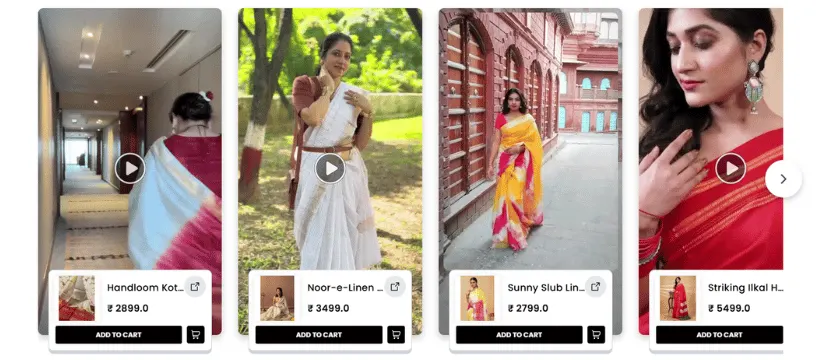
Now put that video on your product page as a shoppable video. The customer lands on the PDP, sees a real person reviewing the product, and can add to cart directly from the video player. That video converts not for 48 hours but for months. Every visitor to that product page sees the social proof.
Tools like ReelV make this simple for Shopify stores. Use the Stories format to organise multiple creator testimonials under named thumbnails on your PDP. Use Floats for a single high-performing review video as a pop-up on the product page. The video loads from ReelV’s own CDN, so it does not slow down the site.
The ROI calculation changes completely. A Rs 10,000 micro-influencer video that generates 50 direct sales has a 2–3x ROAS. That same video, repurposed as a shoppable testimonial on your PDP, might generate another 200 sales over six months. The total ROAS jumps to 10–15x. The influencer did not generate those extra sales, the content did. But the content only works because it was placed where the purchase decision happens.
Key Takeaways
- Influencer marketing delivers an average $5.78 return per $1 spent. Top campaigns hit $18–20. But the average hides wide variation. Measurement determines whether you are in the top or the bottom.
- Six metrics matter: Influencer ROAS, CPA, Earned Media Value, Content Repurpose Value, Influencer-Acquired LTV, and Blended CAC Impact. Track all six, not just direct ROAS.
- Micro-influencers deliver the highest ROI per rupee for D2C brands. 30–50% lower CPA than paid ads. 3–6% engagement (vs 0.6–2.5% for macro). A portfolio of 15–30 micro-influencers beats one or two macro-influencers.
- Content repurpose is the hidden multiplier. A creator video that runs as a paid ad, a shoppable video on your PDP, and in email flows generates 3–5x the value of the direct post alone. Most brands leave this value on the table.
- Influencer-acquired customers are better customers. 15–37% higher repeat purchase rates. Higher LTV. The trust transfer from creator to brand creates stickier customers than paid ads.
- Always-on programs beat one-off campaigns. boAt, Mamaearth, and Sugar all built continuous creator relationships, not quarterly campaigns. The compounding effect of consistent UGC is the real flywheel.
- The biggest ROI mistake is measuring only direct sales. Content repurpose value, LTV uplift, branded search increases, and blended CAC reduction add 40–60% more value that most brands never count.
Frequently Asked Questions
What is a good influencer marketing ROI for D2C brands?
The average influencer marketing ROI is $5.78 per $1 spent. For Indian D2C brands, a 3:1 ROAS on direct sales is acceptable, 5:1 is good, and above 8:1 is excellent. When content repurpose value and LTV uplift are included, effective ROI can reach 10–20x for well-optimised micro-influencer campaigns.
How do you measure influencer marketing ROI?
Track six metrics: Influencer ROAS (revenue divided by total campaign cost), Cost Per Acquisition (total cost divided by new customers), Earned Media Value (impressions multiplied by CPM), Content Repurpose Value (performance of creator content used in paid ads, email, and shoppable videos), Influencer-Acquired LTV (90-day and 180-day repeat rates), and Blended CAC Impact (effect on overall acquisition cost). Use unique discount codes and UTM links for attribution.
Are micro-influencers better than celebrities for D2C brands?
For most D2C brands, yes. Micro-influencers (10K–100K followers) deliver 30–50% lower CPA, 3–6% engagement rates (vs 0.6–2.5% for macro), and higher audience trust. A portfolio of 15–30 micro-influencers provides diversified reach, lower risk, and better conversion. Celebrities work for one-time awareness pushes but rarely deliver better per-rupee ROI than micro-influencers.
How can D2C brands maximise influencer marketing ROI?
Five strategies: (1) Use micro-influencers for 60–70% of budget. (2) Brief for educational content, not generic product placement. (3) Repurpose creator content as paid ads, shoppable videos, and email content. (4) Track LTV of influencer-acquired customers, not just first-purchase revenue. (5) Build always-on creator programs instead of quarterly campaigns. The compounding effect of consistent UGC is the real multiplier.