How to Reduce CAC (Customer Acquisition Cost) for D2C
Practical, Operator-Level Moves to Cut Customer Acquisition Costs Without Cutting Growth. Tested by Indian D2C Brands in 2025–2026.
You already know your CAC is too high. You do not need another article telling you that ad costs have gone up. What you need is a list of things you can do this week to bring that number down. That is what this article is. Twelve tactics to reduce CAC for D2C brands in India, ranked by effort and impact. Each one has been used by real brands in 2025 and 2026. Some are free, some require investment but all of them work if you execute them properly.
A quick note on framing. Our earlier guide on customer acquisition strategies covered the what of D2C growth: which channels to use and how to build a diversified mix. This guide covers the how: specific, operator-level moves to reduce CAC within those channels. If the first guide was the map, this one is the toolkit.
Digital ad costs in India have risen 40–60% over the last three years. Meta CPMs keep climbing. iOS privacy changes made targeting less precise. Over 800 funded D2C brands are fighting for the same audiences. The brands that survive are not the ones who spend the most. They are the ones who reduce CAC faster than their competitors.
Here are twelve ways to do that.
Tactic 1: Test More Creatives, Faster. This Is the Single Best Way to Reduce CAC for D2C Brands.
Most D2C brands test 3 to 5 ad creatives per month. The brands with the lowest CAC test 20 to 50. That is not a typo. Meta and Google algorithms reward fresh creative. When an ad has been running for two weeks, performance drops. This is called creative fatigue. If the audience has seen it, they scroll past and your cost per click goes up plus conversion rate goes down.
More creatives and volume can fix this, not a higher budget. Test different hooks in the first three seconds of a Reel. You can also test different product angles, different customer testimonials or different background colours. Kill the losers after 48 hours and scale the winners for 7–10 days. Then replace them too.
High-growth D2C brands now aim for a creative refresh rate of 5–10 new ad variants per week. AI tools make this possible without a large creative team. You can generate UGC-style video ads from a product URL, test scripts in regional languages, and produce static ad variations at a fraction of what a studio costs.
Creative fatigue is the number one reason CAC rises for D2C brands that are already running good campaigns. If you do only one thing from this list, do this: double your creative testing volume. The ROI is almost immediate.
Tactic 2: Improve Your Website Conversion Rate. The Cheapest Way to Reduce CAC.
Here is a number that should change how you think about your website: a 1% increase in conversion rate can reduce your effective CAC by 20–30%. Same traffic and same ad spend delivering more customers.
Most Indian D2C websites convert at 1.5–2.5%. The best convert at 5–6%. That gap is pure money left on the table. Here is where to focus:
– Page speed. A one-second delay reduces conversions by 7%. Most Indian users are on 4G and If your site takes more than 4 seconds to load, you are losing nearly a third of your visitors before they see a product. Compress images, use lazy loading and get your load time under 2.5 seconds.
– Use Shoppable Videos. Interactive videos engage better and provide better understanding of the products. Testimonial videos generate trust much better that static reviews on the website. The Product cards provide impulse purchase push. Conversion effectively multiplies.
– Mobile-first design. Over 85% of Indian e-commerce traffic is mobile. If your checkout is not designed for a thumb, you are losing customers. One-page checkout, auto-fill addresses, large buttons and no pinch-to-zoom.
– Trust signals above the fold. Customer reviews (show the number, not just stars). Certification badges (MadeSafe, dermat-tested), delivery time estimate and “As seen on Shark Tank India” reduce hesitation.
– UPI as default payment. UPI is the fastest, cheapest payment method, so you must make it the first option at checkout. This removes friction from payment. Every drop-off at the payment stage is a wasted click you already paid for.
– Simplified checkout. Guest checkout option with no forced account creation. Auto-fill from previous orders. Every extra field or step loses 5–10% of remaining buyers.
[Internal link: Read Understanding Unit Economics for D2C Brands for how CRO fits into the full cost stack]
Tactic 3: Use UGC as Ad Creative to Reduce CAC by 30–40%
User-generated content outperforms studio-produced ads. That is no longer a theory. It is a benchmark.
UGC ads — real customers talking about your product on their phone camera — consistently deliver 30–40% lower cost-per-acquisition than polished brand videos. Raw, unedited testimonial videos perform about 40% better than high-production studio ads in feed environments.
Why? Because they look like content, not ads. In a feed full of sponsored posts, something that looks like a friend recommending a product stops the scroll. It earns attention instead of buying it.
How to build a UGC engine to reduce CAC for your D2C brand:
- After every successful delivery, send a WhatsApp message asking for a short video review. Offer a 10–15% discount on their next order in exchange.
- Collect the best videos. Edit them into 15–30 second Reels with a branded intro and CTA.
- Run them as paid ads on Meta. Test multiple UGC videos as ad creatives.
- Repurpose the same UGC for organic posts, product page reviews, and email campaigns.
The 2026 benchmark for smart D2C brands is a 70/20/10 creative split: 70% AI-generated UGC for rapid testing, 20% real customer UGC for social proof, and 10% high-production content for brand building.
Tactic 4: Click-to-WhatsApp Ads to Reduce CAC for D2C Brands in India
This is the most underrated tactic on this list. Click-to-WhatsApp (CTWA) ads on Meta send users directly to a WhatsApp conversation instead of a landing page. The results are remarkably good.
Why CTWA ads reduce CAC:
- Zero drop-off on landing pages. The user goes straight from the ad to a chat. No page load or navigation friction and no need for any form to fill.
- Instant lead capture. The moment someone messages you on WhatsApp, you have their phone number. That is zero-party data captured without a form.
- Familiar interface. Indians spend an average of 4 hours a day on WhatsApp. The interface feels safe. The conversation feels personal. Engagement rates are higher than any website.
- AI chatbots handle the conversation. Chatbots that speak Hinglish can answer product queries, recommend products, and close the sale right inside WhatsApp. No human needed for the first interaction.
D2C brands using CTWA ads report 2–3x higher conversion rates compared to website landing pages, at a similar or lower cost per click. If you sell products that need even a small amount of explanation (skincare, supplements, baby care), this tactic can cut your CAC significantly.
Tactic 5: Match Your Landing Page to Your Ad. Exactly.
This sounds obvious. It is not done by most brands. And it is one of the easiest ways to reduce CAC for D2C brands.
When a customer clicks an ad for “Vitamin C Face Serum — Rs 499,” they should land on a page that shows exactly that product at exactly that price. Not your homepage or a category page and certainly not a page that requires three more clicks to find the product.
Every extra click between the ad and the checkout is a leak. Each leak increases your effective CAC because you paid for that click but lost the customer before they bought.
Build dedicated landing pages for your top 5–10 ad campaigns. Match the headline, the product image, the offer, and the price exactly to the ad creative. Include reviews, a clear CTA, and a one-click add-to-cart. This alone can improve conversion rates by 15–25%.
Tactic 6: COD-to-Prepaid Conversion to Reduce Effective CAC
Cash-on-delivery orders have higher return rates, slower cash settlement, and extra handling fees. The effective CAC on a COD order is always higher than on a prepaid order because a significant percentage of COD orders never complete.
The fix: after a COD order is placed, send an immediate WhatsApp message offering a small incentive (Rs 30–50 off or free shipping upgrade) if the customer converts to prepaid. Tools like Interakt and Razorpay make this automated.
D2C brands that implement COD-to-prepaid nudges report 10–20% conversion rates from COD to prepaid. Every converted order reduces your RTO rate, speeds up cash settlement, and lowers your effective CAC.
Tactic 7: Build an SEO Engine That Compounds and Reduces CAC to Near Zero Over Time
Every rupee spent on SEO compounds. Every rupee spent on ads disappears the moment you stop.
The best long-term way to reduce CAC for D2C brands is to build organic search traffic. When you rank for “best vitamin C serum India” or “wireless earbuds under 2000,” every visitor from Google is free. Your CAC on those visitors is zero (after the initial content investment).
What to create:
- Buying guides: “Top 10 protein powders for beginners in India 2026”
- Comparison content: “Minimalist vs Dot & Key vs Plum: Which serum is right for your skin?”
- Problem-solution content: “How to stop hair fall naturally”
- Ingredient education: “What does niacinamide do for your skin? A complete guide”
SEO takes 6–12 months to show results. That is exactly why you should start today. The brands that invested in content 18 months ago are the ones with the lowest CAC right now.
In 2026, SEO is also evolving into GEO (Generative Engine Optimization). Smart brands are making sure their content gets cited by AI tools like ChatGPT, Gemini, and Perplexity when users ask product questions. If your brand is the source AI models reference, you get free traffic from a channel your competitors have not even started thinking about.
[Internal link: Read Customer Acquisition Strategies for D2C Brands for the full channel diversification framework]
Tactic 8: Referral Programs That Actually Work
Referred customers cost almost nothing to acquire. They have higher trust and convert much faster. These customers typically have higher LTV than ad-acquired customers. A well-designed referral program can reduce your blended CAC by 40–60%.
What makes a referral program work in the Indian D2C context:
- Reward both sides. “Give Rs 100, get Rs 100.” One-sided programs underperform.
- Make sharing effortless. One-tap WhatsApp sharing. Not a code to copy and paste into a form.
- Trigger at the right moment. Right after successful delivery, when satisfaction is highest. Not two weeks later.
- Track it separately. Know your referral CAC. It should be your lowest-cost channel.
Tactic 9: Increase AOV to Reduce Effective CAC Per Rupee of Revenue
If your CAC is Rs 500 and your AOV is Rs 600, your CAC-to-revenue ratio is 83%. Painful. But if you push AOV to Rs 1,000 with the same Rs 500 CAC, that ratio drops to 50%. Same acquisition cost. Better return.
How to increase AOV to reduce the CAC burden:
- Product bundles. A shampoo + conditioner + serum bundle priced 10–15% below individual prices. Customers feel they are getting a deal. You get higher AOV.
- Free shipping threshold. “Free shipping on orders above Rs 799.” Customers add one more item to hit the threshold. Your AOV goes up. Your effective shipping cost per rupee of revenue goes down.
- Smart upsells at checkout. “Add a sunscreen for Rs 199?” Show it at the cart stage. Not buried on a product page. Relevant, timely upsells increase AOV by 10–20%.
Tactic 10: AI-Generated Creative to Reduce CAC Through Volume and Speed
AI is the biggest CAC reduction tool of 2026. Not because it replaces your creative team. Because it makes your creative team 10x faster.
What AI enables:
- Generate 10+ video ad variants from a single product URL. Tools can create UGC-style videos with AI avatars that look realistic enough for feed ads. Cost per creative drops from Rs 10,000–15,000 (manual production) to under Rs 500 (AI-generated).
- Regional language creatives at zero extra cost. A D2C fashion brand generated ads in Tamil, Telugu, and Bengali using AI. Result: 2.5x increase in click-through rates and a significant drop in CAC compared to English-only campaigns.
- Automated script generation from customer reviews. AI reads your best customer reviews and turns them into video scripts. This means your ads say what your happiest customers actually say. More relevant ads convert better. Better conversion means lower CAC.
- Rapid A/B testing of hooks and angles. Test 10 different opening hooks for the same product. Kill losers in 48 hours. Scale winners. This speed of iteration was not possible with human-only teams.
The D2C brands with the lowest CAC in 2026 are not the ones with the biggest budgets. They are the ones with the fastest creative feedback loops. AI makes that speed possible.
Tactic 11: Diversify Beyond Meta and Google to Reduce CAC Concentration Risk
If 70–80% of your customers come from Meta and Google, you are one algorithm change away from a CAC crisis. Brands that reduce Meta/Google dependency to under 50% of their mix show 23% better unit economics.
Where to diversify:
- YouTube Shorts. Short-form video on YouTube has growing ad inventory. Lower CPMs than Instagram Reels in many Indian categories.
- Pinterest. Surprisingly effective for home, fashion, and beauty D2C brands in India. Intent-driven browsing converts well.
- Marketplace ads. Amazon Sponsored Products and Flipkart Product Ads capture high-intent shoppers. CAC can be lower because the buyer is already looking.
- Quick commerce ads. Blinkit and Zepto ads deliver 1.5–2x higher ROAS than Meta for impulse categories. Use for discovery alongside your D2C website.
- Organic social (unpaid Reels and Shorts). A strong organic Reels game reduces your paid ad dependency. Invest in organic content as a CAC reduction strategy, not just a branding exercise.
Tactic 12: Regional and Vernacular Content to Reduce CAC in Tier-2 and Tier-3 Cities
Over 60% of new D2C customers come from tier-2 and tier-3 cities. These audiences are price-conscious, prefer regional language content, and respond to local cultural signals. Running English-only ads to these audiences is throwing money away.
Meesho cracked growth in smaller cities by creating content in 11 Indian languages with regional creators who understood local culture. The cost per acquisition in regional campaigns can be 30–50% lower than English metro campaigns because there is less competition for attention.
How to apply this to reduce CAC for your D2C brand:
- Create ad creatives in Hindi, Tamil, Telugu, Bengali, and Marathi for your top product.
- Partner with micro-influencers in tier-2 cities who create content in the local language.
- Adjust product communication for regional concerns (e.g. climate-specific skincare, regional food preferences).
- Test regional campaigns as separate ad sets with their own budgets. Do not mix them with metro campaigns.
[Internal link: Read CAC vs LTV: The Unit Economics Deep Dive for how reducing CAC improves the LTV ratio]
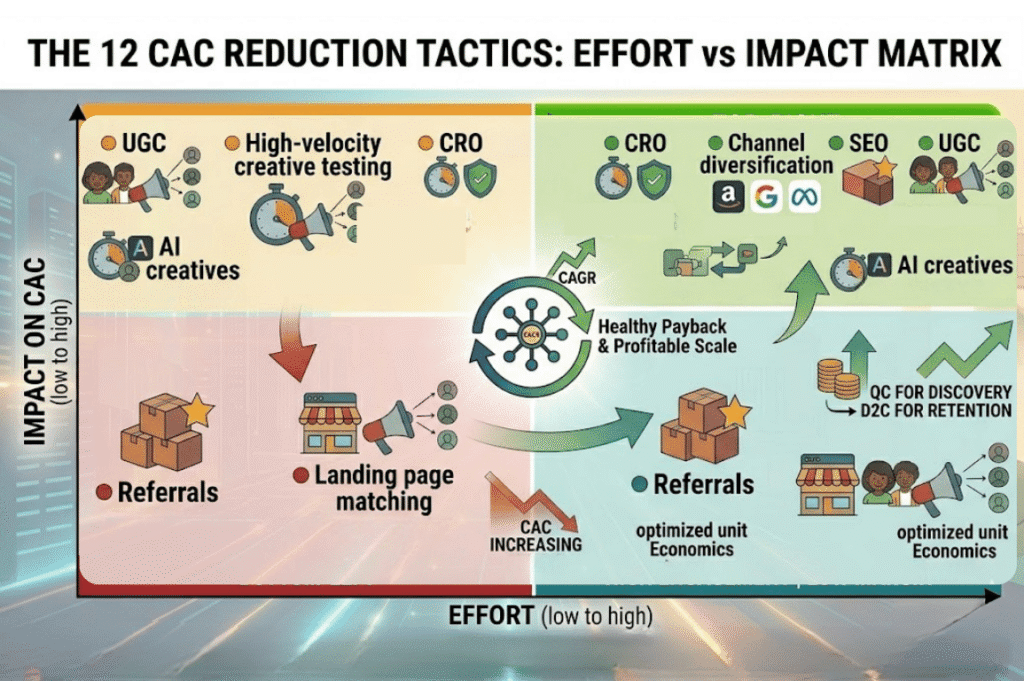
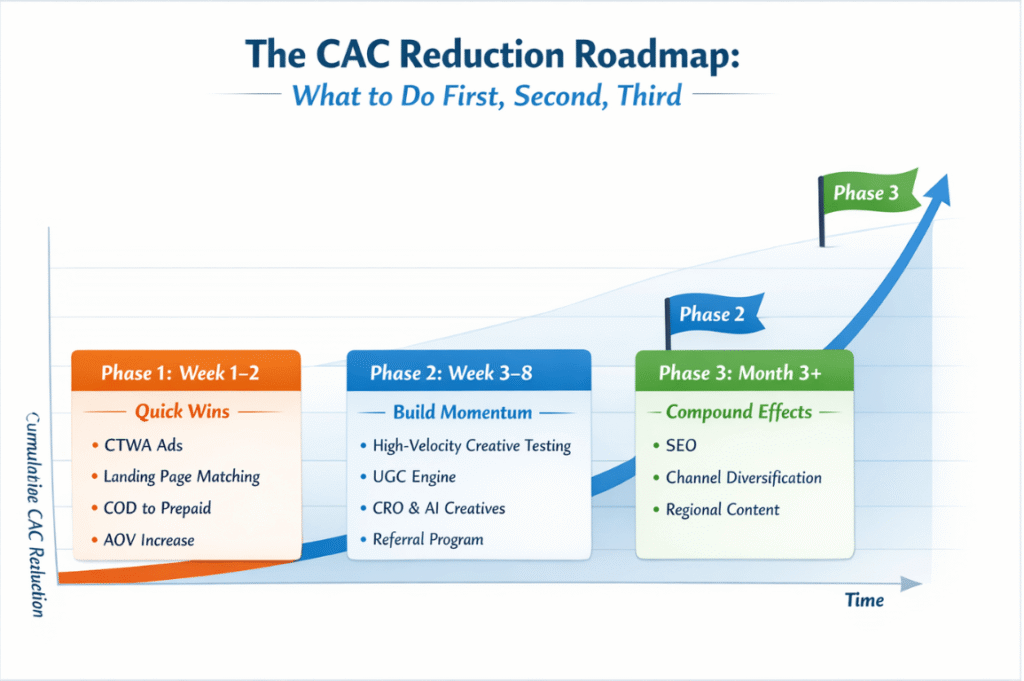
The 12 Tactics Ranked: Estimated CAC Reduction and Effort Level
| Tactic | Est. CAC Reduction | Effort | Time to Impact |
| 1. High-velocity creative testing | 20–35% | Medium | 1–2 weeks |
| 2. Website CRO (speed, checkout, trust) | 20–30% | Medium | 2–4 weeks |
| 3. UGC as ad creative | 30–40% | Low | 2–3 weeks |
| 4. Click-to-WhatsApp ads | 25–40% | Low | 1 week |
| 5. Landing page matching | 15–25% | Low | 1 week |
| 6. COD-to-prepaid conversion | 10–20% effective | Low | 1–2 weeks |
| 7. SEO and content marketing | 50–70% long-term | High | 6–12 months |
| 8. Referral programs | 40–60% on referred | Medium | 1 month |
| 9. AOV increase (bundles, thresholds) | 15–25% effective | Low | 1–2 weeks |
| 10. AI-generated creatives | 25–40% | Medium | 2–4 weeks |
| 11. Channel diversification | 20–30% blended | High | 1–3 months |
| 12. Regional/vernacular content | 30–50% in tier-2/3 | Medium | 2–4 weeks |
Key Takeaways
- Creative testing is the fastest way to reduce CAC for D2C brands. Test 20–50 variants per month instead of 3–5. Kill losers in 48 hours. Scale winners. Refresh weekly.
- CRO is the cheapest lever. A 1% conversion rate increase reduces CAC by 20–30%. Fix speed, checkout, trust signals, and UPI-first payment before spending more on ads.
- UGC outperforms studio content by 30–40%. Build a post-purchase UGC collection engine. Use real customer videos as your primary ad creative.
- WhatsApp is India’s most powerful CAC reduction channel. CTWA ads, abandoned cart recovery, COD-to-prepaid conversion, and referral nudges all live on WhatsApp.
- SEO is the long game that wins. Organic traffic has zero marginal CAC. Start investing in content and GEO today. The payoff comes in 6–12 months and compounds from there.
- AI makes volume testing affordable. Generate regional-language ad creatives, automated video ads, and review-based scripts at a fraction of manual cost.
- Diversify or die. Brands with less than 50% Meta/Google dependency show 23% better unit economics. Add YouTube Shorts, Pinterest, marketplace ads, and organic social.
Frequently Asked Questions About How to Reduce CAC
What is the fastest way to reduce CAC for a D2C brand?
The fastest tactics are high-velocity creative testing (test 20–50 ad variants per month), Click-to-WhatsApp ads (2–3x higher conversion than website landing pages), and landing page matching (15–25% conversion improvement). These can show results within one to two weeks with minimal investment.
How much can CRO reduce my D2C CAC?
A 1% improvement in website conversion rate can reduce effective CAC by 20–30%. Focus on page speed (under 2.5 seconds), mobile-first checkout, trust signals above the fold, UPI as default payment, and simplified guest checkout.
Does UGC actually lower CAC compared to studio ads?
Yes. UGC ads deliver 30–40% lower cost-per-acquisition than polished studio content. Raw testimonial videos perform about 40% better in feed environments because they look like organic content, not advertising. Build a UGC collection system into your post-purchase WhatsApp flow.
How long does SEO take to reduce CAC for D2C brands?
SEO typically takes 6–12 months to show meaningful traffic results. But once content ranks, it compounds. Every visitor from organic search has zero marginal CAC. The brands with the lowest blended CAC in India today are the ones that started SEO 12–18 months ago.
What is Click-to-WhatsApp advertising and how does it reduce CAC?
Click-to-WhatsApp (CTWA) ads on Meta send users directly into a WhatsApp conversation instead of a website. This eliminates landing page drop-offs, captures the phone number instantly, and allows AI chatbots to qualify and convert the lead in a familiar interface. D2C brands report 2–3x higher conversion rates from CTWA compared to traditional website traffic campaigns.it ut integer non vestibulum eros, diam in in et hac mauris maecenas sed sapien fermentum et eu.