Customer Acquisition Strategies for D2C Brands in India: The Complete Playbook
10 Proven Strategies to Acquire Customers Profitably — From Paid Ads and Influencers to SEO, Referrals, and the Guerrilla Tactics Nobody Talks About
Customer acquisition is the biggest cost centre for most D2C brands in India. It is also the most misunderstood. Founders pour money into Meta and Google ads. They celebrate ROAS numbers that look good on a dashboard. Then they check their bank balance and wonder where the profit went. The problem is not that customer acquisition strategies for D2C brands do not work. The problem is that most brands rely on only one or two channels — and the moment those channels get expensive, the entire growth engine stalls.
In 2026, the landscape has changed. Ad costs on Meta and Google have risen roughly 30% year-on-year in competitive D2C categories. iOS privacy changes have added 20–25% to customer acquisition costs. India has over 800 funded D2C brands, all fighting for the same eyeballs. The brands that win are not the ones that spend the most. They are the ones with the smartest, most diversified customer acquisition strategies.
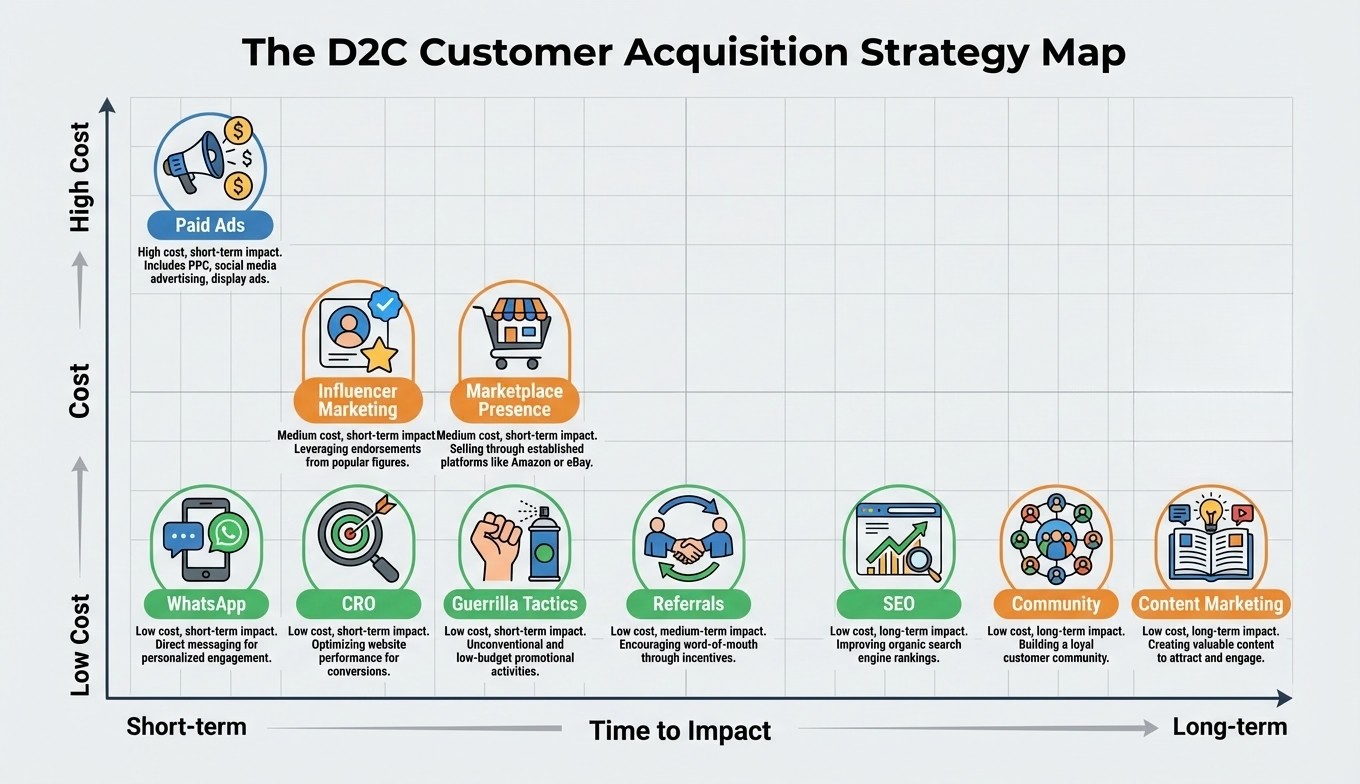
This guide gives you the complete playbook. Ten proven customer acquisition strategies for D2C brands in India — from paid ads and influencer marketing to SEO, referrals, WhatsApp, community building, and the guerrilla tactics that nobody talks about. With real examples, real numbers, and a framework to decide which strategies fit your stage, category, and budget.
Why Customer Acquisition Costs Are Rising for D2C Brands in India
Before we dive into strategies, let us understand the problem. Customer acquisition strategies for D2C brands need to solve for a market where acquiring customers is getting harder and more expensive every year.
Here is what is happening:
- Meta and Google CPMs are up 30% year-on-year in competitive categories like beauty, fashion, and wellness. The same ad budget buys fewer customers every quarter.
- iOS privacy changes (App Tracking Transparency) have made ad targeting less precise. Brands report 20–25% higher CAC since the change. Attribution is harder. Optimisation is muddier.
- Market saturation. India has over 800 funded D2C brands. In beauty and personal care alone, dozens of brands bid for the same audience. More competition means higher auction prices.
- Discount dependency. Many brands use heavy first-purchase discounts (30–50% off) to drive orders. This inflates CAC and attracts deal-hunters who never come back.
- Platform concentration risk. Brands that get 70–80% of customers from Meta and Google are one algorithm change away from a revenue hit. Diversification is not optional any more.
The solution is not to spend more. It is to spend smarter and build more channels. The best customer acquisition strategies for D2C brands combine paid, organic, owned, and earned channels into a balanced mix that reduces dependence on any single platform.
Brands that reduce Meta/Google dependency to under 50% of their acquisition mix show 23% better unit economics. The goal is not to abandon paid ads. It is to surround them with channels that compound over time.
[Internal link: Read CAC vs LTV: The Unit Economics Deep Dive for D2C Brands for the full measurement framework]
Strategy 1: Performance Marketing — The Foundation of D2C Customer Acquisition
Let us start with the obvious. Paid ads on Meta (Instagram and Facebook) and Google are still the primary customer acquisition channel for most D2C brands in India. And they still work — if you do them right.
Meta Ads: Where D2C Discovery Happens
Instagram is where Indian consumers discover new brands. Reels, Stories, and feed ads drive awareness and first clicks. For beauty, fashion, and lifestyle D2C brands, Meta is the single most important paid channel. The key is creative quality. In a feed crowded with ads, your creative has three seconds to stop the scroll. The brands that win on Meta are the ones that test 20–30 ad creatives per month, kill the losers fast, and scale the winners. A/B test everything: headlines, images, offers, landing pages and audiences.
Google Ads: Capturing High-Intent Buyers
Google Search and Shopping ads capture customers who are already looking for a product. When someone searches “best vitamin C serum India” or “wireless earbuds under 2000,” they have buying intent. Google puts your brand in front of them at the exact moment of intent. For categories with strong search demand (electronics, health supplements, home products), Google is often more efficient than Meta. The CAC is lower because the customer is already looking.
The Performance Marketing Rules That Matter
- Start small, prove profitability, then scale. A profitable Rs 50,000/month spend is better than a loss-making Rs 5 lakh/month spend.
- Track contribution margin, not ROAS. A 3x ROAS can still lose money after COGS, shipping, and returns. CM2 is the real profitability metric. (checkout what CM2 means here)
- Diversify platforms. Test YouTube Shorts, Pinterest, and marketplace ads alongside Meta and Google. Do not put all your budget on one platform.
Strategy 2: Influencer and Creator Marketing — The Highest-ROI Customer Acquisition Channel
One of the customer acquisition strategies for D2C brands that has consistently outperformed traditional ads in India, it is influencer marketing. Creator partnerships deliver 30–40% lower cost-per-lead than traditional ads. And 43% of Indian shoppers say they are influenced by content from creators. This is not a nice-to-have. It is a core acquisition channel.
Micro-Influencers Beat Celebrities
The biggest mistake brands make is signing one expensive celebrity. The smarter move: work with 50–100 micro-influencers (10,000–100,000 followers) who have real engagement with a niche audience. A college student recommending earphones feels more authentic than a Bollywood star reading a script. And the cost per acquisition is a fraction.
How the Best D2C Brands Use Influencers
- boAt built its brand through hundreds of creators — from cricketers to gym-goers to gamers. Influencer marketing is in boAt’s DNA, not a bolt-on.
- Mamaearth partnered with 500+ bloggers and micro-influencers, focusing on educational content about ingredient safety.
- Sugar Cosmetics built a massive Instagram community through tutorials, user-generated content, and creator collaborations.
The key insight: repurpose influencer content as paid ad creative. User-generated content (UGC) from creators often outperforms brand-produced ads. Run it as paid media and you get the best of both worlds: authenticity at scale.
[Internal link: Read Key Characteristics of Successful D2C Brands in India for how top brands build content and community]
Strategy 3: SEO and Content Marketing — The Long-Term Customer Acquisition Engine
SEO is the single most effective of the long-term customer acquisition strategies for D2C brands. Why? Because organic traffic has zero marginal cost. Once you rank for a keyword, every visitor is free. Brands that invest in SEO and content marketing reduce their dependence on paid ads over time. This is the shift from rented attention (paid ads) to owned attention (organic traffic). It takes 6–12 months to see results. But the compounding effect is enormous.
What to Write About
- Buying guides: “Best vitamin C serums in India 2025”
- Comparison content: “boAt vs JBL: Which earbuds are better for you?”
- Educational content: “How to read a skincare ingredient label”
- Problem-solution content: “How to fix back pain from a bad mattress”
This type of content attracts customers who are researching before buying. They find your brand through Google, trust your expertise, and convert into buyers. Minimalist and Wakefit both built significant organic traffic through content that ranks for category keywords.
Strategy 4: WhatsApp Marketing — India’s Most Underused Customer Acquisition Channel
This is one of the most underrated Customer Acquisition Strategies as WhatsApp has 500+ million users in India. Open rates are above 90% and Click-through rates are 5–10x higher than email. And yet most D2C brands barely use it for customer acquisition.
Here is how smart D2C brands use WhatsApp as a customer acquisition strategy:
- COD-to-prepaid conversion. After a COD order is placed, send a WhatsApp message offering a small discount if the customer pays online. This reduces return rates by 10–20% and improves effective CAC.
- Abandoned cart recovery. A WhatsApp reminder within an hour of cart abandonment converts at 2–3x the rate of email reminders.
- Referral nudges. After a successful delivery, send a WhatsApp message with a referral code. Make sharing effortless with one tap to share with friends.
- Flash sale alerts. Send exclusive early access to WhatsApp subscribers. Create urgency to drive repeat purchases.
Tools like Interakt and Wati make WhatsApp Business API accessible to D2C brands of all sizes. In the Indian D2C context, WhatsApp is not just a retention channel. It is a powerful acquisition and conversion channel.
Strategy 5: Referral Programs — Acquiring Customers at Near-Zero Cost
Referred customers cost almost nothing to acquire which makes this one of the best Customer Acquisition Strategies. They have higher trust (a friend recommended the brand), higher conversion rates, and typically higher LTV than ad-acquired customers. A well-designed referral program can reduce blended CAC by 40–60%. The formula is simple: give Rs 100, get Rs 100. The referrer gets a reward and the new customer gets a discount. Both sides win.
The keys to a successful D2C referral program:
- Make sharing frictionless. One-tap sharing via WhatsApp, not complicated referral codes.
- Reward both the referrer and the referred. One-sided programs underperform.
- Trigger the referral ask at the right moment — right after a successful delivery when satisfaction is highest.
- Track referral CAC separately. It should be your lowest-cost channel.
Strategy 6: Community Building — Turning Customers into Advocates
The most powerful customer acquisition strategies for D2C brands are the ones where customers acquire other customers. Community building makes this happen. boAt calls its customers “boAtheads.” It is not just a name, it’s a tribe. Over 2 crore customers identify with that community. They share boAt content, recommend products to friends, and defend the brand on social media. That is free acquisition at scale.
How to build community as a D2C brand:
- Create a branded identity your customers want to be part of.
- Build an active WhatsApp group or Instagram community for your top buyers.
- Encourage and amplify user-generated content. Repost customer photos and also feature their reviews.
- Run exclusive member-only launches and early access events.
Community is a long-term play. It does not reduce CAC in month one. But by month twelve, a strong community can become your single biggest source of organic, word-of-mouth acquisition.
Strategy 7: Conversion Rate Optimisation — Getting More Customers Without Spending More
Here is a fact most founders overlook: a 1% increase in conversion rate can lower your effective CAC by 20–30%. You do not need more traffic, you need more of the traffic you already have to convert. Conversion rate optimisation (CRO) is the most capital-efficient of the Customer Acquisition Strategies for D2C brands. Here is where to focus:
- Speed. A one-second delay in page load reduces conversions by 7%. Optimise for mobile. India’s internet is still largely 4G.
- Videos. In the Insta-ready world, educate your customers, about your products with the help of byte-sized videos. You can also use ReelV for this.
- Trust signals. Reviews, ratings, badges (MadeSafe, Dermat-tested), and “As seen on Shark Tank India” all reduce purchase anxiety.
- UPI-first checkout. UPI is the cheapest and fastest payment method. Make it the default to reduce payment failures and also reduce drop-offs.
- Free shipping thresholds. Instead of free shipping on every order, set a minimum order value. This increases AOV and protects margins while still reducing checkout friction.
- Simplified checkout. Every extra step loses customers. Guest checkout. Auto-fill addresses. One-page checkout. Remove every unnecessary field.
Strategy 8: Marketplace Presence — Borrowing Traffic You Cannot Build Alone
Amazon, Flipkart, Myntra, Nykaa — these platforms have hundreds of millions of active shoppers. The traffic is already there, you just need to show up. Many D2C brands treat marketplaces as the enemy which is a mistake. The smartest D2C brands use marketplaces for discovery and volume while using their own website for margin and data. This is these blended methods that make the customer acquisition strategies works for D2C Brands.
Marketplace-specific customer acquisition tactics:
- Invest in marketplace ads (Amazon Sponsored Products, Flipkart Product Ads). They capture high-intent shoppers.
- Optimise product listings: titles, images, bullet points, and A+ content for search.
- Use marketplace sales to build reviews and social proof. Then redirect organic customers to your own website.
- Track unit economics separately for marketplace and D2C. Know where you make money and where you lose it.
[Internal link: Read D2C vs Marketplace vs Omnichannel: Which Model Wins in India? for the full channel strategy]
Strategy 9: Guerrilla Marketing — The Customer Acquisition Tactic Nobody Talks About
Most blogs about customer acquisition strategies for D2C brands cover ads, SEO, and influencers. Few talk about guerrilla marketing. But some of the most memorable customer acquisition moments in Indian D2C came from bold, unconventional tactics that cost almost nothing compared to their impact.
The Wakefit Sleep Internship: A Masterclass in Guerrilla Customer Acquisition
In 2019, Wakefit — the D2C mattress brand — launched a campaign called the Sleep Internship. The concept was simple and outrageous: Wakefit would pay people Rs 1 lakh to sleep – for 100 nights – on a Wakefit mattress. The “interns” in-turn (pun intended) had to track their sleep data, share their experience on social media, and report on how the mattress affected their sleep quality. Wakefit received over 1.5 lakh applications. The story was covered by major media outlets across India. Social media exploded with conversations about the campaign.
The genius of the Sleep Internship was that it solved three customer acquisition problems at once:
- Awareness at near-zero media cost. The campaign went viral. News coverage and social media buzz replaced the need for millions in paid ads. Wakefit’s brand awareness surged overnight.
- Product trial built into the campaign. Every “intern” was essentially a 100-day product reviewer. Their real, documented experience was more convincing than any ad creative. And their social posts became user-generated content that Wakefit could repurpose.
- Data collection. The 1.5 lakh applications gave Wakefit a massive database of high-intent potential customers. These were people who were actively interested in sleep products. That database became a retargeting goldmine.
The total cost? A handful of stipends and a few mattresses. The total impact? Millions in earned media, hundreds of thousands of qualified leads, and a permanent place in the minds of Indian consumers as the brand that takes sleep seriously.
The Wakefit Sleep Internship is the best example of guerrilla customer acquisition in Indian D2C. It proves that the most effective campaigns are not always the most expensive. Sometimes, a bold idea that makes people talk is worth more than a crore in ad spend. The question every D2C founder should ask: what is my Sleep Internship moment?
Strategy 10: Retention as an Acquisition Strategy — Because Your Best Customers Bring More
This is the strategy that separates good D2C brands from great ones. Retention is not just about keeping customers. It is about using existing customers to acquire new ones. Here is how retention feeds acquisition:
- Repeat customers reduce blended CAC. If you acquire a customer for Rs 500 and they buy three times, your effective CAC per order drops to Rs 167. Repeat purchases are the cheapest form of acquisition.
- Happy customers refer friends. A customer who has a great experience becomes a marketing channel. Word of mouth is free and more trusted than any ad.
- Reviews and ratings drive conversion. Every positive review from an existing customer lowers the CAC for the next customer. Social proof compounds.
- Email and WhatsApp automation keep the flywheel spinning. Welcome flows, abandoned cart recovery, post-purchase follow-ups, and reorder reminders — all automated, all cheap, all effective.
The key metric: repeat purchase rate. A strong D2C brand should aim for 30–40% of revenue from repeat customers within 90 days. The higher this number, the lower your blended CAC and the more sustainable your growth. It is the effectiveness that makes this one of the best customer acquisition strategies for any D2C Brand.
[Internal link: Read Understanding Unit Economics for D2C Brands in India for how retention improves the full cost stack]
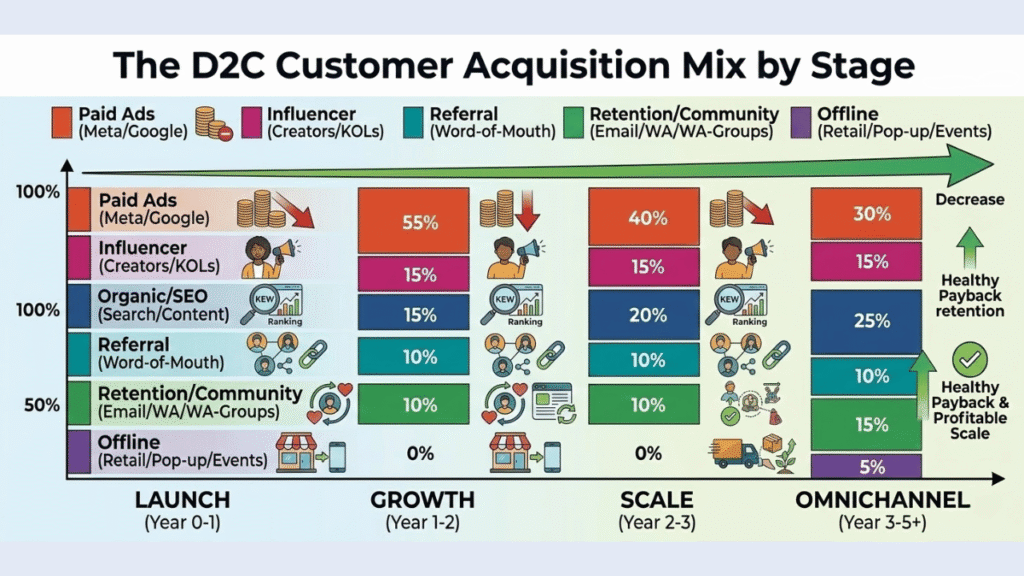
The Customer Acquisition Mix: How to Balance Channels by Stage
Not all customer acquisition strategies for D2C brands are right at every stage. Here is a framework for matching strategy to stage (according to us):
| Stage | Primary Channels | Budget Split |
| Launch (0–Rs 50L revenue) | Meta Ads, micro-influencers, marketplace listing, WhatsApp | 70% paid, 20% influencer, 10% organic |
| Growth (Rs 50L–Rs 5Cr) | Meta + Google Ads, influencer scale, SEO start, referral program, CRO | 50% paid, 25% influencer, 15% organic/SEO, 10% referral |
| Scale (Rs 5Cr–Rs 50Cr) | Diversified paid, SEO + content, community, WhatsApp automation, marketplace ads | 40% paid, 20% organic/SEO, 20% influencer, 10% referral, 10% retention |
| Omnichannel (Rs 50Cr+) | All channels. Offline adds free walk-in traffic. Brand marketing reduces paid dependency. | 30% paid, 25% organic, 20% offline, 15% retention, 10% brand |
The pattern is clear: as brands scale, the paid percentage drops and owned, earned, and organic channels grow. The best D2C brands in India operate at 30–40% paid acquisition. The struggling ones are stuck at 70–80%.
Key Takeaways
- Customer acquisition strategies for D2C brands must be diversified. Dependence on one channel is a risk. The best brands combine paid, organic, influencer, referral, and community channels.
- CAC is rising. Meta and Google costs up 30% YoY. iOS privacy changes added 20–25%. Diversification is survival.
- Influencer marketing delivers the highest ROI. Creator partnerships produce 30–40% lower CPL than traditional ads. Micro-influencers beat celebrities.
- SEO is the best long-term CAC reducer. Organic traffic is free. It compounds. Start today.
- WhatsApp is India’s most underused acquisition channel. 90%+ open rates. 5–10x email CTR. Use it for COD conversion, abandoned carts, referrals, and flash sales.
- Retention drives acquisition. Repeat customers reduce blended CAC. Happy customers refer friends. Reviews lower acquisition cost for the next buyer.
- Think in stages. At launch, 70% paid is fine. At scale, aim for 30–40% paid. The rest should be owned and earned.
Frequently Asked Questions
Latest Posts
- Marmeto, India’s First Shopify Premier Partner, Pivots From Services to Product-First Technology Company
- L’Oréal in Talks to Acquire D2C Beauty Startup Innovist
- Anveshan and the Rs 1,000 Crore Farm-to-Fork Valuation Leap
- Assiduus Global Raises $25 Million to Scale AI-Powered Middleware for Cross-Border D2C Commerce
- The Budget Split That Separates Brands That Scale from Brands That Stall