
Shopify vs WooCommerce for Indian D2C Brands: Which Platform Should You Pick in 2026?
A No-Nonsense Comparison on Cost, Payments, Shipping, SEO, App Ecosystem, and Scalability for Indian Founders.
Every Indian D2C founder hits this question within the first week of starting a brand. Shopify or WooCommerce? The internet is full of generic comparisons written for American audiences. Most of them are useless for an Indian founder dealing with Razorpay, COD, Shiprocket, GST invoicing, and WhatsApp marketing. This is the Shopify vs WooCommerce India comparison that actually matters.
Written for D2C founders. Priced in rupees. Focused on the factors that affect your business here: Indian payment gateways, local shipping integrations, total cost of ownership in INR, SEO for Indian search, and the app ecosystem that powers Indian D2C.
The short answer: Shopify wins for most Indian D2C brands. It is faster to launch, easier to operate, and has a deeper ecosystem of India-specific apps. WooCommerce wins for brands that need deep customisation, have a developer on the team, or want to combine heavy content marketing with commerce.
The long answer takes about 4,500 words. Here it is.
Shopify vs WooCommerce India: What Are They, Actually?
Shopify is a hosted platform. You pay a monthly subscription. Shopify handles the servers, security, uptime, and software updates. You focus on your products, marketing, and customers. Think of it as renting a fully furnished office. You walk in and start working.
WooCommerce is an open-source plugin that sits on top of WordPress. You install it on your own hosting. You manage the server, security updates, plugin compatibility, and backups. Think of it as buying land and building your own office. You own everything, but you are responsible for everything too.
Globally, WooCommerce powers about 36% of all ecommerce sites. Shopify powers about 28%. But in the Indian D2C ecosystem, Shopify is dominant. The vast majority of funded Indian D2C brands (boAt, Mamaearth, Minimalist, Sugar, Lenskart, The Whole Truth, Country Delight) run on Shopify. WooCommerce is more popular with bootstrapped brands, content-heavy businesses, and brands that started as WordPress blogs before adding commerce.
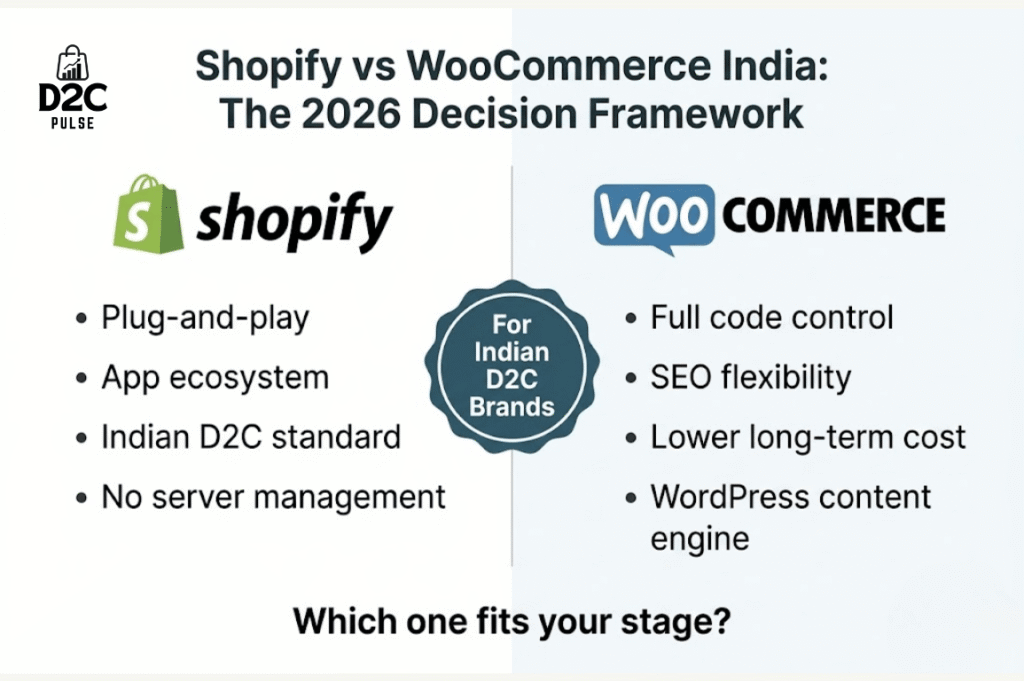
The Real Cost of Shopify vs WooCommerce in India: A Rupee-by-Rupee Breakdown
This is the section where most comparisons get it wrong. They compare Shopify’s subscription price to WooCommerce’s “free” price. That is misleading. WooCommerce is free to install. It is not free to run. Let us break down the actual cost for an Indian D2C brand.
| Cost Component | Shopify (Basic Plan) | WooCommerce |
| Platform / Subscription | Rs 1,499–1,994/month | Free (open-source plugin) |
| Hosting | Included in subscription | Rs 500–5,000/month (shared to cloud) |
| SSL Certificate | Included | Free (Let’s Encrypt) or Rs 1,000–5,000/year |
| Theme / Design | 12+ free themes. Premium: Rs 10,000–20,000 one-time | Thousands of free themes. Premium: Rs 3,000–15,000 one-time |
| Payment Gateway Fee (Razorpay) | 2.36% + Shopify’s 2% third-party fee = 4.36% per transaction | 2.36% only. No extra platform fee. |
| Apps / Plugins (monthly) | Rs 3,000–15,000/month (typical: Rs 5,000) | Rs 0–10,000/month (many free plugins) |
| Developer / Maintenance | Rarely needed. Rs 0–5,000/month | Rs 3,000–15,000/month for updates, security, fixes |
| GST on Subscription (18%) | Rs 270–359/month | On hosting only: Rs 90–900/month |
| Estimated Year-1 Total (Rs 10L/mo revenue) | Rs 1.2–2.5 lakh/year | Rs 0.8–2.0 lakh/year |
The hidden cost killer for Shopify in India: Shopify Payments is not available in India. That means every Indian Shopify store must use a third-party gateway like Razorpay. And Shopify charges an extra 2% on top of the gateway’s own fees.
So WooCommerce is cheaper? Not always. The cost shifts once you factor in developer time. WooCommerce requires someone to manage hosting, update plugins, fix conflicts, patch security holes, and handle performance issues. If you pay a developer Rs 10,000–15,000 per month for this, the cost difference shrinks fast. Shopify handles all of that for you.
[Internal link: Read Understanding Unit Economics for D2C Brands in India for how platform costs fit into the full P&L waterfall]
Payments and Checkout: The India-Specific Shopify vs WooCommerce Comparison
This is the single biggest differentiator in the Shopify vs WooCommerce India debate. And it goes against Shopify.
Shopify Payments, Shopify’s own payment processor, is not available in India. Every Indian Shopify store must use a third-party gateway. The most popular choices are Razorpay, GoKwik, and ShopFlo. But Shopify charges an additional 0.5–2% transaction fee for using any third-party gateway. This fee is on top of the gateway’s own processing fee.
WooCommerce has no such fee. You integrate Razorpay, Cashfree, PayU, or any gateway you want. The only fee is the gateway’s own processing charge (typically 2–2.36%). There is no platform-level surcharge.
On the checkout experience side, Shopify has an edge. GoKwik, ShopFlo, and Razorpay Magic Checkout all have deep Shopify integrations with one-click checkout, COD-to-prepaid nudges, address pre-fill, and RTO reduction. These integrations are more mature on Shopify than on WooCommerce.
For COD management (still a large share of Indian D2C orders), Shopify’s app ecosystem is stronger. GoKwik alone claims up to 40% RTO reduction through its smart COD verification. WooCommerce has COD plugins, but the integration depth and automation are not at the same level.
| Payment Factor | Shopify | WooCommerce |
| Razorpay integration | Yes. +2% Shopify fee (Basic) | Yes. No extra fee. |
| GoKwik / ShopFlo | Deep integration. One-click checkout. | Limited. Basic plugin only. |
| COD management | Strong. Multiple apps. | Basic plugins. Less automation. |
| UPI / Wallets / EMI | Via Razorpay / PayU / Cashfree | Via Razorpay / PayU / Cashfree |
| Transaction fee (platform) | 0.5–2% extra | None |
Verdict: WooCommerce wins on cost. Shopify wins on checkout experience and COD tooling. For brands doing Rs 20 lakh+ monthly revenue, the Shopify transaction fee becomes a serious cost. Upgrading to the Grow plan (Rs 5,599/month) or Advanced (Rs 22,680/month) reduces this fee and may be worth it.
Shipping and Logistics: Shopify vs WooCommerce India for D2C Fulfilment
Indian D2C shipping is complex. Multiple courier partners. PIN code coverage gaps. COD reconciliation. RTO management. NDR handling. Both platforms can handle it, but the depth differs.
Shopify’s advantage is Shiprocket. Shiprocket’s Shopify app is best-in-class. One-click integration. Automatic order sync. Courier recommendation engine across 17+ partners. Bulk label generation. Real-time tracking updates. Delhivery, Blue Dart, XpressBees, and Shadowfax all plug in smoothly.
WooCommerce has Shiprocket integration too, but through a WooCommerce plugin that requires more manual configuration. It works, but it is not as polished or automated as the Shopify version. For smaller brands, the difference is minor. For brands doing 500+ orders a day, the Shopify integration saves real operational time.
Verdict: Shopify wins. The shipping and logistics app ecosystem for Indian D2C is deeper and more automated on Shopify.
SEO: Where WooCommerce Beats Shopify for Indian D2C Brands
This is WooCommerce’s strongest card. If your growth strategy depends on organic search and content marketing, WooCommerce gives you more control.
WooCommerce sits on WordPress, which is the most SEO-friendly content management system on the planet. You get full control over URL structures, category hierarchies, metadata, schema markup, and site architecture. Plugins like Yoast SEO and RankMath give granular control over every page. You can create buying guides, comparison content, educational articles, and long-form content that ranks on Google and gets cited by AI search engines.
Shopify’s SEO has improved a lot. But it still has structural limitations. Shopify forces a /products/ and /collections/ URL structure that you cannot change. Its blogging engine is basic compared to WordPress. Creating the kind of deep, content-rich pages that rank for category keywords is harder on Shopify.
For a D2C brand like Wakefit, which built a massive content engine around sleep education and mattress buying guides, WooCommerce (or WordPress with WooCommerce) would be the natural fit. For a brand like boAt, where the primary growth engine is paid ads and marketplaces, Shopify’s SEO limitations barely matter.
| SEO Factor | Shopify | WooCommerce |
| URL control | Fixed structure (/products/, /collections/) | Full control. Any structure. |
| Blogging | Basic. Limited formatting. | Full WordPress CMS. Best-in-class. |
| Schema markup | Via apps (paid) | Free plugins (Yoast, RankMath) |
| Page speed | Fast (hosted CDN) | Depends on hosting quality |
| GEO / AI search | Limited content tools | Deep content = better for AI citations |
Verdict: WooCommerce wins on SEO. If content and organic search are core to your strategy, WooCommerce gives you a structural advantage that Shopify cannot match.
[Internal link: Read How to Reduce CAC for D2C Brands for why SEO and GEO are the highest-ROI channels in 2026]
The App Ecosystem: Shopify vs WooCommerce India for D2C Tools
Shopify’s app store is more curated. Apps are vetted for quality and performance. The Indian D2C-specific app ecosystem on Shopify is deep: ReelV for shoppable videos, GoKwik and ShopFlo for checkout, Shiprocket and Delhivery for shipping, Interakt for WhatsApp, Klaviyo and WebEngage for retention, Judge.me for reviews, Nector and Smile.io for loyalty. These apps talk to each other. The integrations are tested. The ecosystem works as a system, not a collection of independent tools.
WooCommerce’s plugin library is larger (thousands of plugins), but quality varies wildly. A free plugin might break after a WordPress update. Two plugins might conflict with each other. Security vulnerabilities in one plugin can expose your entire store. This is the trade-off for flexibility: you get more options, but you also get more risk.
Shopify also launched AI-native features in 2025–2026 (Shopify Magic) that cover product descriptions, email campaigns, customer segmentation, and even agentic storefronts that sell products directly inside ChatGPT, Gemini, and Perplexity. WooCommerce can add similar AI features via third-party plugins, but the integration is fragmented.
Verdict: Shopify wins for Indian D2C brands. The app ecosystem is deeper, more integrated, and more India-specific.
[Internal link: Read Best Shopify Apps for Indian D2C Brands for the full 15-app stack]
Ease of Use and Speed to Launch
Shopify wins this category outright. A non-technical founder can launch a Shopify store in a few hours. Pick a theme. Add products. Connect Razorpay. Install Shiprocket. Start selling. No server setup or WordPress installation and also no plugin conflicts.
WooCommerce requires WordPress hosting, WordPress installation, WooCommerce plugin setup, theme configuration, payment gateway integration, shipping plugin configuration, and security hardening. A developer can set it up in a few days. A non-technical founder may struggle for weeks.
For a solo founder with no technical background who wants to launch fast and start selling, Shopify is the answer. For a founder with a developer on the team who wants more control, WooCommerce is viable.
Scalability: Which Platform Grows Better With Indian D2C Brands?
Shopify handles scaling seamlessly. Traffic spikes during Diwali sales? Shopify allocates more server resources automatically. No manual intervention needed and sites don’t crash. No midnight calls to a hosting provider. Shopify’s global CDN delivers content from the nearest server to your customer.
WooCommerce scalability depends entirely on your hosting. A Rs 500/month shared hosting plan will crash during a sale. A Rs 5,000–10,000/month cloud hosting setup (AWS, DigitalOcean, or managed WordPress hosts) handles traffic better, but you need to configure caching, CDN, and server resources yourself.
For Indian D2C brands that run flash sales, influencer drops, or festival campaigns where traffic spikes 5–10x in hours, Shopify’s infrastructure is more reliable out of the box.
Verdict: Shopify wins for brands that expect traffic spikes and want zero infrastructure management. WooCommerce can scale too, but it requires technical investment.
Data Ownership and Vendor Lock-In: The WooCommerce Advantage
When comparing Shopify vs WooCommerce, this is WooCommerce’s other strong card. With WooCommerce, you own everything. Your code, the data, database and even your hosting. If you want to switch hosting providers, you can. If you want to modify any part of the checkout flow, you can. There is no platform that can change the rules on you.
Shopify is a rented platform. Your store lives on Shopify’s servers. If Shopify changes its pricing, you have to pay it. And if Shopify removes a feature, you lose it too. The issue is that if you want to migrate away from Shopify, the process takes 4–12 weeks with careful data mapping, URL redirects, and SEO preservation.
For most D2C brands in the Rs 10–50 lakh monthly revenue range, vendor lock-in is a theoretical risk, not a practical one. Shopify’s ecosystem is so deep that moving away would cost more than staying. But for brands that want long-term ownership and control, WooCommerce provides that peace of mind.
The Full Shopify vs WooCommerce India Comparison Table for D2C Brands
| Factor | Shopify | WooCommerce |
| Monthly cost (India) | Rs 1,499–22,680 + apps + transaction fees | Rs 500–10,000 hosting + plugins |
| Transaction fee (platform) | 0.5–2% on third-party gateways | None |
| Payment gateways | Razorpay, GoKwik, ShopFlo (+Shopify fee) | Razorpay, Cashfree, PayU (no extra fee) |
| Checkout experience | Superior. One-click, COD tools. | Good. Less automation. |
| Shipping | Best-in-class Shiprocket integration | Shiprocket plugin. Less polished. |
| SEO | Good. Fixed URL structure. | Excellent. Full control. |
| Content / Blogging | Basic blog | Full WordPress CMS |
| App ecosystem (India) | Deep. India-specific. Curated. | Larger but fragmented. Quality varies. |
| Ease of use | Non-technical friendly | Needs a developer |
| Speed to launch | Hours to days | Days to weeks |
| Scalability | Automatic. CDN. Zero-downtime. | Depends on hosting. Manual tuning. |
| AI features (2026) | Shopify Magic. Native. Growing. | Third-party plugins. Fragmented. |
| Data ownership | Shopify owns the platform | You own everything |
| GST handling | Built-in GST support | Via plugins |
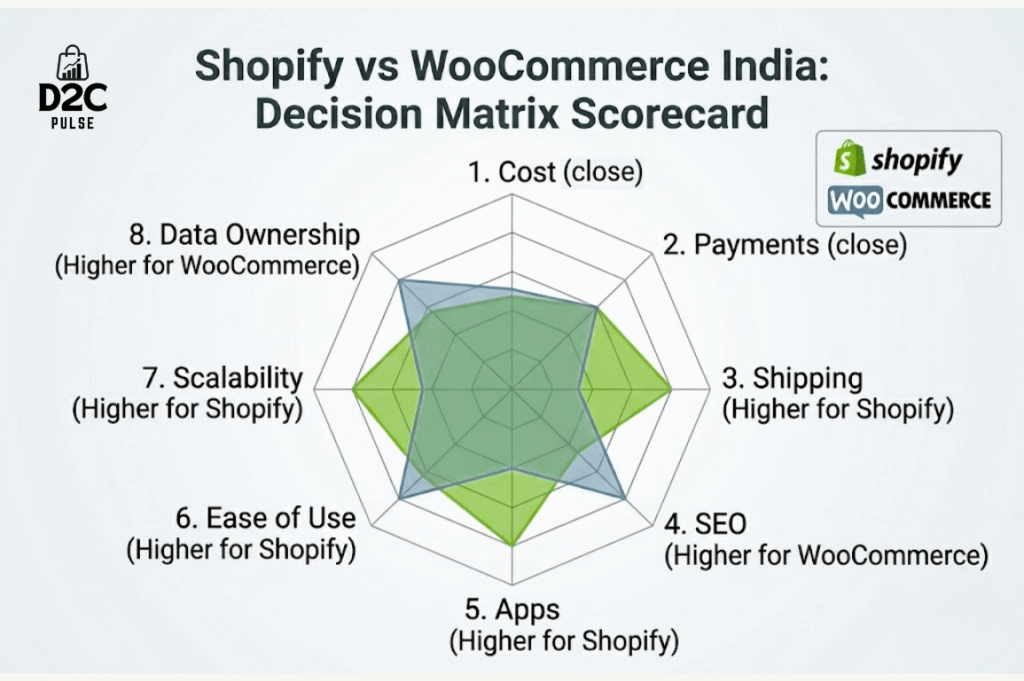
The Decision Framework: Shopify vs WooCommerce India Based on Your Stage
Choose Shopify if:
- You are a non-technical founder launching your first D2C brand
- Speed to market is your priority. You want to start selling in days, not weeks.
- Your primary growth channels are paid ads, influencer marketing, and marketplaces. Not content marketing.
- You want to use the full Indian D2C app ecosystem (GoKwik, ShopFlo, Shiprocket, Interakt, ReelV) with minimal setup.
- There is expectation of traffic spikes during sales events and do not want to manage infrastructure.
- or if you are doing Rs 10 lakh+ monthly revenue and need a reliable, low-maintenance platform.
Choose WooCommerce if:
- You have a developer on the team (or are technical yourself)
- Content marketing and SEO are your primary acquisition strategy. You plan to publish buying guides, comparison articles, and educational content regularly.
- You want to avoid Shopify’s 2% transaction fee on Razorpay payments. At Rs 20–50 lakh monthly revenue, this saves Rs 4–10 lakh per year.
- You need deep customisation of the checkout flow, product pages, or store architecture that Shopify’s templates cannot provide.
- Data ownership matters to you. You want to own your code, your database, and your hosting.
- You already have a WordPress site or blog and want to add commerce to it.
For 80% of Indian D2C brands launching in 2026, Shopify is the right choice. It is faster, easier, and has a deeper Indian ecosystem. WooCommerce is the right choice for the 20% who prioritise SEO, content, customisation, and long-term cost savings. Neither is universally better. The best platform is the one that fits your team, your strategy, and your stage.
What About Dukaan, Wix, and Other Platforms?
Dukaan is a mobile-first Indian platform built for small sellers who want to launch in minutes. It is cheaper than both Shopify and WooCommerce but has limited customisation, fewer apps, and a smaller ecosystem. This may work for solopreneurs and micro-brands but may not work for brands planning to scale past Rs 10 lakh monthly revenue.
Wix and BigCommerce have ecommerce features, but their Indian D2C ecosystem is thin. Very few Indian payment gateways, shipping partners, and retention tools have deep integrations with these platforms. For Indian D2C brands, the practical choice is Shopify or WooCommerce.
Key Takeaways from Shopify vs WooCommerce debate
- Shopify is the default for Indian D2C brands. It is faster to launch, easier to operate, and has the deepest Indian app ecosystem. Most funded D2C brands in India run on Shopify.
- WooCommerce is better for content-led, SEO-heavy brands. If organic search and deep content are your growth engine, WooCommerce on WordPress gives structural advantages Shopify cannot match.
- The Shopify transaction fee is the biggest India-specific disadvantage. Shopify Payments is not available in India. Every Shopify store pays an extra 0.5–2% on Razorpay transactions. At Rs 20 lakh+ monthly revenue, this adds up fast.
- WooCommerce is free to install but not free to run. Hosting, developer maintenance, plugin costs, and security management add up. The total cost difference between platforms narrows at scale.
- Shopify wins on shipping and checkout for India. Shiprocket, GoKwik, ShopFlo, and other India-specific tools have deeper Shopify integrations.
- WooCommerce wins on data ownership. You own your code, your data, and your hosting. No vendor lock-in.
- Choose based on your team and growth strategy. Non-technical founder + paid ads = Shopify. Technical team + content strategy = WooCommerce. Both can scale to crores.
Frequently Asked Questions about Shopify vs WooCommerce
Is Shopify or WooCommerce better for Indian D2C brands?
Shopify is better for most Indian D2C brands because of its ease of use, speed to launch, and deep India-specific app ecosystem (GoKwik, ShopFlo, Shiprocket, Interakt). WooCommerce is better for brands that prioritise SEO, content marketing, deep customisation, and avoiding the Shopify transaction fee on third-party payment gateways.
How much does Shopify cost in India per month?
Shopify Basic costs Rs 1,499–1,994 per month. The Grow plan costs Rs 5,599 per month. The Advanced plan costs Rs 22,680 per month. On top of this, add 18% GST, payment gateway fees, app subscriptions (typically Rs 3,000–15,000/month), and Shopify’s 0.5–2% transaction fee on third-party gateways. Realistic total cost for a Basic plan store is Rs 6,000–15,000 per month.
Can I use Razorpay with both Shopify and WooCommerce?
Yes. Razorpay integrates with both platforms. The difference: on WooCommerce, you pay only Razorpay’s processing fee (around 2.36%). On Shopify, you pay Razorpay’s fee plus Shopify’s additional 0.5–2% third-party transaction fee.
Is WooCommerce really free?
The WooCommerce plugin is free to install. But you need paid hosting (Rs 500–5,000/month), a domain, potentially premium plugins, and developer support for updates and security. Realistic first-year cost for a WooCommerce store is Rs 0.8–2.0 lakh.
Which platform is better for SEO in India?
WooCommerce, because it runs on WordPress. You get full URL control, superior blogging tools, and granular SEO plugins like Yoast and RankMath. Shopify’s SEO is good but has fixed URL structures and a basic blog editor. For brands where organic search and content marketing are primary growth channels, WooCommerce has a structural advantage.