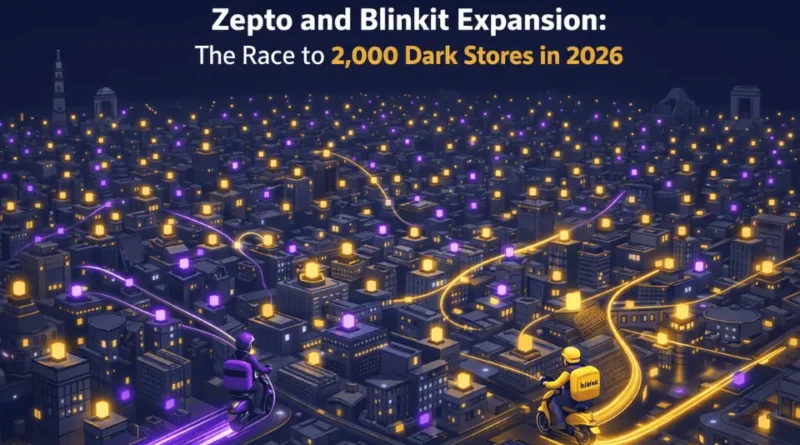
Zepto and Blinkit Expansion: The Race to 2,000 Dark Stores in 2026
Quick commerce leaders Zepto and Blinkit accelerate infrastructure growth. Analyze the unit economics of scaling dark stores and the impact on D2C availability.
The defining theme of the Indian retail landscape in 2026 is no longer just “e-commerce”—it is the absolute dominance of “Quick Commerce.” As of late March, market leaders Zepto and Blinkit have announced plans to collectively add over 2,000 new dark stores by the end of the year. This infrastructure blitz is not just about speed; it is about creating a “Parallel Retail Economy” that threatens to bypass traditional kirana stores and modern trade outlets alike.
The Architecture of Hyper-Growth
To understand the scale of this expansion, one must look at the density required for a 10-minute promise. Blinkit, which recently posted its first-ever EBITDA profit, is using its positive cash flow to aggressively out-build competitors. Zepto, fueled by its recent massive funding rounds, is targeting “micro-markets” within Tier-1 and Tier-2 cities that were previously underserved.
A dark store in 2026 is a sophisticated, data-rich environment. These are no longer simple warehouses; they are high-velocity fulfillment centers where AI predicts inventory needs down to the hour. The surge to 2,000 stores implies a massive investment in real estate and localized supply chains. For these platforms, the goal is “Saturation.” By placing a dark store every 2-3 kilometers in urban India, they reduce the delivery radius to a point where “Last-Mile” costs become structurally lower than traditional courier-based e-commerce.

The Profitability Pivot for Zepto and Blinkit
While the sector was long criticized for “burning cash to deliver milk,” the recent profitability metrics from Blinkit have changed the narrative. The “Quick Commerce” model is proving that high frequency (customers ordering 3-4 times a week) and increasing Average Order Values (AOV) as categories expand into electronics and beauty can lead to sustainable unit economics. The current expansion is a “Land Grab” to ensure that once the market matures, these two giants own the most valuable real estate in the digital economy.
Implications for Indian D2C Founders and Marketers
For D2C founders, this news signals the “Death of the 3-Day Delivery Standard.” If your product category is available on Zepto or Blinkit, that is where your customer will buy it. Founders must now treat “Quick Commerce Listing” as a higher priority than their own website for impulse-driven SKUs. For marketers, this expansion offers a “Hyper-Local Sampling” opportunity. With 2,000 new stores, you can run geo-fenced campaigns that offer 10-minute delivery to very specific high-income neighborhoods. The takeaway for 2026: Distribution is no longer a logistics problem; it is a marketing advantage. If you aren’t “Quick-Commerce Ready,” you are effectively conceding the urban Indian consumer to your competitors.