How D2C is Different from Traditional Retail in India
A Clear, Side-by-Side Comparison for Founders, Operators, and Brand Builders
For decades, Indian brands followed one path to reach customers. They made products. Handed them to distributors. Who passed them to wholesalers. Who stocked them in retail shops. The customer picked up whatever was on the shelf. That model still works. But a new one has arrived. And it is changing everything. Here we would see how we can compare D2C vs traditional retail.
D2C — Direct-to-Consumer — is a model where brands sell straight to customers. No middlemen, No distributors, No retailers sitting between the brand and the buyer. The brand owns the product, the store, the data, and the relationship.
If you are building a brand, running one, or investing in one, you need to understand how D2C is different from traditional retail. Not in theory. In practice. In the Indian market.
Today we will try to give you a clear, side-by-side comparison. Here we cover about distribution, margins, data, speed, reach, and more. With real examples from Indian brands that are doing this right.
The Core Difference Between D2C vs Traditional Retail
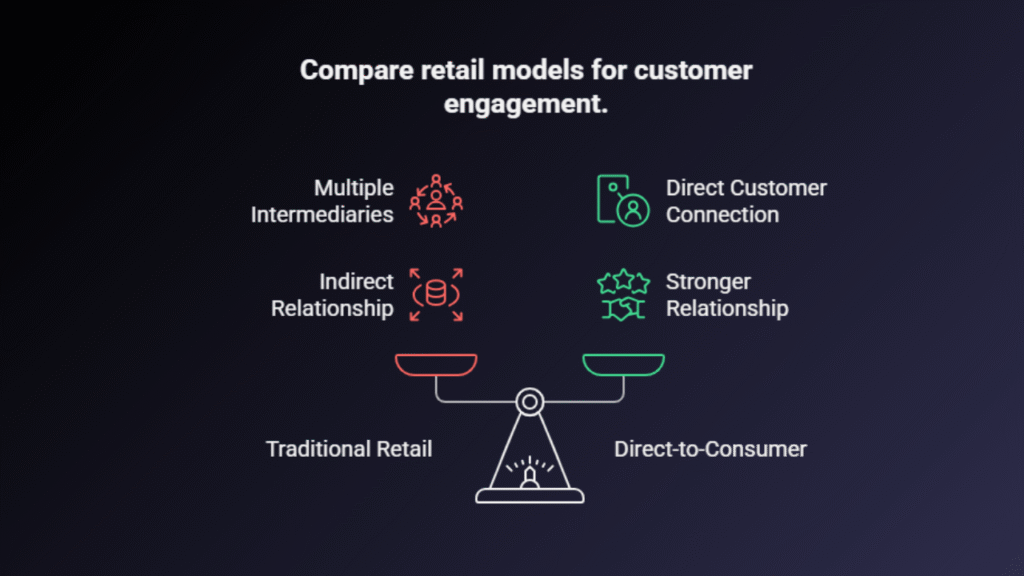
The difference comes down to one thing: who sits between the brand and the customer.
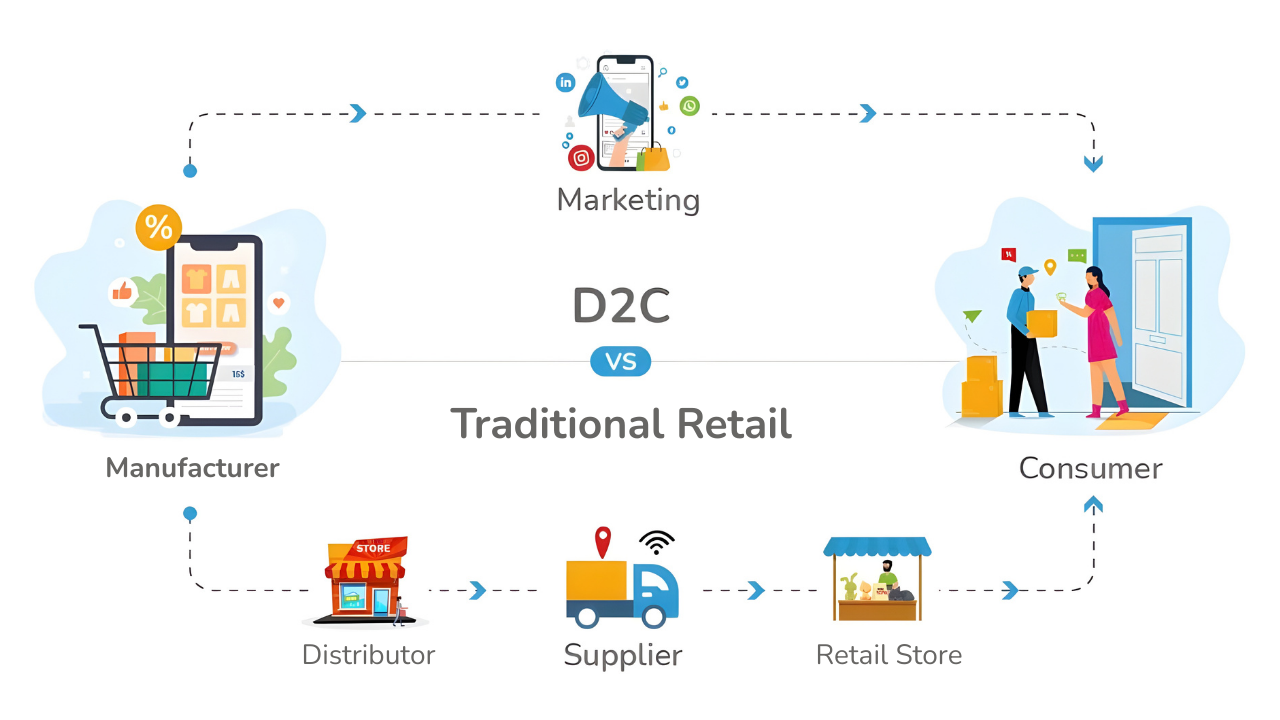
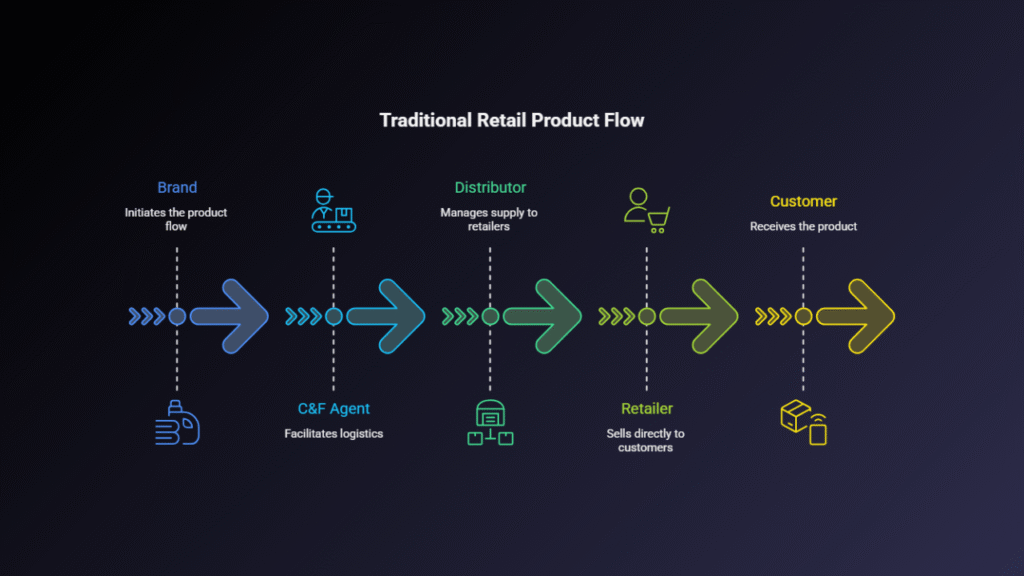
In traditional retail, there are many layers. The brand makes the product. A carrying and forwarding (C&F) agent moves it. A distributor stores it. A retailer sells it. Each layer takes a cut. Each layer adds distance between the brand and the buyer.
In D2C, those layers disappear. The brand sells directly. Through its own website. Its own app. Sometimes its own stores. The customer buys from the brand. Not from a shop that happens to stock the brand.
Traditional retail: Brand → C&F → Distributor → Retailer → Customer. D2C: Brand → Customer. That is the shift.
This is not just a small change. It changes how brands make money. How they talk to customers. How fast they can move. And how much they know about the people who buy their products.
D2C vs Traditional Retail: A Side-by-Side Comparison
Here is how the two models stack up across the factors that matter most:
| Factor | D2C Model | Traditional Retail |
| Distribution | Brand sells through its own website, app, or stores. Few or no middlemen. | Product passes through C&F agents, distributors, and retailers before reaching the customer. |
| Brand Control | Full control. The brand decides pricing, packaging, messaging, and customer experience. | Limited. Retailers control shelf space, pricing, and how the product is shown. |
| Customer Data | Rich first-party data. The brand knows who bought, what they browsed, and when they come back. | Thin data. Mostly from distributors and periodic market research. |
| Margins | Higher per unit. No middleman cuts. But customer acquisition and logistics costs can be high. | Lower per unit due to distributor and retailer margins. But volume is typically much higher. |
| Speed | Fast. Launch a new product in days. Test it with a small batch. Scale what works. | Slow. Need distributor buy-in, retailer stocking, and shelf space. Takes weeks or months. |
| Reach | Strong in cities and semi-urban areas. Tier 2 and 3 reach is growing but still limited. | Deepest reach. Kiranas, bazaars, and general trade cover the smallest towns and villages. |
| Customer Bond | Direct. The brand builds a one-to-one relationship. Can personalise every touchpoint. | Indirect. The retailer is the face. The brand is one of many products on a shelf. |
| Marketing | Digital-first. Social media, influencers, content, SEO, paid ads. Data-driven. | ATL-heavy. TV, print, hoardings, trade promotions. Broad reach but hard to measure. |
| Returns | The brand handles returns directly. High RTO and COD rates in India add cost. | Retailer handles exchanges. The brand rarely deals with end-customer returns. |
[Internal link: For a three-way comparison, read D2C vs Marketplace vs Omnichannel: Which Model Wins in India?]
How D2C vs Traditional Retail Differ on Distribution
This is the most obvious difference. But the details matter.
In traditional retail, a product might change hands three or four times before it reaches the customer. The brand ships to a C&F agent. The agent sends it to a regional distributor. The distributor delivers to local retailers. The customer walks into the shop.
Each handoff adds time. Each handoff adds cost. And each handoff takes the brand further from the customer.
In D2C, the brand ships straight to the customer. In India, this usually means a 3PL partner like Delhivery or Shiprocket picks up from the warehouse and delivers to the door. There is one step between production and the customer.
But here is the trade-off. Traditional retail gives you access to 12 million kirana stores across India. D2C gives you a website that nobody knows about until you spend money driving traffic to it. Reach versus control — that is the constant tension.
D2C brands own the pipe. Traditional brands rent it. Both approaches have costs. The question is which costs you can live with.
The Margin Story: Where D2C Wins and Where It Loses
How do margins work D2C vs traditional retail. People assume D2C means better margins. That is half true.
On a per-unit basis, D2C brands keep more money. There is no distributor taking 8–12%. No retailer taking 20–30%. The brand captures the full selling price minus production and delivery costs.
But here is what eats into those margins:
- Customer acquisition cost (CAC): Running ads on Meta and Google to get people to your website is expensive. In competitive categories like beauty and fashion, CAC can be very high.
- Logistics and shipping: Last-mile delivery in India can cost 50 to 100 rupees per order. For low-price products, that is a big chunk of the selling price.
- Cash-on-delivery (COD): A large share of Indian e-commerce orders are still COD. This means more returns, more failed deliveries, and slower cash flow.
- Returns and RTO: Return-to-origin rates can run 15–25% in some categories. Every returned order is a cost with no revenue.
In traditional retail, the brand does not pay for any of this. The distributor handles logistics. The retailer handles the customer. Returns are rare because the customer sees the product before buying.
So the real question is not “which model has better margins?” It is: “Can my brand make the D2C economics work at my price point, in my category, at my scale?” That depends on your product, your repeat rate, and your ability to lower CAC over time.
[Internal link: Read Understanding Unit Economics for D2C Brands in India for the full framework]
Customer Data: The Biggest Advantage with D2C vs Traditional Retail
This is where D2C has a clear, structural advantage. And it is not even close.
When a customer buys from a traditional retail store, the brand knows almost nothing. It knows how many units it shipped to the distributor. It might know which region sold more. But it has no idea who the actual buyer is. What else they looked at. Whether they will come back.
When a customer buys from a D2C website, the brand knows everything. The name. The email. The location. The pages they browsed. The products they added to cart but did not buy. The time they spend on site. Whether they came from an Instagram ad or a Google search.
This data is gold. It lets brands:
- Segment customers by behaviour, not just demographics.
- Run targeted campaigns that speak to specific needs.
- Predict which customers are likely to buy again.
- Spot product problems early through real-time feedback.
- Calculate the true cost of acquiring and retaining each customer.
Traditional brands spend crores on market research to get a fraction of this insight. D2C brands get it for free. Every single day. From every single order.
This is why investors love D2C brands. Not just for the revenue. For the data layer that sits underneath it. One of the biggest differentiation factors in D2C vs traditional retail.
Speed and Agility: How D2C Brands Move Faster
Speed is a real advantage. And in a fast-moving market like India, it matters a lot.
Say a beauty brand spots a trending ingredient on social media. A D2C brand can formulate a product, test it with a small batch, put it on the website, and start selling within weeks. If it works, scale. If it does not, pull it down. Minimal waste.
A traditional brand faces a different reality. It needs to brief the R&D team. Get packaging approved. Produce inventory. Convince distributors to stock it. Negotiate shelf space with retailers. Run trade promotions. By the time it hits the shelf, the trend may be over.
This speed gap is why D2C brands win in categories driven by trends, novelty, and personal expression. Think skincare, snacks, fashion, wellness, and home decor.
Traditional brands win when the game is about consistency, scale, and deep penetration. Think staples, daily essentials, and mass-market FMCG.
D2C brands are speedboats. Traditional retail brands are cargo ships. Both have a purpose. But they move very differently.
Customer Relationship: One-to-One vs One-to-Many
In traditional retail, the retailer owns the customer relationship. The shopkeeper recommends. The shopkeeper builds trust. The brand is one of many products on the shelf. That’s where we have a big difference in D2C vs traditional retail.
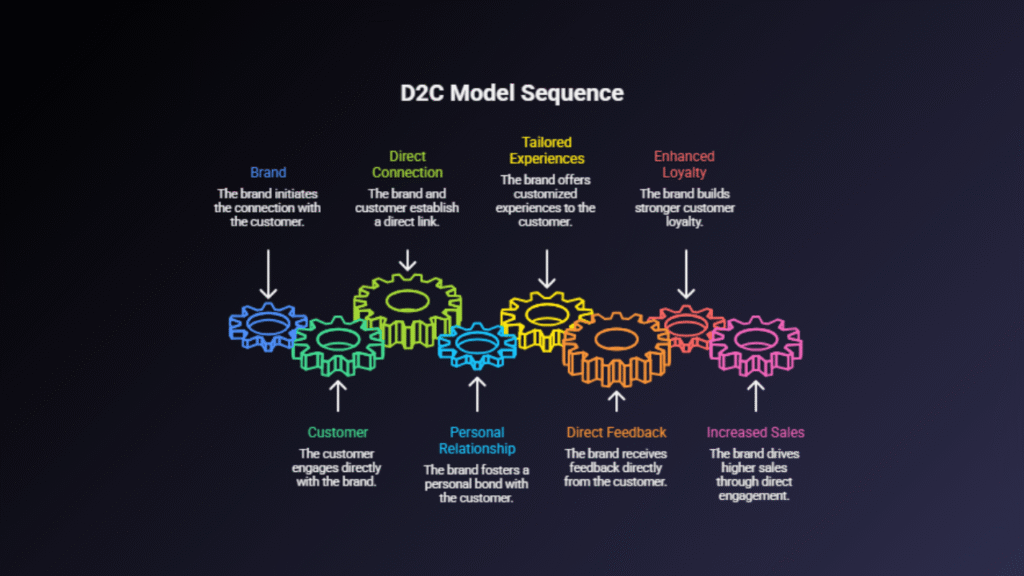
In D2C, the brand owns the relationship end to end. From the first ad they see on Instagram to the unboxing experience to the follow-up WhatsApp message asking if they liked the product.
This direct relationship changes three things:
- Trust is built by the brand, not borrowed from the retailer. Mamaearth built trust through content, transparency, and founder storytelling. Not through a shop owner saying “try this.”
- Feedback is instant. A D2C brand sees a bad review within hours. It can respond, fix the issue, and improve the product. A traditional brand might not hear about a quality problem for months.
- Loyalty is owned. D2C brands build loyalty programs, communities, and subscription models that keep customers close. Traditional brands rely on shelf presence and trade discounts to stay relevant.
In India, WhatsApp has become the secret weapon for D2C customer relationships. Brands use it for order confirmations, delivery updates, product tips, and reorder reminders. It feels personal. And it drives repeat purchases in a way that no retail shelf can.
Marketing: Digital Precision vs Mass Reach
The marketing approaches are fundamentally different for D2C vs traditional retail.
Traditional retail brands spend heavily on mass media. TV ads. Print campaigns. Hoardings. In-store promotions. The goal is broad awareness. Reach as many eyeballs as possible.
D2C brands spend on targeted digital channels. Instagram ads aimed at 25-to-35-year-old women in Mumbai who have shown interest in skincare. Google ads that appear when someone searches “best protein powder for beginners.” Influencer collaborations with creators who have a loyal niche following.
The trade-off:
- Traditional marketing builds mass awareness but is hard to measure. You know the ad ran. You do not know who saw it, what they thought, or whether it led to a sale.
- D2C marketing is precise and measurable. You know the exact cost of every click, every add-to-cart, and every purchase. But it can become expensive fast in competitive categories.
The smartest Indian D2C brands start with performance marketing to drive sales. Then they invest in content, SEO, and brand building to reduce their dependence on paid ads over time. This is the shift from rented attention to owned attention.
[Internal link: Read Performance vs Brand Marketing for D2C: Finding the Right Balance]
Reach: Where Traditional Retail Still Wins vs D2C
Let us be honest, when it comes to D2C vs traditional retail, Traditional retail has one advantage that D2C cannot match yet: deep Bharat reach.
India has around 12 million kirana stores. They serve every village, every small town, every neighbourhood. A Parle biscuit or a Clinic Plus shampoo sachet is available in places where internet connectivity is spotty and online payments are still uncommon.
D2C brands are strong in metro and tier-1 cities. They are growing in tier-2 cities. But tier-3 and rural India is still largely served by traditional retail.
This is why the most successful Indian D2C brands do not stay online forever. boAt started online but now sells in electronics stores across the country. Mamaearth started on its website but is now in 40,000+ retail outlets. Lenskart started as a D2C eyewear brand and now has over 2,000 physical stores.
The pattern is clear: start D2C, build the brand, then expand into traditional retail and offline channels. This is the omnichannel evolution that defines winning D2C brands in India.
[Internal link: Read Lenskart Omnichannel Strategy Case Study for the full breakdown]
Real Indian Brands: D2C vs Traditional retail in Action
Let us look at how this plays out with real brands:
boAt vs JBL
JBL uses traditional distribution. You find it in Croma, Reliance Digital, and electronics shops across India. It benefits from global brand recall and deep retail presence.
boAt started online. It used influencer marketing and sharp pricing to build a following with young Indians. And at the same time, It controlled the brand story. It also owned the customer data. And it grew to become India’s number one audio brand. Now it sells offline too. But the brand was built through D2C.
Mamaearth vs Himalaya
Himalaya is a traditional personal care brand. Strong distribution. Available in every medical store and supermarket. Trusted for decades.
Mamaearth started as a D2C brand for toxin-free baby care. They built trust through Instagram content, influencer partnerships, and founder credibility on Shark Tank India. The brand then expanded from baby care to full personal care. It now has both online and offline presence. But the speed of its growth — from zero to IPO in seven years — was made possible by the D2C model.
Country Delight vs Amul
Amul is India’s largest dairy brand. Massive traditional distribution. Available everywhere from village shops to city supermarkets.
Country Delight sells fresh milk and dairy products through an app-based subscription. No middlemen. Direct from farm to doorstep. It uses the D2C model to promise freshness that traditional supply chains cannot guarantee. It works in a focused set of cities, but within those cities, it has built fierce customer loyalty.
When Does It Make More Sense to choose D2C vs Traditional Retail?
D2C is not better than traditional retail. And traditional retail is not better than D2C. The right model depends on your brand, your category, and your stage. Here is a simple framework to see which you should use when choosing D2C vs traditional retail.
D2C makes more sense when:
- Your product solves a specific, well-defined problem for a niche audience.
- Your category benefits from education, content, and storytelling (skincare, wellness, specialty food).
- You want to test products quickly without large inventory commitments.
- You want to own customer data and build a direct relationship.
- Your price point supports the cost of delivery and customer acquisition.
Traditional retail makes more sense when:
- Your product is a daily essential with wide mass-market appeal.
- Price points are very low (sachets, snacks, staples) and delivery cost per unit is too high for D2C.
- Your customers are in rural India or small towns with limited internet access.
- You need the trust signal that comes from physical shelf presence.
The best approach in India: Start D2C to validate the brand, build a customer base, and understand your unit economics. Then expand into offline channels once you have brand pull and strong repeat rates. This is the playbook that boAt, Mamaearth, Lenskart, and Wakefit have all followed. [Disclaimer: This is just our view when we compare D2C vs traditional retail.]
[Internal link: Read Scaling a D2C Brand from 1 Crore to 100 Crore: The Stage-by-Stage Playbook]
Key Takeaways
- The core difference is who controls the customer relationship. D2C brands own it. Traditional retail brands share it with distributors and retailers.
- D2C gives better margins per unit, but higher acquisition and logistics costs. Traditional retail gives lower margins per unit, but lower acquisition costs and higher volume.
- Data is the biggest D2C advantage. First-party customer data lets D2C brands personalise, iterate, and retain customers far more effectively. The biggest advantage of D2C vs traditional retail.
- Traditional retail still wins on reach. 12 million kirana stores give traditional brands access to deep Bharat that D2C cannot match yet.
- Speed favours D2C. New products can go from idea to sale in weeks, not months.
- The winning Indian pattern is D2C-first, omnichannel later. Build the brand online. Expand offline when brand pull is strong.
Frequently Asked Questions?
Latest Posts
- Marmeto, India’s First Shopify Premier Partner, Pivots From Services to Product-First Technology Company
- L’Oréal in Talks to Acquire D2C Beauty Startup Innovist
- Anveshan and the Rs 1,000 Crore Farm-to-Fork Valuation Leap
- Assiduus Global Raises $25 Million to Scale AI-Powered Middleware for Cross-Border D2C Commerce
- The Budget Split That Separates Brands That Scale from Brands That Stall