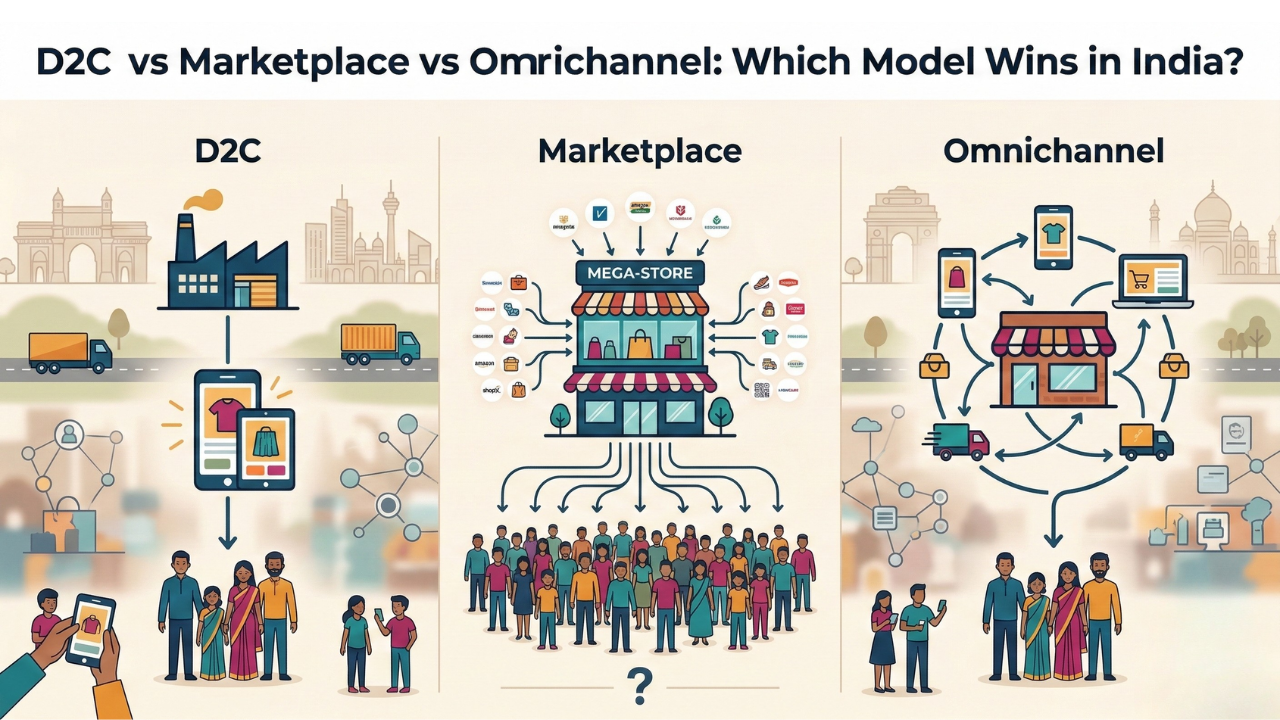
D2C vs Marketplace vs Omnichannel comparison – Which Model Wins in India?
A Decision Framework for Founders Choosing Between Direct, Marketplace, and Hybrid Models
Every brand in India faces the same question early on: where should I sell? Should I build my own website and sell directly to the end consumer? Or should I list on Amazon and Flipkart first? Some choose to do both, but is it possible? Should I open physical stores or not? The answer is not obvious. And getting it wrong costs time, money, and momentum. This is the D2C vs marketplace debate. And in India, it has a third option that most winning brands eventually choose: omnichannel.
Each model has clear strengths. Each has clear costs. And the right choice depends on your product, your category, your stage, and your economics. This guide gives you a structured framework to make that decision. We compare D2C, marketplace, and omnichannel across the factors that matter most — margins, data, control, reach, speed, and scalability. With real Indian brand examples at every step.
First, Let Us Define the Three Models
D2C (Direct-to-Consumer)
The brand sells through its own website, app, or stores. No middlemen. The brand controls pricing, customer data, and the full experience. Think of a Shopify store with Razorpay payments and Delhivery shipping.
Examples: Minimalist (started website-only), Country Delight (app-only subscription), The Whole Truth (own website first).
Marketplace
The brand lists products on platforms like Amazon, Flipkart, Myntra, Nykaa, or Meesho. The marketplace owns the customer. It controls search, pricing visibility, and fulfilment. The brand is one of many sellers on the shelf.
Examples: Thousands of Indian brands sell exclusively through Amazon and Flipkart. WOW Skin Science famously built its early growth as an Amazon-first brand.
Omnichannel
The brand sells everywhere — own website, marketplaces, and physical stores. When comparing D2C vs Marketplace, each channel serves a purpose. The website is for margin and data. Marketplaces are for discovery and volume. Stores are for trust and experience. All connected.
Examples: Lenskart (website + app + 2,000+ stores), Mamaearth (website + Amazon + 40,000+ retail outlets), boAt (website + marketplace + offline electronics stores).
D2C is a channel. Marketplace is a channel. Omnichannel is a strategy that uses both — and adds offline on top.
D2C vs Marketplace vs Omnichannel: The Full Comparison
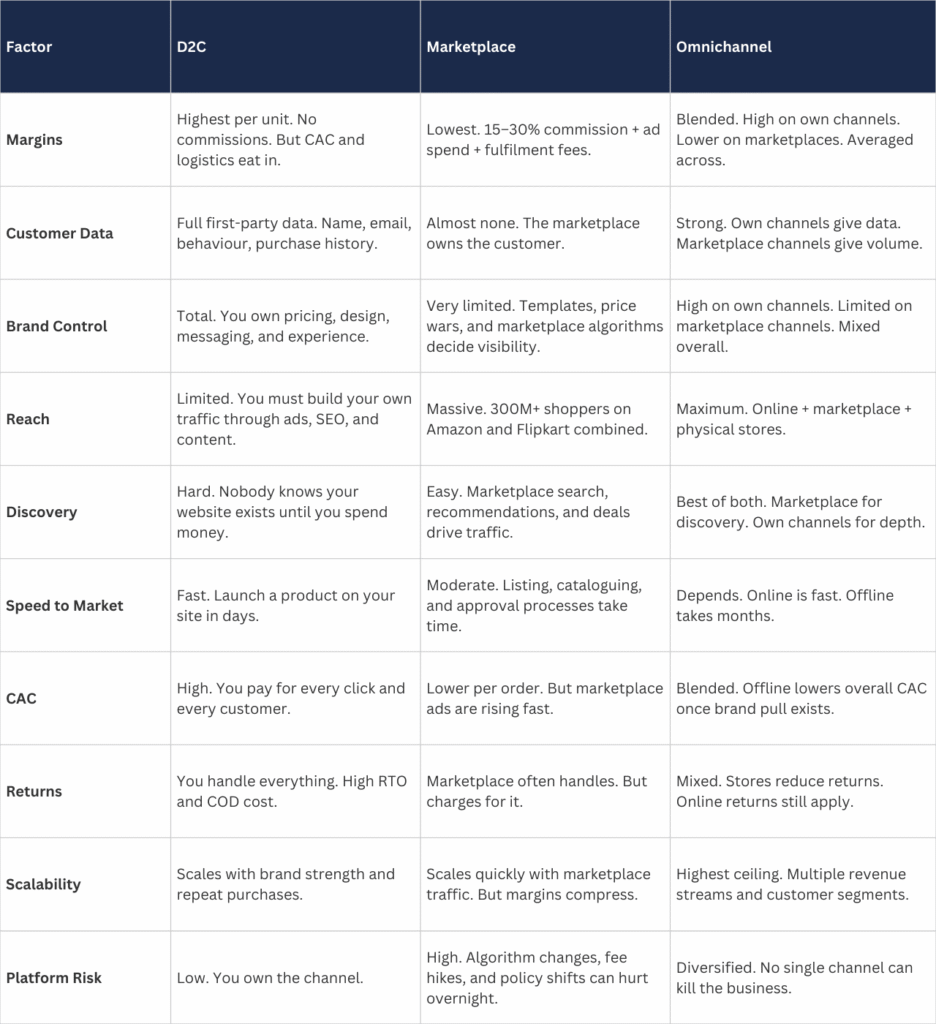
Here is how the three models – D2C vs Marketplace vs Omnichannel – compare across the ten factors that matter most:
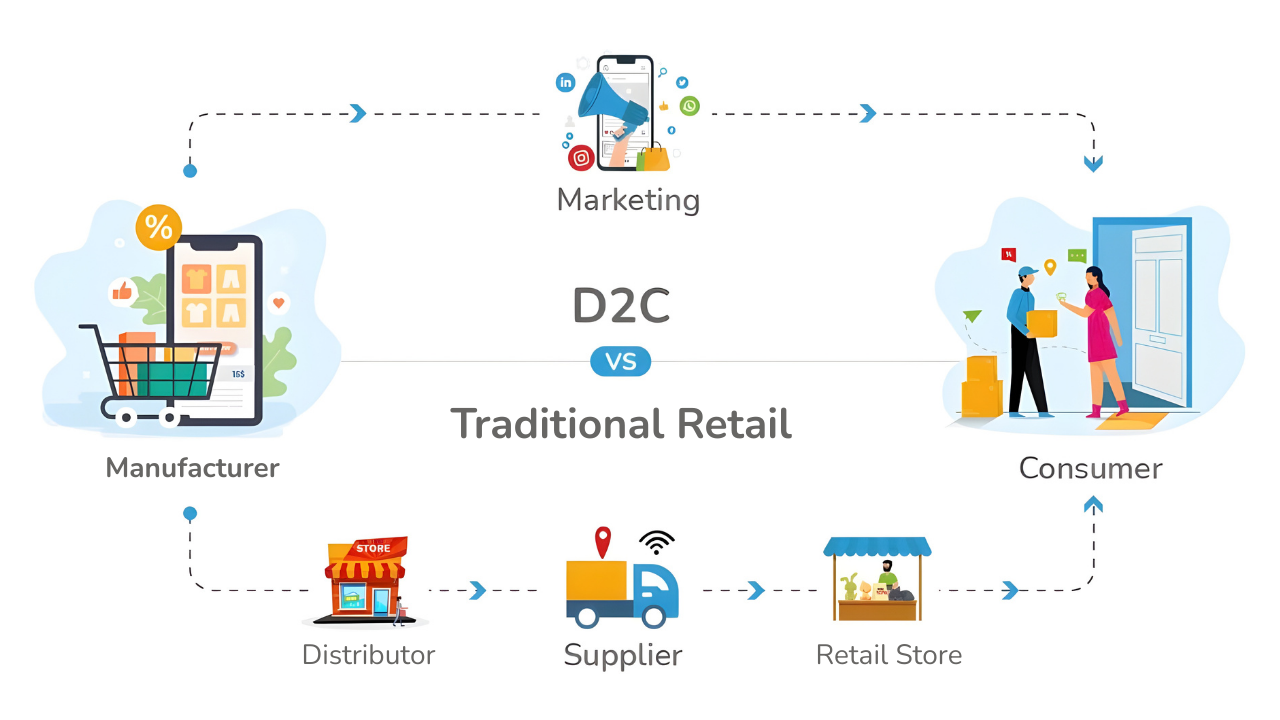
[Internal link: Read How D2C is Different from Traditional Retail in India for the two-model comparison]
The D2C Model: Full Control, Higher Cost
D2C is all about ownership. You own the store and all the corresponding data that comes with the business. You own the customer relationship too. Nobody can change the rules on you overnight.
This is the model’s biggest strength. And its biggest challenge.
Where D2C wins:
- You keep the full margin. No 15–30% marketplace commission.
- You know exactly who your customer is. Email, phone, browsing history, purchase patterns.
- You control pricing. No race-to-the-bottom pressure from competing sellers.
- You build brand equity. The customer remembers your brand, not Amazon.
- You test fast. New product? Put it on your site tomorrow.
Where D2C struggles:
- Traffic is not free. You must spend on ads, SEO, influencers, and content to bring people to your site.
- Customer acquisition cost (CAC) keeps rising. Meta and Google ad costs have gone up 30% year-on-year in competitive categories.
- Logistics is your problem. You pick the 3PL partner and you only manage returns as well as handle COD.
- Trust is earned slowly. A new website has zero built-in credibility. Customers hesitate.
A recent McKinsey survey of over 1,000 Indian MSMEs found that 53% now favour D2C routes over marketplace-only selling. But favouring D2C does not mean abandoning marketplaces. Most brands use both.
The Marketplace Model: Instant Reach, Limited Control
Marketplaces are powerful. Amazon India, Flipkart, Myntra, Nykaa, Meesho — these platforms have hundreds of millions of active shoppers. The traffic is already there. You just need to show up.
This is why many brands start here. It is the fastest way to get sales.
Where marketplaces win:
- Massive built-in traffic. You do not need to drive customers to the platform. They are already there.
- Trust is borrowed. Customers trust Amazon’s delivery and return policies. That trust transfers to your product.
- Fulfilment is handled. FBA (Fulfilled by Amazon) and Flipkart’s logistics handle warehousing, shipping, and returns.
- Discovery is easier. Marketplace search algorithms and deal pages drive product visibility.
Where marketplaces struggle:
- Commissions are steep. Amazon charges 15–30% depending on the category. Add advertising costs (5–15% of revenue), and your effective take can drop sharply.
- You do not own the customer. The marketplace owns the email, the relationship, and the data. You cannot retarget. You cannot build loyalty directly.
- Price wars are constant. Competitors can undercut you. The marketplace algorithm rewards lower prices. Your margin shrinks.
- Platform risk is real. A policy change, an algorithm update, or a fee hike can hurt your business overnight. You have no control.
Marketplace e-commerce in India is expected to reach up to 100 billion dollars by 2030. These platforms are not going away. But relying on them alone is a strategic risk that more brands are recognising.
Marketplaces are great for discovery and volume. But they are rented land. You build on someone else’s platform. And the landlord can change the rules at any time.
The Omnichannel Model: The Best of Both — With More Complexity
Omnichannel means selling everywhere. Own website, Marketplaces, Physical stores – All connected and all serving different purposes. It’s not D2C vs Marketplace, but taking D2C and Marketplace together.
In 2025, this is no longer a luxury strategy. It is the default for any serious brand. The binary between online and offline has collapsed. Customers discover on Instagram, compare on Amazon, check reviews on YouTube, and buy from wherever is most convenient.
Where omnichannel wins:
- Maximum reach. You meet customers wherever they are — online, on platforms, and in person.
- Diversified revenue. No single channel can kill your business.
- Physical stores build trust. Customers can see, touch, and try the product. This is especially powerful in India.
- Stores reduce returns. When a customer tries before buying, return rates drop dramatically.
- Blended CAC drops. Once a brand has offline presence, not every customer needs to be acquired through paid ads.
Where omnichannel struggles:
- Complexity rises fast. Managing inventory across channels, pricing consistency, and fulfilment from multiple locations is operationally hard.
- Capital requirements jump. Physical stores need rent, staff, fit-out, and inventory. This is a very different cost structure from running a Shopify store.
- Brand dilution risk. If your marketplace presence and offline presence do not feel consistent, the brand suffers.
- Needs brand pull first. Omnichannel works when people already want your product. Opening stores for a brand nobody has heard of is a recipe for burning cash.
D2C brands in India accounted for nearly 18% of total retail space leased in the first half of 2025, with 60% of that space taken by fashion, homeware, and furnishing brands. The offline expansion is real. And it is accelerating.
[Internal link: Read Lenskart Omnichannel Strategy Case Study for the full playbook]
The Margin Maths: D2C vs Marketplace Economics
Let us make this concrete. Here is how the unit economics compare for a product with a 1,000-rupee selling price in D2C vs Marketplace:
| Cost Component | D2C (Own Website) | Marketplace (Amazon) |
| Selling Price | Rs 1,000 | Rs 1,000 |
| COGS (Cost of Goods) | Rs 300 (30%) | Rs 300 (30%) |
| Platform Commission | Rs 0 | Rs 200 (20%) |
| Shipping & Logistics | Rs 80 | Rs 60 (FBA rates) |
| Payment Gateway | Rs 20 (2%) | Included in commission |
| Marketing / Ad Spend | Rs 200 (20% of revenue) | Rs 100 (10% marketplace ads) |
| Contribution Margin | Rs 400 (40%) | Rs 340 (34%) |
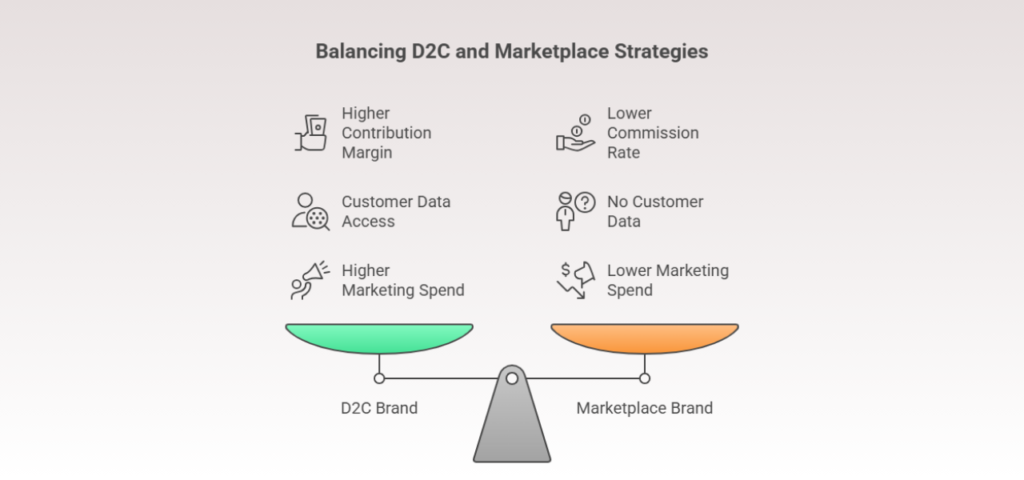
On the surface, D2C margins look better. But the D2C brand is spending 20% on marketing to acquire customers. If CAC rises or repeat rates are low, that 40% contribution margin can drop fast. The marketplace brand spends less on ads. But it gives up 20% in commission. And it has no customer data to improve retention.
The real winner? The brand that uses both channels strategically. Marketplace for volume and discovery. D2C for margin and retention. That is the blended economics play. Instead of looking at D2C vs Marketplace, it should be about how both can be used to their advantages.
[Internal link: Read Understanding Unit Economics for D2C Brands in India for the full framework]
Real Indian Brands: How They Chose Their Model
Minimalist — D2C-First, Then Marketplace
Minimalist launched on its own website with a science-led skincare positioning. It built the brand through Instagram content and ingredient transparency. Once brand pull was strong, it expanded to Amazon and Nykaa for volume. The D2C site remained the core for data and margins.
WOW Skin Science — Marketplace-First, Then D2C
WOW did the opposite. It built its early growth on Amazon India, becoming one of the top-selling personal care brands on the platform. Then it invested in its own D2C website to capture margin and customer data. An Amazon-first breakout that added D2C later.
Lenskart — Omnichannel From the Start
Lenskart started online but recognised early that eyewear needs physical trial. It invested heavily in technology (virtual try-ons, home eye tests) and built over 2,000 stores. Today, it operates a fully integrated omnichannel model where data flows across all touchpoints.
Sugar Cosmetics — D2C to Omnichannel
Sugar started as a D2C brand selling through its own channels. It built a loyal digital community through bold branding and influencer partnerships. Then it expanded into marketplaces and now has a growing offline presence. The classic D2C-first, omnichannel-later playbook.
Country Delight — Pure D2C by Design
Country Delight sells fresh dairy through an app-based subscription model. No marketplace. No retail. The entire value proposition — farm-fresh delivery within hours — depends on owning the full supply chain. Some categories simply demand a pure D2C model.
The Decision Framework: Which Model Fits Your Brand?
There is no one right answer when choosing D2C vs Marketplace. The right model depends on where you are and what you are building. Here is a simple framework:
Choose D2C-first when:
- Your product needs education and storytelling (skincare, wellness, specialty food).
- Your price point is high enough to absorb CAC and logistics costs.
- You want to test products quickly without committing large inventory.
- Owning customer data and building a direct relationship is central to your strategy.
- You have a clear content and community angle to drive organic traffic.
Choose marketplace-first when:
- Your product competes on price and convenience (daily essentials, electronics accessories).
- You need sales volume fast and do not have the budget for brand building.
- Your category has high marketplace search demand (“best shampoo”, “wireless earbuds”).
- You want to validate product-market fit before investing in your own platform.
Choose omnichannel when:
- You have an established brand with strong customer demand.
- Your product benefits from physical trial (eyewear, mattresses, apparel, cosmetics).
- You want to reduce dependence on any single channel.
- Your unit economics support the higher cost of offline operations.
The winning Indian pattern: Start D2C or marketplace (depending on category). Build the brand, prove unit economics and then go omnichannel. This is the path boAt, Mamaearth, Lenskart, Sugar, and Wakefit have all taken.
[Internal link: Read Scaling a D2C Brand from 1 Crore to 100 Crore: The Stage-by-Stage Playbook]
Five Common Mistakes Brands Make When Choosing a Model | D2C vs Marketplace
- Going marketplace-only and never building D2C. You grow revenue but never own the customer. When marketplace fees rise or algorithms shift, you have no safety net.
- Going D2C-only and ignoring marketplace reach. You spend crores on ads while marketplace traffic sits there unused. Many categories need both channels to work.
- Expanding to omnichannel too early. Opening stores before the brand has pull is expensive. Stores work when people already want your product. Not before.
- Pricing differently across channels without strategy. If your D2C price is higher than Amazon, customers just buy on Amazon. Pricing must be consistent or deliberately structured.
- Not tracking unit economics by channel. A brand might look profitable overall but lose money on marketplace orders and make money on D2C orders. If you do not track by channel, you cannot optimise.
Key Takeaways
Track unit economics by channel. Not all revenue is equal when it comes to D2C vs Marketplace. Know where you make money and where you lose it.
D2C gives you control and data. Marketplace gives you reach and speed. Omnichannel gives you both — with more complexity.
Margins are highest on D2C. But CAC and logistics can eat into them. Marketplace margins are lower due to 15–30% commissions. Omnichannel blends both.
Customer data is the biggest strategic difference. D2C gives you full first-party data. Marketplaces give you almost none. This shapes everything — retention, personalisation, and LTV.
Platform risk is real. Brands that rely only on marketplaces are one algorithm change away from a revenue hit. D2C and omnichannel reduce this risk.
Most winning Indian brands start with one channel and evolve. They make a choice about D2C vs Marketplace. Either it’s D2C-first or marketplace-first, then expand. The end state for serious brands is almost always omnichannel.
Frequently Asked questions about D2C vs Marketplace
Latest Posts
- Marmeto, India’s First Shopify Premier Partner, Pivots From Services to Product-First Technology Company
- L’Oréal in Talks to Acquire D2C Beauty Startup Innovist
- Anveshan and the Rs 1,000 Crore Farm-to-Fork Valuation Leap
- Assiduus Global Raises $25 Million to Scale AI-Powered Middleware for Cross-Border D2C Commerce
- The Budget Split That Separates Brands That Scale from Brands That Stall