The Complete D2C Ecosystem in India, Explained
Every Layer That Powers a Direct-to-Consumer Brand — From SaaS to Logistics to Capital
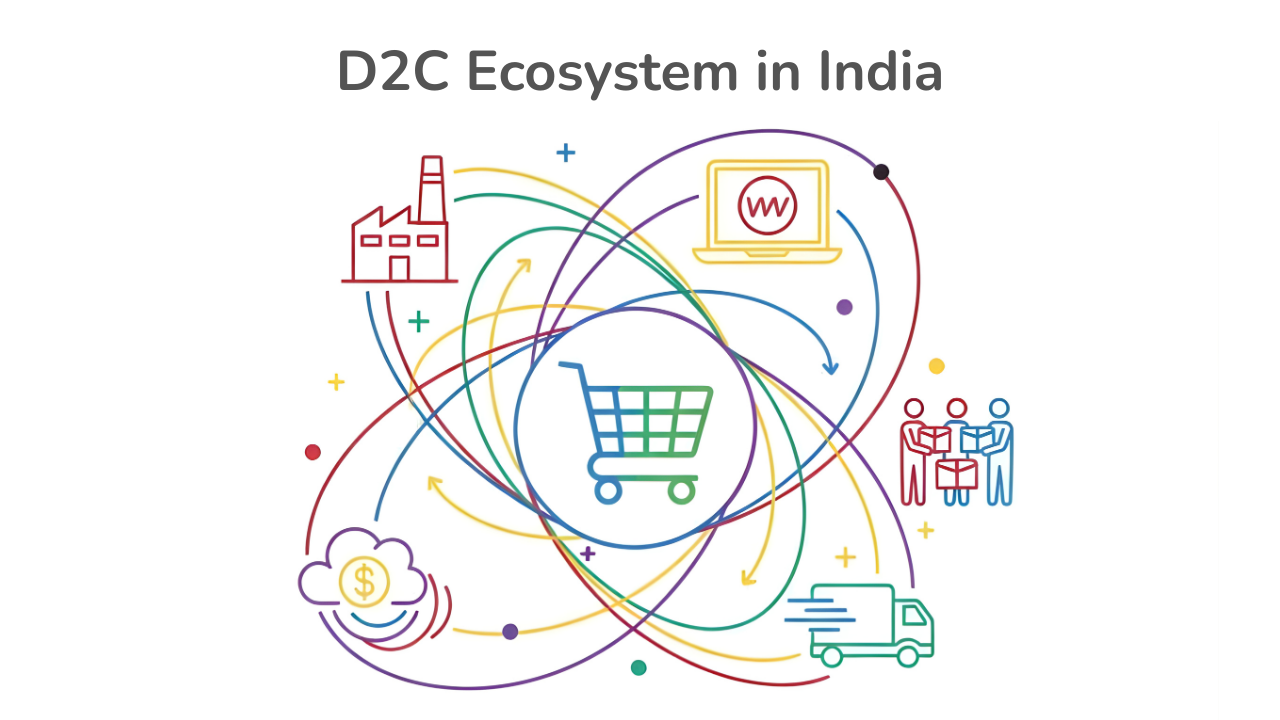
A D2C brand does not work alone. It cannot. Behind every brand that sells directly to customers in India, there is an entire ecosystem at work. Platforms that host the store. Payment gateways that process the order. Logistics companies that deliver the box. Marketing tools that bring the customer. Analytics software that tracks what happened. And investors who fund the whole thing. This is the D2C ecosystem in India. And it is far bigger than most people realise.
If you only look at the brands, you miss the picture. The real story is in the infrastructure that makes D2C possible. The SaaS companies. The logistics networks. The payment rails. The capital flows. The marketing stack. All of it working together. This guide maps every layer of the Indian D2C ecosystem. If you are a founder, you will know what tools and partners you need. In case you are a SaaS company, you will see where you fit. And if you are an investor, you will understand the full value chain you are betting on.
Why You Need to Think in Ecosystems, Not Just Brands
Most coverage of D2Cecosystem in India focuses on brands. Who raised funding, who hit 100 crore in revenue and who went public. But brands are just one layer. The reason D2C works today — and did not work ten years ago — is because the supporting ecosystem has matured.
Think about it. In 2014, if you wanted to start a D2C brand in India, you had to build almost everything yourself. Your own website from scratch, a payment integration all by yourself. Look for a dependable shipping network or make your own. Build your own marketing tools. The cost was enormous. The time was months.
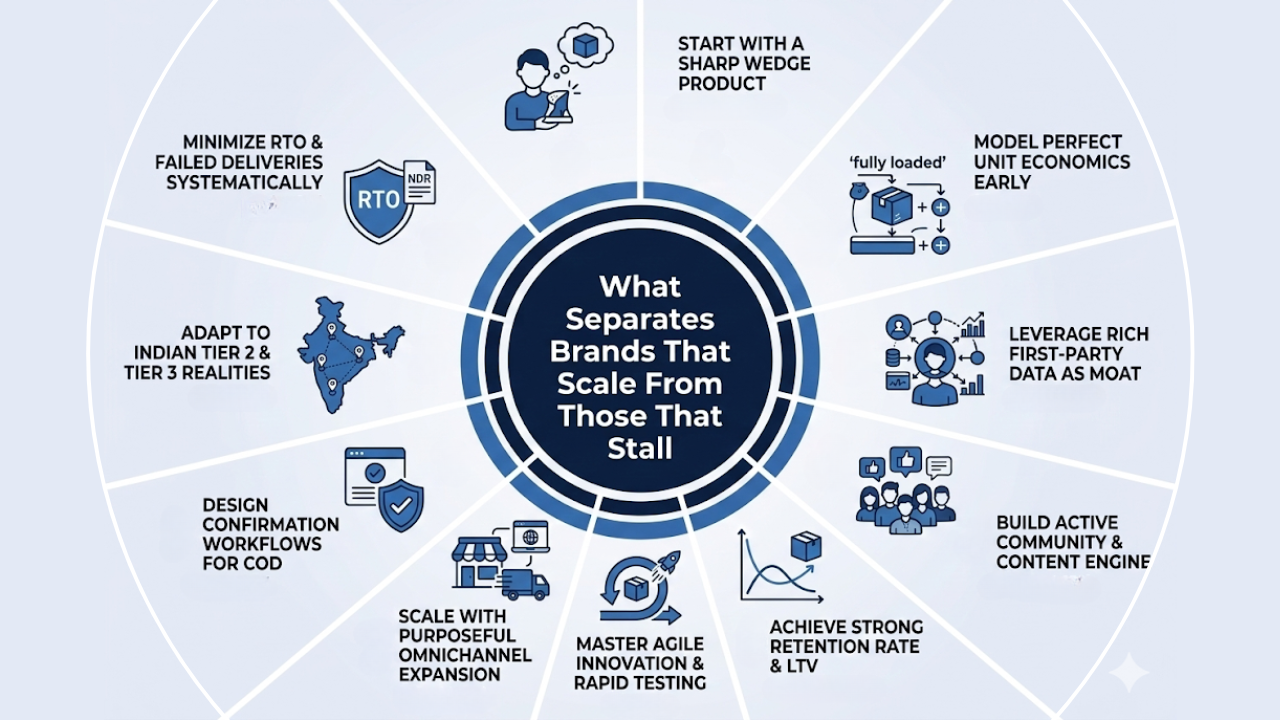
In 2025, a founder can launch a D2C store in a week. Shopify hosts the site. Razorpay handles payments. Shiprocket ships the product. Meta runs the ads. Klaviyo sends the emails. Everything plugs together. That shift — from build-everything to plug-and-play — is what created India’s D2C boom. And understanding the ecosystem is what separates operators who scale from those who stall.
The Seven Layers of the D2C Ecosystem in India
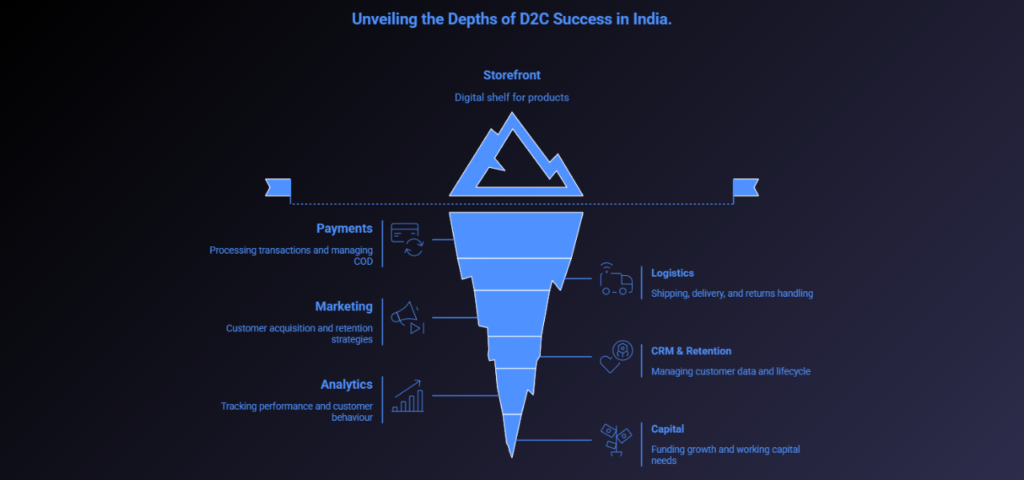
The D2C ecosystem in India has seven distinct layers. Each one solves a specific problem. Together, they form the full infrastructure a brand needs to operate.
Here is the map:
| Layer | What It Does | Key Players (India) | Why It Matters |
| Storefront | Hosts the brand’s online store | Shopify, WooCommerce, Dukaan, custom builds | The digital shelf. Where the customer sees and buys the product. |
| Payments | Processes transactions and manages COD | Razorpay, Cashfree, PayU, PhonePe Business | Every rupee flows through this layer. Speed and trust matter. |
| Logistics | Ships, delivers, and handles returns | Delhivery, Shiprocket, Ecom Express, XpressBees, Shadowfax | Last-mile delivery defines customer experience in India. |
| Marketing | Acquires and retains customers | Meta Ads, Google Ads, influencer platforms, affiliate networks | How brands get discovered. The biggest cost centre for most D2C brands. |
| CRM & Retention | Manages customer data and lifecycle | WebEngage, MoEngage, Klaviyo, CleverTap, Interakt (WhatsApp) | Repeat purchases are where D2C brands make real money. |
| Analytics | Tracks performance and customer behaviour | Google Analytics, Mixpanel, Hotjar, platform-native dashboards | Data turns guesses into decisions. The core D2C advantage. |
| Capital | Funds growth and working capital | VCs (Fireside, Matrix), revenue-based lenders (Recur, GetVantage) | D2C brands need cash to grow. The capital layer fuels everything else. |
Now let us go deeper into each layer.
Layer 1: The Storefront — Where the Brand Lives Online
Every D2C brand needs a digital home. This is the storefront layer. In India, Shopify is the most popular choice. It powers thousands of D2C stores and is very fast & easy to set up. It has a massive app store and integrates with almost every other tool in the ecosystem.
Other options exist. WooCommerce is popular with brands that want more control and lower costs. Dukaan serves smaller sellers and early-stage brands. Some large brands build custom storefronts when they need features that no platform offers out of the box.
What the storefront layer handles:
- Product pages and catalogues
- Shopping cart and checkout
- Mobile-responsive design
- Discount codes and promotions
- Integration with payments, logistics, and marketing tools
The storefront is not just a website. It is the brand’s most important asset. Every other tool plugs into it. If the storefront breaks, nothing else works.
[Internal link: Read Shopify vs WooCommerce for Indian D2C Brands for a detailed comparison]
Layer 2: Payments — The Rails That Move Money
Payments are the backbone of D2C. Every order passes through this layer and so does the whole D2C ecosystem in India.
India has one of the most advanced digital payment ecosystems in the world. UPI alone processed over 185 billion transactions in FY25. And for D2C brands, this is a huge advantage. Customers can pay instantly, without friction or delays. The big players in this layer are Razorpay, Cashfree, and PayU. Razorpay alone powers payments for an estimated 63% of Indian D2C brands.
What the payment layer handles:
- UPI, cards, net banking, and wallet payments
- Cash-on-delivery management and COD-to-prepaid conversion
- EMI and buy-now-pay-later options
- Refund processing and settlement
- Checkout optimisation to reduce drop-offs
The biggest challenge in this layer? COD. Cash-on-delivery still accounts for a large share of orders in the D2C ecosystem in India. COD leads to higher returns, slower cash flow, and more failed deliveries. Smart payment tools now offer COD-to-prepaid nudges via WhatsApp — asking customers to pay online after placing a COD order. This alone can cut return rates by 10–20%.
[Internal link: Read Best Payment Gateways for D2C Brands in India for a full comparison]
Layer 3: Logistics — The Physical Backbone
You can have the best brand. The best product. The best ads. But if the delivery fails, you lose the customer.
Logistics is the hardest layer to get right in India. The country is vast. Infrastructure varies wildly across regions. And customers expect fast, reliable delivery because Amazon and Flipkart have set that bar. Most D2C brands do not build their own logistics. They use third-party logistics (3PL) partners. The biggest names are Delhivery, Shiprocket, Ecom Express, XpressBees, and Shadowfax.
What the logistics layer handles:
- Warehousing and inventory storage
- Order picking, packing, and dispatch
- Last-mile delivery to the customer
- Return pickups and reverse logistics
- Non-delivery report (NDR) management
- PIN code serviceability checks
Shiprocket works as an aggregator. It connects brands with 25+ courier partners through a single dashboard. This gives smaller brands access to the same delivery network that larger companies use. Delhivery operates its own network. It handles everything from first mile to last mile. For brands that need more control and faster delivery, Delhivery is often the choice. The big challenge? Cost. Last-mile delivery in India can cost 50 to 100 rupees per shipment. For low-price products, this eats heavily into margins. And return logistics (RTO) can add another 15–25% in costs.
[Internal link: Read Top Logistics Challenges for D2C Brands in India for the full breakdown]
Layer 4: Marketing — How Brands Get Discovered
No traffic means no sales. The marketing layer is where D2C brands spend the most money. And where they face the most competition in the D2C ecosystem in India. In the early days of Indian D2C, Meta (Facebook and Instagram) ads were cheap and effective. You could build a brand on paid social alone. That era is over. Ad costs have risen sharply. Customer acquisition costs have gone up by an estimated 30% year-on-year in competitive categories.
Today, the marketing layer has multiple channels:
Paid Acquisition
- Meta Ads: Still the primary channel for most D2C brands. Instagram is where discovery happens for beauty, fashion, and lifestyle.
- Google Ads: Search and Shopping ads capture high-intent buyers. Essential for categories where customers search before buying.
- Marketplace Ads: Brands selling on Amazon and Flipkart use their ad platforms to boost visibility within those ecosystems.
Organic and Content
- SEO: Long-term play. Brands that invest in content and search optimisation reduce their dependence on paid ads over time.
- Content Marketing: Blog posts, guides, and educational content that attract organic traffic and build trust.
- Social Media: Organic Instagram reels, YouTube content, and community building on WhatsApp.
Influencer and Creator Marketing
This has become a core channel of D2C ecosystem in India. According to industry data, 43% of Indian shoppers are influenced by content from creators. D2C brands work with micro-influencers and niche creators to build credibility and drive sales. This is not optional any more. It is a core part of the marketing stack.
The smartest D2C brands shift from paid-heavy to a balanced mix of paid, organic, influencer, and retention marketing. Those that stay dependent on ads alone struggle to reach profitability.
[Internal link: Read Customer Acquisition Strategies for D2C Brands in India for the full playbook]
Layer 5: CRM and Retention — Where the Real Money Is Made
Acquiring a customer is expensive. Keeping them is where D2C brands make money. The retention layer is everything that happens after the first purchase. Its job is simple: get the customer to come back and buy again.
In the D2C ecosystem in India, this layer curently runs on four channels:
- Email: Welcome flows, abandoned cart sequences, post-purchase follow-ups, and winback campaigns. Tools like Klaviyo and WebEngage power this.
- WhatsApp: The most powerful retention channel in India. Brands use it for order updates, product tips, reorder reminders, and flash sale alerts. Tools like Interakt and Wati make this possible.
- SMS: Still useful for transactional messages and time-sensitive offers.
- Loyalty programs: Point-based systems, VIP tiers, and referral programs that reward repeat behaviour.
The key metric here is repeat purchase rate. A strong D2C brand in India should aim for a meaningful share of revenue from returning customers within 90 days of their first purchase. The higher this number, the more sustainable the business becomes.
CRM tools like WebEngage, MoEngage, and CleverTap let brands segment customers by behaviour, run personalised campaigns, and automate the entire lifecycle. This is not a nice-to-have. It is core infrastructure.
[Internal link: Read Retention Marketing Strategies for D2C Brands for the complete framework]
Layer 6: Analytics — The Intelligence Layer
Data is what makes D2C different from traditional retail. But raw data is useless. You need tools to turn it into decisions. The analytics layer is the brain of the ecosystem. It tracks everything: where customers come from, what they browse, what they buy, and why they leave.
What the analytics layer tracks:
- Website traffic sources and conversion funnels
- Customer acquisition cost (CAC) by channel
- Customer lifetime value (LTV) and cohort analysis
- Product performance and inventory velocity
- Return rates by product, region, and payment method
- Marketing spend vs revenue by campaign
Google Analytics is the baseline. Almost every brand in the D2C ecosystem in India uses it. Mixpanel goes deeper into product analytics — tracking what users do inside the site. Hotjar shows heatmaps and session recordings. And most storefronts (Shopify, WooCommerce) have their own native dashboards.
The brands that win are the ones that act on their data. Not the ones that simply collect it.
[Internal link: Read CAC vs LTV Deep Dive for D2C Brands for the full measurement framework]
Layer 7: Capital — The Fuel That Powers Growth
D2C brands need money. A lot of it. Inventory, marketing, logistics, technology — all of it costs cash before revenue comes in. The capital layer of the D2C ecosystem in India has evolved. There are now multiple ways to fund a D2C brand:
Venture Capital
VCs like Fireside Ventures, Matrix Partners, and Sequoia have been the biggest backers of Indian D2C brands. In FY22 alone, D2C startups raised close to 800 million dollars. But the game has changed. Investors now want to see positive contribution margins, strong retention, and a clear path to profitability. Growth-at-all-costs is over.
Revenue-Based Financing
This is a newer model. Companies like Recur Club, GetVantage, and InCred offer debt tied to revenue. They advance 15–30% of monthly sales as quick capital. No equity dilution. This is especially useful for managing COD-related cash flow gaps.
Bootstrapping and Profitability-First
Not every brand raises VC money. Many successful brands in the D2C ecosystem in India are bootstrapped. They grow slower but keep full ownership. And they are forced to get unit economics right from day one. Capital is fuel, not strategy. The brands that raise money and burn it on ads without fixing unit economics are the ones that fail. The brands that use capital to build systems are the ones that scale.
[Internal link: Read How D2C Brands Raise Venture Funding in India for the step-by-step guide]
The Government and Infrastructure Layer: UPI, ONDC, and India Stack
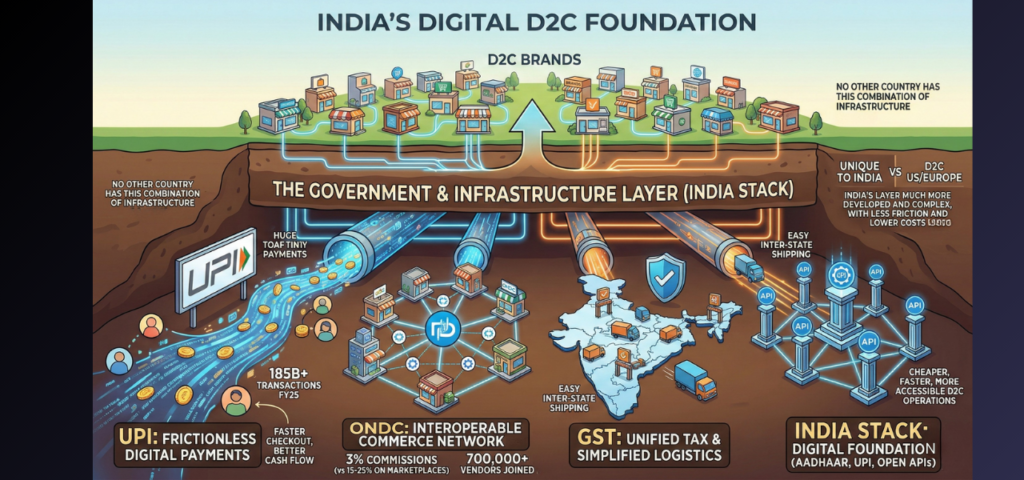
There is an eighth layer that sits beneath everything else in the D2C ecosystem in India. It is not a company or a tool. It is India’s digital infrastructure.
- UPI: India’s Unified Payments Interface has made digital payments almost frictionless. It processed over 185 billion transactions in FY25. For D2C brands, this means faster checkout, lower payment failures, and better cash flow.
- ONDC: The Open Network for Digital Commerce is a government-backed protocol that lets brands sell through an interoperable network. Commission ceilings are around 3%, compared to 15–25% on traditional marketplaces. Over 700,000 vendors have already joined.
- GST: A unified tax system has simplified inter-state logistics. Before GST, shipping across state borders was a nightmare of paperwork and delays.
- India Stack: The combination of Aadhaar, UPI, and open APIs has created a digital foundation that makes D2C operations cheaper, faster, and more accessible.
This infrastructure layer is unique to India. No other country has the combination of UPI adoption, low-cost logistics networks, and government-backed open commerce protocols. It is what makes the Indian D2C ecosystem structurally different from D2C in the US or Europe.
How All the Layers Connect: The D2C Ecosystem Flow
These layers do not work in isolation. They connect into a single flow:
- Customer discovers the brand through marketing (Layer 4) — an Instagram ad, a Google search, or an influencer post.
- The Customer then visits the storefront (Layer 1) — browses products, reads reviews, adds to cart.
- Customer pays through the payment layer (Layer 2) — UPI, card, or COD.
- Order is shipped through the logistics layer (Layer 3) — picked, packed, and delivered.
- Post-purchase experience kicks in through CRM and retention (Layer 5) — delivery updates on WhatsApp, a review request, a reorder nudge.
- Analytics tracks everything (Layer 6) — which channel drove the sale, what the CAC was, whether the customer will come back.
- Capital funds the cycle (Layer 7) — inventory for the next batch, ads for the next campaign, tools for the next quarter.
When all seven layers work together smoothly, the brand grows. When one layer breaks — logistics delays, payment failures, high CAC — the entire system slows down.
The D2C ecosystem in India is a chain. It is only as strong as its weakest layer. The founder’s job is to optimise every link.
Who Else Lives in the D2C Ecosystem in India?
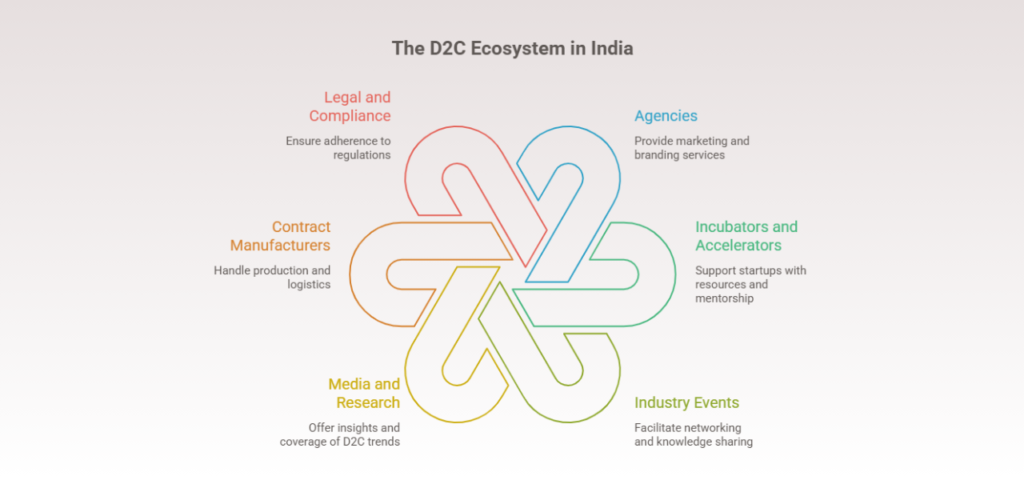
Beyond the seven core layers, the Indian D2C ecosystem includes several other players:
- Agencies: Performance marketing agencies, creative studios, and growth consultancies that serve D2C brands.
- Incubators and accelerators: Programs like Shark Tank India, Y Combinator, and D2C-focused accelerators that help early-stage brands launch.
- Industry events: Conferences like the TiE D2C Summit and D2C India Expo that bring together founders, investors, and enablers.
- Media and research: Platforms that cover the D2C space — reporting on trends, funding, and brand strategies.
- Contract manufacturers: The production partners behind D2C brands, especially in beauty, personal care, food, and nutraceuticals.
- Legal and compliance: Advisors who handle regulatory requirements — data protection, consumer rights, packaging rules, and food safety.
The ecosystem is not just technology. It is people, capital, knowledge, and infrastructure. All of it working together.
Why Understanding the D2C Ecosystem Matters
If you are a founder, understanding the ecosystem helps you make better tool and partner choices. You know what to build and what to buy. You know where to invest and where to save.
If you are a SaaS company, you see exactly where you fit. You understand the pain points at each layer. You can build products that solve real problems for real brands.
If you are an investor, you understand the full value chain. You can spot opportunities not just in brands but in the infrastructure that powers them.
If you are an agency, you know which tools your clients use and how the layers interact. You can provide better, more integrated services.
The D2C ecosystem in India is not a trend. It is infrastructure. And infrastructure compounds.
Key Takeaways
Understanding the ecosystem helps everyone. Founders, SaaS companies, investors, and agencies all benefit from seeing the full map.
The D2C ecosystem has seven core layers: storefront, payments, logistics, marketing, CRM and retention, analytics, and capital. Each solves a specific problem.
India’s digital infrastructure is the foundation. UPI, ONDC, GST, and India Stack make the D2C ecosystem structurally unique and globally competitive.
The ecosystem is plug-and-play. A founder can launch a D2C brand in a week using existing tools. That was not possible ten years ago.
Every layer connects. Marketing drives traffic to the storefront. Payments process the order. Logistics delivers it. CRM brings the customer back. Analytics measures everything. Capital funds the cycle.
The ecosystem is the moat, not just the brand. Brands that understand and optimise every layer are the ones that scale and survive.
Frequently Asked Questions
Latest posts
- Marmeto, India’s First Shopify Premier Partner, Pivots From Services to Product-First Technology Company
- L’Oréal in Talks to Acquire D2C Beauty Startup Innovist
- Anveshan and the Rs 1,000 Crore Farm-to-Fork Valuation Leap
- Assiduus Global Raises $25 Million to Scale AI-Powered Middleware for Cross-Border D2C Commerce
- The Budget Split That Separates Brands That Scale from Brands That Stall