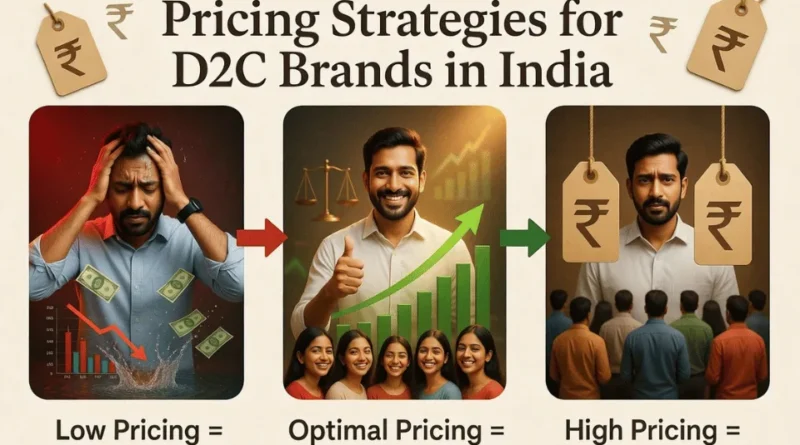
How to Price for Profit in a Value-Conscious Market
Eight Pricing Models. India-Specific Factors That Change the Maths. The Early-Stage Founder’s Pricing Checklist. And the Mistakes That Kill Margins Before You Even Start.
Pricing is the one decision that touches every other number in your D2C business. Be it your margin, or CAC payback, your LTV or the repeat rate, your brand perception or marketplace competitiveness, ability to offer free shipping or the cash flow. All of it flows through the choice you make among the various pricing strategies.
And yet, most Indian D2C founders treat pricing as a guessing game. They look at what competitors charge, pick a number in the middle, and hope for the best. Or worse, they underprice to “win on volume” and discover twelve months later that volume without margin is just busy insolvency.
India makes pricing harder than most markets. The consumer is value-conscious but not just price-sensitive. They want quality, compare on Instagram, check ingredient lists and also calculate cost-per-use. And they live in a market where COD, high return rates, and logistics costs eat into your margin in ways that American D2C playbooks do not account for.
This guide covers eight pricing strategies for D2C brands in India. Not abstract theory. Practical models with Indian brand examples, the maths behind each, and the India-specific factors that change how pricing works here. If you are an early-stage founder, there is a dedicated section at the end with a checklist for getting your pricing right before you launch.
Strategy 1: Cost-Plus Pricing. The Safety Net for Early-Stage Founders.
How it works: Calculate your total variable cost per order (COGS + packaging + shipping + payment fees + return costs). Add your target contribution margin. That is your minimum price.
Example: Your face wash costs Rs 120 to make. Packaging is Rs 35. Shipping is Rs 70. Payment gateway takes Rs 20. Return handling reserves Rs 30. Total variable cost: Rs 275. You want a 40% contribution margin. Minimum price: Rs 460. Round to Rs 499.
When to use it: At launch, when you do not yet know your product’s perceived value. Cost-plus ensures you do not sell below your cost floor. Many founders skip this step and discover they are losing money on every order.
Indian brand example: Most bootstrapped D2C brands start here. A new skincare founder uses cost-plus to set a floor price, then adjusts upward based on market response.
Limitation: Cost-plus ignores what the customer is willing to pay. If your product is genuinely differentiated, cost-plus leaves money on the table. It also does not account for marketing costs in the price structure.
Strategy 2: Value-Based Pricing. Price What the Product Is Worth, Not What It Costs.
How it works: Price based on the customer’s perceived value of the product, not your production cost. If the customer believes your serum is worth Rs 800 because of ingredient transparency, clinical data, and brand trust, you charge Rs 800 even if it costs Rs 150 to make.
Indian brand example: Minimalist prices serums at Rs 500–700 for 30ml bottles. The COGS is a fraction of that. The perceived value comes from ingredient percentages on the label, clinical studies, and educational content that positions the brand as a science authority. The customer pays for trust and transparency, not raw materials.
When to use it: When your product has clear differentiation that the customer can understand and articulate. Value-based pricing requires that you have invested in brand building, education, and trust signals.
Limitation: Requires strong brand narrative. A new brand with no reviews, no content, and no trust signals cannot charge a value-based premium. You need to earn the right to value-based pricing through consistent brand marketing.
The difference between cost-plus and value-based pricing for D2C brands in India is often 2–3x. A serum that costs Rs 150 to make can be priced at Rs 460 (cost-plus) or Rs 700 (value-based). That Rs 240 gap is where brand building turns into margin. It is the financial case for investing in content, education, and trust.
Strategy 3: Competitive Anchoring. Price Relative to What the Customer Already Knows.
How it works: Set your price relative to a reference point the customer already recognises. If the imported equivalent costs Rs 2,500 and you offer comparable quality at Rs 900, you are anchoring against the premium player. If the mass-market competitor charges Rs 300 and you charge Rs 500 with better ingredients, you are anchoring above with a “premium but worth it” message.
Indian brand examples: Minimalist anchored against The Ordinary (expensive in India due to import duties) by offering similar ingredient-first skincare at Indian prices. boAt anchored against JBL (Rs 3,000–5,000) by offering comparable audio quality at Rs 999–1,999. The anchor told the customer: you are getting similar value for less.
When to use it: When a well-known competitor has already established a price reference in the customer’s mind. Your job is to position against that reference, either above (premium) or below (value).
Limitation: If there is no clear competitor reference, this strategy has nothing to anchor against. It also ties your pricing to someone else’s strategy. If they drop prices, you face pressure to follow.
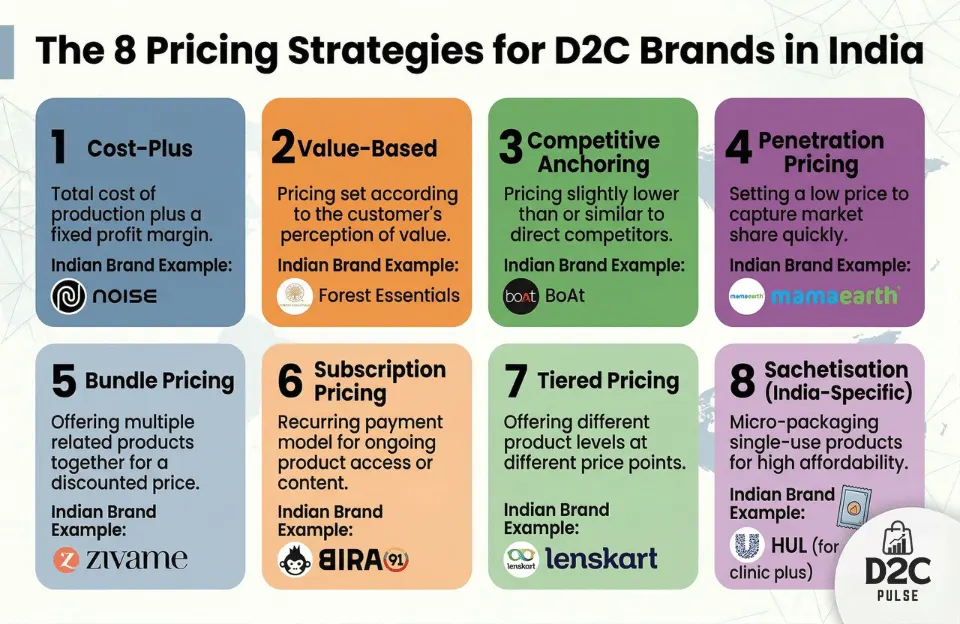
Strategy 4: Penetration Pricing. Start Low, Build Volume, Then Raise.
How it works: Launch at a price below your target to acquire customers quickly and build market share. Once the brand has traction, gradually increase prices.
Indian context: Penetration pricing is common in crowded D2C categories like fashion and personal care, where customers have dozens of alternatives. A new men’s grooming brand might launch a razor kit at Rs 299 (below breakeven) to acquire 5,000 customers, then raise the refill price to Rs 499 once the customer is locked into the handle.
When to use it: When market share matters more than immediate profitability. Typically used by funded brands that can absorb early losses.
Limitation and India-specific warning: Penetration pricing attracts deal-hunters who leave the moment you raise prices. In India, where 74% of consumers switch brands for better value, low-price customers are the least loyal. If your repeat rate is poor, penetration pricing just burns cash. Use it only if your product creates genuine switching costs (like a razor handle that locks customers into refill purchases).
Strategy 5: Bundle Pricing. Increase AOV Without Increasing Perceived Cost.
How it works: Sell two or more products together at a price lower than buying each separately. The customer feels they are getting a deal. The brand increases AOV. Both win.
Indian brand examples: Mamaearth sells a “Complete Skincare Kit” (face wash + serum + moisturiser) at Rs 999 instead of Rs 1,350 if bought separately. boAt bundles earbuds with a carrying case. Bombay Shaving Company sells a “Grooming Kit” with razor + foam + post-shave balm.
When to use it: When you have complementary products. Bundles work best when the items naturally go together and the customer would buy them anyway. A face wash and a serum make sense as a bundle. A face wash and a coffee mug do not.
India-specific advantage: Bundles are powerful in India because they offer “perceived savings” without explicit discounting. Instead of saying “30% off,” you say “Save Rs 351 when you buy the complete kit.” The customer gets value. The brand protects its per-unit price perception. Festival bundles (Diwali gift boxes, Holi combos) are a specific Indian D2C pricing lever.

Also Read: Understanding Unit Economics for D2C Brands in India for how bundle pricing affects AOV and margin
Strategy 6: Subscription Pricing. Lock In Recurring Revenue.
How it works: Offer a recurring delivery at a discounted price compared to one-time purchase. The customer commits to regular orders. The brand gets predictable revenue and zero CAC on repeat orders.
Indian brand examples: Country Delight (daily milk subscription). Blue Tokai (monthly coffee subscription with flexible frequency). Sid’s Farm (dairy subscription with daily quality testing). The Derma Co. (skincare subscription plans for ongoing routines).
India-specific factor: Indian consumers are cautious about subscriptions. Rigid lock-ins cause cancellations. The winning approach is flexibility: let customers pause, skip, or cancel easily. A subscription that feels like a convenience stays. A subscription that feels like a trap churns. Country Delight gets this right by letting users modify their daily order via the app.
Pricing tip: Offer a 10–15% discount on subscription vs one-time price. Enough to incentivise, not enough to destroy margin. On a Rs 500 product, Rs 425 on subscription is effective without feeling like a heavy discount.
Strategy 7: Tiered Pricing. One Product, Multiple Price Points.
How it works: One of the best pricing strategies. Offer multiple versions of the product at different price points, each targeting a different customer segment. A basic version for price-sensitive buyers. A standard version for the core audience. A premium version for those willing to pay more.
Indian brand examples: Lenskart’s frame categories range from Rs 500 budget frames to Rs 5,000+ premium frames. Wakefit sells mattresses from Rs 5,000 (foam) to Rs 25,000 (orthopaedic). Lenskart’s Buy-1-Get-1 Gold membership is itself a tier that converts casual buyers into committed customers.
When to use it: When your customer base spans income levels. Tiered pricing lets you serve the tier-2 consumer at Rs 499 and the metro consumer at Rs 1,499 without diluting the brand. The key: the basic version must still feel like a quality product. If the basic tier feels cheap, it damages the entire brand.
India-specific advantage: India’s income pyramid is steep. The top 40 million affluent consumers and the next 200 million aspirational middle-class consumers have very different price tolerances. Tiered pricing captures both without forcing a single-price compromise.
Strategy 8: Sachetisation. Most Powerful Pricing Strategies for D2C.
How it works: Offer the product in a small, affordable trial size. Not a discount. Not a free sample. A complete, functional product at a price point that removes the barrier to first purchase. Rs 49–199 for a sachet, mini, or trial pack. The goal is to convert a sceptical first-timer into a confident repeat buyer.
Why it is India-specific: India’s FMCG giants have known this for decades. Shampoo sachets at Rs 2–5 built categories. The D2C version is the same principle applied to premium products. A Rs 1,200 serum feels risky to a first-time buyer in Lucknow. A Rs 199 trial size of the same serum removes the risk entirely. If the product works, the customer upgrades to the full size.
Indian brand examples: Mamaearth trial kits. Minimalist smaller serum sizes. boAt’s sub-Rs 500 earbuds as entry into the audio ecosystem. Sleepy Owl’s single-serve cold brew packs before you commit to a full subscription.
Economics: The trial size may break even or lose a small amount on the first order. That is acceptable. The goal is not first-order profit. The goal is to acquire a customer at a low CAC who upgrades to full-size products on repeat orders. If 30% of trial-size buyers convert to full-size within 60 days, the trial SKU is your most efficient acquisition tool.
Sachetisation is the India-specific pricing strategy that most D2C playbooks from the US do not include. In a market where 60%+ of new D2C customers come from tier-2/3 cities and are buying from a brand for the first time, a Rs 199 trial size converts sceptics into loyalists more efficiently than any ad campaign.
Also Read: Regional D2C Growth Beyond Metros for how trial pricing unlocks tier-2/3 consumers
Six India-Specific Factors That Change D2C Pricing Maths
- COD inflates your effective cost per order. COD orders cost Rs 15–30 more in logistics fees and have 25–30% higher return rates. Your price must absorb this. Track unit economics separately for prepaid and COD. If COD orders are unprofitable at your current price, either raise the price, add a small COD surcharge, or use WhatsApp nudges to convert COD to prepaid.
- Free shipping expectations squeeze margins on low-AOV orders. Indian D2C consumers expect free shipping. On a Rs 500 order with Rs 70 shipping cost, that is 14% of revenue going to logistics. Set a free-shipping threshold (Rs 799 or Rs 999) that encourages higher AOV. Below the threshold, charge a flat Rs 49–99 delivery fee.
- Marketplace price parity creates pressure. If you sell on Amazon at Rs 599, your own website cannot be Rs 799. Consumers check this and the price consistency across channels is essential. If you want higher prices on your website, justify it with exclusive bundles, better gifting options, or loyalty points that are not available on marketplaces.
- GST adds 5–18% depending on category. Make sure your MRP includes GST. Founders who set their target price before accounting for GST discover their actual margin is 5–18% thinner than planned. Build GST into your pricing model from day one.
- Festival and sale season pricing must be planned, not reactive. Diwali, New Year, Independence Day, and Republic Day sales are massive purchase drivers. Plan your pricing calendar. Create festival bundles. Prepare limited editions. Brands that react to sale season at the last minute discount desperately. Brands that plan offer value-add bundles at protected margins.
- Tier-2/3 consumers have lower AOV but higher loyalty potential. Average order values in tier-2/3 are 20–40% lower than metros. Design entry-point SKUs (Rs 299–499) specifically for these markets. The first order is an investment in a customer relationship, not a profit event. Repeat orders from tier-2/3 customers at full price are where the margin lives.
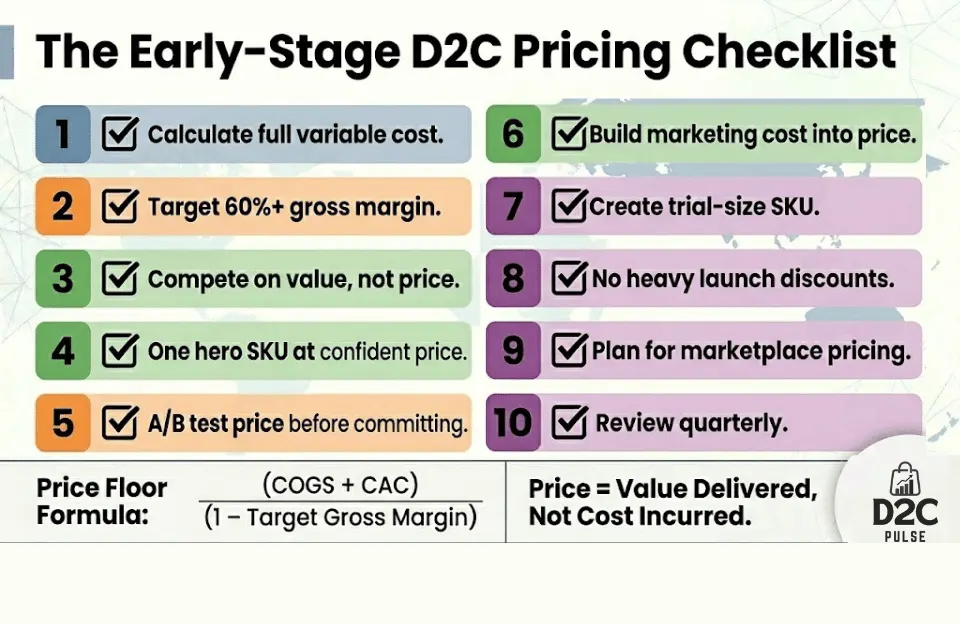
The Early-Stage Founder’s Pricing Checklist: What to Get Right Before You Launch
If you are in the early growth stage (Rs 0–50 lakh monthly revenue), pricing mistakes are the fastest way to burn through capital and kill the business. Here are the ten things to get right.
- Calculate your full variable cost per order before setting any price. COGS + packaging + shipping + payment fee + COD cost + return reserves. This is your price floor. If you sell below this, you lose money on every order no matter how many you sell.
- Target a 60%+ gross margin. In competitive D2C categories with high ad costs, anything below 40% makes profitability extremely difficult. 60%+ gives you room for marketing, returns, and scale. If your COGS does not allow 60% margins, either reformulate the product or raise the price.
- Do not compete on price. Compete on value. If your only advantage is being cheaper, any competitor with deeper pockets can undercut you tomorrow. Build a brand story, ingredient transparency, or product superiority that justifies a higher price. Minimalist charges more than most Indian serums. They sell more because they educate more.
- Start with one hero SKU at a confident price. Do not launch with 15 products at 15 different price points. Launch one product at a price you can defend. Prove the unit economics. Then add SKUs. boAt started with one earphone cable. Minimalist started with one serum. Country Delight started with one product: milk.
- Test your price before you commit. Run a small batch of Meta ads to a landing page with your product at two different prices (A/B test). Measure conversion rates. If the higher price converts at 80% of the lower price’s rate, the higher price is more profitable because the margin per order is significantly higher.
- Build in room for marketing in your price. If your product costs Rs 300 to make and deliver, and you price at Rs 400, you have Rs 100 of margin. After spending Rs 250 on CAC, you are Rs 150 in the hole. Your price must account for marketing spend, not just COGS. A Rs 800 price on the same product gives you Rs 500 of margin, which absorbs a Rs 250 CAC and leaves Rs 250 profit.
- Create a trial-size SKU from day one. Your hero product at Rs 799. A trial version at Rs 199. The trial is your customer acquisition tool. It converts sceptics at a low CAC. If 30% upgrade to full-size within 60 days, the trial SKU pays for itself.
- Do not offer heavy launch discounts. A 50% launch discount attracts deal-hunters who never pay full price. Use a 10–15% welcome discount or a free sample add-on instead. Protect your price perception from day one. It is much harder to raise prices later than to start where you want to be.
- Plan for marketplace pricing from the start. If you plan to sell on Amazon or Nykaa, factor in their 15–30% commission when setting your MRP. Your D2C site price and marketplace price must be consistent. Build your margin to absorb marketplace commissions without changing the consumer-facing price.
- Review and adjust pricing every quarter. Your input costs change and so does your marketing costs along with the competitive landscape. A price set at launch should not be permanent. Review quarterly. A/B test price increases. A 5–10% price increase that does not reduce conversion rate goes straight to your bottom line.
The Eight Pricing Strategies for D2C Brands in India: Summary
| Strategy | Best For | Indian Example | Key Risk |
| Cost-Plus | Early-stage. Setting a price floor. | Bootstrapped founders launching first product. | Ignores customer willingness to pay. Leaves margin on table. |
| Value-Based | Differentiated products with brand trust. | Minimalist serums (Rs 500–700 for Rs 150 COGS). | Requires earned trust. Cannot charge premium without brand. |
| Competitive Anchoring | Categories with clear reference competitors. | boAt vs JBL. Minimalist vs The Ordinary. | Ties pricing to competitor. Vulnerable to price wars. |
| Penetration | Funded brands prioritising market share. | New grooming brand at Rs 299 to acquire users. | Attracts deal-hunters. Low loyalty. Burns cash. |
| Bundle | Brands with complementary products. | Mamaearth kits. Bombay Shaving Co. grooming sets. | Over-bundling reduces flexibility. Inventory complexity. |
| Subscription | Consumables with regular replenishment. | Country Delight. Blue Tokai Coffee. | Indian consumers dislike rigid lock-ins. Churn risk. |
| Tiered | Products spanning income segments. | Lenskart frames Rs 500–Rs 5,000. | Basic tier must feel quality. Cheap tiers damage brand. |
| Sachetisation | India-specific. Tier-2/3. First-time D2C buyers. | Mamaearth trial kits. Minimalist mini sizes. | Must convert to full-size. If no upgrade, losses mount. |
Key Takeaways from Pricing Stragies article
- Pricing is the single most important unit economics decision for D2C brands in India. It sets the ceiling for margin, CAC payback, and profitability. Get it wrong and no amount of marketing can save you.
- Eight pricing strategies work for Indian D2C brands: cost-plus, value-based, competitive anchoring, penetration, bundle, subscription, tiered, and sachetisation. Most successful brands use 2–3 in combination.
- Value-based pricing is the highest-margin approach. But it requires earned trust through brand building, education, and transparency. The gap between cost-plus and value-based is often 2–3x. That gap is the financial return on brand investment.
- Sachetisation is India’s unique D2C pricing superpower. A Rs 199 trial size converts sceptical tier-2/3 first-time buyers into loyal full-size customers more efficiently than any ad campaign.
- Six India-specific factors change pricing maths: COD costs, free shipping expectations, marketplace parity, GST, festival pricing, and tier-2/3 AOV differences. Build them into your model from day one.
- Early-stage founders: target 60%+ gross margin, start with one hero SKU, create a trial-size, avoid heavy discounts, and A/B test your price before committing. Review quarterly. A 5–10% price increase that does not reduce conversion goes straight to profit.
- Do not compete on price. Compete on value. Low prices attract deal-hunters. Education, transparency, and brand trust attract loyal customers. The brands that survive in India are not the cheapest. They are the ones that justify their price the best.
Frequently Asked Questions about Pricing Strategies
What are the best pricing strategies for D2C brands in India?
The eight most effective pricing strategies for D2C brands in India are: cost-plus (price floor), value-based (perceived worth), competitive anchoring (vs known reference), penetration (low entry for market share), bundle (increased AOV), subscription (recurring revenue), tiered (multiple price points), and sachetisation (India-specific trial sizes). Most successful brands use 2–3 strategies in combination.
How should early-stage D2C founders in India approach pricing?
Start by calculating your full variable cost per order (COGS + packaging + shipping + payment fees + return reserves). Target 60%+ gross margin. Launch with one hero SKU at a confident price. Create a trial-size SKU at Rs 199–299 for customer acquisition. A/B test your price before committing. Avoid heavy launch discounts. Build marketing cost into the price. Plan for marketplace commissions. Review and adjust quarterly.
What is sachetisation and why does it matter for D2C in India?
Sachetisation is the strategy of offering a product in a small, affordable trial size to remove the barrier to first purchase. It is India’s most powerful pricing innovation for D2C. A Rs 1,200 serum feels risky to a first-time buyer. A Rs 199 trial size removes the risk. If 30% upgrade to full-size within 60 days, the trial SKU is the most efficient customer acquisition tool in the D2C toolkit.
How do COD and returns affect D2C pricing in India?
COD orders cost Rs 15–30 extra in logistics fees and have 25–30% higher return rates than prepaid orders. Each returned COD order costs forward shipping + reverse shipping + product damage risk with zero revenue. Your pricing must account for this. Track unit economics separately for COD and prepaid. Use WhatsApp nudges to convert 10–20% of COD orders to prepaid.
Should D2C brands offer the same price on their website and marketplaces?
Yes. Price consistency across channels is essential because consumers check. If your Amazon price is Rs 599 and your website is Rs 799, the customer buys on Amazon and you lose the direct relationship. If you want to incentivise website purchases, use exclusive bundles, loyalty points, or free add-ons that are not available on marketplaces, rather than different base prices.