Consumer Behavior Trends: Ten Shifts That Changed How Indians Buy
The Demand Side of D2C. What Consumers Are Doing Differently, Why It Matters for Brands, and How to Build for Each Shift.
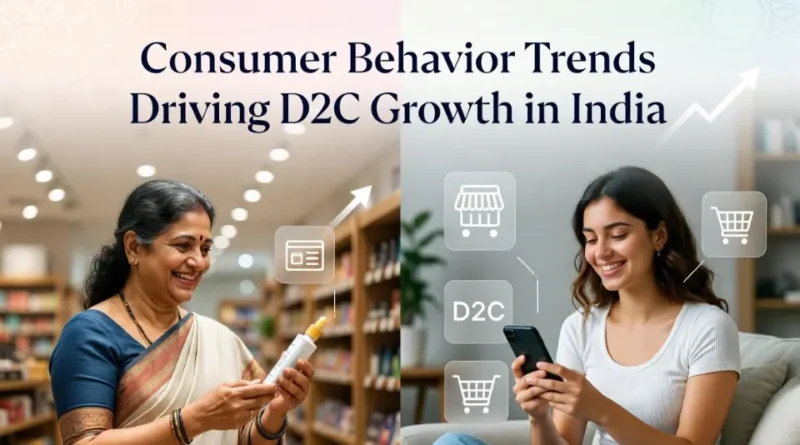
Most D2C analysis focuses on the supply side. What brands are doing, which tools they use, how they acquire customers or how they manage unit economics. This article is about the demand side, and covers the shifting consumer behavior trends. The D2C in India did not grow because brands got smarter, it grew because consumers changed.
The Indian consumer of 2016 and the Indian consumer of 2026 are almost different species. One bought whatever was on the nearest shelf. The other reads ingredient labels on Instagram, watches a 30-second product demo before adding to cart, cross-references reviews on YouTube, pays via UPI in three seconds, and expects delivery within 48 hours. One trusted brands because of TV ads and the other trusts brands because of a creator’s honest review.
Understanding these consumer behavior trends driving D2C growth in India is not academic. It is the foundation of every product decision, marketing strategy, and growth plan a D2C founder makes. If you do not know why your customer buys, you cannot know what to build.
Here are ten consumer behavior trends that are shaping D2C in India right now, with data, real examples, and what each shift means for brands.
Trend 1: Video-First Trust. The Consumer Who Watches Before They Buy.
This is one of the consumer behavior trends that most D2C brands in India still underestimate. Gen Z and millennials have grown up on Instagram Reels, YouTube Shorts, and TikTok. Their default mode of consuming information is video. When they land on a product page and see only static images and text, something feels off, Incomplete and Untrustworthy. They need to see the product in use. They want to watch a real person apply the serum, unbox the package, wear the shirt in natural light.
This is not a vague preference, but a measurable conversion driver. D2C brands that add shoppable videos to their product detail pages see 15–30% increases in conversion rates. The reason is simple: video answers the questions that static images cannot. How does the fabric drape? What does the texture look like? How big is the jar in someone’s hand? How does the founder explain why this product is different?
The “Why” Video: Founder Storytelling as a Conversion Tool
Here is something that brands don’t understand about the D2C consumer behavior trends . They do not just want to see the product. They want to understand the “why” behind it. Why did you start this brand? What problem were you solving? What makes you different from the 50 other brands in this category?
Mamaearth’s growth started with Ghazal and Varun Alagh’s personal story of searching for toxin-free baby products. Minimalist’s positioning is anchored in the founders’ belief that Indian consumers deserve ingredient transparency. boAt connected with young Indians by telling a story about affordable style, not just selling headphones. In every case, the founder’s “why” was the emotional hook that converted browsers into buyers.
Now imagine that “why” story playing as a video on your home page and not buried on YouTube or lost in an Instagram feed. Right there, on the page where the purchase decision happens. A 60-second video of the founder explaining why they created this product, what goes into it, and who it is for. That video does more than any carousel of product photos.

Shoppable Videos: Bringing Video Commerce to Your Own Website
Social media gets the discovery, but the conversion happens on the website. And this is where most D2C brands create a gap. The customer watches an engaging video on Instagram, clicks through to the product page, and finds flat images and bullet points. The energy drops, the trust built by the video does not carry over, the customer hesitates and some leave.
Shoppable videos close that gap and are changing the actual consumer behavior trends. They bring the video experience directly to the product page, collection page, or landing page where the purchase decision is made. The customer can watch a product demo, a founder story, a customer testimonial, or a how-to tutorial and add the product to cart directly from the video player.
For D2C brands on Shopify, ReelV is one of the best tools for implementing this. It offers three video formats designed for different parts of the buyer’s journey. Floats are single pop-up videos on the corner of a page, ideal for a quick product demo on a specific PDP. Stories work like Instagram highlights, letting brands organise founder videos, customer testimonials, and tutorials under named thumbnails. Reels are video carousels with product cards and direct add-to-cart, perfect for PDPs and homepage.
The video-first consumer does not trust what they cannot see in motion. Static images say “trust us.” Videos say “see for yourself.” The D2C brands winning in 2026 are the ones that bring the video experience to their own website, not just their social channels. Shoppable videos are the bridge between social discovery and on-site conversion.
Also Read: Best Shopify Apps for Indian D2C Brands for the full tool stack
Trend 2: The Label-Reading Consumer. Ingredients Before Brand Names.
Indian consumers are reading labels. This shift is most visible in skincare and food. Minimalist built a Rs 500 crore brand by putting ingredient percentages on the front of every bottle. The Whole Truth built its identity on radical ingredient transparency. Clean-label foods (no preservatives, no artificial colours, clearly listed ingredients) are growing across categories.
A PwC survey on consumer behavior trends found that 65% of Indian consumers have purchased products directly from a brand’s website, with food, clothing, and beauty as the top categories. These direct purchasers are predominantly millennials who research before buying. They compare formulations, check concentration percentages and also google whether an ingredient is safe.
What this means for D2C brands: If your product page does not explain what is inside, why it is there, and what it does, you are losing the label-reading consumer. Education content is not optional. It is how this consumer decides to buy.
Also Read: Minimalist Brand Strategy Case Study for how ingredient transparency built a Rs 2,955 Cr brand
Trend 3: Social-First Discovery. The Product Is Found on a Feed, Not a Shelf.
The discovery path has flipped. Previous generations found products in stores and then checked reviews online. Gen Z and young millennials discover products on Instagram, YouTube, or a creator’s page first. They validate on reviews and social proof. Then they buy, either online or in a store.
80% of Gen Z consumers use social media for shopping-related activities. Instagram Reels and YouTube Shorts are driving direct purchases, especially for impulse and low-ticket products. Entertainment and shopping have merged into a single experience.
This is one of the most important consumer behavior trends driving D2C growth because it removes the geographic and shelf-space barriers that traditional retail created. A brand in Jaipur can reach a consumer in Chennai through a 30-second Reel, without needing a distributor, a retailer, or a physical shelf in between.
What this means for D2C brands: Your social media is your storefront. Not your website. The website converts. Social media discovers. If your brand is not creating short-form video content, you are invisible to the fastest-growing consumer segment in India.
Trend 4: Vernacular and Regional. The Consumer Who Shops in Hindi, Tamil, or Marathi.
India’s next 200 million digital shoppers are not English-first. They browse in Hindi, WhatsApp in Telugu and watch YouTube in Marathi. And they want to buy from brands that speak their language.
53% of Indian consumers prefer locally produced food over imported alternatives, higher than the global average of 44%. Platforms offering multilingual support are gaining traction. Hyperlocal marketing with regional flavours, local language content, and contextual messaging consistently outperforms generic national campaigns.
This is one of the consumer behavior trends that most D2C brands in India underestimate. The Instagram feed of a typical skincare brand is in English. But the customer in Lucknow, Indore, or Coimbatore processes information faster in their regional language. Brands that create content in Hindi, Tamil, or Bengali see 2–3x better engagement rates than English-only content in those markets.
What this means for D2C brands: If you are targeting beyond metros, your ad creatives, WhatsApp messages, and product descriptions should be in the customer’s language. Regional language ads have 2.5x higher CTR in tier-2 and tier-3 cities.
The next wave of D2C growth in India will not come from English-speaking metro consumers. It will come from regional-language consumers in tier-2 and tier-3 cities who want brands that feel local, not foreign.
Trend 5: The Tier-2 and Tier-3 Consumer. Aspirational, Price-Aware, and Growing Fast.
Over 60% of new D2C customers now come from cities beyond the top 8 metros. These are consumers in Jaipur, Lucknow, Chandigarh, Bhopal, Coimbatore, Nagpur, and hundreds of smaller cities.
The tier-2 consumer is not the same as the tier-1 consumer. They are aspirational but price-sensitive, want branded products but at value pricing, trust peer reviews and regional influencers more than celebrities and are more likely to pay COD than UPI (though this is changing). Also they have fewer physical retail options, which makes D2C their only access point for many brands.
Lenskart’s store expansion into tier-2 and tier-3 cities is driven by this consumer. ClearDekho built its entire model around eyewear for tier-3 and tier-4 towns. GIVA’s aggressive offline expansion targets tier-2 cities with 240+ stores.
What this means for D2C brands: Your pricing, your entry-level SKUs, your payment options (COD is still essential), and your ad targeting need to account for the tier-2 consumer. A Rs 2,000 serum sells in Mumbai. A Rs 499 starter kit sells in Indore. Same brand. Different entry point.
Trend 6: Instant Gratification. The Consumer Who Expects Delivery in Hours, Not Days.
Quick commerce has rewired consumer expectations. Blinkit, Zepto, and Swiggy Instamart have trained urban consumers to expect delivery in 10–30 minutes for groceries and essentials. This expectation is bleeding into other categories. Consumers who get milk in 15 minutes start asking why their skincare order takes three days.
This is reshaping D2C logistics. Brands that were comfortable with 3–5 day delivery are now losing impulse buyers to quick commerce platforms that stock competing products. The consumer behavior trends is clear: speed is no longer a differentiator. It is a baseline expectation.
What this means for D2C brands: If your product is available on quick commerce platforms, be there. If it is not a quick commerce category, bring your delivery time below 48 hours in metros. The consumer’s patience is shrinking. Every extra day of delivery time reduces conversion.
Also Read: Quick Commerce vs D2C: Threat or Opportunity? for the full channel analysis
Trend 7: Value Consciousness, Not Just Price Sensitivity. They Want Quality for Less.
74% of global consumers switched brands in the past year. The top reason: value for money. This does not mean Indian consumers only buy the cheapest option. It means they calculate cost-per-use, compare ingredient quality-per-rupee, and expect transparent pricing.
boAt built a Rs 3,100 crore brand by offering audio quality that felt like Rs 5,000 at a Rs 1,500 price point. Minimalist offered clinical-grade skincare at 30–50% below international competitors. Snitch delivers trend-driven menswear at fast-fashion prices without the fast-fashion guilt.
The value-conscious consumer is not looking for discounts. They are looking for a fair deal. If your product costs Rs 2,000, they want to understand why it is worth Rs 2,000. If it is worth Rs 800, no amount of branding will justify the Rs 2,000 price tag. They will find out. They have the tools to compare.
What this means for D2C brands: Transparent pricing builds trust. Showing cost breakdowns (Lenskart’s fair pricing campaigns, The Whole Truth’s ingredient-cost transparency) converts value-conscious consumers better than discounts. Do not compete on price. Compete on perceived value per rupee.
Trend 8: Sustainability and Health Conciousness, Not Just a Preference.
79% of Indian consumers say they will support businesses that demonstrate sustainability initiatives. Millennials and Gen Z are the most willing to pay a premium for sustainable products. Searches for eco-friendly goods have risen 71% over the past five years globally.
But here is the catch: Indian consumers are also very good at spotting greenwashing. Gen Z reads labels, calls out fake claims, and shares their findings on social media. A brand that puts “eco-friendly” on the label without substance will be called out, not rewarded.
Brands like PeeSafe, SuperBottoms (reusable diapers), and Earth Rhythm (clean beauty) have built genuine sustainability into their product and supply chain. The consumer behavior trends is not that everyone buys sustainable. It is that sustainability has become a filter that an increasingly large segment uses to shortlist brands.
What this means for D2C brands: If sustainability is part of your brand, make it specific and verifiable. “We use 40% less plastic packaging than our previous version” is more credible than “We care about the planet.” Back claims with numbers. Avoid vague language.
Trend 9: Creator Trust Over Brand Trust. The Influencer Is the New Retailer.
43% of Indian shoppers are influenced by content from creators. Not by brand advertising. Not by celebrity endorsements. By the creator they follow for skincare tips, fitness advice, or fashion inspiration.
This is a fundamental shift in how trust works. The traditional path: brand advertises on TV, consumer trusts the brand because they see it everywhere, consumer buys. The new path: consumer trusts a creator because of consistent, authentic content. Creator recommends a product. Consumer buys from that recommendation.
Consumers in smaller cities trust regional influencers more than national celebrities. A skincare creator in Jaipur has more purchase influence over her 50,000 followers than a Bollywood actress has over her 50 million. Because the creator feels relatable. The actress feels aspirational but distant.
What this means for D2C brands: Invest in micro and nano influencer relationships (1,000–50,000 followers), not just celebrity deals. These creators have higher trust, higher engagement, and lower cost. The ROI per rupee spent on micro-influencers consistently beats macro-influencer campaigns.
Also Read: The Rise of Influencer-Led D2C Brands in India for the full creator economy analysis
Trend 10: Reverse Discovery. Digital First, Physical Second.
This is the meta-trend that ties everything together. The Indian consumer’s discovery path has permanently reversed.
In traditional retail, the path was: see product in store → check reviews online → buy in store. In 2026, the path is: discover product on social media or AI search → research on the brand’s website → buy online or visit store to try. The first touch is digital. The conversion may be physical. But the discovery is always digital.
This reverse discovery pattern is why D2C works. If the consumer finds products online first, the brand that controls the online narrative controls the sale. It does not matter whether the customer eventually buys on Amazon, on the brand’s website, or in a physical store. The brand that won the digital discovery won the sale.
What this means for D2C brands: Your SEO, your social content, your AI search presence (ChatGPT, Perplexity), and your shoppable video strategy are the front door of your business. The physical store is the back room. Invest accordingly.
The consumer behavior trends driving D2C growth in India are not temporary. Label-reading, social discovery, vernacular preference, value consciousness, creator trust, and reverse discovery are structural shifts. Brands that build for these behaviors will grow. Brands that ignore them will spend more and more money trying to reach consumers who have already moved on.
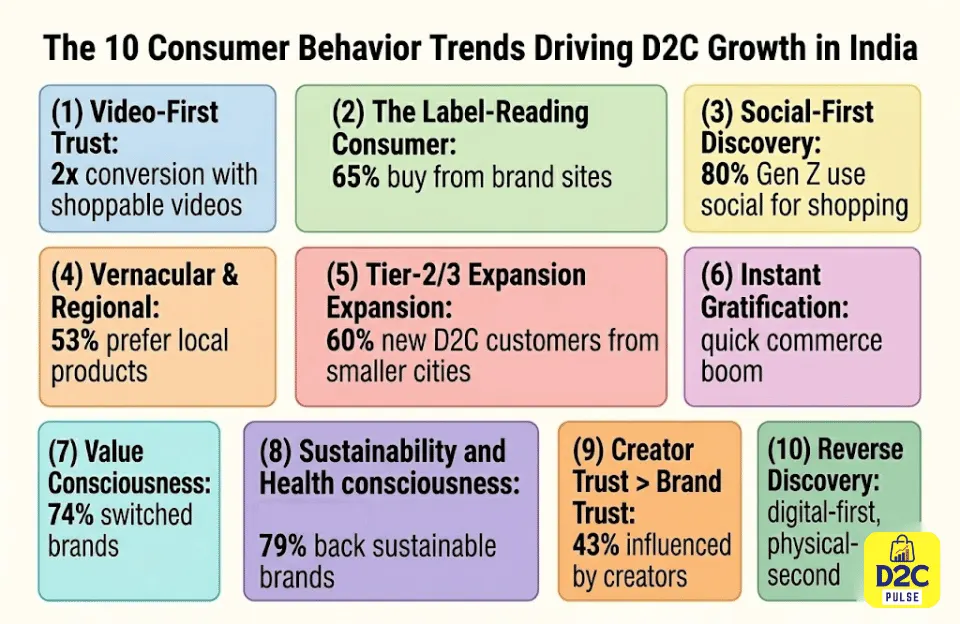
The Ten Consumer Behavior Trends Driving D2C Growth: At a Glance
| Trend | Key Stat | What to Build | Video Role |
| 1. Video-First Trust | 5–30% conversion lift | Shoppable videos on PDPs | Founder story, product demo, how-to |
| 2. Label-Reading | 65% buy direct | Ingredient education | Formulator explainer videos |
| 3. Social Discovery | 80% Gen Z on social | Video-first website experience | Carousel reels on homepage |
| 4. Vernacular | 2.5x CTR regional ads | Multi-language content | Regional language product videos |
| 5. Tier-2/3 Expansion | 60%+ from smaller cities | Entry SKUs, COD, video | Video as primary product info |
| 6. Instant Gratification | 10–30 min delivery expected | Quick commerce + fast delivery | — |
| 7. Value Consciousness | 74% switched brands | Transparent pricing | Comparison and value-demo videos |
| 8. Sustainability | 79% back sustainable brands | Verifiable claims | Behind-the-scenes process videos |
| 9. Creator Trust | 43% influenced by creators | Micro-influencer partnerships | UGC as shoppable testimonials on PDP |
| 10. Health Obsession | $90B market by 2030 | Functional claims + data | Expert/dermatologist explainers |
Key Takeaways from Changes in Consumer Behavior Trends
- The video-first consumer is the defining shift. Gen Z and millennials trust video over static images. They want to see the product in use, hear the founder’s story, and watch real testimonials before buying. Shoppable videos on PDPs drive 5–30% conversion lifts.
- The founder’s “why” is a conversion tool. Consumers connect with brands that explain why they exist, not just what they sell. A 60-second founder story video on a product page builds emotional trust that product photos cannot.
- Social discovery needs website follow-through. 80% of Gen Z use social for shopping. But the sale happens on the website. If the website feels like a downgrade from Instagram, the consumer leaves. Shoppable video bridges the gap.
- ReelV is the tool that makes on-site video work for Shopify D2C brands. Separate CDN (no speed impact), three video formats (Floats, Stories, Reels), media-level analytics, ShopFlo/GoKwik integration, and a CRO service that no competitor offers. Rs 29–299/month.
- Vernacular video unlocks tier-2/3 growth. Regional language video content converts 2–3x better than English-only content in smaller cities. Video is the natural medium for non-English-first consumers.
- Creator UGC should live on your website, not just on social. Repurpose influencer reviews as shoppable video testimonials on PDPs. Give that content permanent shelf life and purchase context.
- Reverse discovery means your website is the decision-making room. Social gets the first click. The website gets the conversion. If your website is static in a video-first world, you are losing revenue at the final step.
Frequently Asked Questions about Consumer Behavior Trends
What consumer behavior trends are driving D2C growth in India?
The key consumer behavior trends driving D2C growth include: the video-first consumer who trusts video over static images, the label-reading consumer who demands ingredient transparency, social-first discovery (80% of Gen Z), vernacular shopping preferences, tier-2/3 city expansion, instant gratification expectations, value consciousness, sustainability as a purchase filter, creator trust overtaking brand trust, and reverse discovery where digital comes first.
Why do shoppable videos matter for D2C brands?
Shoppable videos matter because today’s consumer, especially Gen Z and millennials, processes information through video. They want to see products in use, hear founder stories, and watch real testimonials before buying. Shoppable videos on product pages drive 5–30% conversion lifts because they close the gap between social discovery (where video builds interest) and website conversion (where the purchase happens). ReelV is one of the best Shopify tools for this, offering separate CDN infrastructure, three video formats, and CRO-first placement strategy.
How does the founder’s story help D2C conversion?
The Indian D2C consumer connects with brands that explain their “why.” A founder explaining why they started the brand, what problem they saw, and what makes their product different builds emotional trust. When this story is delivered as a video on the product page (not buried on YouTube), it directly improves conversion because it gives the consumer a reason to choose your brand over alternatives at the moment of decision.
How important are tier-2 and tier-3 cities for D2C growth in India?
Over 60% of new D2C customers come from tier-2 and tier-3 cities. These consumers are aspirational but price-sensitive. They are video-native, consuming content primarily through YouTube and Instagram. They respond better to regional language video content, peer reviews, and entry-level pricing. D2C brands that create vernacular video content and place it on their websites unlock this segment far more effectively than text-only approaches.